AWID es un organización feminista internacional de membresía, que brinda apoyo a los movimientos que trabajan para lograr la justicia de género y los derechos de las mujeres en todo el mundo.
Lxs defensorxs se identifican a sí mismas como mujeres y personas lesbianas, bisexuales, transgénero, queer e intersex (LBTQI) y otrxs que defienden derechos y que debido a su trabajo en derechos humanos están bajo riesgos y amenazas específicos por su género y/o como consecuencia directa de su identidad de género u orientación sexual.
Lxs defensorxs son objeto de violencia y discriminación sistemáticas debido a sus identidades y su inclaudicable lucha por derechos, igualdad y justicia.
El Programa Defensorxs colabora con contrapartes internacionales y regionales así como con lxs afiliadxs de AWID para crear conciencia acerca de estos riesgos y amenazas, abogar por medidas de protección y de seguridad que sean feministas e integrales, y promover activamente una cultura del autocuidado y el bienestar colectivo en nuestros movimientos.
Riesgos y amenazas dirigidos específicamente contra lxs defensorxs
lxs defensorxs enfrentan los mismos tipos de riesgos que todxs lxs demás defensorxs de derechos humanos, de comunidades y del medio ambiente. Sin embargo, también están expuestas a violencia y a riesgos específicos por su género porque desafían las normas de género de sus comunidades y sociedades.
Por defender derechos, lxs defensorxs están en riesgo de:
Ataques físicos y muerte
Intimidación y acoso, incluso en los espacios virtuales
Acoso judicial y criminalización
Agotamiento
Un enfoque integral y colaborativo de la seguridad
Trabajamos de manera colaborativa con redes internacionales y regionales y con nuestrxs afiliadxs
para crear conciencia de las violaciones de derechos humanos contra lxs defensorxs y de la violencia y discriminación sistemáticas que enfrentan
para fortalecer los mecanismos de protección y asegurar respuestas más oportunas y efectivas para lxs defensorxs que están en riesgo
Trabajamos para promover un enfoque integral de la protección que incluya:
remarcar la importancia del autocuidado y el bienestar colectivo, y reconocer que el significado de cuidado y bienestar puede variar entre las diferentes culturas;
documentar las violaciones dirigidas contra lxs defensorxs usando una perspectiva feminista interseccional;
promover el reconocimiento y celebración social del trabajo y la resiliencia de lxs defensorxs; y
construir espacios ciudadanos que conduzcan al desmantelamiento de las desigualdades estructurales sin restricciones ni obstáculos.
Nuestras acciones
Nos proponemos contribuir a un mundo más seguro para lxs defensorxs, sus familias y comunidades. Creemos que actuar por los derechos y la justicia no debe poner en riesgo a lxs defensorxs, sino que debe ser valorado y celebrado.
Promoviendo la colaboración y coordinación entre organizaciones de derechos humanos y organizaciones de derechos de las mujeres en el plano internacional para fortalecer la capacidad de respuesta en relación a la seguridad y el bienestar de lxs defensorxs.
Apoyando a las redes regionales de defensorxs y de sus organizaciones, tales como la Iniciativa Mesoamericana de Mujeres Defensorxs de Derechos Humanos y la WHRD Middle East and North Africa Coalition [Coalición de Defensorxs de Derechos Humanos de Medio Oriente y África del Norte], promoviendo y fortaleciendo la acción colectiva para la protección, poniendo el énfasis en establecer redes de solidaridad y protección, promover el autocuidado y la incidencia y movilización por la seguridad de lxs defensorxs.
Aumentando la visibilidad y el reconocimiento de lxs defensorxs y sus luchas, así como de los riesgos que enfrentan, a través de la documentación de los ataques que sufren, e investigando, produciendo y difundiendo información sobre sus luchas, estrategias y desafíos.
Movilizando respuestas urgentes de solidaridad internacional para lxs defensorxs que están en riesgo a través de nuestras redes internacionales y regionales y de nuestrxs afiliadxs activxs.
"No era una persona. Era una potencia". - Así recuerda unx compañerx activista a Navleen Kumar.
Nacida el 15 de octubre de 1994, Navleen Kumar fue una ferviente activista por el derecho a la tierra y la justicia social de la India.
Con integridad y compromiso, trabajó durante más de una década para proteger y restaurar las tierras de los pueblos indígenas (adivasi) en el distrito de Thane, un área arrebatada por los propietarios y promotores inmobiliarios a través de medios como la coerción y la intimidación. Luchó contra esta injusticia y estos crímenes a través de intervenciones legales en diferentes tribunales, y descubrió que la manipulación de los registros de las tierras era una característica recurrente en la mayoría de los casos de adquisición de terrenos. En uno de los casos, el de los Wartha (una familia tribal), Navleen descubrió que la familia había sido engañada con la complicidad de funcionarixs gubernamentales.
Así, a través de su trabajo, ayudó a restituir la tierra a la familia Wartha, y siguió dedicándose a otros casos de transferencias de tierras adivasi.
"Su artículo sobre el impacto de la alienación de la tierra en las mujeres y las niñas y niños adivasi traza la historia y las complejidades de la alienación tribal desde la década de los 70, cuando las familias de clase media comenzaron a trasladarse a los suburbios de Mumbai, que se extendían mientras el valor de la propiedad en la ciudad aumentaba de forma exponencial.
Los complejos de viviendas proliferaron en estos suburbios, y lxs integrantes de las comunidades tribales, que eran analfabetxs, pagaron el precio por ello. El costo de las tierras de primera, cerca de las líneas de ferrocarril, alcanzó un precio elevado y los constructores se abalanzaron sobre este cinturón como buitres, arrebatando de forma ilegal las tierras a las comunidades tribales y otrxs residentes locales ". - Jaya Menon, Comisión de Justicia y Paz.
Durante el curso de su activismo, Navleen recibió numerosas amenazas y sobrevivió a varios atentados contra su vida. A pesar de ello, siguió trabajando no sólo en lo que era importante para ella, sino que además contribuyó a cambiar la vida y la realidad de las muchas personas a las que apoyó en su lucha por la justicia social.
Navleen murió apuñalada el 19 de junio de 2002 en su edificio de departamentos. Dos gánsteres locales fueron arrestados por su asesinato.
Могу ли я поделиться информацией об опросе с другими?
Да, пожалуйста! Мы просим распространить ссылку на опрос среди своих коллег по сети. Чем больше различных точек зрения мы соберем, тем более полным будет наше понимание финансового положения феминистских организаций.
Les tendances antidroits au sein des systèmes régionaux des droits humains
Chapter 6
À la Commission africaine et au Système interaméricain, les antidroits promeuvent les notions essentialistes de culture et de genre pour miner les avancées en matière de droits et décrédibiliser la redevabilité. Les antidroits gagnent en influence dans les systèmes de protection des droits humains régionaux et internationaux.
La Commission africaine des droits de l’Homme et des peuples commence à présenter les droits des femmes et droits sexuels comme mettant en danger sa capacité à adresser les « droits réels » et contraires aux « valeurs africaines », un précédent inquiétant à l’égard des droits. Le retrait de son statut d’observatrice à la Coalition des lesbiennes africaines est un exemple de cette tendance, et traduit la répression de l’engagement féministe panafricaniste.
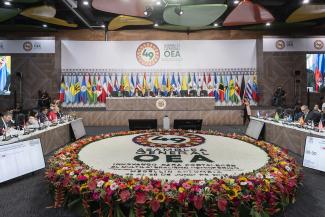
Au sein de l’Organisation des États américains (OEA) et du Système interaméricain de protection des droits humains, les stratégies antidroits incluent l’ONGisation de groupes religieux, l’adoption d’un langage séculier et la prise de contrôle de cadres discriminatoires. L’influence antidroits a pris plusieurs formes, et notamment l’intimidation d’activistes trans et l’entrave à l’introduction d’un langage progressif dans les résolutions.
Sommaire
Réduire les féministes au silence au sein du Système africain de protection des droits humains
Les groupes antidroits en Amérique latine : l’Assemblée générale de l’Organisation des États américains (OEA) et le Système interaméricain de protection des droits humains
« Le privé est politique » - tel est le mantra féministe que personnifiait la fougueuse et courageuse Nadyn Jouny. Nadyn avait personnellement vécu la douleur de la violence structurelle des systèmes juridiques qui refusent aux femmes de jouir de leurs droits.
Lorsqu’elle décide de demander le divorce, les tribunaux religieux chiites – conformément aux lois relatives au statut personnel du Liban – lui refusent la garde de son jeune fils Karam. Comme tant d’autres femmes au Liban et d’autres pays, Nadyn s’est retrouvée dans la situation douloureuse et insoutenable de devoir abandonner ses droits sur son enfant pour pouvoir quitter une relation abusive et non voulue. Mais Nadyn s’est battue, jusqu’au dernier jour.
Elle s’est servie de ses compétences médiatiques pour devenir la voix de celles qui n’en ont pas dans leur combat contre un droit de la famille discriminant, tant au Liban qu’à l’étranger. Nadyn a cofondé le groupe autofinancé « Protecting Lebanese Women » (PLW) et s’est alliée à d’autres mères libanaises vivant des situations similaires. Ensemble, elles ont cherché à sensibiliser la société en manifestant pour leurs droits devant les tribunaux religieux et attirant l’attention des médias sur les très grandes injustices qu’elles subissaient.
Nadyn a également collaboré avec ABAAD – Resource Center for Gender Equality, une autre organisation libanaise pour les droits des femmes, à l’occasion de campagnes pour la défense des droits des femmes, l’égalité dans le droit de la famille et la garde des enfants, et contre le mariage forcé et précoce.
Nadyn a tragiquement perdu la vie dans un accident de voiture le 6 octobre 2019, alors qu’elle se rendait à une manifestation contre les augmentations de taxes injustifiées, dans un pays qui connaît déjà une crise financière croissante. Nadyn Jouny n’avait que 29 ans au moment de son décès.
I believe empowered women empower women and that is why I’ve had an incredible time being an AWID member. My knowledge and understanding of Feminism and intersectionality has been broadened by the exposure I received being part of the AWID Community Street Team. I hope more women join and share topics and ideas that will help other women.
- Loyiso Lindani, South Africa.
Transnational Embodiments - Editor's Note
Lost For Words
Chinelo Onwualu
Ghiwa Sayegh
When we are desperate for change, as we are both in illness and insurrection, our language drains of complexity, becomes honed to its barest essentials... As illness and revolution persist, though, the language made in them and about them deepens, lets in more nuance, absorbed in the acutely human experience of encountering one’s limits at the site of the world’s end. Johanna Hedva
When we began scheming for such an issue with Nana Darkoa, ahead of AWID’s Crear | Résister | Transform: a festival for feminist movements!, we departed from a question that is more of an observation of the state of the world – a desire to shift ground: why do our sexualities and pleasures continue to be tamed and criminalized even as we are told, over and over again, that they bring neither value nor progress? We came to the conclusion that when they are embodied, something about our sexualities works against a world order that continues to manifest itself in border controls, vaccine apartheids, settler colonialism, ethnic cleansing, and rampant capitalism. Could we speak, then, of the disruptive potential of our sexualities? Could we still do that when, in order to be resourced, our movements are co-opted and institutionalized.
When our embodied labor becomes profit in the hands of the systems we seek to dismantle, it is no wonder that our sexualities and pleasures are once again relegated to the sidelines – especially when they are not profitable enough. In many instances during the production of this issue, we asked ourselves what would happen if we refused to accommodate the essential services of capitalism. But can we dare ask that question when we are exhausted by the world? Perhaps our sexualities are so easily dismissed because they are not seen as forms of care. Perhaps what we need is to reimagine pleasure as a form of radical care – one that is also anti-capitalist and anti-institutional.
As we enter our second full year of a global pandemic, our approach to transnational embodiments has had to focus on a single political realization: that taking care is a form of embodiment. And because right now so much of our work is being done without consideration for the borders between and within ourselves, we are all Transnationally Embodied – and we are all failing. We are failing to take care of ourselves and more critically, to take care of each other.
This failure is not of our own making.
Many of our parents thought of labor as transactional, something to be given in exchange for compensation and a guarantee of care. And while that exchange was not always honored, our parents did not expect that their work would provide them fulfillment. They had their leisure, their hobbies, and their communities for that. Today, we their children, who have been conditioned to think of our labor as intertwined with our passion, have no such expectations. We think of work and leisure as one and the same. For too many of us, work has come to embody our whole selves.
However, heteropatriarchal capitalism doesn’t value us, let alone our labor or our sexualities. This is a system that will only demand more and more until you die. And when you die, it will replace you with somebody else. Expectations to be online round the clock mean we simply can’t get away from work, even when we want to. This commercialization of labor, divorcing it from the person, has infiltrated every aspect of our lives and is being perpetuated even in the most feminist, the most radical and revolutionary circles.
Capitalist expectations have always been particularly pernicious to bodies who don’t fit its ideal. And those seeking to consolidate their powers have used the pandemic as an opportunity to target women, sexual minorities, and any others that they see as less than.
This special issue exists because of, and certainly in spite of this.
Almost every contributor and staff member was pushing themselves past their capacity. Every single piece was produced from a place of passion, but also incredible burnout. In a very real way, this issue is an embodiment of transnational labor – and in the digital world we live in, all labor has become transnational labor. As we have to contend with new borders that do not break an old order but reify it, we experienced firsthand, alongside our contributors, how capitalism drains our limits – how it becomes difficult to construct cohesive arguments, especially when these come with a deadline. We collectively became lost for words – because we are lost for worlds.
Feeling lost and alone in the world of heteropatriarchal capitalism is exactly why we need to re-evaluate and rethink our systems of care. In many ways, we turned this issue into a mission of finding pleasure in care. Because it has become more difficult to construct cohesive arguments, visual and creative mediums have come to the forefront. Many who used to write have turned to these mediums as ways to produce knowledge and cut through the mental fog that’s enveloped us all. We brought into the issue other voices, in addition to many whom you heard at the festival, as a way of opening up new conversations, and extending our horizons.
As we are robbed of our words, it is our political duty to continue to find ways to maintain and care for ourselves and each other. So much of our current realities are trying to erase and displace us, while still exploiting our labor. Our embodiment, therefore, becomes a form of resistance; it is the beginning of us finding our way out and into ourselves.
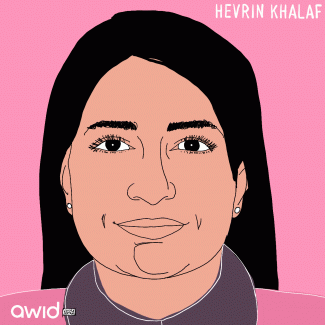
Hevrin Khalaf was a prominent Syrian Kurdish political leader in the autonomous region of Rojava where Kurdish women are risking their lives to resist the Turkish offensive and build a feminist system.
She was Secretary-General of the Future Syria Party (FSP), a group that aimed to build bridges, reconcile different ethnic groups and work towards a “democratic, pluralistic, and decentralized Syria.”
Hevrin was a symbol of this reconciliation effort. She also worked to promote equality between women and men and was a representative for visiting journalists, aid workers, and diplomats.
Hevrin was also a civil engineer from Derik, and was one of the founders of the Foundation for Science and Free Thought in 2012.
On 12 October 2019 she was tortured and murdered by the Turkish-backed militia, Ahrar al-Sharqiya during a military operation against Syrian Democratic Forces in Rojava.
“The killing of Khalaf is a turning point in Syria’s modern history. It once again demonstrated the old Kurdish proverb “no friends but the mountains.” I will always be a friend of Khalaf and her vision of a better world.” - Ahed Al Hendi
Depuis l’adoption de la Déclaration et du programme d’action de Beijing il y a 30 ans, les groupes fascistes exercent un pouvoir et une influence croissantes dans les espaces multilatéraux, faisant reculer les acquis en matière d’égalité de genre et de protection des droits humains dans le monde.
À l’approche de la CSW69, nous co-organisons de courageuses initiatives horizontales, sur le terrain et en ligne, pour échanger des stratégies et bâtir un pouvoir féministe au-delà de Beijing+30. Notre présence collective perturbe les mécanismes d’exclusion des institutions dans ces espaces tout en soutenant les mouvements qui s’organisent autour d’alternatives féministes aux systèmes d’oppression.
Participez aux conversations du 10 au 21 mars 2025 pour, collectivement, faire de la CSW69 un espace de résistance et de solidarité.
Un gozo para el mundo: Seis preguntas a Naïké Ledan
Entrevista realizada por Chinelo Onwualu
Naike Ledan es una defensora de la justicia social, una feminista comprometida y con 20 años de experiencia en la defensa de los derechos humanos y la justicia social, el empoderamiento de las mujeres, la lucha por el acceso universal a los servicios básicos y la inclusión social, así como por el desarrollo de las capacidades de la sociedad civil. Tiene una vasta trayectoria de trabajo en Canadá, en África occidental y meridional, y en Haití, en la promoción de los derechos civiles, el desarrollo de las capacidades de las organizaciones de la sociedad civil, enfocada sobre todo en los determinantes sociales de la exclusión estructural. Valora los principios de un liderazgo compartido, anticolonial, contra la opresión y los espacios antipatriarcales.
Chinelo Se te conoce como activista por los derechos trans; me intriga cómo fue tu recorrido hasta allí.
Naike Crecí en Haití donde viví hasta los 18 años y luego me fui a vivir a Montreal donde pasé 19 años. Cuando volví a Haití, en 2016, pensaba que estaba regresando a casa pero el lugar había cambiado y tuve que readaptarme. No volví a conectarme como había esperado hacerlo con la familia y las amistades de mi infancia. Volví habiendo vivido en el exterior, con una situación laboral cómoda y durante mucho tiempo me sentí bastante extranjera. Y a la vez me sentía muy en casa por el idioma, los silencios entendidos, no tener que explicar nada cuando empezamos a cantar un anuncio publicitario. Ya sabes: esas cosas que compartimos, esa energía, ese espacio, ese espíritu.
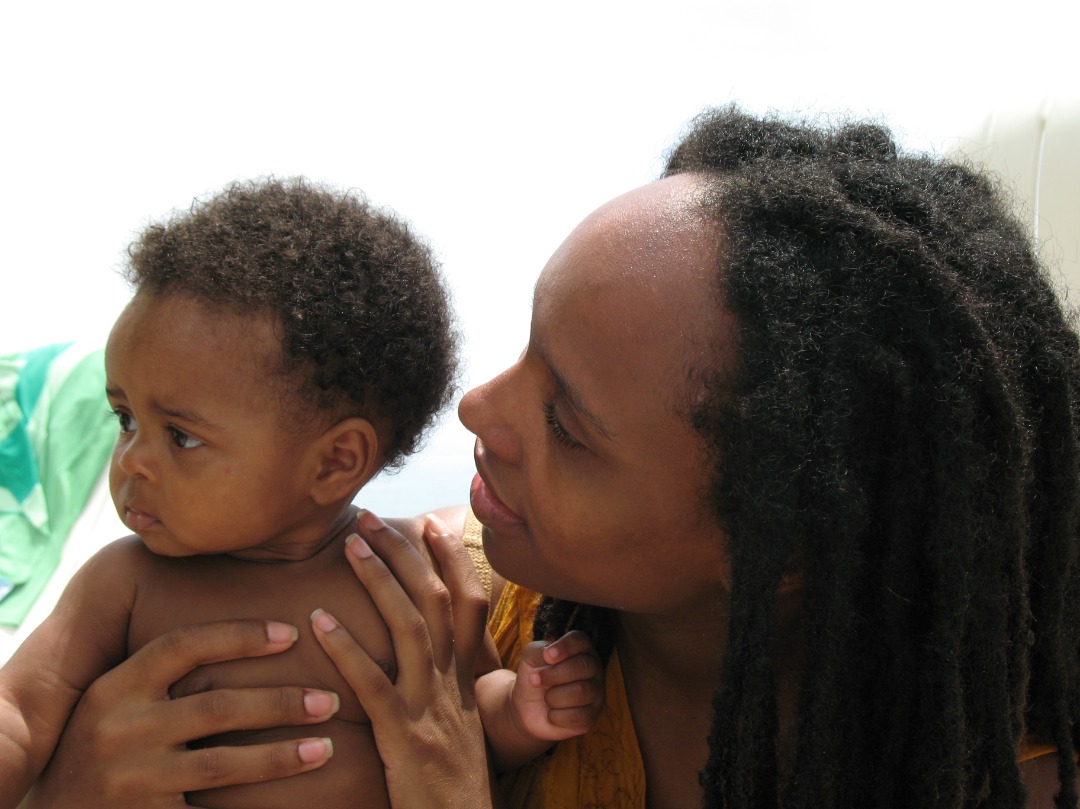
Cuando volví a amarme a mí mismx – yo lo llamaría «renacimiento» – que coincidió con parir a mi primerx hije, parirme a mí mismx y enamorarme de mi ser queer o alguien que ama a personas de su mismo género. (Créditos: Naïké Ledan)
Lo que me ayudó fue que me gustó mucho la tarea de andar por el país y documentar lo que la gente sabía. Entonces, dejé la comodidad de lado. Me convertí en directora nacional de una organización regional que era completamente queer. Mi trabajo consistía sobre todo en conseguir recursos y desarrollar capacidades en la sociedad civil. Mi estrategia era salir a las zonas rurales, buscar a todas las organizaciones pequeñas que había ahí, ayudarlas a desarrollar su capacidad y financiarlas. No me interesaban lxs polítiquxs, ni andar a los apretones de manos o sacarme fotos (risas). Tuve un muy buen aliado: Charlot Jeudy, el activista (queer) que fue asesinado hace tres años en su casa. Nos acercamos mucho después de que se prohibió en Haití un festival de cine afro-queer que habíamos planeado juntxs. La prohibición hizo mucho ruido y logró que se hablara de ser queer en todas partes, entonces Charlot me presentó a todas las OSC pequeñitas que había en cada rincón del país. Y ahí estaba yo para ayudarlas a registrarse o a elaborar sus planes estratégicos. Fue esa clase de trabajo la que me convirtió en activista queer y, por extensión, en activista trans. Aunque yo no me defino como activista. Es una palabra con mucho peso, ¿no crees? Es algo que otrxs dicen de ti. Yo creo que solo soy amante y luchadorx (risas).
Chinelo Cuéntame sobre el taller que facilitaste durante el Festival de AWID. ¿De qué se trataba y en qué contexto surgió?
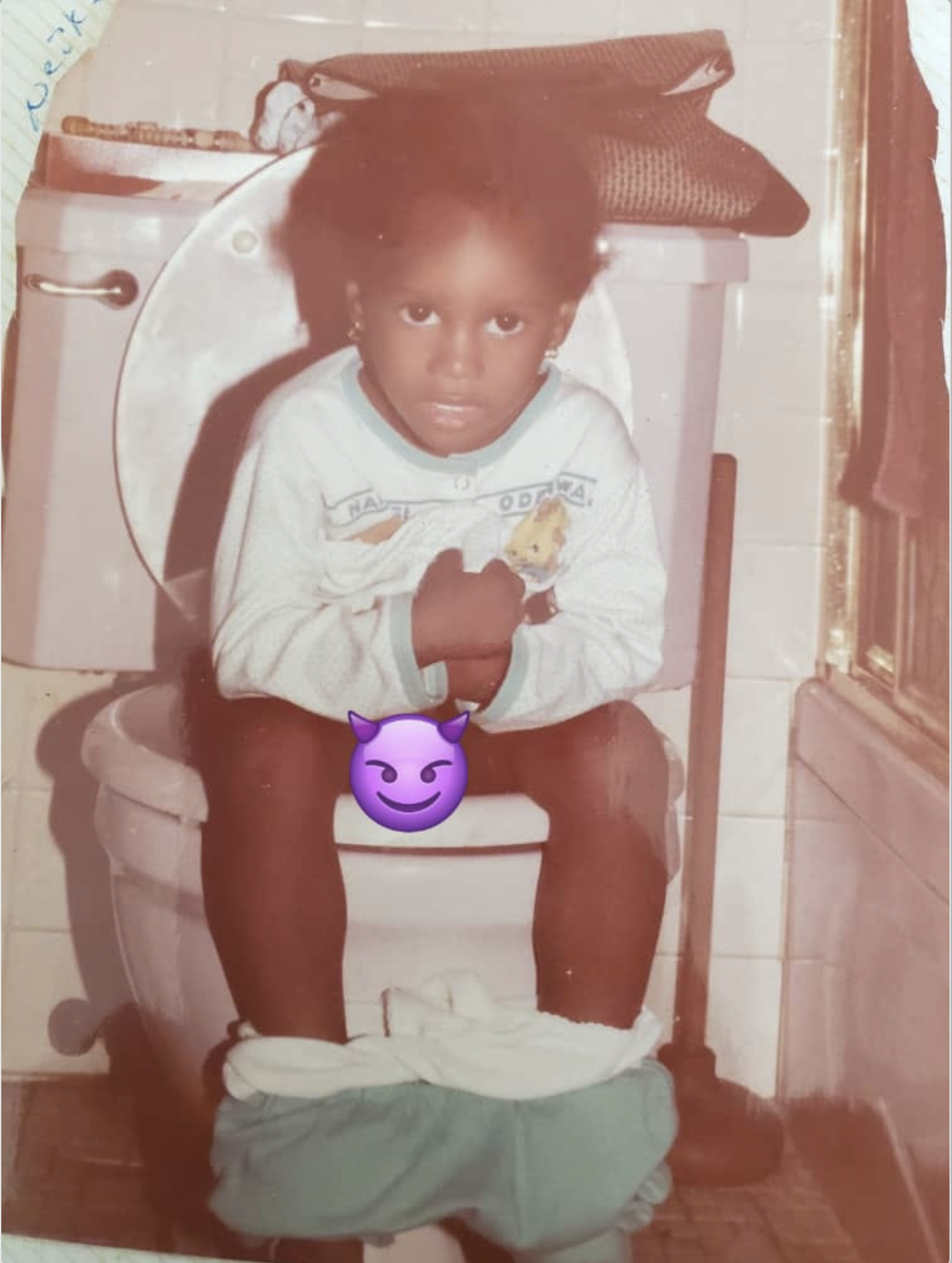
Mi profunda conciencia de mí mismx en la infancia y cómo ya cuestionaba las desigualdades e injusticias a muy temprana edad (+/- 4 años de edad). (Créditos: Naïké Ledan)
Naike Los medios internacionales no hablan en serio sobre Haití, pero en un ambiente político tan malo como el que estamos viviendo, el ambiente económico se torna aún más catastrófico. Como haitianx más bien de clase media, que habla otros idiomas, que tiene otros pasaportes, al principio dudé de si yo debía ocupar ese espacio o no. Pero muchas veces me veo como un puente más que como alguien que va a hablar de sí mismx. Entonces decidí invitar a Semi, una joven mujer trans brillante que vive fuera de Puerto Príncipe, para que tomara el espacio y la palabra, y nos trazara un recorrido sobre el ecosistema de las realidades que viven las mujeres trans en Haití. Terminamos creando una sesión sobre el feminismo que no incluye — o, diría yo, los espacios feministas formales (que no lo hacen) — y cómo en Haití las chicas trans no cuentan con espacios donde puedan contribuir al conocimiento de las mujeres y compartir sus realidades. Por eso el Festival de AWID me dio la oportunidad de ceder el espacio a las mujeres que deben ocuparlo. Lo pasamos muy bien, tomamos vino en línea mientras charlábamos. Mi cofacilitadora, Semi, contó cómo fue haber sido unx niñx/niña/mujer trans en distintas etapas de su vida. También habló de los peligros de la calle, de la pobreza, la exclusión, lo que ocurre cuando «se te nota», así como de sus victorias.
Chinelo ¿Qué relación existe en Haití entre las mujeres trans y las organizaciones feministas? ¿Cómo ha sido tu experiencia en este sentido?
Naike La experiencia de las mujeres trans en Haití ha sido realmente difícil; devastadora en realidad. Pasaron de la invisibilidad absoluta a estar extremadamente sexualizadas. Otra cosa que sucede es que las están matando y los medios no informan acerca de esos asesinatos. Así de inexistentes, de borradas son y están las mujeres trans. Están en todas partes pero no en los espacios laborales, ni en los espacios feministas ni en las organizaciones. Ni siquiera en las organizaciones LGBT. Solo muy recientemente, y gracias a mucha presión del activismo, algunas de estas organizaciones de alguna manera se están readaptando, pero en los espacios feministas esto sigue estando fuera de toda consideración. Todavía tenemos que escuchar el viejo discurso excluyente que dice «No son mujeres. Por supuesto, si no se les nota … » La cultura de que no se note es una conversación sobre gestión de riesgos: cuánto se te nota y cuánto no se te nota, y lo que eso implica para tu cuerpo y en términos de la violencia que causa. En las realidades trans-excluyentes que vivimos, que se reproducen en muchos espacios feministas, a las que no «se les nota» en absoluto tal vez se las considere chicas, pero solo hasta cierto punto. Pero, ¿qué pasa cuando se enamoran, cuando quieren conversar, cuando están en el armario, cuando quieren adoptar una determinada estética o seguir una carrera? La conversación sobre la terapia hormonal termina centrándose en la reducción de riesgos, como lo dijo la propia Semi en el taller. Pero no tenemos la opción de las terapias hormonales, no tenemos ni el marco médico ni un sistema que apoye a las que quieran tomar por ese camino.
Chinelo Cuando hablas de lo que piensa la sociedad acerca de las personas trans y las personas queer, suena bastante similar a lo que ocurre en Nigeria que puede ser un ambiente profundamente homofóbico.
Naike Haití es un país muy complejo de maneras muy hermosas. Aquí nada es simple, ¿sabes?, las cosas nunca son de una sola forma. La gente es muy tolerante, y también muy homofóbica. Hay zonas rurales en las que la gente no es para nada homofóbica porque allí hay muchos templos vudús y esa es una religión que respeta la vida. Un principio básico de la religión vudú es que todxs lxs niñxs son niñxs. Por eso es una religión que no define lo que está bien ni lo que está mal. Durante muchísimo tiempo la gente pensó en Haití como un refugio, un lugar donde había tolerancia — estamos hablando de los setenta, ochenta, antes del VIH, inclusive los noventa. Luego vino el terremoto (en 2010) donde murieron casi 300 000 personas. Y entonces llegó todo ese dinero de las iglesias evangélicas del sur de Estados Unidos para reconstruir el país y encontrar a Jesús. Por eso la homofobia en Haití es algo muy reciente. En lo profundo, en el corazón del alma de su cultura, no puedo realmente decir que sea un país homofóbico. Pero en la vida cotidiana no hay duda de que esa violencia lastima la piel de las personas queer. Y de las mujeres, de las mujeres empobrecidas, las mujeres de piel oscura, porque el colorismo está muy arraigado en el Caribe.
Chinelo ¿Cómo te has enfrentado a esto? ¿Cuál ha sido tu estrategia para sobrevivir?
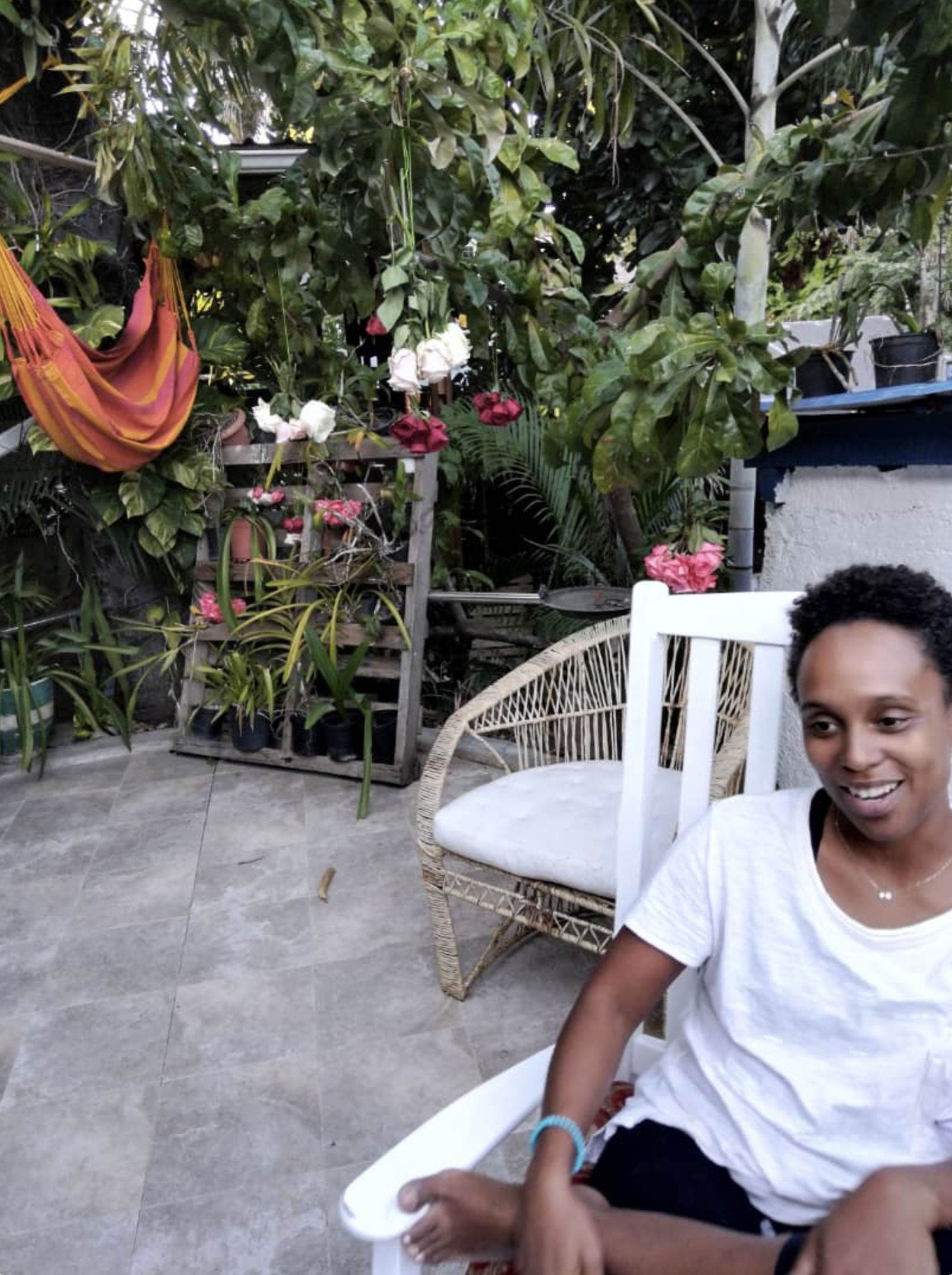
Mi regreso a Haití como parte de mi proceso de descolonización y la elección de posicionar físicamente mis sentidos y los de mi familia de manera inflexible del lado de la magia y la negritud. (Créditos: Naïké Ledan)
NaikeEstoy enamoradx de mi trabajo. Me encanta trabajar. Cuando recién llegué trabajaba en una ONG horrible pero el trabajo que hacía era maravilloso. Estaba siempre en zonas rurales, conversando y aprendiendo de la gente, de las mujeres. Y eso me colmó el corazón durante mucho tiempo porque adoro mi cultura, a la gente negra, a las mujeres negras, a las ancianas negras, lxs bebés negrxs. Es algo que me colma espiritualmente. Cuando vivíamos en Canadá, mis hijxs iban a esas escuelas sólo de blanquxs donde lxs trataban como mascotas. No hablaban creole ni francés. Y ahora corren libres por el jardín y ya están empezando a pelearse en creole. También encontré espacios de supervivencia en la gente a la que conocí. Forjé lazos con gente queer y con otra gente rara como yo, y eso ha sido realmente maravilloso. Pero ahora todo se ha vuelto más difícil porque ya no me siento segurx en Haití. En Puerto Príncipe ocurren casi 40 secuestros por semana, y esto es así desde 2018. Ahora tengo ataques de ansiedad y de pánico. Entonces, es hora de irme y he comenzado a preguntarme dónde está mi hogar. Pasé 19 años en Montreal pero allí nunca sentí que estuviera en mi casa. Desde que me fui, nunca lo extrañé y por eso no quiero volver. Últimamente estoy llorando mucho porque siento como que está comenzando mi segundo exilio.
Chinelo ¿Cómo es tu relación con el placer, el tiempo libre y el descanso?
Naike Mi relación con el placer, el tiempo libre y el descanso es la misma, porque para mí son una sola cosa. Son esos momentos vividos en los que disfruto del sol sobre mi rostro, por ejemplo. Es placer, tiempo libre y descanso a la vez.
Placer: Es el espacio al que siempre voy, casi siempre como refugio donde puedo celebrarme a mí mismx. Me reservo el poder y el derecho de hacer mucho ruido o nada de ruido cuando disfruto del placer que siento — de todo el placer en el que me deleito en abundancia, viciosamente, que incluye el placer de la soledad y el silencio pero no se limita a eso.
Tiempo libre: andar en bicicleta, ir a festivales de música, comer, descubrir vinos, bailar las danzas vudús tradicionales de Haití son algunas de las muchas opciones que se me ocurren en este momento.
Descanso: Para eso vivo. Como persona que sobresale en su trabajo y que está literalmente enamorada de él, es una paradoja lo haraganx que soy. Nadie lo sabe porque lo que todo el mundo ve es una persona que trabaja muchísimo y es muy exitosa. No saben que puedo ser inflexible en cuanto a disfrutar profundamente de no hacer nada.
ExplorarCorporalidades Transnacionales
Esta edición en alianza con Kohl: una publicación para Body and Gender Research analizará soluciones, propuestas y realidades feministas para transformar nuestro mundo actual, nuestros cuerpos y nuestras sexualidades.
نصدر النسخة هذه من المجلة بالشراكة مع «كحل: مجلة لأبحاث الجسد والجندر»، وسنستكشف عبرها الحلول والاقتراحات وأنواع الواقع النسوية لتغيير عالمنا الحالي وكذلك أجسادنا وجنسانياتنا.
When you do a search for “Female Genital Mutilation” or “FGM” online, an image of four line-drawings of the female anatomy pop up next to its Wikipedia entry. (...)
Diana Isabel Hernández Juárez fue una maestra guatemalteca, defensora de los derechos humanos y activista comunitaria y del medioambiente. Fue la coordinadora del programa ambiental de la parroquia de Nuestra Señora de Guadalupe, en la costa sur del país.
Diana dedicó su vida a co-crear conciencia ambiental, y trabajó de modo particularmente estrecho con comunidades locales para abordar problemas ambientales y proteger los recursos naturales. Inició proyectos tales como viveros forestales, granjas municipales, huertas familiares y campañas de limpieza. Participó activamente en programas de reforestación, tratando de recuperar especies nativas y paliar la falta de agua, en más de 32 comunidades rurales.
El 7 de septiembre de 2019, Diana recibió disparos y fue asesinada por dos hombres armados desconocidos mientras se encontraba participando de una procesión en su comunidad. Diana tenía solamente 35 años en el momento de su muerte.