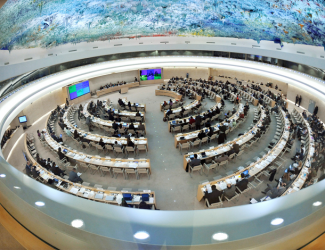
Jean-Marc Ferré | Flickr (CC BY-NC-ND 2.0)
A general view of participants at the 16th session of the Human Rights Council in Geneva, Switzerland.

Análisis Especiales

AWID es un organización feminista internacional de membresía, que brinda apoyo a los movimientos que trabajan para lograr la justicia de género y los derechos de las mujeres en todo el mundo.

Consejo de Derechos Humanos (CDH)

El Consejo de Derechos Humanos (CDH) es el cuerpo intergubernamental del sistema de las Naciones Unidas responsable de la promoción y protección de todos los derechos humanos en todo el mundo. El HRC se reúne en sesión ordinaria tres veces al año, en marzo, junio y septiembre.  La La Oficina del Alto Comisionado para los Derechos Humanos (ACNUDH) es la secretaría del Consejo de Derechos Humanos.

El CDH  trabaja de la siguiente forma:

  • Debate y aprueba resoluciones sobre cuestiones mundiales de derechos humanos y el estado de los derechos humanos en determinados países

  • Examina las denuncias de víctimas de violaciones a los derechos humanos o las de organizaciones activistas, quienes interponen estas denuncias representando a lxs víctimas.

  • Nombra a expertos independientes que ejecutarán los «Procedimientos Especiales» revisando y presentado informes sobre las  violaciones a los derechos humanos desde una perspectiva temática o en relación a un país específico

  • Participa en discusiones con expertos y  gobiernos respecto a cuestiones de derechos humanos.

  • A través del Examen Periódico Universal, cada cuatro años y medio, se evalúan los  expedientes de derechos humanos de todos los Estados Miembro de las Naciones Unidas

Aprende más sobre el CDH


La Sesión actual - CDH44

Se está llevarando a cabo en Ginebra, Suiza del 30 de junio al 17 de julio de 2020.

AWID trabaja con socios feministas, progresistas y de derechos humanos para compartir conocimientos clave, convocar diálogos y eventos de la sociedad civil, e influir en las negociaciones y los resultados de la sesión.

Con nuestrxs socixs, nuestro trabajo será:


◾️ Monitorear, rastrear y analizar actores, discursos y estrategias anti-derechos y su impacto en las resoluciones

◾️ Desarrollar conjuntamente una labor de promoción conjunta para contrarrestar a los actores anti-derechos y debatir más a fondo las conclusiones del Informe de Tendencias de OUR de 2017

◾️ Apoyar, coordinar y desarrollar de manera colaborativa el Caucus feminista emergente en el CDH


Contenido relacionado

Snippet - CSW68 - AWID In-Person Exhibit Booth - FR

Kiosque d'exposition en personne de l'AWID

📅 Mardi 12 mars
🕒 de 9 h à 17 h HNE

🏢 Armenian Cultural Center, 630 2e avenue, coin de la 35e rue

Main image
FFC - Banners.png
Body

The Feminist Film Club

As part of AWID’s Feminist Realities journey, we invite you to explore our newly launched Feminist Film Club: a collection of short and feature films selected by feminist curators and storytellers from around the world, including Jess X. Snow (Asia/Pacific), Gabrielle Tesfaye (Africa/African Diaspora), and Esra Ozban (South West Asia, North Africa). Alejandra Laprea is curating the Latin & Central American program, which we’ll launch in September during AWID’s Crear, Résister, Transform: A Festival for Feminist Movements. In the meantime, look out for announcements on special films screenings and conversations with filmmakers!

Voici votre guide pratique et les infographies «Vers un écosystème de financement féministe»

Snippet FEA ASOM Challenges Story 1 (EN)

CHALLENGES:

  • Climate Change
  • Access to financial credit Intermediaries
  • Cultivation for illicit usage

Ana M. Tallada Iglesia

Ana was a strong advocate of women’s rights and worked with a broad cross-section of women, from those in grassroots networks to those in the private sector.

She believed in building bridges across sectors. Ana was a member of the National Network for the Promotion of Women (RNPM), and was active in developing many social programs that address issues such as sexual and reproductive health and rights. 


Ana M. Tallada Iglesia, Peru

Snippet - WITM Who should - EN

Who should take this survey*?

The survey is for groups, organizations and movements working specifically or primarily for the rights of women, LBTQI+ people and on gender justice in all contexts, at all levels, and in all regions. If this is one of the core pillars of your group, collective, network or any other type of organization - whether registered or not, newly formed or long-standing, we invite you to take this survey.

Girl in a jacket

*At this time, we are not asking for responses from individuals or funders.

Learn more about the survey:
Consult the F.A.Q.

Body

The AWID Forum Access Fund

We strive to make the AWID Forum a truly global gathering with participation from a diverse array of movements, regions and generations. To this end, AWID mobilizes resources for a limited Access Fund (AF) to assist some participants with the costs of attending the Forum. 

The 14th AWID International Forum will take place 11-14 January 2021, in Taipei, Taiwan. 


How will  the Access Fund be allocated?

For this AWID Forum, there will be no application process. 

Access Fund grants will be allocated by invitation only to:

  • Two  persons per activity selected for the Forum program (decided by those organizations, groups or individuals organizing the activity) 
  • Participants who identify as part of Priority Forum  Constituencies (PFCs) recommended by the organizations, networks and groups who are co-creating the Forum with AWID. 
  • PFCs are those which we consider would strengthen our collective power as movements, are not centered in mainstream feminist movements, and whose Feminist Realities we would like to honor, celebrate and visibilize: 
    - Black feminists 
    - Indigenous feminists
    - Trans, gender non-conforming and intersex feminists
    - Feminists with disabilities 
    - Feminist sex workers and informal workers, including migrant workers
    - Feminists affected by migration 
    - Women affected by drug policy
    - Feminists from the Forum regions (with a focus on the Pacific and mainland China) 

In addition, AWID will fund approximately 100 participants from the Forum’s location. Forum Committee Members (Content and Methodology, Access and Host) as well as those in the Artists Working Group [link] are also granted Access Fund support.

What does the Access Fund cover?

For selected participants, the Access Fund will cover the cost of their:

  • Flight
  • Accommodation
  • Visa
  • Local transportation in Taipei
  • Travel medical insurance

The Access Fund will NOT cover their: 

  • Forum registration fee
  • Transportation to and from the airport in their city of departure
  • Other incidental costs

Apart from the Access Fund, how can I fund my participation at the Forum?

We have listed other ideas on how to fund your participation at the AWID Forum on the Funding Ideas page. 

More Funding Ideas

Snippet FEA Barcelona, Spain (ES)

Barcelona, España

Metzineres


Lxs Mujerxs Toman Drogas.

SUPÉRALO

Marceline Loridan-Ivens

Nacida en 1928, Marceline trabajó como actriz, guionista y directora.

Dirigió The Birch-Tree Meadow en 2003, protagonizada por Anouk Aimee, así como varios otros documentales. También fue una sobreviviente del Holocausto. Tenía solo quince años cuando ella y su padre fueron arrestadxs y enviadxs a campos de concentración nazis. Los tres kilómetros entre su padre en Auschwitz y ella en Birkenau eran una distancia infranqueable, sobre la cual escribió en una de sus novelas más influyentes: Pero no regresaste.

Al hablar sobre su trabajo, una vez afirmó: «Todo lo que puedo decir es que todo lo que pueda escribir, todo lo que pueda develar, es mi tarea hacerlo».


Marceline Loridan-Ivens, France

Snippet - WITM to claim - EN

To claim your power as an expert on the state of resourcing for feminist movements

Body

AWID Member Community Guidelines

Co-creating welcoming and safe spaces

The co-creation of our feminist realities starts with ourselves and how we treat each other. We are dedicated to creating and protecting safe and supportive spaces for our communities both online and in person. We also consider that safe and welcoming spaces are co-owned and co-created.

We  expect our members to act in a manner that is ethical, responsible and consistent with the values of AWID and assume collective responsibility to ensure an atmosphere of mutual respect and solidarity. 


All AWID members are encouraged to: 

  • Connect with others, help break isolation and further solidarity.  It’s easy to feel lost and alone, and a little friendliness and responsiveness goes a long way.

  • Interact and engage peacefully. Differences in opinion will naturally arise, so please think of these differences as useful for expanding your thinking and ways of seeing the world.

  • Help build a space that recognizes and validates multiple lived experiences and diversities of bodies and gender expressions. Recognize that we all carry intersectional identities.

  • Use inclusive language. Be respectful of how people want to be referred to in terms of gender identity or expression (like pronouns), and practice inclusive language. 

  • Listen and make adjustments in your behavior and ways of engaging if someone says they feel uncomfortable. Don’t ask others questions that you wouldn't want to be asked yourself.

  • Help challenge oppressive behavior, which includes harassment, verbal or physical violence, violation of consent, and any action that perpetuates classism, ageism, ableism, racism, misogyny, heterosexism, transphobia and other oppressions.  If needed, please reach out to AWID staff. 

  • Practice speaking and listening with an open mind and heart and without judgement.

  • Be honest, open and heartfelt. Speak and share authentically about your experiences, your challenges, your hopes and dreams, and your vision for your own life and your community.

  • Practice active listening and self-awareness. Be aware of how much time and space you are taking up- leave room for others, practice active listening and learning.

  • Be mindful and credit others for their work and activism. Remember that we are all working collectively to contribute to change-- Ensure that you recognize the contribution of others and credit them when appropriate e.g. in discussions, or in articles, pictures etc.

  • Stay safe! We encourage you to take measures to protect yourself online and in person, especially if you have reason to believe that speaking out will put you in danger. Members may use aliases or profile images that conceal their identity. For more information please refer to the Digital Security First Aid Kit for Human Rights Defenders produced by APC - Association for Progressive Communications. 

  •  Respect the privacy needs of others! Do not share or forward any information without explicit permission.


Our Values

Solidarity 

We take a position in solidarity with each other and diverse struggles for justice and freedoms. We strive to mobilize and strengthen collective action and practice meaningful ways of working with each other.

Human rights

We believe in a full application of the principle of rights including those enshrined in international laws and affirm the belief that all human rights are interrelated, interdependent and indivisible. We are committed to working towards the eradication of all discriminations based on gender, sexuality, religion, age, ability, ethnicity, race, nationality, class or other factors.

Responsibility, Accountability, and Integrity

We strive for transparency, responsible use of our resources, fairness in our collaborations and accountability and integrity with our members, partners, funders and the movements with(in) which we work. We are committed to reflecting on our experiences, sharing our learnings openly, and striving to change our practices accordingly.

Intersectionality

We believe that for feminist movements to be transformative and strong we must continue to work across our similarities and differences. We also must interrogate power and privilege both within and outside our movements.

Bodily autonomy, integrity and freedoms

We celebrate everyone's right to choose their identities, relationships, goals, work, dreams and pleasures, and what they do with their mind, body and spirit. We believe in working towards access to resources, information and safe and enabling environments that allow this to happen.

Justice and systemic change

We work towards a world based on social, environmental, and economic justice; and interdependence, solidarity, and respect. We work towards dismantling systems of oppressive power and against all its manifestations, including patriarchy, fundamentalisms, militarisms, fascisms and corporate power that threaten our lives and our world. We want a just world where resources and power are shared in ways that enable everyone to thrive.


Please note:  

AWID reserves the right to delete comments, suspend or revoke membership when our community guidelines have been violated. AWID members are not authorised to represent AWID in any official capacity unless stipulated in writing. Members cannot use AWID spaces to proselytize or recruit members to join a religious faith or organisation. Members cannot use AWID spaces to request funds for personal use although links to external fundraising efforts or activism campaigns are permissible.
 

Snippet FEA Metzineres has supported (FR)

Depuis sa fondation,

Metzineres a accompagné plus de

383

personnes.

Dilma Ferreira Silva

Dilma Ferreira Silva fue una destacada activista por los derechos de las comunidades del Amazonas y luchó durante décadas por los derechos de las personas afectadas por las represas.

Ella misma fue una de las 32.000 personas desplazadas por el Tucuruí, una mega central hidroeléctrica, construida en Brasil durante la dictadura militar de 1964-1985.

En 2005 Dilma fue invitada a unirse al Movimiento de los Pueblos Afectados por las Represas en Brasil (MAB), y en 2006 formó el colectivo de mujeres, y eventualmente se convirtió en coordinadora regional del movimiento.

Al hablar de su activismo, sus colegas comentaban:

"Se destacó muy rápido porque siempre fue muy intrépida en la lucha".

Dilma vivió en el asentamiento rural de Salvador Allende, a 50 kilómetros de Tucuruí, y dedicó toda su vida a proteger a las comunidades y las tierras afectadas por la construcción de mega proyectos. Dilma se preocupaba especialmente por el impacto de género que esos proyectos podrían causar, y defendía los derechos de las mujeres.

En una reunión nacional del MAB en 2011, Dilma, dirigiéndose a las mujeres afectadas por las represas, dijo:

"Somos las verdaderas Marías, guerreras, luchadoras que están allí, enfrentando el desafío de la lucha diaria".

En los años siguientes, Dilma organizó grupos de base del MAB y trabajó con la comunidad para formar cooperativas agrícolas que condujeron a una mejor redistribución de los alimentos entre la comunidad. Conjuntamente, mejoraron la comercialización de la pesca y desarrollaron un proyecto de cisternas para el agua potable. También  fue defensora de la comunidad de agricultores cuyas tierras eran codiciadas por los "grileiros" (acaparadores de tierras).

El 22 de marzo de 2019, a la edad de 48 años, Dilma, su marido y su amigo fueron brutalmente asesinados. Los tres asesinatos fueron parte de una ola de violencia en la Amazonia contra el Movimento dos Trabalhadores Sem Terra (traducido como 'Movimiento de los Trabajadores Sin Tierra') y lxs activistas medioambientales e indígenas.

Snippet - WITM Why now_col 1 - FR

Pourquoi maintenant?

A monochromatic orange illustration of a woman with curly hair with her hand on her chin. She seems to inquisitive or posing a question.

Dans le monde entier, les mouvements féministes, de défense des droits des femmes, pour la justice de genre, pour la défense des personnes LBTQI+ et les mouvements alliés vivent un moment critique, face à de puissantes remises en question de droits et libertés pourtant acquis.

Ces dernières années ont vu la rapide montée de l’autoritarisme, de la violente répression de la société civile et de la criminalisation des défenseur·ses des droits humains des femmes et des personnes de genre divers, l’escalade de guerres et de conflits dans plusieurs régions du monde, la perpétuation des injustices économiques et de crises conjuguant la santé, l’écologie et les changements climatiques.

Body