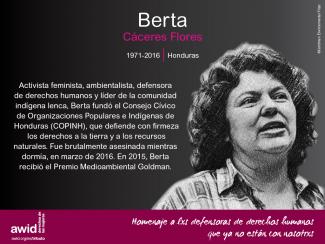
Berta Cáceres Flores

Les jeunes activistes féministes jouent un rôle crucial au sein des organisations et des mouvements pour les droits des femmes à travers le monde. Ce sont elles qui soulèvent les nouveaux problèmes auxquels les féministes sont confrontées aujourd'hui. Leur force, leur créativité et leur adaptabilité sont vitales pour assurer la viabilité des organisations féministes.
Pourtant, elles sont confrontées à toute une série d’obstacles particuliers, notamment l'accès limité au financement et au soutien, le manque de possibilités de renforcement des capacités et une augmentation considérable des agressions sur les jeunes défenseuses des droits humains. Ces obstacles entraînent un manque de visibilité qui rend leur intégration et leur participation effective au sein des mouvements pour les droits des femmes encore plus difficiles.
Le Programme d’activisme des jeunes féministes de l'AWID a été mis en place pour veiller à ce que les voix des jeunes femmes soient entendues et représentées dans le discours féministe. Nous voulons faire en sorte que les jeunes féministes aient un meilleur accès à du financement, à des opportunités de renforcer leurs capacités et aux processus internationaux.
En plus de soutenir directement les jeunes féministes, nous travaillons également avec des activistes des droits des femmes de tout âge pour élaborer des modèles et des stratégies d’organisation multigénérationnelles plus efficaces.
Nous souhaitons que les jeunes féministes puissent jouer un rôle actif dans les prises de décisions qui concernent leurs droits. Nos actions incluent :
Favoriser la mise en commun et le partage d'informations par la Plateforme de jeunes féministes. Étant donné l'importance des médias en ligne pour le travail des jeunes féministes, notre équipe a lancé la Plateforme de jeunes féministes en mai 2010. Elle a pour objectifs d’échanger des renseignements, de renforcer les capacités des membres par le truchement de webinaires et de discussions en ligne, et d'encourager la consolidation d’une communauté de jeunes féministes.
Soutenir la recherche et le renforcement des connaissances sur l'activisme des jeunes féministes, pour accroître la visibilité et l'influence de leur activisme au sein et entre les mouvements pour les droits des femmes et auprès d'autres acteurs-trices clés, tels les donateurs.
Faire la promotion de la collaboration multigénérationnelle, en explorant de meilleures façons de travailler ensemble.
Inciter les jeunes féministes à s’engager dans les processus internationaux relatifs au programme de développement, notamment ceux des Nations Unies.
S’assurer leur collaboration dans tous les domaines prioritaires de l'AWID, y compris le Forum, pour faire en sorte que leurs contributions, leurs perspectives, leurs besoins et leur activisme se traduisent dans les débats, les politiques et les programmes qui les concernent.
Esta publicación (zine) colaborativa surgió de una serie de círculos de intercambio que reunieron a feministas de todo el mundo durante 2022. El propósito fue intercambiar ideas y aprender mutuamente de qué manera las comunidades responden a la crisis climática en diversos contextos locales.

We welcome applications across the full range of thematic areas and intersections important to feminist and gender justice movements. In the application form, you will be able to mark more than one theme that fits your activity.
by Chinelo Onwualu
On September 2nd, 2021, the amazing feminist and social justice activists of AWID’s Crear | Résister | Transform festival came together not only to share resistance strategies, co-create, and transform the world, but also to talk dirty on Twitter.
Cette politique régit toutes les pages hébergées sur le site www.awid.org, et tout autre site web géré par l'AWID, ainsi que les pages d’inscription à ces sites. Elle ne s'applique pas aux pages hébergées par des organisations autres que l'AWID auxquelles nous pouvons nous associer, et dont les politiques de confidentialité peuvent différer. Veuillez lire le document suivant pour comprendre notre politique de confidentialité concernant la nature, le but, l'utilisation et le partage de vos données personnelles collectées via ce site web.
D’une manière générale, vous pouvez naviguer sur ce site web sans nous soumettre vos informations personnelles. Cependant, dans certaines circonstances, nous vous demanderons de nous fournir certaines données personnelles.
Lorsque vous êtes sur le site web et que nous vous demandons des données personnelles, ces informations ne sont pas partagées en dehors de l’AWID.
1.1.1 Les données que vous fournissez pour obtenir des mises à jour de l'AWID :
Lorsque vous vous inscrivez pour avoir accès au site web - par exemple, que vous vous abonnez pour recevoir des courriels de notre part ou que vous demandez à devenir membre – nous vous demandons de fournir des données personnelles telles que votre nom, pays, langue, courriel pour recevoir les mises à jour. Vous nous transmettez ces informations grâce à des formulaires sécurisés et elles sont stockées sur des serveurs sécurisés.
1.1.2 Les données de paiement que vous envoyez pour devenir membre ou vous inscrire à un événement :
En devenant membre ou en vous inscrivant à des événements, vous devrez peut-être également fournir des données de paiement. L’AWID ne stocke aucune information de carte de crédit sur ses serveurs et utilise des systèmes de paiement sécurisés pour traiter ces informations.
1.1.3 Les informations facultatives que vous avez choisi de nous fournir (avec votre consentement) :
Lorsque vous communiquez avec l’AWID ou que vous fournissez des informations facultatives via des formulaires en-ligne ou utilisez le site pour communiquer avec d'autres membres, nous recueillons ces informations et toute information que vous choisissez de donner.
1.1.4 Les données que nous recueillons via des formulaires de contact ou lorsque vous communiquez directement avec nous :
Lorsque vous communiquez avec nous, nous recueillons ces données ainsi que toute autre information que vous choisissez de nous fournir.
Nous collectons et stockons également certaines autres informations concernant l'utilisation de notre site web par nos utilisateurs-trices afin que des tiers puissent nous fournir des rapports et des analyses concernant l'utilisation et les modes de navigation des utilisateurs-trices.
Pour plus d'informations sur les cookies, veuillez consulter la page suivante : www.allaboutcookies.org/fr/.
Si vous ne souhaitez pas recevoir de cookies, vous pouvez facilement modifier le paramétrage de votre navigateur web pour refuser de recevoir des cookies, ou pour demander d’être informé-e lorsque vous recevez un nouveau cookie. Cliquez ici pour voir comment procéder.
L'AWID utilise les informations collectées à propos de vous pour :
Si vous vous êtes abonné-e aux bulletins électroniques de l'AWID ou à des mises à jour par courrier électronique ou si vous êtes devenu-e membre, nous vous enverrons régulièrement des informations, ainsi qu’indiqué dans la section correspondante du site web. Vous pouvez vous désabonner à tout moment des bulletins électroniques ou des mises à jour par courriel en suivant les liens vers les informations de désabonnement incluses dans nos courriels.
L'exactitude des données vous concernant personnellement est importante pour l'AWID. Nous sommes en permanence à la recherche de moyens pour vous faciliter l’accès aux données que l'AWID conserve à votre sujet via notre site web et à la possibilité et les modifier. Si vous changez votre adresse e-mail, ou si l'une des autres informations que nous détenons est inexacte ou n’est plus d’actualité, merci de nous contacter ici.
Si vous avez consenti à ce que l’AWID utilise vos données personnelles, vous pouvez néanmoins changer d’avis à tout moment en nous contactant et en spécifiant l’autorisation que vous annulez. Veuillez noter que le retrait de votre consentement n'affecte pas la légalité des activités de traitement basées sur ce consentement avant son retrait.
Excepté dans le cas détaillé ci-dessous, l'AWID ne divulgue aucune de vos informations personnelles et ne vend ni ne loue des listes contenant vos informations à des tiers. L'AWID peut divulguer des informations quand elle a votre permission de le faire ou dans des circonstances particulières, par exemple lorsqu’elle croit de bonne foi que la loi l'exige.
Nous mettons continuellement en œuvre et mettons à jour les mesures de sécurité administratives, techniques et physiques afin de protéger vos données contre tout accès non autorisé, perte, destruction ou altération de celles-ci. Certaines des mesures de protection que nous utilisons pour protéger vos informations sont les pare-feu, le cryptage des données et les contrôles d'accès aux informations. Si vous savez, ou avez des raisons de croire, que vos informations d'identification AWID ont été perdues, volées, détournées ou autrement compromises, ou en cas d'utilisation non autorisée réelle ou suspectée de votre compte d'adhésion à l’AWID, veuillez nous contacter.
Cette politique est susceptible d’être modifiée de temps à autre. La dernière version de la politique sera postée sur notre site web, ainsi que la date de sa dernière mise à jour. En cas de modification(s) apportées à cette politique, vous recevrez une mise à jour par courriel. Au cas où vous ne seriez pas d'accord avec la politique ainsi révisée, vous aurez la possibilité d'annuler votre (vos) abonnement(s) chez nous. N’hésitez pas à nous contacter. Tous vos commentaires au sujet de cette politique sont les bienvenus !
Dernière mise à jour : mai 2019
As world leaders gather in Brazil, feminist movements are advocating, gathering and disrupting the status quo- at COP30 and beyond! We're heading alongside other feminists to Belém, Brazil for COP30, from 10 November – 21 November 2025, where we will continue to denounce false solutions.
Participants will come together in Bangkok, Thailand. We can’t wait!
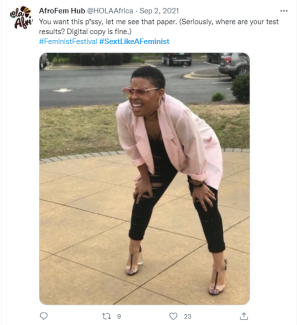
Si quieres esta concha, déjame ver ese papel (En serio, ¿dónde está el resultado de tu prueba? En versión digital está bien)

This calendar is a gift to our global feminist community. It is our promise of future connection and movement moments in the year to come. This past year has seen unspeakable injustices. We welcome a new year full of powerful movement spirit, of hopeful solutions and strategies. For a more just world for all.
As you flip through the pages note the diversity of art from our artist members who use their work to amplify and interlink our different movements under the feminist umbrella. Do you see yourself, your movement, your communities in these pages? We encourage you to use this calendar as a practical tool to mark time and space, but also to pencil in occasions to connect with feminists and activists.
This calendar invites us to immerse ourselves in the inspiring world of feminist artistry. Each month, as it gently unfolds, brings forth the vivid artwork of feminist and queer artists from our communities. Their creations are not mere images; they are profound narratives that resonate with the experiences of struggle, triumph, and undying courage that define our collective quest. These visual stories, bursting with color and emotion, serve to bridge distances and weave together our diverse experiences, bringing us closer in our shared missions.
Enciende tu fuego feminista leyendo nuestras investigaciones y publicaciones varias sobre financiamiento, defensoras de derechos humanos, construcción de movimientos, fundamentalismos, justicia económica, seguimiento y evaluación feminista y más
ใหม่
ผู้เข้าร่วมประชุมจะได้เข้าร่วมตามสถานที่ต่างๆนอกเพื้นที่ในการจัดงานที่กรุงเทพฯ และตามส่วนต่างๆของ โลกในแต่ละวันของการประชุม สถานที่ประชุมที่ผู้เข้าร่วมจัดการเองทั้งหมดนั้นจะเชื่อมต่อกับสถานที่จัดงาน
จริงในกรุงเทพฯเช่นเดียวกับบุคคลที่เชื่อมต่อทางออนไลน์ ผู้เข้าร่วมในจุดศูนย์กลาง Hub นี้จะสามารถ ดำเนินรายการในหัวข้อกิจกรรมต่างๆ เข้าร่วมอภิปราย แลกเปลี่ยน และเพลิดเพลินไปกับโปรแกรม ที่หลากหลาย
ที่ตั้งจุดศูนย์กลาง Hub จะประกาศในปี 2567
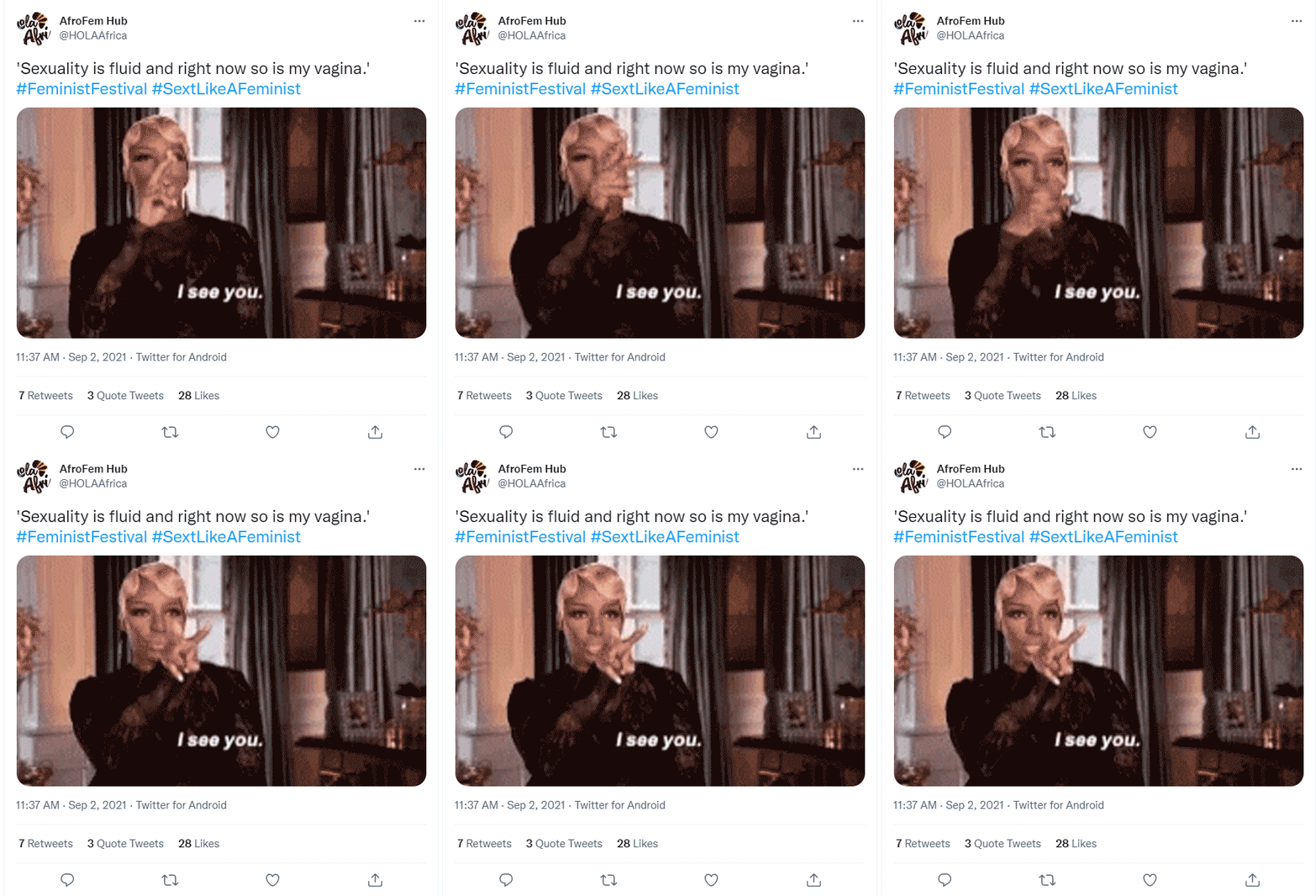
« La sexualité est fluide, et là mon vagin aussi. »
#FeministFestival #SextLikeAFeminist
Du 27 au 30 avril 2026, l’AWID participera à la Conférence Women Deliver 2026, en co‑créant un espace politique avec les mouvements féministes et de justice de genre, ancré dans le care et la solidarité transnationaux.
À une époque où le fascisme et la militarisation continuent de progresser à l’échelle mondiale, la connexion féministe et la solidarité au‑delà des frontières sont plus que jamais essentielles. Nous organisons plusieurs espaces, à Women Deliver et en ligne, pour connecter les mouvements entre eux à travers des espaces de dialogue, afin de construire des agendas féministes de solidarité et d’action.
Communicating Desire
Host: We tend to think about communicating desire as something that is limited to the private intimacy of the bedroom and our personal relationships. But can we also think of this kind of communication as a structure, a praxis that informs our work, and how we are, how we do in the world?
Lindiwe
I believe that unfortunately in the past, expressing your sexuality has been limited. You were allowed to express it within the confines of your marriage, which was permitted, there have always been taboo and stigmas attached to expressing it any other way. When it comes to communicating, obviously the fact that certain stigmas are attached to expressing your sexuality or expressing your desire makes it a lot harder to communicate that in the bedroom or intimately with your partner. From my personal experience, I do believe that obviously if I feel more comfortable expressing myself outside of the bedroom on other matters or other topics, it’s easier for me to build that trust, because you understand conflict resolution with that particular person, you understand exactly how to make your communication special towards that particular person. It’s not easy. It’s something that is consistently done throughout whatever your engagement is, whether it’s your relationship or whether it’s casual and just in the moment. But I believe that confidence outside can definitely translate to how you communicate your desire.
Manal
Since childhood, a woman is raised with that, “you’re not allowed to talk about your body, you’re not allowed to talk about your desire,” which puts a heavy responsibility on women, especially girls in their teens when they need to express themselves and talk about these issues. So for me I think this is a big problem. You know, I have been married for more than 25 years, but still, until now, I cannot talk about my desires. I cannot say what I want or what I prefer, because it’s like I’m not allowed to go beyond this line. It’s like haram, despite it being my right. This is the case for all my friends, they just can’t express themselves in the right way.
Louise
Personally, I find that expressing our desires, my desires, however that expression comes in hand, has to do with the other, and the gaze that the other would have on me. So this is also something that we can link to cinema. And the gaze I would have on myself as well: what I think I am as an individual, but also what society expects of me and my sexuality. In the past, I somehow did the analogy between what happens in the bedroom and what happens in the workplace, because there is sometimes this dynamic of power, whether I want it or not. And oftentimes, verbal communication is harder than we think. But when it comes to representation in film, that’s a totally different game. We are very far away from what I guess all of us here would like to see on screen when it comes to just communicating sexual desires inside or outside the bedroom.
Host: We can think about the digital world as embodied: while it might be virtual, it is not less real. And this was made clear in the context of AWID’s feminist realities festival, which took place entirely online. What does it mean then to talk about sexuality, collectively, politically, in online spaces? Do we navigate virtual spaces with our bodies and affects, and in this case, what are the different considerations? What does it do to communication and representation?

Lindiwe
Social media makes you feel community-based. When you express what it is that you want or like, there is someone who’s either going to agree or disagree, but those who do agree make you feel that you belong to a community. So it’s easier to throw it out into the universe, or for others to see, and potentially not get as much judgment. And I say this very loosely because sometimes, depending on what it is that you’re expressing, it either will get you vilified or celebrated. But when it comes to the bedroom, there is an intimacy and almost a vulnerability that is exposing you and different parts of you that is not as easy to give your opinion on. When it comes to expressing your desire, speaking it and saying it and maybe putting a Tweet or a social media post, or even liking and reading other communities that are same-minded is a lot easier than telling your partner, “this is how I want to be pleasured” or “this is how what I want you to do next,” because of the fear of rejection. But not only that, just the vulnerability aspect – allowing yourself to be bare enough to let the other person see into what you are thinking, feeling, and wanting – I think this is where the difference would come in for me personally. I feel it is a lot more community-based on social media, and it’s easier to engage in discourse. Whereas in the bedroom, you don’t want to necessarily kill the moment. But I think that also kind of helps you understand going forward, depending on the relationship with the person, how you would engage thereafter. So I always know that if I try to communicate something and I fail to do so in the moment, I can always try to bring it up outside of that moment and see what the reaction would be so I know how to approach it going forward.
Louise
You know the question in films is, I don’t know if the male gaze is done intentionally or not. Like we don’t really know that. What we know is that the reason why sexuality in general has been so heternormative and focused on penetration and not giving any space for women to actually ask for anything in films, is because most of the people who have been working in this industry and making decisions in terms of, you know, storytelling and editing have been white men. So rape revenge is this very weird film genre that was birthed in the 70s, and half of the story would be that a woman is being raped by one or multiple people, and in the other half, she would get her revenge. So usually she would murder and kill the people who have raped her, and sometimes other people next to them. At the beginning of the birth of this genre and for 30 years at least, those films were written, produced, and directed by men. This is why we also want so much representation. A lot of feminists and pioneers in queer filmmaking also used the act of filming in order to do that and to reclaim their own sexuality. I’m thinking about Barbara Hammer, who’s a feminist and queer pioneer in experimental cinema in the U.S. where she decided to shoot women having sex on 16mm, and by doing so reclaimed a space within the narrative that was exposed in film at that time. And there is also then the question of invisibilization: we know now, because of the internet and sharing knowledge, that women and queer filmmakers have been trying and making films since the beginning of cinema. We only realize it now that we have access to databases and the work of activists and curators and filmmakers.
Host: And this opens up the conversation on the importance of keeping our feminist histories alive. The online worlds have also played a crucial role in documenting protests and resistance. From Sudan to Palestine to Colombia, feminists have taken our screens by storm, challenging the realities of occupation, capitalism, and oppression. So could we speak of communicating desire – the desire for something else – as decolonization?
Manal
Maybe because my village is just 600 residents and the whole village is one family – Tamimi – there are no barriers between men and women. We do everything together. So when we began our non-violent resistance or when we joined the non-violent resistance in Palestine, there was no discussion whether women should participate or not. We took a very important role within the movement here in the village. But when other villages and other places began to join our weekly protests, some men thought that if these women participate or join the protests, they will fight with soldiers so it will be like they’re easy women. There were some men who were not from the village who tried to sexually harass the women. But a strong woman who is able to stand in front of a soldier can also stand against sexual harassment. Sometimes, when other women from other places join our protest, they are shy at first; they don’t want to come closer because there are many men. If you want to join the protest, if you want to be part of the non-violent movement, you have to remove all these restrictions and all these thoughts from your mind. You have to focus on just fighting for your rights. Unfortunately, the Israeli occupation realizes this issue. For example, the first time I was arrested, I wear the hijab so they tried to take it off; they tried to take off my clothes, in front of everybody. There were like 300-400 people and they tried to do it. When they took me to the interrogation, the interrogator said: “we did this because we want to punish other women through you. We know your culture.” So I told him: “I don’t care, I did something that I believe in. Even if you take all my clothes off, everybody knows that Manal is resisting.”
Lindiwe
I think even from a cultural perspective, which is very ironic, if you look at culture in Africa, prior to getting colonized, showing skin wasn’t a problem. Wearing animal skin and/or hides to protect you, that wasn’t an issue and people weren’t as sexualized unless it was within context. But we conditioned ourselves to say, “you should be covered up” and the moment you are not covered up you are exposed, and therefore it will be sexualized. Nudity gets sexualized as opposed to you just being naked; they don’t want a little girl to be seen naked. What kind of society have we conditioned ourselves to be if you’re going to be sexualizing someone who is naked outside of the context of a sexual engagement? But environment definitely plays a big role because your parents and your grannies and your aunts say “no, don’t dress inappropriately,” or “no, that’s too short.” So you hear that at home first, and then the moment you get exposed outside, depending on the environment, whether it’s a Eurocentric or more westernized environment to what you are used to, then you are kind of free to do so. And even then, as much as you are free, there’s still a lot that comes with it in terms of catcalling and people still sexualizing your body. You could be wearing a short skirt, and someone feels they have the right to touch you without your permission. There is so much that is associated with regulating and controlling women’s bodies, and that narrative starts at home. And then you go out into your community and society and the narrative gets perpetuated, and you realize that you get sexualized by society at large too, especially as a person of color.

Host: And finally, in what ways can our resistance be more than what we are allowed? Is there a place for pleasure and joy, for us and our communities?
Louise
Finding pleasure as resistance and resistance in pleasure, first for me there is this idea of the guerrilla filmmaking or the action of filming when you’re not supposed to or when someone told you not to, which is the case for a lot of women and queer filmmakers in the world right now. For example, in Lebanon, which is a cinema scene that I know very well, most of the lesbian stories that I’ve seen were shot by students in very short formats with “no production value” as the west would say – meaning with no money, because of the censorship that happens on an institutional level, but also within the family and within the private sphere. I would think that filming whatever, but also filming pleasure and pleasure within lesbian storytelling is an act of resistance in itself. A lot of times, just taking a camera and getting someone to edit and someone to act is extremely hard and requires a lot of political stance.
Lindiwe
I have a rape support group. I’m trying to assist women to reintegrate themselves from a sexual perspective: wanting to be intimate again, wanting to not let their past traumas influence so much how they move forward. It’s not an easy thing, but it’s individual. So I always start with understanding your body. I feel the more you understand and love and are proud of it, the more you are able to allow someone else into that space. I call it sensuality training, where I get them to start seeing themselves as not sexual objects, but as objects of pleasure and desire that can be interchangeable. So you’re worthy of receiving as well as giving. But that’s not only from a psychological point of view; it is physical. When you get out of the shower, you get out of the bath, and you’re putting lotion on your body, look at every part of your body, feel every part of your body, know when there are changes, know your body so well that should you get a new pimple on your knee, you are so aware of it because just a few hours ago it wasn’t there. So things like that where I kind of get people to love themselves from within, so they feel they are worthy of being loved in a safe space, is how I gear them towards claiming their sexuality and their desire.
Manal
You know we began to see women coming from Nablus, from Jerusalem, from Ramallah, even from occupied 48, who have to drive for 3-4 hours just to come to join the protests. After that we tried to go to other places, talk with women, tell them that they don’t have to be shy, that they should just believe in themselves and that there is nothing wrong in what we are doing. You can protect yourself, so where is the wrong in participating or in joining? Once I asked some women, “why are you joining?” And they said, “if the Tamimi women can do it, we can do it also.” To be honest I was very happy to hear this because we were like a model for other women. If I have to stand for my rights, it should be all my rights, not just one or two. We can’t divide rights.