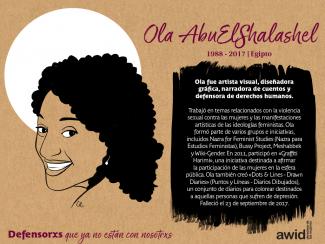
Ola AbuElShalashel
- Category
- Derechos civiles y políticos
- Date of death / disappearance
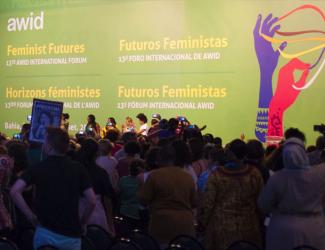
In September 2016, the 13th AWID international Forum brought together in Brazil over 1800 feminists and women’s rights advocates in a spirit of resistance and resilience.
This section highlights the gains, learnings and resources that came out of our rich conversations. We invite you to explore, share and comment!
One of the key takeaways from the 2016 Forum was the need to broaden and deepen our cross-movement work to address rising fascisms, fundamentalisms, corporate greed and climate change.
With this in mind, we have been working with multiple allies to grow these seeds of resistance:
And through our next strategic plan and Forum process, we are committed to keep developing ideas and deepen the learnings ignited at the 2016 Forum.
AWID Forums started in 1983, in Washington DC. Since then, the event has grown to become many things to many peoples: an iterative process of sharpening our analyses, vision and actions; a watershed moment that reinvigorates participants’ feminisms and energizes their organizing; and a political home for women human rights defenders to find sanctuary and solidarity.
Une communauté en ligne pour et par les jeunes féministes qui militent pour les droits humains des femmes, l'égalité de genre et la justice sociale dans le monde entier
Finance des projets initiés par de jeunes féministes. Vise à renforcer la capacité des organisations de jeunes féministes à mobiliser des ressources pour leurs actions et à encourager des bailleur-euse-s de fonds et d’autres allié-e-s à financer l’activisme des jeunes féministes.
Cette plateforme sera l’espace de référence pour accéder à des informations et à des ressources concernant la sauvegarde de l'universalité des droits humains dans les espaces internationaux et régionaux.
Visitez le site (en anglais)
Un site pour en savoir plus sur les mesures d’urgence entreprises pour protéger les défenseuses des droits humains et pour trouver des outils et des ressources au soutien de leur travail et de leur bien-être.
Une initiative régionale créée pour prévenir, répondre, documenter et rendre publics tous les cas de violence contre les défenseuses des droits humains dans la région mésoaméricaine.
Visitez le site (en anglais et en espagnol)
Un réseau qui réalise un travail de plaidoyer et propose des ressources pour protéger et soutenir les défenseuses des droits humains dans le monde entier.
Visitez le site (en anglais)
Une coalition d’organisations féministes, de droits des femmes, de développement, de justice sociale et d’organisations de terrain qui conteste le programme mondial de développement et plaide pour qu’il soit recadré.
Visitez le site (en anglais)
Le rôle du groupe consiste à assurer la pleine participation des groupes de femmes non gouvernementaux aux processus politiques de l'ONU sur le développement durable, le programme de l’après-2015 et les questions environnementales.
Visitez le site (en anglais)
Une alliance d’organisations et de réseaux de femmes qui font un travail de plaidoyer en faveur de l'égalité de genre, de l'autonomisation des femmes et des droits humains dans le cadre des processus des Nations unies relatifs à la composante Financement du développement (FdD).
Visitez le site (en anglais)
Meet Aura Roig, the visionary feminist activist, anthropologist, director and founder of the Metzineres cooperative.
She spent the last two decades researching, designing and implementing drug policies from the perspective of harm reduction, human rights and intersectional feminism.
Having experienced and learned from communities who use drugs around the world, she returned to Barcelona and created Xarxa de Dones que Usen Drogues (the Network of Women Who Use Drugs, XADUD). XADUD was a space of mutual support and solidarity with the struggle to secure rights for marginalized groups, which later became the Metzineres cooperative.
Aura is currently working on expanding the Metzineres model to provide support to bigger constituencies, while also extensively documenting their prolific journey and learnings.
Absolutely, we want to hear about your experience with resourcing.

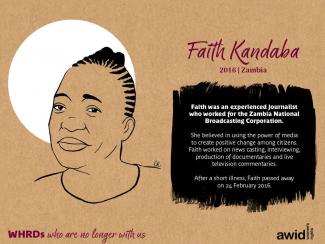
Estas 20 Defensoras de derechos humanos (WHRDs, por las siglas en inglés) trabajaron como periodistas, y de manera más amplia, en los medios comunicación de México, Colombia, Fiji, Libia, Nepal, Estados Unidos de Norteamérica, Nicaragua, Filipinas, Rusia, Alemania, Francia, Afganistán, y el Reino Unido. De ellas, 16 han sido asesinadas, y la causa de muerte en uno de los casos sigue sin ser esclarecida. Por esto, en este Día Mundial de la Libertad de Prensa, por favor únete a nosotrxs para conmemorar la vida y el trabajo de estas mujeres, compartiendo las memes aquí incluidas con tus colegas, amistades y redes, utilizando los hashtags #LibertadDePrensa y #WHRDs.
Los aportes del trabajo realizado por estas mujeres fueron celebrados y honrados en nuestro Tributo virtual para defensoras que ya no están con nosotrxs.
Por favor, haz click en cada imagen de abajo para ver una versión más grande y para descargar como un archivo.


Mientras estés en São Paulo, Brasil, puedes visitar la Ocupação 9 de Julho y pedir una comida colaborativa. También puedes comprar sus productos en su tienda online desde el extranjero.
Visita la tienda en línea de la Asociación de Mujeres Afrodescendientes del Norte del Cauca (ASOM) donde puedes encontrar hermosos productos hechos a mano.
Hay varias formas de apoyar a Metzineres: puedes hacer una donación económica, donar materiales y servicios, o proponer una formación, un taller o una actividad (para más información, ¡ver aquí!)
El financiamiento externo incluye donaciones y otras formas de financiamiento provenientes de fundaciones filantrópicas, gobiernos, donantes bilaterales, multilaterales y corporativos y de donantes individuales, ya sea que estos se encuentren radicados en tu país o en el exterior. Excluye aquellos recursos que las agrupaciones, organizaciones o movimientos generan de manera autónoma como, por ejemplo, cuotas de membresía, contribuciones voluntarias del personal, afiliadxs o adherentes, colectas comunitarias, alquiler de espacios propios o venta de servicios. Para consultar más referencias, en la propia encuesta se encuentran incluidas las definiciones de los distintos tipos de financiamiento y descripciones breves de distintos tipos de donantes.
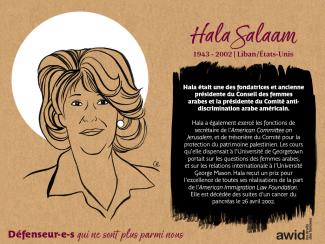
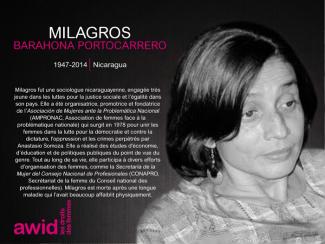
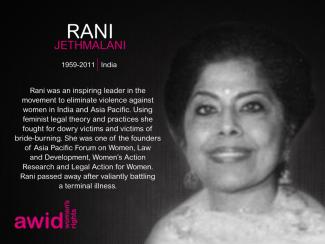
Les données que nous avons recueillies pour élaborer notre hommage montrent à quel point le Mexique est un pays dangereux pour les défenseuses. Sur les 12 femmes mexicaines défenseuses des droits humains que nous commémorons cette année, 11 ont été assassinées. Elles étaient des journalistes ou des activistes, des défenseuses des droits des femmes ou de ceux des personnes trans*. Nous vous invitons à vous joindre à nous pour rendre hommage à ces défenseuses, à leur travail et à l’héritage qu’elles nous ont laissé. Faites circuler ces mèmes auprès de vos collègues et amis ainsi que dans vos réseaux et twittez en utilisant les hashtags #WHRDTribute et #16Jours.
S'il vous plaît cliquez sur chaque image ci-dessous pour voir une version plus grande et pour télécharger comme un fichier


L’AWID est engagée en faveur de la justice linguistique, et nous regrettons que l’enquête WITM ne puisse, à l’heure actuelle, être accessible dans d’autres langues. Cependant, si vous avez besoin d’une aide à la traduction ou que vous souhaitez participer à l’enquête dans une autre langue, n’hésitez pas à nous contacter à l’adresse witm@awid.org.
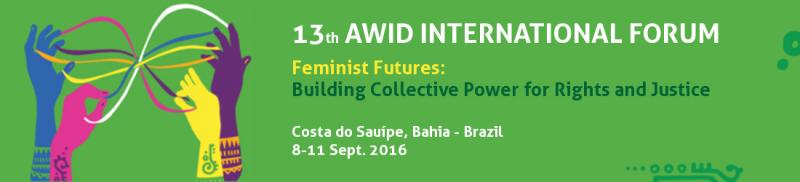
This kit includes sample messages fit for Twitter, Facebook, LinkedIn and Instagram, plus images that can be used to accompany these messages.
Using this kit is simple. Just follow these steps:
Match up your favourite messages and images any way you like.
Share them on your personal and/or professional social media accounts.
Match up your favourite tweets below with these images for Twitter
I'm going to the #AWIDForum. It's THE place to connect with women's rights & social justice movements. Join me!: http://forum.awid.org/forum16/
Can't wait to re-imagine #FeministFutures connect with other women's rights & social justice activists @ the #AWIDForum Join me!: http://forum.awid.org/forum16/
I’m so excited to attend the #AWIDForum next September, and now we can register! Join me! http://forum.awid.org/forum16/
Registration is now open for the #AWIDForum! Costa do Sauípe, Brazil, 8-11 Sept. 2016: http://forum.awid.org/forum16/
Join #AWIDForum, a historic global gathering of women's rights & social justice activists: http://forum.awid.org/forum16/
Join #AWIDForum to celebrate the gains of our movements & analyze lessons to move forward: http://forum.awid.org/forum16/
#AWIDForum – not just an event, a chance to disrupt oppression & advance justice: http://forum.awid.org/forum16/
Join the #AWIDForum to celebrate, strategize and renew ourselves and our movements: http://forum.awid.org/forum16/
Let's build #FeministFutures together. Register for 2016 #AWIDForum. Costa do Sauípe, Brazil http://forum.awid.org/forum16/
Join us to re-imagine & co-create #FeministFutures at the 2016 #AWIDForum. Register: http://forum.awid.org/forum16/
#FeministFutures: seize the moment @ #AWIDForum to advance shared visions for a just world: http://forum.awid.org/forum16/
We’ll be 2,000 social movement activists @ the #AWIDForum, strategizing our #FeministFutures http://forum.awid.org/forum16/
We’re more than a one-issue struggle. Join us at the #AWIDForum: http://forum.awid.org/forum16/
Join #AWIDForum, a space to strategize across movements & leverage our collective power: http://forum.awid.org/forum16/
Mobilize solidarity & collective power across social movements at the #AWIDForum: http://forum.awid.org/forum16/
Break the silos b/w our movements. Re-imagine & co-create our futures. All at the #AWIDForum: http://forum.awid.org/forum16/
Solidarity is a verb. Let’s put it into action at the #AWIDForum: http://forum.awid.org/forum16/
Donors engaging with women’s rights and social movements at the #AWIDForum: http://forum.awid.org/forum16/
Media and movements: amplifying #FeministFutures at the #AWIDForum: http://forum.awid.org/forum16/
Match up your favourite messages below with these images for Facebook.
These messages may also be used on Twitter via private Direct Messages, which don’t have character limits.
NOUS SOMMES LA SOLUTION