
Resourcing Feminist Movements
The “Where is the Money?” #WITM survey is now live! Dive in and share your experience with funding your organizing with feminists around the world.
Learn more and take the survey
Around the world, feminist, women’s rights, and allied movements are confronting power and reimagining a politics of liberation. The contributions that fuel this work come in many forms, from financial and political resources to daily acts of resistance and survival.
AWID’s Resourcing Feminist Movements (RFM) Initiative shines a light on the current funding ecosystem, which range from self-generated models of resourcing to more formal funding streams.
Through our research and analysis, we examine how funding practices can better serve our movements. We critically explore the contradictions in “funding” social transformation, especially in the face of increasing political repression, anti-rights agendas, and rising corporate power. Above all, we build collective strategies that support thriving, robust, and resilient movements.
Our Actions
Recognizing the richness of our movements and responding to the current moment, we:
-
Create and amplify alternatives: We amplify funding practices that center activists’ own priorities and engage a diverse range of funders and activists in crafting new, dynamic models for resourcing feminist movements, particularly in the context of closing civil society space.
-
Build knowledge: We explore, exchange, and strengthen knowledge about how movements are attracting, organizing, and using the resources they need to accomplish meaningful change.
-
Advocate: We work in partnerships, such as the Count Me In! Consortium, to influence funding agendas and open space for feminist movements to be in direct dialogue to shift power and money.
Related Content
Nana Abuelsoud
Nana is a feminist organizer and a reproductive rights and population policy researcher based in Egypt. She is a member of Realizing Sexual and Reproductive Justice (RESURJ), a member of the Advisory Board of the A Project in Lebanon, and a member of the Community Committee of Mama Cash. Nana holds an MSc in Public Health from KIT Institute and Vrije University in Amsterdam. In her work, she follows and contextualizes national population policies while building evidence that addresses modern eugenics, regressive international aid, and authoritarianism. Previously, she was part of the Geneva Foundation for Medical Education and Research, the Egyptian Initiative for Personal Rights, and Ikhtyar Feminist Collective in Cairo.
Qual é o objetivo do inquérito WITM?
O objetivo principal do inquérito WITM é chamar a atenção para o estado financeiro dos diversos movimentos feministas, de direitos das mulheres, de justiça de género, de LBTQI+ e de aliados globalmente, e com base nisto, fortalecer ainda mais o argumento para transferir mais recursos de melhor qualidade e poder para os movimentos feministas.
Do you produce an annual report?
Yes, we do produce annual reports.
All our annual reports are accessible online.
É possível existir várias respostas para o inquérito WITM em nome de um grupo específico?
Não, solicitamos apenas um inquérito completo por grupo.
2011: The fifth High-level dialogue kick starts Post-2015 discussions
The Fifth High- Level Dialogue on Financing for Development, 7 – 8 December 2011, marked the beginning of the Post 2015 development agenda discussions, and the link to financing for development. The conference gave a special focus to increasing aid to finance the MDG’s. In his closing remarks, the Secretary General called on members to begin to consider the post-2015 development framework.
هل استطيع تعبئة الاستطلاع خارج KOBO ومشاركتكم/ن الأجوبة عن طريق البريد الالكتروني؟
ما لم تكن هناك مشكلات في إمكانية الوصول و/أو إذا كنت تملأ/ئي الاستبيان بلغات أخرى، فإننا نشجعك بشدة على استخدام KOBO لجمع وتحليل البيانات الموحدة للاستطلاع.
I am not able to submit a written proposal, are you accepting any other formats?
As part of our commitment to accessibility in all aspects of the AWID Forum we are accepting audio/video formats for those individuals/organizations/groups who can't submit a written application.
If you choose to send your proposal in an audio/video format, kindly follow the same order to answer the questions as detailed in the Activity Proposal Form.
To submit an audio/video file please Contact us, selecting Forum Call for Activities as the subject of your email.
Будет ли у меня возможность поделиться мыслями по вопросам, которые не учтены в опросе?
Да, в конце опроса мы попросим вас поделиться более подробной информацией по важным для вас аспектам, ответив на открытые вопросы.
Why did AWID decide to change the Forum location from Bali to Taipei?
Events in Indonesia, in late 2019 - in particular, signs of intensifying militarization and backlash against LGBTQ rights - led us to question AWID’s ability to maintain a reasonably safe and welcoming environment for the diversity of participants we aspire to bring together at the Forum.
After careful consideration the AWID Board of Directors decided to change the venue for the 14th International AWID Forum, in November 2019 from Bali to Taipei.
Taipei offers a strong degree of logistical capacities, and is accessible for many travellers (with a facilitated e-visa process for international conferences).
For more details:
Como é que os dados recolhidos através do questionário serão divulgados e processados?
Os dados serão processados para fins estatísticos para esclarecer o estado de financiamento dos movimentos feministas globalmente e serão divulgados apenas em forma agregada. A AWID não divulgará informações sobre uma organização específica ou informações que permitam identificar uma organização através da respetiva localização ou características sem o respetivo consentimento comprovado.
حالة التمويل للحركات النسوية ووقائعها تتغير بسرعة. هل هذا الاستطلاع لمرة واحدة؟
كلا. يبني هذا الاستطلاع على المعلومات التي حشدتها جمعية حقوق المرأة في التنمية حول كيفية الحصول على تمويل أكبر وأفضل للحركات النسوية وحركات التغيير الاجتماعي وهذه الدورة الثالثة لاستطلاع "أين التمويل للتنظيمات النسوية". نهدف للقيام بالاستطلاع مرة كل ثلاثة أعوام.
Snippet - WITM Who should - PT
Quem deve realizar este inquérito?
O inquérito destina-se a grupos, organizações e movimentos que trabalham especificamente ou principalmente pelos direitos das mulheres, pessoas LBTQI+ e pela justiça de género, em todos os contextos, em todos os níveis e em todas as regiões. Se este for um dos pilares principais do seu grupo, da sua comunidade, da sua rede ou de qualquer outro tipo de organização, quer esteja registada ou não, seja nova ou já estabelecida, convidamo-lo a participar neste inquérito.

* De momento, não solicitamos respostas de indivídues ou de fundos feministas e de mulheres.
Snippet - CSW69 - Feminist Solidarity Space - EN
Feminist Solidarity Space
✉️ By registration for larger groups. Drop-ins for smaller groups. Register here
📅 Tuesday, March 11, 2025
🕒 12.00-2.00pm and 4.00-6.00pm EST
🏢 Chef's Kitchen Loft with Terrace, 216 East 45th St 13th Floor New York
Organizer: AWID
Snippet - CSW69 - Challenging the Status Quo - EN
Challenging the Status Quo
A Critical Dialogue on Gender Equality and Human Rights
✉️ Online registration available. Register here
📅 Friday, March 21, 2025
🕒 2.30pm EST
🏢 Church Center of the United Nations, 11th Floor. 777 United Nations Plaza, New York, NY 10017
🎙️AWID speaker: Anissa Daboussi, Manager, Advancing Universal Rights and Justice team
Organizer: IWRAW AP, OURs, AWID, SRI
About the AWID International Forum
More than an event!
The AWID International Forum is a truly global space that gives participants an opportunity to network, build alliances, celebrate, and learn in a stimulating, emotive and safe atmosphere.

More and more, we are trying to bring the Forum process outside of the convening’s borders. Engaging with partners and deepening relationships all year round, connecting with local movements to better understand problems and co-create solutions. The Forum event itself, held every three to four years in a different region of the world, is just a crystallization of all these alliances that we are building as part of our work.
The AWID Forum dissolves our inner and external boundaries, fosters deep discussion, personal and professional growth, and strengthens our movements for gender justice and women’s rights.
As a convening, it is a response to the urgency to promote stronger and more coordinated engagement and action by feminists, women’s rights and other social justice advocates, organizations and movements. We also believe that the Forum is more than just an event – it can facilitate a process to influence thinking and set agendas for feminist movements and other related actors.
Evolving from a national conference of around 800 people, the event now brings together around 2000 feminists, community leaders, social justice activists, and donor agencies from around the world.
The 14th AWID International Forum will take place 11-14 January 2021 in Taipei, Taiwan.
The past Forums
2016 - Feminist Futures: Building Collective Power for Rights and Justice (Costa de Sauipe, Brazil)
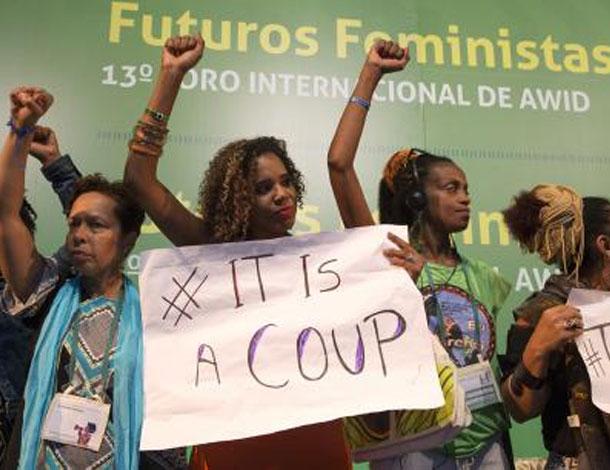
Given the complex world that we face today, the 2016 AWID Forum did not focus on a particular “issue”, but rather on creating more effective ways of working together!
Despite the challenging contexts in which the 2016 Forum took place (the Zika epidemic, a strike by Brazilian foreign-service workers, the impeachment of President Dilma Rousseff and subsequent turmoil), it succeeded in bringing together over 1800 participants from 120 countries and territories across all regions of the world.
What happened at the 13th AWID international Forum:
-
For 96% of participants who responded to the post Forum evaluation survey, the Forum was a major source of inspiration and energy.
-
98% of participants considered it an important convening space for feminist movements and expressed hope that AWID continues to organize forums.
-
59% of Forum evaluation survey respondents declared to be very satisfied with the Forum and 34% somewhat satisfied.
-
Over 150 sessions were delivered in different formats on a variety of topics ranging from bodily integrity and freedoms, to gender-based violence in the workplace, to strategies for building collective power.
-
The first-time Black Feminisms Forum (BFF), held just before the main AWID Forum, brought together 250 Black feminists from all over the world to co-create a powerful space to build and strengthen ongoing, intergenerational, transnational connections
Read more about what the 2016 AWID Forum achieved:
Download the Forum evaluation report
2012 - Transforming Economic Power to Advance Women's Rights and Justice (Istambul, Turkey)
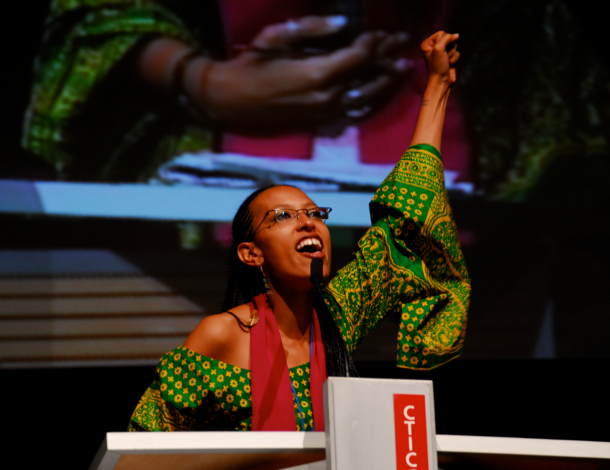
The 12th AWID Forum was the largest and most diverse AWID Forum to date, bringing together 2239 women’s rights activists from 141 countries. Of these participants, around 65% were from the Global South and close to 15% were young women under 30, and 75% attended an AWID Forum for their first time.
The Forum program focused on transforming economic power to advance women’s rights and justice and featured over 170 different kinds of sessions including feminist economics toolbox skills-building sessions, breakout sessions representing all 10 Forum themes, in-depth sessions, and solidarity roundtables.
Building on the momentum of the 2012 Forum, we transformed the website into a resource and learning Hub, which builds on the content generated by participants by featuring multi-media resources on all Forum components.
Visit the 2012 Forum web archive
All AWID Forums
- 2016: Feminist Futures: Building Collective Power for Rights and Justice (Costa de Sauipe, Brazil). Read the 2016 Forum Evaluation report
- 2012: Transforming Economic Power to Advance Women's Rights and Justice (Istanbul, Turkey)
- 2008: The Power of Movements (Cape Town, South Africa). Read our 2008 Forum Report
- 2005: How does change happen? (Bangkok, Thailand)
- 2002: Reinventing Globalization (Guadalajara, Mexico)
- 1999: Leading Solutions for Equality and Justice (US)
- 1996: Beyond Beijing From Words to Action (US)
- 1993: Joining Forces to Further Shared Visions (US)
- 1991: Working Together/Learning Together: A South North Dialogue (US)
- 1989/1990: Global Em-Powerment for Women (US)
- 1987: Moving Forward: Innovations in Development Policy, Action and Research (US)
- 1985: Women Creating Wealth; Transforming Economic Development (US)
- 1983: ‘Women in Development’ (Washington D.C, US)