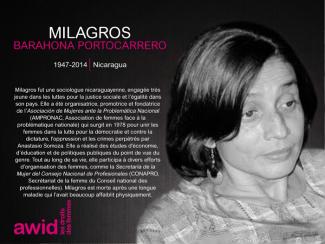
Milagros Barahona Portocarrero
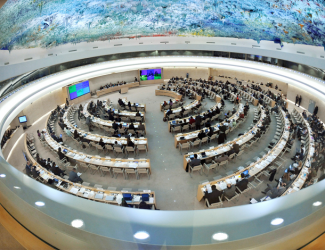
Le Conseil des droits de l'homme (CDH) est un organe intergouvernemental clé du système des Nations Unies, responsable de la promotion et la protection des droits humains autour du globe. Il se réunit trois fois par an en session ordinaire, en Mars, Juin et Septembre. Le Bureau du Haut-Commissariat des Nations Unies aux Droits de l’Homme (HCDH) constitue le secrétariat pour le CDH.
Débat et adopte des résolutions sur les questions globales des droits humains ainsi que sur la situation des droits humains dans des pays particuliers
Examine les plaintes des victimes de violations des droits humains et des organisations activistes, au nom des victimes de violations des droits humains
Nomme des experts indépendants (que l'on connaît sous le nom de « Procédures Spéciales ») pour réviser les cas de violation des droits humains dans des pays spécifiques, ainsi que pour examiner et suivre des questions globales relatives aux droits humains
Prend part à des discussions avec les experts et les gouvernements sur les questions de droits humains
Évalue les bilans des États membres de l'ONU en matière de droits humains tous les quatre ans et demi, dans le cadre de l'examen périodique universel.
La prochaine session du CDH a lieu à Genève, en Suisse, du 30 juin au 17 juillet 2020.
AWID travaille avec des partenaires féministes, progressistes et du domaine des droits humains pour partager nos connaissances clé, convoquer dialogues et évènements avec la société civile, et influencer les négociations et les résultats de la session.
Le cadre de référence de votre recherche vous guidera tout au long du processus de recherche. Le document de référence que vous élaborez peut aussi servir de note de synthèse destinée aux personnes qui vous conseillent et à vos partenaires, ainsi qu’à une demande de financement aux éventuels donateurs.
Dans cette section
Avant de mener toute recherche :
- Fixez les objectifs de votre recherche.
- Dressez la liste des questions principales auxquelles vous souhaitez que votre recherche réponde.
- Écrivez les types de données que vous devrez recueillir et examinez-les pour répondre à vos questions principales.
- Définissez les produits finaux que vous élaborerez à l’aide de votre recherche.
Le cadre de votre recherche pourra évoluer avec le temps, alors que vous peaufinez vos questions et recueillez de nouvelles informations. Cependant, le fait de créer un cadre de recherche dès le départ vous permettra de travailler à partir d’une base solide.
Afin que votre recherche WITM ait une base solide, il est important de définir clairement ce que vous souhaitez accomplir.
Par exemple, l’un des objectifs de la recherche mondiale WITM de l’AWID consistait à fournir des données rigoureuses afin de prouver ce que nous savions déjà par ouï-dire : que les organisations de droits des femmes sont sous-financées, et de surcroît de façon marquée. Ces données nous permettraient selon nous d’être en meilleure position pour influencer les prises de décisions des bailleurs de fonds.
Vos objectifs pourraient être les suivants :
Structurez votre processus de recherche à l’aide de questions clés auxquelles seule votre recherche puisse répondre et limitez ces questions à un laps de temps spécifique (p. ex. la dernière année, les derniers cinq ans, etc.).
Tenez compte des aspects suivants :
Le fait de choisir une période spécifique pour votre recherche peut mener à des résultats plus précis qu’ils ne le seraient si vous travailliez avec un calendrier ouvert. De plus, la décision de répéter ou non votre recherche à intervalles réguliers vous permettra de fixer des repères de collecte de données, facilitant la reproduction et la comparaison au fil du temps.
Principales questions qui ont guidé le processus de recherche WITM de l’AWID :
- Quelle est la situation actuelle quant à la durabilité financière des organisations de droits des femmes à travers le monde ?
- Quelles sont les tendances externes et internes qui influent sur les décisions de financement des donateurs à l’appui des organisations et des mouvements de femmes ?
Maintenant que vous avez défini vos questions principales, vous pouvez déterminer les types de données qui vous aideront à répondre à ces questions. Ainsi, vous serez en mesure de planifier le reste du calendrier de votre recherche WITM.
Par exemple, est-ce que vous mènerez une enquête qui couvre une vaste proportion de votre population prioritaire ? Est-ce que vous analyserez les demandes de financement que les bailleurs de fonds reçoivent dans une région particulière ? Est-ce que vous procéderez à des interviews (recommandé) ? En déterminant quelles sont les données dont vous avez besoin, vous pourrez entrer en contact avec des parties externes qui vous fourniront ces données dès le départ, et serez à même de planifier en conséquence l’ensemble de votre calendrier. Nous vous suggérons les sources de données suivantes :
La diversité des ensembles de données constitue un excellent moyen de créer une analyse robuste et riche.
Par exemple, les données de l’Enquête mondiale de l’AWID en 2011 sont les piliers de nos récentes analyses. Cependant, nous avons également recueilli des données d’interviews sur le terrain, avec des donateurs, des activistes ou des organisations de droits des femmes.
L’élaboration d’un plan initial sur les produits que vous créerez vous permettra non seulement de fixer votre calendrier, mais vous donnera également une idée des ressources dont vous aurez besoin.
Par exemple, produirez-vous uniquement un rapport de recherche ou créerez-vous également des infographies, des dépliants et des présentations ? Selon les produits que vous choisirez, vous aurez peut-être à recourir à des sociétés de conception graphique, à prévoir des manifestations, etc.
Ces produits seront également les outils que vous utiliserez pour atteindre vos objectifs. Ainsi, il est important de garder ces objectifs à l’esprit. Par exemple, votre recherche WITM a-t-elle pour unique objectif de servir d’outil de plaidoyer visant à influencer les bailleurs de fonds ? Si tel est le cas, vos produits devraient vous permettre de mobiliser les bailleurs de fonds de manière significative.
Exemples de produits :
Le fait d’établir un cadre de recherche portant sur les objectifs, les questions principales, les types de données et les produits finaux vous permettra de créer un calendrier bien planifié, de préparer vos ressources à l’avance et de fixer un budget réaliste.
Cette démarche facilitera les interactions avec les partenaires externes, tout en vous permettant de gérer plus aisément les contretemps inattendus.

• 1 mois
• 1 personne (ou plus) chargée de la recherche
• Exemple 1 : Cadre de référence d’une recherche
• Exemple 2 : Cadre de référence d’une recherche
L’AWID est engagée en faveur de la justice linguistique, et nous regrettons que l’enquête WITM ne puisse, à l’heure actuelle, être accessible dans d’autres langues. Cependant, si vous avez besoin d’une aide à la traduction ou que vous souhaitez participer à l’enquête dans une autre langue, n’hésitez pas à nous contacter à l’adresse witm@awid.org.
Coopérative Textile Nadia Echazú
.
La recherche documentaire peut se dérouler tout au long de votre initiative. Elle peut vous aider à encadrer vos travaux, à choisir des questions de sondage et à comprendre vos résultats.
Dans cette section
- Préciser le contexte
- S’appuyer sur les connaissances existantes
- Sources éventuelles d’information pour la recherche documentaire
1. Sites Web et rapports annuels des donateurs
2. Sources d’information en ligne
La réalisation de recherches documentaires tout au long de votre initiative peut vous aider à encadrer vos travaux, à choisir les questions de sondage et à vous fournir une clarté contextuelle, tout en rehaussant votre compréhension des résultats de votre sondage. Vous pourriez notamment comparer les similarités et les différences entre les résultats de votre sondage et l’information diffusée par la société civile et les donateurs.
Il se peut que vous déceliez des tendances dans les résultats de votre sondage et que vous souhaitiez mieux les comprendre.
Par exemple, vos données de sondage pourraient révéler que les budgets des organisations diminuent, mais cela ne vous dit pas pour quelle raison cette situation se produit. L’analyse des publications vous donne un contexte et vous révèle certaines des raisons pour lesquelles ces tendances surviennent.
La recherche documentaire garantit également que vous appuyez votre recherche sur les connaissances existantes touchant à votre sujet d’intérêt, confirmant ainsi la validité et la pertinence de vos résultats.
Vos résultats pourraient être complémentaires ou contradictoires par rapport aux connaissances actuelles, mais ils doivent faire référence aux données existantes sur le sujet.
Pour que votre recherche soit complète et englobe tout le panorama du financement qui entoure votre sujet, examinez une gamme de secteurs de financement.
Vous pouvez notamment considérer :
- Les fonds pour les femmes
- Les fondations privées et publiques
- Les organisations non gouvernementales internationales (ONGI)
- Les agences bilatérales et multilatérales
- Les acteurs et actrices du secteur privé
- Les philanthropes
- Les groupes de financement participatif
Inclure tout secteur pertinent dans le cadre de référence de votre recherche.
Par exemple, vous pourriez décider qu’il est important d’effectuer des recherches sur les organisations non gouvernementales (ONG) locales.
Voici des sources directes d’information sur les actions des bailleurs de fonds qui contiennent habituellement des renseignements sur les politiques et les budgets. Si vous réalisez vos recherches avant d’interviewer les donateurs, vos questions seront mieux ciblées et vos interviews plus solides.

• 1-2 mois
• 1 personne (ou plus) chargée de la recherche
7. Synthétisez les résultats de votre recherche
The estimated time to complete the survey is 30 minutes.

1 of 3 trans and travesti people in Argentina live in a poor household
Contenu lié
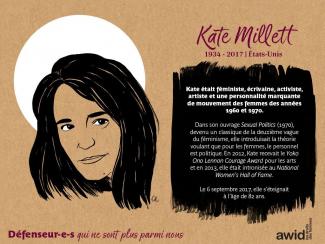
TV5Monde: Kate Millett, décès d'une féministe qui combattait avec caresses et plaisir
In the current context, we have identified five major threats to the struggle towards feminist just economies.
“Financialisation refers to the increasing importance of financial markets, financial motives, financial institutions, and financial elites in the operation of the economy and its governing institutions both at the national and international levels”. - Gerald Epstein
Epstein Gerald A. 2006: Financialization and the World Economy. Edward Elgar Publishing.
Financial institutions exert a strong influence over economic governance and the direction of development policy. The growing dominance of the corporate sector and international financial institutions in defining local and global public policies, has resulted in the capture of the State in the interest of capital. The current financial system, including controversial credit and debt policies, are integral to the reproduction and expansion of capital accumulation processes.
This raises important questions of how to regulate and re-think the global financial system, not only to avoid serious negative consequences of debt-driven crises,but to allow for sustainable livelihoods and the realization of economic and social rights without retrogression.
For more details, see the article by Balakrishnan and Heintz “Debt, Power, and Crisis: Social Stratification and the Inequitable Governance of Financial Markets”
For the past 20 years, trade agreements (both bilateral or multilateral) have expanded their role demonstrating increased interest in Intellectual Property Rights (IPR) to be given to corporations.
IPR has clearly benefitted transnational corporations with huge impacts on the ability of poorer nations and peoples to realize human rights, notably:
In addition, agriculture import liberalisation resulting in an influx of cheap goods jeopardise women’s self-employed farmers in poor countries and food security. Investment protection clauses included in trade agreements limit the policy space of national governments to create and enforce regulations on issues as crucial as environmental protection, labour rights, and the duration of copyrights.
Feminist movements have been, and are, at the forefront of resistance to these agreements exposing its pitfalls.
(See for example, the reactions by feminist networks around the globe to both the Transatlantic and TransPacific Trade and Investment Partnership Agreement negotiations.)
The commodification of the Earth’s resources and resulting environmental degradation and climate change produced by decades of aggressive industrialisation, plunder and extractivism of the world’s resources, have damaged biodiversity and ecological resilience. These damages are now threatening the existence of human society itself.
The international community has failed to address production and consumption patterns sitting at the root of the problem. Instead, governments –with the support of large corporations interested in making a profit - are leaning towards a “green economy” approach promoting “energy-efficient technologies” (including nuclear energy, biofuels, genetically modified organisms and geo-engineering) and carbon trade schemes as the silver bullet.
While the processes of land and resource appropriation is not new – in fact, they are central struggles in colonial histories- what is new is the advanced means by which land and natural resource wealth are becoming commodities in new markets.
International Financial Institutions play a central role in promoting land markets in developing countries. These institutions finance land reforms that enable powerful actors to use land for speculative gain in exchange of meagre promises of jobs and growth. Land-grabbing has far reaching negative impacts on local peoples’ access to essential goods and services apart from displacement and environmental degradation that are associated with it.
People who are resisting land grabbing, among them women human rights defenders, face diverse forms of violence including physical attacks and sexual abuse, on a daily basis.
This patriarchal foundation is particularly hegemonic in today’s neoliberal models.
The many ways in which political economy and development are connected to sexuality or gender is evident: think how capitalism defines what can even be characterized as labour and ties human worth to wage-labour productivity.
For the most part, women’s position in the global economy continues to be one of gender-based labour exploitation with women’s work undervalued in precarious jobs, domestic subsistence, reproduction, and in unwaged household production. Because reproductive labour has been naturalized as women's unpaid work, it has provided an immense subsidy to capitalism at the same time as a source of gender oppression and subjugation.
This situation is aggravated by the fact that as social protection mechanisms begin to dwindle, women’s care burden increases.
Further, the phenomenon of global migration spurred on by thousands of economic refugees escaping oppressive poverty across the globe is not estranged to that of capitalist gender power relations. Remittances become a major source of development financing for the families and communities, but at a major cost for women migrants who struggle to earn a living wage in their new country.
In the same vein, we have seen how patriarchal capitalist systems are using violence and oppression to maintain their status quo. Rising global expenditures in militarism and violence, both perpetrated by state and non-state actors, is increasingly used to control dissent, women’s bodies and voice and settle economic, political and social disputes.
Across the world, violence, incarceration and discrimination disproportionately targets
An intersectional analysis linking gender, race, ethnicity, age, ability, nationality, sexual orientation and gender identity, among other status is needed to challenge structural violence and its links with a capitalist global system.
A profound crisis in the current global governance system is also evident in the feeble inter-governmental agreements reached and how they often lack the most fundamental accountability mechanisms. The multilateral system that served global governance before is failing to respond to the current multiple crises. The same system continues to be deeply undemocratic, with increasing presence and power by corporations occupying the spaces where States used to be.
These threats challenge feminists to re-think our framework and strategies. To renew and reactivate our commitment to movement building with others for a just economy.
They challenge us to consider broad agendas for socio-economic transformations, from a feminist perspective, in ways that address the realities of the majority of the impoverished. Now is the time to bring about change for a just economy and to address the persistent systemic challenges.
Absolutamente; esas preguntas son opcionales y valoramos tu derecho a la anonimidad. Te pedimos que respondas la encuesta independientemente de tu decisión de compartir el nombre de tu agrupación, organización o movimiento y la información de contacto con AWID.

EL CUPO LABORAL TRANS
no está siendo respetado por las empresas
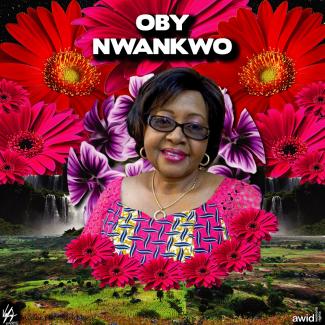
With a legal career spanning more than 30 years, Oby was known across Africa and around the world as a champion for gender justice and human rights.
She founded and served as Executive Director of the Civil Resource Development and Documentation Centre (CIRDDOC), a Nigerian NGO which sponsors trainings and network-building activities for members of civil society, parliamentarians and other key stakeholders to promote human rights, good governance and access to justice and rule of law.
Oby is remembered fondly by activists in Nigeria as an “extraordinary activist who displayed energy and passion towards the fight for gender equality and gender justice in Nigeria and across Africa.”