Jean-Marc Ferré | Flickr (CC BY-NC-ND 2.0)
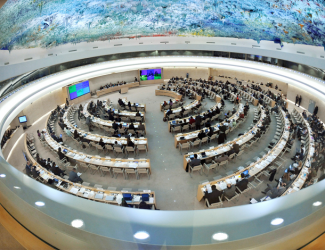
A general view of participants at the 16th session of the Human Rights Council in Geneva, Switzerland.

Analyses Spéciales

L´AWID est une organisation féministe mondiale qui consacre ses efforts à la justice de genre, au développement durable et aux droits humains des femmes

Conseil des Droits de l'Homme (CDH)

​​​​​​Le Conseil des droits de l'homme (CDH) est un organe intergouvernemental clé du système des Nations Unies, responsable de la promotion et la protection des droits humains autour du globe. Il se réunit  trois fois par an en session ordinaire, en Mars, Juin et Septembre. Le Bureau du Haut-Commissariat des Nations Unies aux Droits de l’Homme (HCDH) constitue le secrétariat pour le CDH.

Le CDH :

  • Débat et adopte des résolutions sur les questions globales des droits humains ainsi que sur la situation des droits humains dans des pays particuliers

  • Examine les plaintes des victimes de violations des droits humains et des organisations activistes, au nom des victimes de violations des droits humains

  • Nomme des experts indépendants (que l'on connaît sous le nom de « Procédures Spéciales ») pour réviser les cas de violation des droits humains dans des pays spécifiques, ainsi que pour examiner et suivre des questions globales relatives aux droits humains

  • Prend part à des discussions avec les experts et les gouvernements sur les questions de droits humains

  • Évalue les bilans des États membres de l'ONU en matière de droits humains tous les quatre ans et demi, dans le cadre de l'examen périodique universel.

En savoir plus sur le CDH


Session actuelle: CDH 44

La prochaine session du CDH a lieu à Genève, en Suisse, du 30 juin au 17 juillet 2020.

AWID travaille avec des partenaires féministes, progressistes et du domaine des droits humains pour partager nos connaissances clé, convoquer dialogues et évènements avec la société civile, et influencer les négociations et les résultats de la session.
Avec nos partenaires, notre travail consiste à :


◾️ Suivre, surveiller et analyser les acteurs, discours et stratégies anti-droits et leur impact sur les résolutions du CDH.

◾️ Co-développer un plaidoyer collectif pour contrer les acteurs anti-droits et discuter plus en détails les résultats du Rapport de tendances 2017 du OURs

◾️ Soutenir, coordoner et développer de manière collaborative le Caucus féministe qui émerge au CDH.


Contenu lié

Snippet FEA Ecofeminism (FR)

Afrique de l’Ouest

NOUS SOMMES LA SOLUTION


ÉCOFÉMINISME :

Le Respect de Tout ce que Nous Avons Autour de Nous

Est-ce que plusieurs personnes d’un même groupe peuvent répondre séparément aux questions de l’enquête WITM?

Non, nous souhaitons recevoir une seule participation par groupe.

¿Qué ocurre con las propuestas enviadas a través del Llamado actividades?

  1. La primera selección de actividades la realizará el personal de AWID.
  2. A quienes propusieron las actividades que pasen esa primera selección lxs invitaremos a participar de un proceso de votación. Las propuestas más votadas se incluirán en el programa del Foro. AWID podrá hacer algunos ajustes a la selección final para garantizar que nuestro programa guarde un equilibrio adecuado entre regiones, colectivos, temáticas y metodologías.  
  3. El Comité de Contenidos y Metodología del Foro se pondrá en contacto con lxs organizadorxs de las actividades seleccionadas para apoyarlxs en el desarrollo de sus actividades.

Actualizaremos los resultados de este proceso en el sitio web a su debido tiempo.

Trans* rights require stronger protection

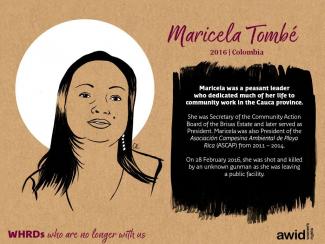
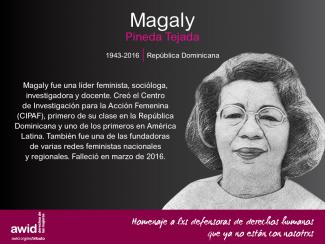
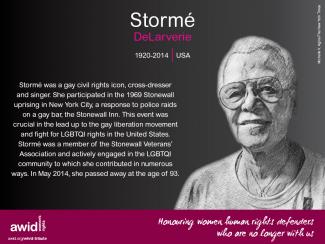
These transgender women were murdered because of their activism and their gender identity. There are insufficient laws recognizing trans* rights, and even where these laws exist, very little is being done to safeguard the rights of trans* people. Please join AWID in honoring these defenders, their activism and legacy by sharing the memes below with your colleagues, networks and friends and by using the hashtags #WHRDTribute and #16Days.


Please click on each image below to see a larger version and download as a file 


Snippet FEA Mariama Sonko (FR)

Nous avons le plaisir de vous présenter Mariama Sonko, agricultrice rurale, éco-féministe et défenseuse des droits humains, vivant actuellement à Niaguis, une ville du sud-ouest du Sénégal.

Ayant grandi dans une famille et une communauté rurale d’agriculteur·rices, elle a été témoin du rôle essentiel des femmes dans la production alimentaire et la conservation des semences depuis son plus jeune âge, tout en étant immergée dans le travail de la terre.

Mariama défend les savoirs agricoles locaux et les pratiques paysannes depuis les années 90. En tant que mère de 5 enfants, la nourriture qu'elle cultive elle-même est la principale source de subsistance de sa famille.

Elle est actuellement présidente de Nous Sommes la Solution et s'engage à promouvoir les pratiques agroécologiques et l'agriculture familiale, à encourager la souveraineté alimentaire, la biodiversité et la préservation des semences paysannes, et à exiger un accès équitable aux ressources et à la terre à travers l'Afrique de l'Ouest.

Source: AWID’s Feminist Realities Festival Crear | Résister | Transform - Day 2/ 2ème jour/ 2º día

Can I access and fill the survey from my phone?

Yes, the survey can be accessed using a smartphone.

Abby Lippman

Abby was a pioneering feminist, human-rights activist and former McGill University epidemiologist.

Abby was renowned for championing social causes and for her insightful critiques of reproductive technologies and other medical topics. Specifically, she campaigned against what she called the "geneticization" of reproductive technologies, against hormone replacement therapy and for better, longer research before the approval of discoveries such as the vaccines against the human papillomavirus.

On the news of her passing, friends and colleagues described her fondly as an “ardent advocate” for women’s health.


Abby Lipman, Canada

¿Necesito visa para asistir al Foro de Taipéi?

Si tienes pasaporte de alguno de los siguientes países (el tiempo de estadía permitido varía según el país), NO necesitas visa para asistir al Foro de Taipéi:

Alemania, Andorra, Australia, Austria, Bélgica, Belice, Bulgaria, Brunei, Canadá, Chile, Ciudad del Vaticano, Croacia, Chipre, Dinamarca, Eslovaquia, Eslovenia, Estados Unidos de América, Estonia, España, Esuatini, Filipinas, Finlandia, Francia, Grecia, Guatemala, Haití, Honduras, Hungría, Irlanda, Islandia, Israel, Italia, Japón*, Letonia, Liechtenstein, Lituania, Luxemburgo, Malasia, Malta, Islas Marshall, Mónaco, Nauru, Nueva Zelanda, Nicaragua, Noruega, Países Bajos, Palaos, Paraguay, Polonia, Portugal, Reino Unido, República Checa, República de Corea, República Dominicana, Rumania, Rusia, San Cristóbal y Nieves, San Marino, Santa Lucía, San Vicente y las Granadinas, Singapur, Suecia, Suiza y Tuvalu.

Las personas con cualquier otro pasaporte NECESITARÁN VISA para ir a Taipéi.


Por favor ten en cuenta:

Es probable que, una vez que te hayas inscripto para asistir al Foro, te llegue un código relacionado con el evento que te permitirá tramitar tu visa en forma electrónica, cualquiera sea tu ciudadanía.

Brindaremos más información sobre este tema cuando se abra el proceso de inscripción.

1. Gather your resources

This section highlights key resources recommended by AWID so you can conduct your own WITM research.

In this section

People needed

  • 1 or more person(s) to lead overall implementation of research methodology and ensure all key pieces are on track (Sections 2-11)
  • 1 or more person(s) to conceptualize the key research objectives and guiding questions
  • 1 or more person(s) to refine and conduct the research methodology, including collecting data
  • 1 or more person(s) to conduct relevant qualitative and quantitative analysis of collected data
  • 1 or more person(s) to document and package research findings for desired audience(s)
  • 1 or more person(s) to serve as an editor to your final products
  • 1 or more person(s) to conduct outreach to spread the word about your survey and advocacy using your research results

Back to top


Potential expenses

  1. Staff and/or consultant salaries
  2. Data analysis software if conducting analysis of large dataset in-house. Options:
    - SPSS
    - Stata
    - R (this is free)
  3. Cost of producing publications and research products
  4. If desired, incentive prize that survey participants can win if they complete the survey
  5. If desired, incentives to offer your advisors

Back to top


Estimated time

  • For research process: 6 to 18 months, depending on size of dataset(s) and staff capacity
  • For advocacy: 1-2 years, as determined by your organizational goals

Back to top


Resources needed

  • List of advisor organizations, donors and activists
  • List of online spaces and events/networks to distribute your survey and present your survey results
  • List of donors, activists, and women’s rights organizations to interview
  • Prepared interview questions
  • List of publication sources to use for desk research

Back to top


Resources available

Online tools

Once you gather these resources, you can estimate the costs for your research using our “Ready to Go? Worksheet”

Back to top


Previous step

Before you begin

Next step

2. Frame your research


Previous step

Before you begin

Next step

2. Frame your research


The Ready to Go? Worksheet helps you estimate resources, staff and budget needed for your research

Download the toolkit in PDF

Snippet FEA Objectives NSS Advocacy (EN)

ADVOCACY

Yellow circle with illustration of a brown woman with a white t-shirt holding a blue loudspeaker.
To influence decision makers and promote more equitable access to land for women working in agriculture

¿Cuántas preguntas contiene la encuesta?

La encuesta contiene 47 preguntas en total, de las cuales 27 son de respuesta obligatoria* y las 20 restantes son opcionales. La mayoría de las preguntas de la encuesta son de opción múltiple. Invitamos a responder la totalidad de las preguntas.

Laura Lee

Laura fue una abogada y líder activista que luchó valientemente por la descriminalización del trabajo sexual en Irlanda.

Es recordada como «una combatiente por la libertad de lxs trabajadorxs sexuales, una feminista, una madre para su hija y una amiga necesaria para mucha gente».

Laura promovió el reconocimiento de las personas de la industria del sexo como trabajadorxs merecedorxs de derechos. Presentó demandas por la descriminalización, e inició una revisión judicial en la Corte Suprema de Belfast respecto de las provisiones que criminalizan la compra de servicios sexuales. Declaró que su intención era llevar el caso a la Corte Europea de Derechos Humanos.


Laura Lee, Ireland

4. Collect and analyze your data

This section will guide you on how to ensure your research findings are representative and reliable.

In this section:

Collect your data

1. Before launch

  • First determine the best way to reach your survey population.
    For example, if you want to focus on indigenous women’s rights organizers, do you know who the key networks are? Do you have contacts there, people who can introduce you to these organizations or ways of reaching them?
  • Determine if your key population can be easily reached with an online survey, if you need to focus on paper survey distribution and collection or a mix of both. This decision is very important to ensure accessibility and inclusiveness.
  • Be prepared! Prior to advertizing, create a list of online spaces where you can promote your survey.
    If you are distributing paper versions, create a list of events, spaces and methods for distributing and collecting results.
  • Plan your timeline in advance, so you can avoid launching your survey during major holidays or long vacation periods.
  • Make it easy for your advisors and partners to advertize the survey – offer them pre-written Twitter, Facebook and email messages that they can copy and paste.

2. Launch

  • Send the link to the survey via email through your organization’s email databases.
  • Advertize on your organization’s social media. Similar to your newsletter, you can regularly advertize the survey while it is open.
  • If your organization is hosting events that reach members of your survey population, this is a good space to advertize the survey and distribute paper versions as needed.
  • Invite your advisors to promote the survey with their email lists and ask them to copy you so you are aware of their promotional messages. Remember to send them follow-up reminders if they’ve agreed to disseminate.
  • Approach funders to share your survey with their grantees. It is in their interest that their constituencies respond to a survey that will improve their own work in the field.

3. During launch

  • Keep the survey open for a minimum of four weeks to ensure everyone has time to take it and you have time to widely advertize it.
  • Send reminders through your email databases and your partners databases asking people to participate in the survey. To avoid irritating recipients with too many emails, we recommend sending two additional reminder emails: one at  midway point while your survey is open and another a week before your survey closes.
  • As part of your outreach, remember to state that you are only collecting one response per organization. This will make cleaning your data much easier when you are preparing it for analysis.
  • Save an extra week! Halfway through the open window for survey taking, check your data set. How have you done so far? Run initial numbers to see how many groups have responded, from which locations, etc. If you see gaps, reach out to those specific populations. Also, consider extending your deadline by a week – if you do so, include this extension deadline in one of your reminder emails, informing people know there is more time to complete the survey. Many answers tend to come in during the last week of the survey or after the extended deadline.

If you also plan to collect data from applications sent to grant-making institutions, this is a good time to reach out them.

When collecting this data, consider what type of applications you would like to review. Your research framing will guide you in determining this.

Also, it may be unnecessary to see every application sent to the organization – instead, it will be more useful and efficient to review only eligible applications (regardless of whether they were funded).

You can also ask grant-making institutions to share their data with you.

See a sample letter to send to grant-making institutions

Back to top


Prepare your data for analysis

Your survey has closed and now you have all this information! Now you need to ensure your data is as accurate as possible.

Depending on your sample size and amount of completed surveys, this step can be lengthy. Tapping into a strong pool of detail-oriented staff will speed up the process and ensure greater accuracy at this stage.

Also, along with your surveys, you may have collected data from applications sent to grant-making institutions. Use these same steps to sort that data as well. Do not get discouraged if you cannot compare the two data sets! Funders collect different information from what you collected in the surveys. In your final research report and products, you can analyze and present the datasets (survey versus grant-making institution data) separately.

1. Clean your data

  • Resolve and remove duplications: If there is more than one completed survey for one organization, reach out to the organization and determine which one is the most accurate.
  • Remove ineligible responses: Go through each completed survey and remove any responses that did not properly answer the question. Replace it with “null”, thus keeping it out of your analysis.
  • Consistently format numerical data: For example, you may remove commas, decimals and dollar signs from numerical responses. Financial figures provided in different currencies may need to be converted.

2. Code open-ended responses

There are two styles of open-ended responses that require coding.

Questions with open-ended responses

For these questions, you will need to code responses in order to track trends.

Some challenges you will face with this is:

  1. People will not use the exact same words to describe similar responses
  2. Surveys with multiple language options will require translation and then coding
  3. Staff capacity to review and code each open-ended response.

If using more than one staff member to review and code, you will need to ensure consistency of coding. Thus, this is why we recommend limiting your open-ended questions and as specific as possible for open-ended questions you do ask. 

For example, if you had the open-ended question “What specific challenges did you face in fundraising this year?” and some common responses cite “lack of staff,” or “economic recession,” you will need to code each of those responses so you can analyze how many participants are responding in a similar way.

For closed-end questions

If you provided the participant with the option of elaborating on their response, you will also need to “up-code” these responses.

For several questions in the survey, you may have offered the option of selecting the category “Other” With “Other” options, it is common to offer a field in which the participant can elaborate.

You will need to “up-code” such responses by either:

  • Converting open-ended responses to the correct existing categories (this is known as “up-coding”). As a simple example, consider your survey asks participants “what is your favorite color?” and you offer the options “blue,” “green,” and “other.” There may be some participants that choose “other” and in their explanation they write “the color of the sky is my favorite color.” You would then “up-code” answers like these to the correct category, in this case, the category “blue.”
  • Creating a new category if there are several “others” that have a common theme. (This is similar to coding the first type of open-ended responses). Consider the previous example question of favorite color. Perhaps many participants chose “other” and then wrote “red” is their favorite. In this case, you would create a new category of “red” to track all responses that answered “red.”
  • Removing “others” that do not fit any existing or newly created categories.

3. Remove unecessary data

Analyze the frequency of the results

For each quantitative question, you can decide whether you should remove the top or bottom 5% or 1% to prevent outliers* from skewing your results. You can also address the skewing effect of outliers by using median average rather than the mean average. Calculate the median by sorting responses in order, and selecting the number in the middle. However, keep in mind that you may still find outlier data useful. It will give you an idea of the range and diversity of your survey participants and you may want to do case studies on the outliers.

* An outlier is a data point that is much bigger or much smaller than the majority of data points. For example, imagine you live in a middle-class neighborhood with one billionaire. You decide that you want to learn what the range of income is for middle-class families in your neighborhood. In order to do so, you must remove the billionaire income from your dataset, as it is an outlier. Otherwise, your mean middle-class income will seem much higher than it really is.

Remove the entire survey for participants who do not fit your target population. Generally you can recognize this by the organizations’ names or through their responses to qualitative questions.

4. Make it safe

To ensure confidentiality of the information shared by respondents, at this stage you can replace organization names with a new set of ID numbers and save the coding, matching names with IDs in a separate file.

With your team, determine how the coding file and data should be stored and protected.

For example, will all data be stored on a password-protected computer or server that only the research team can access?

Back to top


Create your topline report

A topline report will list every question that was asked in your survey, with the response percentages listed under each question. This presents the collective results of all individual responses. 

Tips:

  • Consistency is important: the same rules should be applied to every outlier when determining if it should stay or be removed from the dataset.
  • For all open (“other”) responses that are up-coded, ensure the coding matches. Appoint a dedicated point person to randomly check codes for consistency and reliability and recode if necessary.
  • If possible, try to ensure that you can work at least in a team of two, so that there is always someone to check your work.

Back to top


Analyze your data

Now that your data is clean and sorted, what does it all mean? This is the fun part where you begin to analyze for trends.

Are there prominent types of funders (government versus corporate)? Are there regions that receive more funding? Your data will reveal some interesting information.

1. Statistical programs

  • Smaller samples (under 150 responses) may be done in-house using an Excel spreadsheet.

  • Larger samples (above 150 responses) may be done in-house using Excel if your analysis will be limited to tallying overall responses, simple averages or other simple analysis.

  • If you plan to do more advanced analysis, such as multivariate analysis, then we recommend using statistical software such as SPSS, Stata or R.
    NOTE: SPSS and Stata are expensive whereas R is free.
    All three types of software require staff knowledge and are not easy to learn quickly.

Try searching for interns or temporary staff from local universities. Many students must learn statistical analysis as part of their coursework and may have free access to SPSS or Stata software through their university. They may also be knowledgeable in R, which is free to download and use.

2. Suggested points for analysis

  • Analysis of collective budget sizes
  • Analysis of budget sizes by region or type of organization
  • Most common funders
  • Total amount of all funding reported
  • Total percentages of type of funding (corporate, government, etc)
  • Most funded issues/populations
  • Changes over time in any of these results.

Back to top


Previous step

3. Design your survey

Next step

5. Conduct interviews


Estimated time:

• 2 - 3 months

People needed:

• 1 or more research person(s)
• Translator(s), if offering survey in multiple languages
• 1 or more person(s) to assist with publicizing survey to target population
• 1 or more data analysis person(s)

Resources needed:

• List of desired advisors: organizations, donors, and activists
• Optional: an incentive prize to persuade people to complete your survey
• Optional: an incentive for your advisors

Resources available:

Survey platforms:

Survey Monkey
Survey Gizmo (Converts to SPSS for analysis very easily)

Examples:
2011 WITM Global Survey
Sample of WITM Global Survey
Sample letter to grantmakers requesting access to databases

Visualising Information for Advocacy:
Cleaning Data Tools
Tools to present your data in compelling ways
Tutorial: Gentle Introduction to Cleaning Data


Previous step

3. Design your survey

Next step

5. Conduct interviews


Ready to Go? Worksheet

Download the toolkit in PDF

Snippet FEA Audio A Caring Economy (ES)

Escucha esta historia aquí:

Dois-je répondre à toutes les questions en même temps, ou puis-je y répondre en plusieurs fois?

Au besoin, vous avez la possibilité de sauvegarder vos réponses en cours d’enquête, pour y revenir plus tard. KOBO enregistrera vos brouillons de réponses dans le coin supérieur gauche de la page de l'enquête et rechargera votre dossier lorsque vous reviendrez à l'enquête. Assurez-vous simplement de continuer à partir du même ordinateur et du même navigateur.

Deborah Holmes

Jusqu’à son décès, à la suite d’une lutte brève mais agressive contre le cancer, Deborah était la directrice de la communication et de la mobilisation au Women’s funding network (le réseau de financement des femmes), WFN.

Entre 2008 et 2017, elle avait également travaillé auprès du Fonds mondial pour les femmes. Deborah était extrêmement appréciée et respectée par le conseil d'administration, l’équipe et les partenaires du Fonds mondial pour les femmes.

Kavita Ramdas, ex-PDG a déclaré, à juste titre, que Deborah était « la combinaison unique d’un être mêlant chaleur, générosité, intelligence et style, avec un engagement passionné pour faire fusionner la beauté et la justice. Elle avait compris le pouvoir des histoires. Le pouvoir de la voix des femmes. Le pouvoir de l'expérience vécue. Le pouvoir de renaître de ses cendres et de dire aux autres que c'était possible. Et nous continuons à nous relever. »

Musimbi Kanyoro, l'actuelle PDG du Fonds mondial pour les femmes, a ajouté: « Nous avons perdu une sœur et sa vie illumine des valeurs qui nous unissent et nous inspirent tou-te-s. Alors que nous sommes tou-te-s réuni-e-s pour pleurer le décès de Deborah, souvenons-nous et célébrons sa vie remarquable, audacieuse et passionnée. »


Deborah Holmes, USA