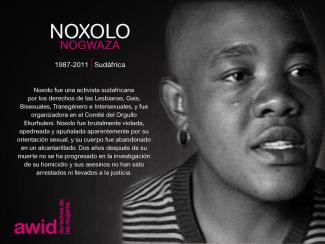
Noxolo Nogwaza

AWID’s Tribute is an art exhibition honouring feminists, women’s rights and social justice activists from around the world who are no longer with us.
This year’s tribute tells stories and shares narratives about those who co-created feminist realities, have offered visions of alternatives to systems and actors that oppress us, and have proposed new ways of organising, mobilising, fighting, working, living, and learning.
49 new portraits of feminists and Women Human Rights Defenders (WHRDs) are added to the gallery. While many of those we honour have passed away due to old age or illness, too many have been killed as a result of their work and who they are.
This increasing violence (by states, corporations, organized crime, unknown gunmen...) is not only aimed at individual activists but at our joint work and feminist realities.
The portraits of the 2020 edition are designed by award winning illustrator and animator, Louisa Bertman.
AWID would like to thank the families and organizations who shared their personal stories and contributed to this memorial. We join them in continuing the remarkable work of these activists and WHRDs and forging efforts to ensure justice is achieved in cases that remain in impunity.
“They tried to bury us. They didn’t know we were seeds.” - Mexican Proverb
It took shape with a physical exhibit of portraits and biographies of feminists and activists who passed away at AWID’s 12th International Forum, in Turkey. It now lives as an online gallery, updated every year.
To date, 467 feminists and WHRDs are featured.
The 3 Women Human Rights Defenders (WHRDs) from the Pacific we are featuring in this year's Online Tribute have worked in the media, campaigned for disability rights and advocated for women’s rights. Their contributions are missed and we honor them in this Tribute. Please join AWID in commemorating these WHRDs, their work and legacy by sharing the memes below with your colleagues, networks and friends and by using the hashtags #WHRDTribute.
Please click on each image below to see a larger version and download as a file


Nous Sommes la Solution élève et développe le leadership des femmes rurales travaillant à des solutions africaines pour la souveraineté alimentaire.
We work to achieve gender justice and women’s human rights by strengthening the collective voice, impact and influence of global women’s rights advocates, organizations and movements.
La encuesta contiene 47 preguntas en total, de las cuales 27 son de respuesta obligatoria* y las 20 restantes son opcionales. La mayoría de las preguntas de la encuesta son de opción múltiple. Invitamos a responder la totalidad de las preguntas.
.

Este kit incluye ejemplos de mensajes para ser utilizados en Twitter, Facebook y LinkedIn, como así también imágenes que puedes usar para acompañar a estos mensajes.
La utilización de este kit es muy simple. Solo tienes que seguir estos pasos:
Descarga aquí tus imágenes favoritas:
Twitter
Facebook
Instagram
Combina estos mensajes con las imágenes para Twitter
Yo voy al #AWIDForum. Es EL lugar para conectar con los movimientos por los derechos de las mujeres y la justicia social ¡Únete a mi!: http://forum.awid.org/forum16/es
¡Ya quiero re-imaginar los #FuturosFeministas c/ otrxs activistas x los DD. de las mujeres y la justicia social en el #AWIDForum! Únete: http://forum.awid.org/forum16/es
Me entusiasma poder asistir al Foro de AWID el próximo mes de mayo ¡Ahora ya podemos registrarnos! ¡Únete a mi! http://forum.awid.org/forum16/es
Se encuentra abierta la inscripción para participar del #AWIDForum! en Costa do Sauípe, Brasil, 8-11 de sept 2016: http://forum.awid.org/forum16/es
Únete al #AWIDForum, un encuentro histórico global de activistas x los derechos de las mujeres y la justicia social: http://forum.awid.org/forum16/es
Únete al #AWIDForum para celebrar los logros de nuestros movimientos y las lecciones aprendidas para seguir avanzando http://forum.awid.org/forum16/es
El #AWIDForum, no es solo un evento sino una oportunidad para confrontar la opresión y promover el avance de la justicia: http://forum.awid.org/forum16/es
Únete al #AWIDForum para celebrar, pensar estrategias y renovar nuestros movimientos y a nosotrxs mismxs: http://forum.awid.org/forum16/es
Construyamos juntxs los #FuturosFeministas. Inscríbete al #AWIDForum. Costa do Sauípe, Brasil: http://forum.awid.org/forum16/es
Únete a nosotrxs para re-imaginar y crear juntxs los #FuturosFeministas en el #AWIDForum. Inscríbete: http://forum.awid.org/forum16/es
#FuturosFeministas: aprovecha el momento en el #AWIDForum para promover nuestras visiones de un mundo mejor: http://forum.awid.org/forum16/es
Seremos 2000 activistas de movimientos sociales en el #AWIDForum, pensando estrategias para nuestros #FuturosFeministas http://forum.awid.org/forum16/es
Somos mucho más que una sola lucha. Únete a nosotrxs en el #AWIDForum: http://forum.awid.org/forum16/es
Únete al #AWIDForum, un espacio para pensar estrategias entre movimientos y hacer uso de nuestro poder colectivo: http://forum.awid.org/forum16/es
Movilicemos la solidaridad y el poder colectivo entre movimientos sociales en el #AWIDForum: http://forum.awid.org/forum16/es
Rompamos el aislamiento entre nuestros movimientos. Re-imaginemos y creemos juntxs nuestros futuros en el #AWIDForum: http://forum.awid.org/forum16/es
Solidaridad es un verbo. Pongámosla en acción en el #AWIDForum: http://forum.awid.org/forum16/es
Donantes se comprometen con los derechos de las mujeres y los movimientos sociales en el #AWIDForum: http://forum.awid.org/forum16/es
Los medios de comunicación y los movimientos amplifican los #FuturosFeministas en el #AWIDForum: http://forum.awid.org/forum16/es
Combina estos mensajes con las imágenes para Facebook
Estos mensajes pueden ser usados en Twitter también vía mensaje privado directo, ya que allí no hay límites de carácteres.
Descarga tus imágenes favoritas para usar en Instagram
A workplace does not have to operate on competition and profit. It does not have to exploit people for the benefit of the owner and a small elite either.
Instead, communities on the margins of formal economies are building cooperative models based on autonomy, cooperation, shared responsibility, self-management and solidarity.
Worker-controlled cooperatives and workplaces have always offered alternative ways of generating employment opportunities, income, social security and savings - while distributing revenues in more communal, sustainable and safer ways.
But it is more than an employment opportunity: it is the making of dreams into a reality, and the building of feminist economies based on solidarity and care for each other. It is about creating a world where our lives, our labor and our communities matter.
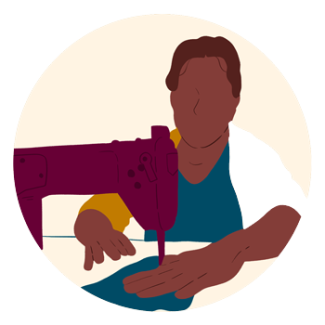
This is the story of the Nadia Echazú Textile Cooperative, the first social enterprise managed by and for travesti and trans people in Argentina.
Au besoin, vous avez la possibilité de sauvegarder vos réponses en cours d’enquête, pour y revenir plus tard. KOBO enregistrera vos brouillons de réponses dans le coin supérieur gauche de la page de l'enquête et rechargera votre dossier lorsque vous reviendrez à l'enquête. Assurez-vous simplement de continuer à partir du même ordinateur et du même navigateur.
.
After assessing your organization’s capacity and research goals, you may choose to conduct a survey as one of the methods of data collection for your research analysis.
In this section:
- Why conduct a survey?
- Identify your survey population 1. Online survey 2. Paper survey
- Create your questions 1. Short and clear questions 2. Simple and universal language 3. "Closed" and "open" questions 4. Logical organization 5. Less than 20 mins 6. Simple and exciting
- Test and translate 1. Your advisors 2. Draft and test 3. Translation
- Target the right population 1. Sample size 2. Degree of participation 3. Database and contact list
A survey is an excellent way to gather information on individual organizations to capture trends at a collective level.
For example, one organization’s budget size does not tell you much about a trend in women’s rights funding, but if you know the budgets of 1,000 women’s rights organizations or even 100, you can start to form a picture of the collective state of women’s rights funding.
As you develop your survey questions, keep in mind the research framing that you developed in the previous section.
Remember: Your framing helps you determine what information you are trying to procure through your survey. The data collected from this survey should allow you to accomplish your goals, answer your key questions, and create your final products.
This is an important step – the clearer you are about which populations you want to survey, the more refined your questions will be.
Depending on your research goals, you may want to create separate surveys for women’s rights organizations, women’s funds and donors. Or you may want to focus your survey on women’s groups and collect interviews for women’s funds and donors, as a survey for each population can be resource-intensive.
The questions you ask women’s groups may be different than ones you would ask women’s funds. If you plan on surveying more than one population, we encourage you to tailor your data collection to each population.
At the same time, some key questions for each population can and should overlap in order to draw comparative analysis from the answers.
If you can reach your survey population online, it is useful and efficient to create an online survey.
We recommend two online tools, both which offer free versions:
Survey Gizmo allows you to convert your data for SPSS, a statistical software useful for advanced data analysis
Your data analyst person(s) will be the best person(s) to determine which tool is best for your survey based on staff capacity and analysis plans.
For accessibility, consider making a PDF form version of your survey that you can attach via email. This ensures organizations that have sporadic internet connections or those that pay for it by the minute can download the survey and complete it without requiring a constant online connection.
You may decide that an online approach is not sufficiently accessible or inclusive enough for your popuation.
In this case, you will need to create a paper survey and methods to reach offline populations (through popular events or through post, with pre-stamped envelopes for returning).
Make it easy for participants to complete your survey.
If the questions are confusing or require complex answers, you risk having participants leave the survey unfinished or providing answers that are unusable for your analysis.
Ensure your questions only ask for one item of information at a time.
For example:
- What is your organization’s budget this year?
Easy to answer: participant can easily locate this information for their organization, and it is only asking for one item of information.- What percentage of your budget have you identified as likely sources for funding for your organization, but are still unconfirmed?
Confusing and difficult to answer: are you asking for a list of unconfirmed funding sources or percentage of funding that is likely but unconfirmed?
This information is difficult to obtain: the respondent will have to calculate percentages, which they may not have on hand. This increases the risk that they will not complete the survey.
Many words and acronyms that are familiar to you may be unknown to survey participants, such as “resource mobilization”, “WHRD”, and “M&E”, so be sure to choose more universal language to express your questions.
If you must use industry lingo – phrases and words common to your colleagues but not widely known – then providing a definition will make your survey questions easier to understand.
Be sure to spell out any acronyms you use. For example, if you use WHRD, spell it out as “Women’s Human Rights Defenders".
Closed questions:
Only one response is possible (such as “yes,” “no” or a number). Survey participants cannot answer in their own words and they typically have to choose from predetermined categories that you created or enter in a specific number. Responses to closed questions are easier to measure collectively and are often quantitative.
Example of a closed question: What is your organization’s budget?
Open-ended questions:
These are qualitative questions that are often descriptive. Respondents answer these questions entirely in their own words. These are more suitable for interviews than surveys.
They are harder to analyze at a collective level as compared to closed-end questions, especially if your survey sample is large. However, by making open-ended questions very specific, you will make it easier to analyze the responses.
Whenever possible, design your survey questions so that participants must select from a list of options instead of offering open-ended questions. This will save a lot of data cleaning and analysis time.
Example of open-ended question: What specific challenges did you face in fundraising this year?
Familiarize yourself with different types of questions
There are several ways to ask closed-ended questions. Here are some examples you can review and determine what fits best for the type of data you want to collect:
If you plan to conduct this research at regular intervals (such as every two years), we recommend developing a baseline survey that you can repeat in order to track trends over time.
Set 1: Screening questions
Screening questions will determine the participant’s eligibility for the survey.
The online survey options we provided allow you to end the survey if respondents do not meet your eligibility criteria. Instead of completing the survey, they will be directed to a page that thanks them for their interest but explains that this survey is intended for a different type of respondent.
For example, you only want women’s rights groups in a given location to take this survey. The screening questions can determine the location of the participant and prevent respondents from other locations from continuing the survey.
Set 2: Standardized, basic demographic questions
These questions would collect data specific to the respondent, such as name and location of organization. These may overlap with your screening questions.
If resources permit, you can store these answers on a database and only ask these questions the first year an organization participates in your survey.
This way when the survey is repeated in future years, it is faster for organizations to complete the entire survey, increasing chances of completion.
Set 3: Standardized and mandatory funding questions
These questions will allow you to track income and funding sustainability. Conducted every year or every other year, this allows you to capture trends across time.
Set 4: Special issues questions
These questions account for current context. They can refer to a changing political or economic climate. They can be non-mandatory funding questions, such as attitudes towards fundraising.
For example, AWID’s 2011 WITM Global Survey asked questions on the new “women & girls” investment trend from the private sector.
The shorter, the better: your survey shouldn’t exceed 20 minutes to ensure completion and respect respondents’ time.
It is natural to get excited and carried away by all the types of questions that could be asked and all the information that could be obtained. However, long surveys will lead to fatigue and abandonment from participants or loss of connection between participants and your organization.
Every additional question in your survey will add to your analytical burden once the survey is complete.
General tips
- Ask for exact budgets instead of offering a range (in our experience, specific amounts are more useful in analysis).
- Specify currency! If necessary, ask everyone to convert their answers to the same currency or ask survey takers to clearly state the currency they are using in their financial answers.
- Ensure you collect enough demographic information on each organization to contextualize results and draw out nuanced trends.
For example, if you are analyzing WITM for a particular country, it will be useful to know what region each organization is from or at what level (rural, urban, national, local) they work in order to capture important trends such as the availability of greater funding for urban groups or specific issues.
Involving your partners from the start will allow you to build deeper relationships and ensure more inclusive, higher quality research.
They will provide feedback on your draft survey, pilot test the survey, and review your draft research analysis drawn from your survey results and other data collection.
These advisors will also publicize the survey to their audiences once it is ready for release. If you plan on having the survey in multiple languages, ensure you have partners who use those languages.
If you decide to do both survey and interviews for your data collection, your advisor-partners on your survey design can also double as interviewees for your interview data collection process.
After your survey draft is complete, test it with your partners before opening it up to your respondents. This will allow you to catch and adjust any technical glitches or confusing questions in the survey.
It will also give you a realistic idea of the time it takes to take the survey.
Once the survey is finalized and tested in your native language, it can be translated.
Be sure to test the translated versions of your survey as well. At least some of your pilot testers should be native speakers of the translated languages to ensure clarity.
Your survey sample size is the number of participants that complete your survey.
Your survey sample should reflect the qualities of the larger population you intend to analyze.
For example: you would like to analyze the millions of women’s rights groups in Valyria but you lack the time and resources to survey every single one.
Instead, you can survey only 500 of the Valyrian women’s rights groups – a sample size - to represent the qualities of all the women’s groups in the region.
Recommended sample size
Although it is not necessary to determine your exact sample size before you launch your survey, having a size in mind will allow you to determine when you have reached enough participants or whether you should extend the dates that the survey is available, in case you feel that you have not reached enough people.
Even more important than size of a sample is the degree to which all members of the target population are able to participate in a survey.
If large or important segments of the population are systematically excluded (whether due to language, accessibility, timing, database problems, internet access or another factor) it becomes impossible to accurately assess the statistical reliability of the survey data.
In our example: you need to ensure all women’s groups in Valyria had the opportunity to participate in the survey.
If a segment of women’s groups in Valyria do not use internet, and you only pull participants for your sample through online methods, then you are missing an important segment when you have your final sample, thus it is not representative of all women’s groups in Valyria.
You cannot accurately draw conclusions on your data if segments of the population are missing in your sample size; and ensuring a representative sample allows you to avoid this mistake.
To gain an idea of what the makeup of women’s groups for your area of research (region, population, issue, etc) looks like, it may be useful to look at databases.
By understanding the overall makeup of women’s groups that you plan to target, you can have an idea of what you want your sample to look like - it should be like a mini-version of the larger population.
After participants have taken your survey, you can then gauge if the resulting population you reached (your sample size) matches the makeup of the larger population. If it doesn’t match, you may then decide to do outreach to segments you believe are missing or extend the window period that your survey is open.
Do not be paralyzed if you are unsure of how representative your sample size is – do your best to spread your survey as far and wide as possible.

4. Collect and analyze your data
1 de cada 3 personas trans y travesti en Argentina vive en un hogar de bajos ingresos.

Notre travail est de portée internationale. Nous collaborons étroitement avec nos membres et d’autres organisations pour les droits des femmes et autres allié-e-s, tant au niveau local que national et régional. Nous faisons en sorte que leurs réalités nourrissent notre travail.
No, it's not. This survey builds on AWID’s 20-year history of mobilizing more and better funding for feminist-led social change and is the third iteration of our Where is the money for feminist organizing? research. Our aim is to repeat the WITM survey every 3 years.
Con una carrera jurídica que abarcó más de 30 años, Oby era conocida en toda África y en el mundo como una defensora de la justicia de género y los derechos humanos.
Fundó y fue Directora Ejecutiva del Civil Resource Development and Documentation Centre (CIRDDOC), una ONG nigeriana que patrocina capacitaciones y actividades de creación de redes para miembrxs de la sociedad civil, parlamentarixs y otrxs actores clave, para promover los derechos humanos, la buena gobernanza y el acceso a la justicia y el estado de derecho.
Oby es afectuosamente recordada por lxs activistas de Nigeria como una «extraordinaria activista que mostraba energía y pasión por la lucha por la igualdad de género y la justicia de género en Nigeria y en toda África».

Ya tienes el producto final y completo de la investigación organizado y editado. Ahora querrás facilitar la difusión de los resultados y para ello necesitarás que sean visualmente accesibles e interesantes.
En esta sección
- Prepara el informe extenso para la difusión pública
1. Piensa tal como lo hace tu público
2. Trabaja con profesionales del diseño
3. Asegura la consistencia de los productos- Controla la calidad de las traducciones
Considera la posibilidad de elaborar productos más breves además del informe extenso.
Como dijéramos en «Sintetiza los resultados de la investigación», AWID muchas veces prepara productos más breves a partir del informe de investigación completo. Esto permite difundirlo más y mejor entre audiencias específicas de importancia clave.
Siempre ten presente cuál es la población a la que te diriges: ¿quién va a leer tu informe?
Ejemplos de productos breves derivados de un informe más extenso:
Todo el tiempo nos bombardean con información. Para conservar el interés de la audiencia, el producto deberá tener un atractivo visual. Una vez más, saber qué quieres lograr y a quién esperas llegar, permitirá que quien se encargue del diseño pueda crear productos para audiencias específicas.
Un informe escrito de muchas páginas en PDF tal vez te parezca la única forma posible de presentar la investigación, pero a mucha gente le puede resultar abrumador — sobre todo en Internet.
Si quieres compartir el producto con una comunidad en línea, piensa en crear memes e infografías para usar en las redes sociales, blogs y plataformas virtuales.
Para decidir si vas a crear o no productos más breves, piensa si podrás dividir los resultados en varios productos más breves para compartirlos con poblaciones específicas o en distintos momentos del año, reavivando así el interés por el producto.
Si cuentas con un tiempo limitado y el presupuesto te lo permite, te recomendamos contratar a profesionales del diseño.
Por razones económicas puedes sentir la tentación de pedirle al personal de tu organización que le dé formato al informe. Pero un diseño gráfico profesional puede marcar una gran diferencia en el aspecto del producto final y por lo tanto en el impacto que podrá alcanzar.
Las personas que se encarguen del diseño (ya sean de tu organización o contratadxs) deben ser capaces de:
¿Qué necesitarás aportarles a quienes se encarguen del diseño?
Recuerda que estarás trabajando con profesionales del diseño, que no necesariamente conocen las temáticas de las mujeres ni tampoco los resultados de la investigación, sobre todo si son personas contratadas y que no forman parte de tu organización.
Comunícales qué elementos del informe son importantes para ti y cuál es tu audiencia. Ellxs te sugerirán formas de destacar esos elementos y de hacer que todo el producto resulte atractivo a lxs usuarixs.
Cuando hayas creado un conjunto de productos informativos más breves, no olvides vincularlos entre sí:
También es importante que el personal que hizo la investigación se involucre en este estadio del proceso, para garantizar que todos los productos derivados sean consistentes con los resultados de la investigación.
Una vez que hayas completado el diseño y la presentación del informe de investigación en su versión final, asegúrate de volver a enviar a traducir cualquier modificación que se haya producido en la terminología o el contenido.
Si además creaste productos breves, una vez que estén diseñados y listos para ser difundidos también necesitarás contar con copias en los idiomas a los que se tradujo el informe. Las traducciones deben ser lo suficientemente claras como para que quien se encarga del diseño pueda elaborar los productos aun si no habla el idioma en que están escritos.
Una vez completadas las traducciones, asegúrate de que una persona que sea hablante nativa del/los idioma/s que corresponda/n las revise, antes de difundirlas.
7. Sintetiza los resultados de la investigación

• 2 - 3 meses
• 1 persona (o más) de investigación
• 1 Editor (editor web o si crea un producto en línea)
• Personal o empresa de diseño
• Traductores, de ofrecer encuesta en varios idiomas
• Lista de los espacios en línea para la difusión
7. Sintetiza los resultados de la investigación
9. Haz incidencia y cuéntale al mundo
LE QUOTA D'EMPLOI TRANS
n'est pas respecté par les entreprises