Adolfo Lujan | Flickr (CC BY-NC-ND 2.0)
Mass demonstration in Madrid on International Women's Day
Multitudinaria manifestación en Madrid en el día internacional de la mujer

Priority Areas

Supporting feminist, women’s rights and gender justice movements to thrive, to be a driving force in challenging systems of oppression, and to co-create feminist realities.

Advancing Universal Rights and Justice

Uprooting Fascisms and Fundamentalisms

Across the globe, feminist, women’s rights and gender justice defenders are challenging the agendas of fascist and fundamentalist actors. These oppressive forces target women, persons who are non-conforming in their gender identity, expression and/or sexual orientation, and other oppressed communities.


Discriminatory ideologies are undermining and co-opting our human rights systems and standards,  with the aim of making rights the preserve of only certain groups. In the face of this, the Advancing Universal Rights and Justice (AURJ) initiative promotes the universality of rights - the foundational principle that human rights belong to everyone, no matter who they are, without exception.

We create space for feminist, women’s rights and gender justice movements and allies to recognize, strategize and take collective action to counter the influence and impact of anti-rights actors. We also seek to advance women’s rights and feminist frameworks, norms and proposals, and to protect and promote the universality of rights.


Our actions

Through this initiative, we:

  • Build knowledge: We support feminist, women’s rights and gender justice movements by disseminating and popularizing knowledge and key messages about anti-rights actors, their strategies, and impact in the international human rights systems through AWID’s leadership role in the collaborative platform, the Observatory on the Universality of Rights (OURs)*.
  • Advance feminist agendas: We ally ourselves with partners in international human rights spaces including, the Human Rights Council, the Commission on Population and Development, the Commission on the Status of Women and the UN General Assembly.
  • Create and amplify alternatives: We engage with our members to ensure that international commitments, resolutions and norms reflect and are fed back into organizing in other spaces locally, nationally and regionally.
  • Mobilize solidarity action: We take action alongside women human rights defenders (WHRDs) including trans and intersex defenders and young feminists, working to challenge fundamentalisms and fascisms and call attention to situations of risk.  


Related Content

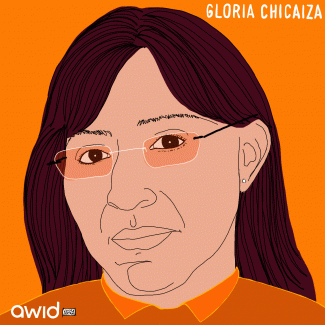
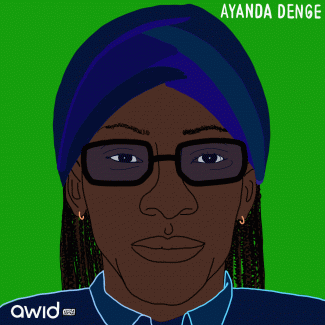
Memory as Resistance: A Tribute to WHRDs no longer with us

AWID’s Tribute is an art exhibition honouring feminists, women’s rights and social justice activists from around the world who are no longer with us. 


In 2020, we are taking a turn

This year’s tribute tells stories and shares narratives about those who co-created feminist realities, have offered visions of alternatives to systems and actors that oppress us, and have proposed new ways of organising, mobilising, fighting, working, living, and learning.

49 new portraits of feminists and Women Human Rights Defenders (WHRDs) are added to the gallery. While many of those we honour have passed away due to old age or illness, too many have been killed as a result of their work and who they are.

This increasing violence (by states, corporations, organized crime, unknown gunmen...) is not only aimed at individual activists but at our joint work and feminist realities.

The stories of activists we honour keep their legacy alive and carry their inspiration forward into our movements’ future work.

Visit the online exhibit

The portraits of the 2020 edition are designed by award winning illustrator and animator, Louisa Bertman

AWID would like to thank the families and organizations who shared their personal stories and contributed to this memorial. We join them in continuing the remarkable work of these activists and WHRDs and forging efforts to ensure justice is achieved in cases that remain in impunity.

“They tried to bury us. They didn’t know we were seeds.” - Mexican Proverb 


The Tribute was first launched in 2012

It took shape with a physical exhibit of portraits and biographies of feminists and activists who passed away at AWID’s 12th International Forum, in Turkey. It now lives as an online gallery, updated every year.

To date, 467 feminists and WHRDs are featured.

Visit the online exhibit

Related Content

Sans frontières ni barrières

Sans frontières ni barrières

« Ne cessez jamais de vous battre parce que la lutte n’est pas finie ; elle vient juste de commencer. » – Marianna Karakoulaki

Depuis l’été 2005, Idomeni, un village situé à la frontière gréco-macédonienne, est progressivement devenu le plus vaste camp officieux de réfugié-e-s de Grèce. À la fin du mois de mai, ce camp a été fermé par les autorités. Et depuis maintenant un an, Marianna Karakoulaki, une jeune journaliste indépendante originaire d’une petite ville du nord-ouest du pays, couvre les événements qui se produisent dans ce village.


Accompagnée par des collègues derrière la police anti-émeute grecque durant une manifestation à Thessalonique

Marianna a aussi couvert les manifestations et les émeutes qui se sont déroulées principalement à Thessalonique, la ville où elle vit depuis quelques années. Outre le travail qu’elle effectue pour différents médias, dont Deutsche Welle (DW), IRIN News et the Middle East Eye, elle réalise également des reportages pour la télévision. Elle a récemment co-réalisé un reportage d’actualité, Macedonia: Tracking down the refugee kidnap gangs (Macédoine : sur la trace des gangs qui kidnappent les réfugiés, en anglais), qui a remporté plusieurs prix dont celui  du meilleur reportage d’actualité pour la télévision décerné par l’Association de la presse étrangère à Londres.

Le féminisme, un fil rouge

« Je me sens absolument féministe, sans aucune réserve. Mon féminisme fait partie de mon identité, tout comme mon athéisme et mes convictions politiques de gauche. »​ – Marianna Karakoulaki

Le féminisme a été le fil rouge de la vie, de l’éducation et du travail de Marianna. Elle a l’impression « de s’être toujours sentie féministe, même quand elle ne savait pas encore vraiment ce que ce mot signifiait », et ce depuis son adolescence et tout au long de ses études de master en sécurité internationale à l’université de Birmingham, au Royaume-Uni. Pendant les épisodes dépressifs occasionnels qu’elle a connu et pendant toutes ses années d’études des mouvements et de la lutte pour l’égalité, le féminisme l’a inspirée et lui a permis d’adopter une nouvelle approche « d’à peu près tout ».

« Il [le féminisme] a entièrement changé mon orientation académique, mon idéologie politique et mon approche de la vie au sens large. C’est la raison pour laquelle je porte toujours autour du cou le poing féministe. » - Marianna Karakoulaki

Pendant une manifestation à la frontière greco-macédonienne à côté d’une clôture macédonienne nouvellement construite

Dans le cadre de son travail, Marianna tente de se consacrer aux questions féministes en donnant la possibilité à celles qui sont reléguées à la marge de s’exprimer, notamment en Grèce où « les questions relatives au genre sont soit ignorées soit insuffisamment prises en charge ».

Elle travaille  depuis un an sur la crise des réfugié-e-s, mais elle a délibérément évité d’écrire un article sur les femmes réfugiées.

« J’ai pris cette décision tout d’abord parce que je ne voulais pas faire intrusion dans la vie de ces femmes dans le simple but de dénicher une bonne histoire. J’ai entendu des récits qui auraient méritées d’être publiées mais, sans vraiment savoir pourquoi, je ne me suis jamais sentie autorisée à raconter la vie de ces personnes dans telle situation de vulnérabilité. Il faut que leurs voix soient entendues, mais il y a un bon moment pour le faire, et je pense qu’il faut attendre qu’elles atteignent enfin un espace sûr dans laquelle leur protection est assurée. »  - Marianna Karakoulaki

Quelques informations complémentaires sur Marianna

Dans le cadre académique, elle est membre de l’équipe de direction et de rédaction de E- International Relations (E-IR), un site académique pour lequel elle dirige la publication d’un livre sur les migrations au XXIe  siècle, à paraître fin 2016. Marianna a également dispensé des cours lors de différents ateliers organisés en Grèce sur l’égalité de genre, les questions de genre et la diversité des féminismes. Elle a également écrit des articles sur le droit à l’avortement notamment aux États-Unis mais aussi sur les questions féministes ou relatives aux femmes dans le Moyen-Orient.


Marianna explique comme suit sa décision de devenir membre de l’AWID :


« Je suis devenue membre de l’AWID parce qu’il s’agit d’une organisation dont les domaines d’action prioritaires sont très proches de mon idéologie et de mes préoccupations et qui donne la parole aux personnes du monde entier que l’on entend jamais, et j’aime beaucoup cela. »  

À la question « quel changement aimeriez-vous voir se matérialiser de votre vivant ? », Marianna apporté cette réponse :

« Si je devais choisir un changement que j’aimerais voir survenir de mon vivant, ce serait l’instauration d’une égalité issue d’une approche venue de la base ; cela demandera du temps, des efforts et du dévouement. Cela exigera également une refonte des tactiques et stratégies des mouvements. Je fais aussi le rêve utopique d’un monde sans nations ni frontières fondé sur l’auto-organisation, mais je crains que cela ne soit pas possible. »

Pour en savoir plus sur Marianna, n’hésitez pas à consulter son site internet (en anglais)

Region
Europe
Source
AWID

Without Borders and Barriers

Without Borders and Barriers

“Don’t give up fighting because the struggle is not over; it has just begun”. – Marianna Karakoulaki

Since the summer of 2015, Idomeni, a village at the Greek-Macedonian border, has increasingly turned into a site of the largest unofficial refugee camp in Greece. At the end of May it was shut down by authorities. For a year now, Marianna Karakoulaki, a young woman originally from a small town in the north-western part of the country has been covering the refugee crisis in Idomeni as a freelance journalist. 

With colleagues behind Greek riot police during a protest in Thessaloniki, Greece

Marianna has also been covering social protests and riots, mostly from Thessaloniki where she has been living for the past couple of years. Reporting for several media outlets, including Deutsche Welle (DW), IRIN News, and the Middle East Eye, she additionally produces TV reports, recently being part of a  Channel 4 News production: Macedonia: tracking down the refugee kidnap gangs which has won several awards including ‘TV News Story of the Year’ from Foreign Press Association in London.

Feminism, a red thread

“I absolutely and without any doubt identify as a feminist, it’s part of my identity along with being an atheist and a leftist.” – Marianna Karakoulaki

Throughout Marianna’s experiences, education and work, feminism has been a red thread throughout her life. She feels she has “always identified with feminism, without actually knowing what it was”, from her teen years and all through her Master’s degree studies in International Security at the University of Birmingham, United Kingdom. Marianna has countered occasional bouts of depression, and alongside studying about movements and the struggle for equality, feminism has inspired and given her a new approach to “pretty much everything”.

“It [feminism] entirely changed my academic focus, political ideology, and general approach to life. That is the reason I always wear a necklace with the feminist fist.” - Marianna Karakoulaki

During a protest at the Greek-Macedonian border next to the newly built Macedonian fence

In her work, Marianna tries to focus on feminist subjects aiming to give voice to those on the margins especially in Greece seeing “gender related issues are either ignored or not covered as they should be.”  

But even though she has been reporting about the refugee crisis for the past year, she has been, as she tells us, deliberately avoiding writing a story on refugee women.

“The main reason for that is that I don’t really want to intrude in refugee women’s lives just for the sake of a good story; I have heard some stories that would have been worth publishing, but for a reason it never felt right as these people are in a vulnerable position. Their voice needs to be heard but there is the right moment for that and for me this is when they finally reach a safe space where they are protected.” - Marianna Karakoulaki

A bit more about Marianna

In her current academic work, she is one of the directors and editors of E- International Relations (E-IR), an online academic publication, where she is currently editing a book on migration in the 21st century due to be published in late 2016. Marianna has also taught at several workshops in Greece on gender equality, gender issues, and the diversity of feminisms and has written papers and articles on abortion rights specifically in the United States of America, as well as about feminist and women’s issues in the Middle East.

Marianna joined AWID as a member because:

“I joined AWID as it’s an organization where its priority areas are very close to my ideology and focus, plus it is giving a voice to those in parts of the world that cannot be heard, and I like that.”

And in answer to the question “what change would you like to see in your lifetime?” Marianna responded:

“If I had to choose a change that I’d like to see in my lifetime, that would be equality that will come from a bottoms-up approach; that will demand time, effort, and devotion. It will also demand a re-approach of the movements’ tactics and strategy. I also have a utopian dream of a world without nations and borders based on self-organisation, but that is rather impossible.”

To find out more about Marianna, please visit her website

Region
Europe
Source
AWID

Sin límites ni barreras

Sin límites ni barreras

«No dejen de pelear porque la lucha no ha terminado: recién empieza.» – Marianna Karakoulaki

Desde el verano (boreal) de 2015, Idomenei, un pueblo ubicado en la frontera entre Grecia y Macedonia, albergó el campamento no oficial de personas refugiadas más grande de Grecia. A fines de mayo de 2016, las autoridades lo cerraron. Desde hace ya un año, Marianna Karakoulaki, una joven originaria de otra ciudad pequeña pero en el noroeste del país, ha venido cubriendo la crisis de las personas refugiadas en Idomenei como periodista independiente. 

Con colegas tras la policía en una protesta en Thessaloniki, Grecia

Marianna también ha cubierto protestas y levantamientos sociales, en particular desde Thessaloniki donde vivió durante los últimos años. Es corresponsal de varios medios como Deutsche Welle (DW), IRIN News, y Middle East Eye. Además, produce informes para la televisión y recientemente intervino en una producción de Channel 4 News: Macedonia: tracking down the refugee kidnap gangs [En la pista de las bandas que secuestran refugiadxs en Macedonia; en inglés] que obtuvo varios premios, entre ellos el de cobertura noticiosa del año en televisión otorgado por la Asociación de Prensa Extranjera en Londres. 

Feminismo, un hilo conductor rojo    

 «Me defino como feminista, absolutamente y sin ninguna duda. Es parte de mi identidad, al igual que ser atea y de izquierda.»  – Marianna Karakoulaki

El feminismo ha sido un hilo conductor rojo que recorre todas las experiencias, la formación y el desempeño laboral de Marianna a lo largo de su vida. Considera que: «desde siempre me he identificado con el feminismo, sin saber qué era», ya en su adolescencia y durante sus estudios de Maestría en Seguridad Internacional en la Universidad de Birmingham, Reino Unido. Marianna hizo frente a crisis depresivas esporádicas y además de estudiar los movimientos y las luchas por la igualdad, el feminismo la ha inspirado y le ha aportado un nuevo enfoque «prácticamente sobre todas las cosas».

«El feminismo cambió por completo mis prioridades académicas, mi ideología política y mi enfoque sobre la vida en general. Por eso siempre llevo puesto un colgante con el puño feminista.»  - Marianna Karakoulaki

Durante una protesta en la frontera entre Grecia y Macedonia cerca de la recientemente construida barrera fronteriza macedonia

En su trabajo, Marianna intenta abordar temáticas feministas para hacer que se escuchen las voces de los márgenes sobre todo en Grecia  «ya que los temas de género son ignorados o no se los cubre como se debería».

Pero aunque lleva más de un año informando sobre la crisis de las personas refugiadas ha tratado, en forma deliberada, de evitar escribir sobre las mujeres refugiadas. 

 «La razón principal es que no quiero entrometerme en las vidas de las mujeres refugiadas solo para obtener una buena nota; escuché algunas historias dignas de ser publicadas, pero nunca sentí que fuera apropiado hacerlo porque son personas en una posición de vulnerabilidad. Es necesario que se escuchen sus voces pero hay un momento adecuado para hacerlo y para mí ese momento será cuando por fin lleguen a un espacio seguro donde estén protegidas.» - Marianna Karakoulaki

Un poco más acerca de Marianna

En su trabajo académico actual, es una de las directoras y editoras de E- International Relations [Relaciones internacionales electrónicas; E-IR], una publicación académica en línea para la que está editando un libro sobre migraciones en el siglo XXI que se publicará este año. Marianna también ha dictado varios talleres en Grecia sobre igualdad de género, otras temáticas de género y la diversidad de los feminismos. Escribió artículos académicos y periodísticos sobre el derecho al aborto en Estados Unidos así como sobre temáticas feministas y de mujeres en Medio Oriente.

Marianna se afilió a AWID porque:

«...es una organización cuyas áreas prioritarias son muy afines a mi ideología y a lo que yo priorizo. También porque le da voz a quienes viven en zonas del mundo desde las que no pueden ser escuchadas, y eso me gusta.»

En respuesta a la pregunta sobre qué cambios le gustaría ver en su vida, Marianna afirmó:

«Si tuviera que elegir un cambio que quiero ver en mi vida, sería una igualdad producto de un enfoque ‘desde abajo hacia arriba’. Eso llevará tiempo, esfuerzo y dedicación, así como una revisión de las tácticas y la estrategia de los movimientos. También tengo el sueño utópico de un mundo sin naciones ni fronteras, cuya base sea la organización autónoma, pero eso es bastante imposible.»

Para saber más sobre Marianna, por favor visita su sitio de Internet [en inglés]

Region
Europa
Source
AWID

2018: Supporting feminist movements to thrive and disrupt

This report looks back and celebrates the first year of AWID’s new strategic plan as we took our first steps towards our desired outcomes of supporting feminist movements to thrive, challenging anti-rights agendas and co-creating feminist realities.

Download the full report


We worked with feminists to disrupt anti-rights agendas, achieving important victories fought and won within the United Nations system when ground-breaking language on structural discrimination, sexual rights, and states’ obligations were included in a number of resolutions. Yes, the multilateral system is in crisis and in need of serious strengthening but these victories are important as they contribute to the legitimacy of feminist demands, providing feminist movements with more pressure points and momentum to advance our agendas.

We tried and tested different ways to build knowledge with feminist movements through webinars, podcasts and ‘live’ conversations. We developed facilitation guides with popular educators to reclaim knowledge in the interest of social and gender justice, even about a topic as seemingly opaque as illicit funding flows. We commissioned blogs and opinions about how feminist groups fund and resource themselves and threw light on the threats facing our human rights systems.

Within AWID, we practiced and learned from our shared leadership approach, and told the story of the trials and tribulations of co-leading a global, virtual organization. We don’t have a definitive answer to what feminist leadership looks like, but we know, a year on, that a continued commitment to collective experimentation and learning has enabled us to keep building an organization that we are all excited to contribute to.

As we look back on this year, we want to thank all our friends and supporters, colleagues and companions, who have given their time and shared their wealth of knowledge and wisdom with us. We want to thank our members who helped frame our strategic plan and joined us to make feminist demands. We could not do this work without you.

Download the full report

Marianne Mesfin Asfaw

Biography

Marianne Mesfin Asfaw is a Pan-African feminist who is dedicated to social justice and building community. She has a BA in Gender Studies and International Relations from the University of British Columbia (UBC), and an MA in Gender Studies and Law from SOAS University of London. She has previously worked in academic administration and international student support, and has worked as a researcher and facilitator in feminist and non-profit spaces. She has also worked and volunteered at non-governmental organizations including Plan International in administrative roles. Prior to taking up her current role she worked in logistics and administrative support at AWID. She is from Ethiopia, was raised in Rwanda and is currently based in Tkaronto/Toronto, Canada. She enjoys reading, traveling and spending time with her family and friends. In the warmer months she can be found strolling around familiar neighborhoods in search of obscure cafés and bookstores to wander into.

Position
Coordinator, Building Feminist Economies
Add to stories
Off

Veena Singh

Biography

Veena Singh is a Fiji Islander, feminist, and woman of colour. Born and raised in a small rural town in Fiji, she draws strength from her rich mixed heritage (her mother is an Indigenous Fijian woman and her father is Fijian of Indian descent). Veena’s identity and lived experiences deeply inform her commitment to justice, equity, and inclusion.  With over two decades of experience in human rights, gender equality, community development, and social inclusion, Veena is a passionate advocate for shifting power to create transformative change and for building an “economy of kindness”. Her work spans diverse areas including community development; women, peace and security; social policy; human rights; and policy advocacy.

Veena is deeply committed to advancing inclusion, peace and justice, sexual and reproductive health and rights (SRHR), climate justice, transitional justice, and human rights. She brings a wealth of experience working across grassroots networks, international organizations, and government institutions, always centering community and locally led approaches and feminist principles.

Outside of her ‘office life’, Veena is an environmental advocate, mental health champion, and writer. She is a mum to 11 cats, a saree wearer, and a lover of snail-mails and postcards. A thoughtful observer of feminist movements in Fiji and the Pacific, Veena is on a personal journey to “decolonise the mind and the self through radical self-reflection.” Above all, she is driven by a desire and dream to produce relatable, resonant writing that connects with the Pacific diaspora and amplifies voices from the margins.

Position
Co-President
Add to stories
Off

Alejandra Morena

Biography

Alejandra is passionate about women’s rights and gender justice. She dreams of creating a world that centers care – for people and nature. As a feminist human rights expert, she’s worked at the intersections of gender, climate, social and economic justice at various international organizations. Her areas of expertise include knowledge building and co-creation, research, facilitation, and advocacy. She holds a MA in Human Rights from the University of Essex and has authored and co-developed many publications, including the article “Enraged: Women and Nature”. The campaign Feminist Activism Without Fear draws on interviews and research carried out by Alejandra. 

Originally from Argentina, she has lived and worked in several countries in Europe and Latin America over the past two decades. Alejandra loves photography, the sea, baking with her daughter, and enjoying food from around the world. As a mother, she aims to be a cycle breaker. Alejandra draws energy and inspiration from the amazing women in her life, who are spread in many corners of the world.

Position
Research & Advocacy Lead, Resourcing Feminist Movements
Add to stories
Off

I am interested in working for women’s rights. How do I get started?

January 2015: 1st drafting session on the outcome document for the 3rd FfD Conference

The 1st drafting session on the outcome document for the 3rd Financing for Development Conference

  • In January 2015 a series of drafting sessions towards the final outcome document started at UN headquarters in New York.
  • Prior to the first drafting session the co-facilitators of the Addis conference preparatory process presented an elements paper for the so-called “zero-draft” outcome document, as the basis for the intergovernmental negotiations of the outcome document.
  • During the sessions, women’s rights organisations emphasised the need to treat the FfD and means of implementations (MOI) under the post 2015 processes separately, because FfD provides a unique opportunity for states to address the structural causes of inequality

How much does registration cost?

This information will only be available when registration opens.