Analyses Spéciales

L´AWID est une organisation féministe mondiale qui consacre ses efforts à la justice de genre, au développement durable et aux droits humains des femmes

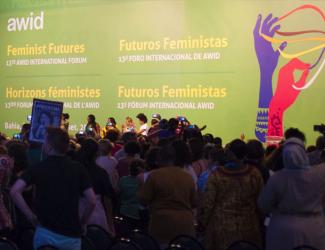
Forum de l'AWID : Co-créer nos horizons féministes

En septembre 2016, 1800 féministes et défenseur-e-s des droits des femmes venu-e-s des quatre coins de nos mouvements se réunissaient sur les côtes de Bahia à l’occasion du 13ème Forum international de l’AWID.

Cette section met l’accent sur les victoires, les enseignements et les ressources qui ont couronné nos conversations. Nous vous invitons à l’explorer, la partager et laisser vos impressions.


L’un des principaux éléments à retenir de ce Forum a été la nécessité d’élargir et d’approfondir notre travail de collaboration entre mouvements pour faire  face à une montée des fascismes et des fondamentalismes, une exacerbation de la cupidité des entreprises et un changement climatique en progression.

L’AWID a donc travaillé avec plusieurs allié-e-s  pour ériger ces semences de résistance :

A travers son prochain plan stratégique et le processus de son Forum, l’AWID s’engage à poursuivre et approfondir les rapports, les apprentissages et les processus amorcés lors du Forum 2016, tout en s’inspirant de l’actualité.

Et maintenant ?

Le monde est bien différent de celui qu’il était l’an dernier et il continuera à changer dans les années à venir.

Le prochain Forum de l’AWID se tiendra dans la région Asie-Pacifique (les dates et le lieu exacts seront annoncés en 2018). Nous attendons avec impatience de vous y retrouver !

A propos du Forum de l’AWID

Les Forums de l’AWID ont vu le jour en 1983, à Washington DC. Depuis, ils revêtent de nombreux aspects et incarnent, selon les personnes, tantôt un processus itératif visant à affiner nos analyses, notre vision et nos actions, un évènement clé galvanisant les féminismes des participant-e-s et leurs organisations ou un espace politique offrant refuge et solidarité aux défenseur-se-s des droits humains.
En savoir plus sur les éditions précédentes

Contenu lié

هل يمكن أن تعبئ مجموعة واحدة الاستطلاع أكثر من مرة واحدة؟

كلا. نطلب فقط تعبئة استطلاع واحد لكل مجموعة.

Voici votre guide pratique et les infographies «Vers un écosystème de financement féministe»

Su’ad Al-Ali

Ardente défenseure des droits des femmes et des enfants, Su’ad dirigeait Al-Weed Al-Alaiami, une organisation irakienne de défense des droits humains.

Elle a participé aux manifestations de juillet 2018 qui ont eu lieu à Bassorah et dans plusieurs autres villes irakiennes pour protester contre le chômage, réclamer des emplois et des services publics appropriés pour les citoyen-ne-s, ainsi que pour exiger l'élimination de la corruption endémique. Le 25 septembre 2018, Su’ad a été assassinée dans le quartier d’Al-Abbasiyah, dans le centre-ville de Bassorah.

Une vidéo de l’incident a montré une personne qui s'est approchée d'elle alors qu'elle montait dans sa voiture, et lui a tiré une balle dans la tête avant de pointer son arme sur son chauffeur, Hussain Hassan, qui a été blessé à l'épaule. Su’ad Al-Ali avait 46 ans et était mère de quatre enfants.


Su'ad Al Ali, Iraq

Snippet FEA Workers demonstrations in Georgia 1 (FR)

Quatre personnes avec des affiches lors d'une manifestation et, au milieu, une femme avec un mégaphone qui parle.

Je suis en train de rédiger un rapport de recherche. L’AWID peut-elle m’aider ?

L’AWID fournit une profusion de ressources pour vous aider dans votre recherche.

Nous vous invitons à explorer nos sections Domaines prioritaires et Informez-vous ou utlisez l'outil de recherche pour trouver des informations sur un suject spécifique.

Nous recommendons particulièrement la consultation de notre boîte à outils « Où est l’argent pour les droits des femmes ? » (« Where Is The Money for Women's Rights? », WITM). Cette boîte à outils est une méthodologie de recherche autogérée  pour soutenir les individus et les organisations qui souhaitent mener leur propre recherche sur les tendances de financement en adaptant la méthodologie de recherche de l’AWID à une région, une question ou une population spécifique.

Explorez la boîte à outils WITM

Могу ли я пройти опрос со своего телефона?

Да, доступ к опросу можно получить с помощью смартфона.

The AWID Forum Access Fund

We strive to make the AWID Forum a truly global gathering with participation from a diverse array of movements, regions and generations. To this end, AWID mobilizes resources for a limited Access Fund (AF) to assist some participants with the costs of attending the Forum. 

The 14th AWID International Forum will take place 11-14 January 2021, in Taipei, Taiwan. 


How will  the Access Fund be allocated?

For this AWID Forum, there will be no application process. 

Access Fund grants will be allocated by invitation only to:

  • Two  persons per activity selected for the Forum program (decided by those organizations, groups or individuals organizing the activity) 
  • Participants who identify as part of Priority Forum  Constituencies (PFCs) recommended by the organizations, networks and groups who are co-creating the Forum with AWID. 
  • PFCs are those which we consider would strengthen our collective power as movements, are not centered in mainstream feminist movements, and whose Feminist Realities we would like to honor, celebrate and visibilize: 
    - Black feminists 
    - Indigenous feminists
    - Trans, gender non-conforming and intersex feminists
    - Feminists with disabilities 
    - Feminist sex workers and informal workers, including migrant workers
    - Feminists affected by migration 
    - Women affected by drug policy
    - Feminists from the Forum regions (with a focus on the Pacific and mainland China) 

In addition, AWID will fund approximately 100 participants from the Forum’s location. Forum Committee Members (Content and Methodology, Access and Host) as well as those in the Artists Working Group [link] are also granted Access Fund support.

What does the Access Fund cover?

For selected participants, the Access Fund will cover the cost of their:

  • Flight
  • Accommodation
  • Visa
  • Local transportation in Taipei
  • Travel medical insurance

The Access Fund will NOT cover their: 

  • Forum registration fee
  • Transportation to and from the airport in their city of departure
  • Other incidental costs

Apart from the Access Fund, how can I fund my participation at the Forum?

We have listed other ideas on how to fund your participation at the AWID Forum on the Funding Ideas page. 

More Funding Ideas

Fahmida Riaz

« Après
Après l’amour la première fois,
Nos corps et nos esprits nus
Une galerie des glaces,
Complètement désarmés, absolument fragiles,
Nous nous couchons dans les bras de l’autre
Respirant attentivement,
Avec la crainte de briser
Ces figurines en cristal. » - Fahmida Riaz

Fahmida Riaz a brisé les tabous sociaux en écrivant sur le désir des femmes dans ses poèmes, créant des récits alternatifs à propos du corps des femmes et de leur sexualité, et établissant de nouveaux standards dans la littérature urdu.

Son travail s’est confronté à de sévères critiques de la part des conservateurs, qui l’ont accusée d’utiliser des expressions érotiques et « pornographiques » dans son langage poétique.  

Fahmida a finalement été mise sur liste noire et accusée de sédition en vertu de l’article 124A du Code pénal pakistanais sous la dictature de Zia-ul-Haq. Forcée à l’exil en 1981, elle a passé presque sept ans en Inde avant de retourner au Pakistan. 

Dans la préface de « Badan Dareeda » (Un corps ravagé), un recueil de poèmes publié en 1974, elle écrit :

Si, en effet, je suis forcée à me tenir aujourd’hui devant ce maqtal et me confronte à la potence, je dois y faire face, la tête haute. Mes poèmes sont la trace d’une tête mutilée : des sons émanant même lorsque suspendue par des cordes… Un corps ravagé a pris la forme de razmia, ou  d’un son de rupture. Et si cette rupture est effectivement choquante pour les gens, c’est que la poète a atteint son intention : elle a réussi à la perturber. (traduction de l’urdu vers l’anglais par Asad Alvi) 

La splendeur de Fahmida résidait dans sa défiance de toute logique ou toute catégorie particulière de genre, nation, religion ou culture. Elle refusait d’être mise dans le rôle d’une « femme poète », brisant les définitions traditionnelles de la poésie féminine, des concepts et des thématiques (variant entre conscience politique, corps, culture, désir, religion, foyer), et renversant les inhibitions assignées à son genre.   

« Il faut que vous compreniez que la culture ne peut avoir d’essence. Les cultures changent, circulent entre elles, formant de nouvelles cultures. La culture est née de cette façon. Il n’y a pas de conflits de cultures. »

Fahmida a écrit plus de 15 livres de poésie et de fiction, dont son poème ‘Taaziyati Qaraardaaden’ («Résolutions de condoléances» en anglais) qui pourrait servir d'hommage approprié à sa vie et à son héritage et de collection de poèmes (Apna Jurm To Saabit He «Mon crime est prouvé») publié en 1988 durant son exil.

Fahmida Riaz est née à Meerut, en Inde, le 28 juillet 1946 et est décédée le 21 novembre 2018 à Lahore, au Pakistan. 

Snippet FEA Workers demonstrations in Georgia 2 (EN)

The photo shows a demonstration where a crowd of people is holding a banner in Georgian that reads as follows: “8th of March for worker women”.

2007: CSO engagement rises with the creation of the WWG on FfD

The Women’s Working Group on Financing for Development (WWG on FfD), an alliance of women’s rights organizations and networks, was launched in October 2007 to advocate for the advancement of gender equality, women’s empowerment and human rights in the FfD related UN processes.  

  • The Third High-level Dialogue on Financing for Development, 23-25 October 2007 saw an upsurge in civil society participation. Aside from the six round table sessions, there were hearings for civil society and the business sector.
  • AWID delivered a statement at the plenary on behalf of Civil Society calling for governments to give greater attention to the importance of women’s rights organizations as agents of development, and the need to promote new mechanisms for financing for women in developing and least developed countries. The statement urged governments to give greater support to gender architecture in the United Nations so that the system as a whole could make progress in terms of its commitment to gender equality, women’s empowerment and human rights, including the economic, social, cultural and environmental rights of all persons. 

Terei a oportunidade de partilhar os meus pensamentos sobre questões que não são abordadas pelas perguntas do inquérito?

Sim, encorajamo-lo a partilhar mais sobre questões importantes para si ao responder à(s) pergunta(s) aberta(s) no final do inquérito.

AWID Member Community Guidelines

Co-creating welcoming and safe spaces

The co-creation of our feminist realities starts with ourselves and how we treat each other. We are dedicated to creating and protecting safe and supportive spaces for our communities both online and in person. We also consider that safe and welcoming spaces are co-owned and co-created.

We  expect our members to act in a manner that is ethical, responsible and consistent with the values of AWID and assume collective responsibility to ensure an atmosphere of mutual respect and solidarity. 


All AWID members are encouraged to: 

  • Connect with others, help break isolation and further solidarity.  It’s easy to feel lost and alone, and a little friendliness and responsiveness goes a long way.

  • Interact and engage peacefully. Differences in opinion will naturally arise, so please think of these differences as useful for expanding your thinking and ways of seeing the world.

  • Help build a space that recognizes and validates multiple lived experiences and diversities of bodies and gender expressions. Recognize that we all carry intersectional identities.

  • Use inclusive language. Be respectful of how people want to be referred to in terms of gender identity or expression (like pronouns), and practice inclusive language. 

  • Listen and make adjustments in your behavior and ways of engaging if someone says they feel uncomfortable. Don’t ask others questions that you wouldn't want to be asked yourself.

  • Help challenge oppressive behavior, which includes harassment, verbal or physical violence, violation of consent, and any action that perpetuates classism, ageism, ableism, racism, misogyny, heterosexism, transphobia and other oppressions.  If needed, please reach out to AWID staff. 

  • Practice speaking and listening with an open mind and heart and without judgement.

  • Be honest, open and heartfelt. Speak and share authentically about your experiences, your challenges, your hopes and dreams, and your vision for your own life and your community.

  • Practice active listening and self-awareness. Be aware of how much time and space you are taking up- leave room for others, practice active listening and learning.

  • Be mindful and credit others for their work and activism. Remember that we are all working collectively to contribute to change-- Ensure that you recognize the contribution of others and credit them when appropriate e.g. in discussions, or in articles, pictures etc.

  • Stay safe! We encourage you to take measures to protect yourself online and in person, especially if you have reason to believe that speaking out will put you in danger. Members may use aliases or profile images that conceal their identity. For more information please refer to the Digital Security First Aid Kit for Human Rights Defenders produced by APC - Association for Progressive Communications. 

  •  Respect the privacy needs of others! Do not share or forward any information without explicit permission.


Our Values

Solidarity 

We take a position in solidarity with each other and diverse struggles for justice and freedoms. We strive to mobilize and strengthen collective action and practice meaningful ways of working with each other.

Human rights

We believe in a full application of the principle of rights including those enshrined in international laws and affirm the belief that all human rights are interrelated, interdependent and indivisible. We are committed to working towards the eradication of all discriminations based on gender, sexuality, religion, age, ability, ethnicity, race, nationality, class or other factors.

Responsibility, Accountability, and Integrity

We strive for transparency, responsible use of our resources, fairness in our collaborations and accountability and integrity with our members, partners, funders and the movements with(in) which we work. We are committed to reflecting on our experiences, sharing our learnings openly, and striving to change our practices accordingly.

Intersectionality

We believe that for feminist movements to be transformative and strong we must continue to work across our similarities and differences. We also must interrogate power and privilege both within and outside our movements.

Bodily autonomy, integrity and freedoms

We celebrate everyone's right to choose their identities, relationships, goals, work, dreams and pleasures, and what they do with their mind, body and spirit. We believe in working towards access to resources, information and safe and enabling environments that allow this to happen.

Justice and systemic change

We work towards a world based on social, environmental, and economic justice; and interdependence, solidarity, and respect. We work towards dismantling systems of oppressive power and against all its manifestations, including patriarchy, fundamentalisms, militarisms, fascisms and corporate power that threaten our lives and our world. We want a just world where resources and power are shared in ways that enable everyone to thrive.


Please note:  

AWID reserves the right to delete comments, suspend or revoke membership when our community guidelines have been violated. AWID members are not authorised to represent AWID in any official capacity unless stipulated in writing. Members cannot use AWID spaces to proselytize or recruit members to join a religious faith or organisation. Members cannot use AWID spaces to request funds for personal use although links to external fundraising efforts or activism campaigns are permissible.
 

Sylvia Rivera

Sylvia Rivera was a civil rights activist, a transvestite and sex worker.

Known as the New York Drag queen of color, Silvia was fierce and tireless in her advocacy, in defense of those who  were marginalized and excluded as the “gay rights” movement mainstreamed in the United States in the early 1970’s.

In a well-known speech on Christopher Street Day in 1973, Sylvia, shouted through a crowd of LGBT community members: 

“You all tell me, go and hide my tail between my legs.
I will no longer put up with this shit.
I have been beaten.
I have had my nose broken.
I have been thrown in jail.
I have lost my job.
I have lost my apartment.
For gay liberation, and you all treat me this way?
What the fuck’s wrong with you all?
Think about that!” 

In 1969, at age 17, Silvia took part in the iconic Stonewall Riots by allegedly throwing the second Molotov cocktail to protest the police raid of the gay bar in Manhattan. She continued to be a central figure in the uprisings that followed, organizing rallies and fighting back police brutality.

In 1970, Sylvia worked together with Marsha P. Johnson to establish Street Transvestite Action Revolutionaries (S.T.A.R.), a political collective and organisation that would set up projects of mutual support for trans people living on the streets, those struggling with drug addiction and in prisons and in particular for trans people of color and those living in poverty. 

Defiant of labels, Silvia lived life in a way that challenged people in the gay liberation movement to think differently. She said: 

“I left home at age 10 in 1961. I hustled on 42nd Street. The early 60s was not a good time for drag queens, effeminate boys or boys that wore makeup like we did. Back then we were beat up by the police, by everybody. I didn't really come out as a drag queen until the late 60s. when drag queens were arrested, what degradation there was. I remember the first time I got arrested, I wasn't even in full drag. I was walking down the street and the cops just snatched me. People now want to call me a lesbian because I'm with Julia, and I say, "No. I'm just me. I'm not a lesbian." I'm tired of being labeled. I don't even like the label transgender. I'm tired of living with labels. I just want to be who I am. I am Sylvia Rivera. 

Through her activism and courage, Sylvia offered a mirror that reflected all that was wrong within society, but also the possibility of transformation. Sylvia was born in 1951 and passed away in 2002. 

Snippet FEA Workers Persecution S4 (ES)

Un agente de la ley con equipo antidisturbios rosa sosteniendo un palo

PERSECUCIÓN DE LOS TRABAJADORES

2013: el sexto Diálogo de Alto Nivel revisa el progreso de los ODM

  • El Sexto Diálogo de Alto Nivel sobre la Financiación para el Desarrollo, que tuvo lugar el 7 y 8 de octubre de 2013, se centró en analizar los progresos hacia los ODM e identificar las brechas a ser abordadas en las conversaciones acerca del nuevo marco para el desarrollo.
  • Durante la sesión, el Grupo de Trabajo sobre el desfase en el logro de los ODM presentó un informe en el que hizo referencia al fracaso en alcanzar el ODM 8 (Alianza mundial para el desarrollo) como un factor decisivo que explicaba los obstáculos para el logro de los demás ODM. Ese informe demostró que en el nuevo marco para el desarrollo post-2015 se debía prestar más atención a crear alianzas globales fuertes que garantizaran compromisos vinculantes.

La Revista de las Realidades Feministas

La Revista de las Realidades Feministas

Les presentamos una inspiradora selección de historias e imágenes poderosas de transformación y resistencia creadas por activistas, escritorxs y artistas feministas de todo el mundo.

Explora la Revista

كيف ستعرضون وتعالجون المعطيات التي ستجمعونها في الاستطلاع؟

سيتم جمع المعطيات لأهداف إحصائية لتسليط الضوء على وضع التمويل للحركات النسوية العالمية وسيتم عرضها فقط بشكل إجمالي. لن تنشر AWID المعلومات عن اي منظمة محددة ولن تعرض أي من المعلومات التي ستمكّن من التعرّف على منظمة عن طريق موقعها أو صفاتها دون موافقة المنظمة.