L´AWID est une organisation féministe mondiale qui consacre ses efforts à la justice de genre, au développement durable et aux droits humains des femmes
Forum de l'AWID : Co-créer nos horizons féministes
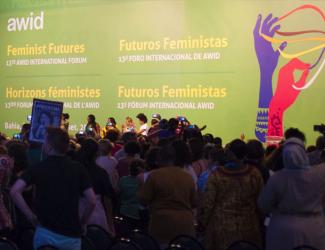
En septembre 2016, 1800 féministes et défenseur-e-s des droits des femmes venu-e-s des quatre coins de nos mouvements se réunissaient sur les côtes de Bahia à l’occasion du 13ème Forum international de l’AWID.
Cette section met l’accent sur les victoires, les enseignements et les ressources qui ont couronné nos conversations. Nous vous invitons à l’explorer, la partager et laisser vos impressions.
L’un des principaux éléments à retenir de ce Forum a été la nécessité d’élargir et d’approfondir notre travail de collaboration entre mouvements pour faire face à une montée des fascismes et des fondamentalismes, une exacerbation de la cupidité des entreprises et un changement climatique en progression.
L’AWID a donc travaillé avec plusieurs allié-e-s pour ériger ces semences de résistance :
Les mouvements peuvent aussi bénéficier d’une nouvelle méthodologie pour envisager nos horizons féministes. (à venir bientôt !)
A travers son prochain plan stratégique et le processus de son Forum, l’AWID s’engage à poursuivre et approfondir les rapports, les apprentissages et les processus amorcés lors du Forum 2016, tout en s’inspirant de l’actualité.
Et maintenant ?
Le monde est bien différent de celui qu’il était l’an dernier et il continuera à changer dans les années à venir.
Le prochain Forum de l’AWID se tiendra dans la région Asie-Pacifique (les dates et le lieu exacts seront annoncés en 2018). Nous attendons avec impatience de vous y retrouver !
A propos du Forum de l’AWID
Les Forums de l’AWID ont vu le jour en 1983, à Washington DC. Depuis, ils revêtent de nombreux aspects et incarnent, selon les personnes, tantôt un processus itératif visant à affiner nos analyses, notre vision et nos actions, un évènement clé galvanisant les féminismes des participant-e-s et leurs organisations ou un espace politique offrant refuge et solidarité aux défenseur-se-s des droits humains.
Nuestras/os afiliadas/os tanto individuales como institucionales provienen de todas las regiones del mundo y de 163 países; las/os más recientes se nos han unido desde Zimbabue, Turquía y los Estados Unidos. ¡Todas/os nuestras/os afiliadas/os aportan una rica y diversa gama de perspectivas, experiencias, conocimiento, energía e inspiración!
¿Sabías que cada semana publicamos perfiles de afiliadas/os?
Uno de los beneficios de ser afiliada/o de AWID es que tu historia sea destacada en nuestro boletín informativo, el cual llega a 35,000 suscriptoras/es, y a través de nuestros canales en las redes sociales que tienen más de 60,000 seguidores.
Publicaciones recientes:
Conoce a Angila Ashitua, una joven afiliada a AWID que vive en el condado de Vihiga, Kenia Occidental.
Aprendiendo más acerca del trabajo que hace AWID y de temas relativos a los derechos de las mujeres y la justicia social por medio de nuestras publicaciones y recursos, incluyendo el último video "Cambiando sistemas, cambiando vidas". [disponible solo en inglés]
Participando en nuestras sesiones de aprendizaje electrónico. ¡Mira lo más destacado de nuestro seminario en línea sobre justicia fiscal! [disponible solo en inglés]
¡Y mucho más!
Puedes renovar tu membresía por uno, dos o tres años; también ofrecemos membresías individuales e institucionales gratis a quienes tengan bajos ingresos o presupuestos.
Si tienes alguna dificultad y necesitas apoyo con el proceso de inscripción, por favor no dudes en comunicarte conmigo a través de membership@awid.org
Testemonios de nuestras/os afiliadas/os
"AWID nos ha resultado una red muy interesante y estamos participando en muchas de sus plataformas". - Engabu Za Tooro (afiliada/o institucional AWID)
"Espero una colaboración fructífera con el equipo. Me siento excelente. Gracias por aceptarme como afiliada". - R. Chakraborty (afiliada individual AWID)
"Muchas gracias, AWID, pues el trabajo que hacen es formidable. Aprecio realmente sus esfuerzos". - E. Khan (afiliada individual AWID)
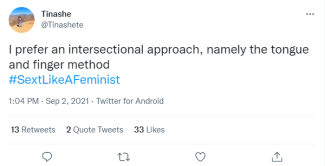
#5 - Sexting like a feminist Tweets Snippet FR
L’analyse minutieuse nécessite de recourir à tous les outils à notre disposition…
Moi je préfère l’approche intersectionnelle, soit la méthode langue et doigt.
CFA FAQ - Funding - AR
تمويل مشاركتك
L’AWID peut-elle financer mon projet de développement ?
Une fois que vous aurez analysé l’ensemble des données issues du sondage, des interviews, de la recherche documentaire et possiblement d’autres sources, vous pourrez créer votre produit final.
Votre produit final sera le document qui synthétisera, analysera et posera un regard critique sur vos données. Ce sera la composante que vous partagerez avec votre communauté afin de présenter et d’expliquer votre recherche à votre auditoire.
À l’AWID, nous rédigeons fréquemment un rapport complet qui analyse chaque ensemble de données et qui synthétise tous nos résultats pour ensuite créer des produits plus concis comme des infographies et des sommaires (expliqué plus loin dans la section « Finalisez et mettez en forme »).
1. Écrivez clairement
Organisez vos données comme si vous vouliez raconter une histoire. Vous pouvez suivre l’ordre de votre sondage. Vous pouvez également regrouper certaines questions qui mènent à votre conclusion de façon cohérente et progressive.
Adaptez votre langage à votre public. Employez un langage universel et évitez le jargon ou les termes trop techniques.
L’importance de la révision
La personne chargée de la révision relira votre document, s’assurera qu’il est rédigé de manière concise, procédera à la vérification des faits, soulèvera les incohérences qui doivent être résolues, assurera la fluidité du texte et suggérera éventuellement des titres.
Il est préférable que cette personne connaisse et comprenne votre travail WITM, sans être engagée dans la recherche. Ainsi, elle apportera au document une nouvelle perspective.
2. Rendez-le attrayant
Créez des tableaux et des graphiques à l’aide des données recueillies. Ce type de documents visuels est très utile pour faire ressortir les principaux résultats de votre recherche et pour valider votre analyse.
Utilisez des images pertinentes qui illustrent vos propos.
Mettez en évidence les principaux chiffres et/ou les témoignages percutants.
Rappel : Plus votre produit est accessible, plus les gens auront envie de le lire…et de le partager!
À cette étape, vous avez recueilli toutes vos données, vous les avez analysées et vous avez transformé ces renseignements en produit final, probablement en un long rapport.
1. Peaufinez vos résultats
Avant de passer à la prochaine étape, vous devriez partager votre produit final avec les organisations, les activistes et les donateurs qui vous conseillent.
C’est le moment idéal pour vérifier les aspects suivants :
Est-ce qu’il manque des points clés à votre analyse des tendances et du panorama actuels du financement ?
Est-ce qu’il manque des points clés à vos conclusions ?
Y a-t-il des données inexactes qui doivent être corrigées ?
Y a-t-il des suggestions de nature générale sur la manière de renforcer le rapport afin d’atteindre les objectifs fixés dans le cadre de référence de la recherche.
Lorsque vous aurez intégré toutes les réactions de vos conseillers et conseillères, assurez-vous de présenter le document à la personne chargée des révisions.
Vous aurez ainsi en main la version finale et complète de votre rapport. Si vous prévoyez de publier votre rapport final en d’autres langues, il est temps de le faire traduire.
2. Encouragez les réactions
Les personnes qui vous conseillent seront probablement très occupées. Assurez-vous de leur accorder un délai raisonnable lorsque vous leur demandez de commenter le texte.
Soyez brefs et spécifiques lorsque vous sollicitez des commentaires, de sorte qu’il leur soit facile d’y répondre. Si vous le souhaitez, vous pouvez simplement copier et coller la liste des points que nous vous avons fournie.
Si vous publiez en plusieurs langues, assurez-vous que vos conseillers et conseillères vérifient la ou les versions finales traduites de vos produits.
Il s’agit d’une contribution considérable de la part de vos conseillers et conseillères. Pensez à leur offrir une forme de reconnaissance.
• 1 personne (ou plus) chargée de la recherche
• 1 éditeur-trice (spécialisé-e web si vous créez des prduits en ligne)
• Traducteur(s)-trice(s), si vous réalisez votre recherche en différentes langues
Ressources requises :
• Liste d’organisations, de donateurs et d’activistes agissant à titre consultatif
• Note conceptuelle (définie par votre cadre de référence)
• Résultats préliminaires de votre sondage
• Questions d'interview
• Résultats de vos interview
• Données de votre recherche documentaire
• Toutes les données utilsées dans le rapport
Louise Malherbe is a film programmer/curator and a film critic based in Berlin. She worked as a film programmer for the Metropolis Cinema Association in Beirut and is now coordinating the Reel Streams project aiming at supporting the dissemination of independent cinema in the Arab region. She is Head of Programming for Soura Film Festival, a queer film festival focusing on the S.W.A.N.A. region, writes film critics for Manifesto XXI, and recently started curating films and festivals for Cinema Akil.
As feminists struggling for gender, peace, economic, social and environmental justice, we know there is no single recipe for success but an array of possibilities that can and are making change happen. The menu of options is as diverse as our movements and the communities in which we live and struggle.
Before we dare to present some of the feminist imaginations for another world, here are the principles around which we base our propositions:
1. Self-determined development from the local to the global
We believe there is no one model for all and that everyone has a right to claim and contribute to building another world that is possible, as the World Social Forum motto puts it.
This includes the right to participate in democratic governance and to influence one’s future – politically, economically, socially and culturally.
Economic self-determination gives peoples the ability to take control over their natural resources and use those resources for their own ends or collective use. Furthermore, women’s economic agency is fundamental to mitigating the often cyclical nature of poverty, denial of education, safety, and security.
2. Rights, substantive equality and justice are at the core of the economy
The principle of substantive equality is laid out in the Convention on the Elimination of All Forms of Discrimination against Women (CEDAW) and other international human rights instruments. This principle is fundamental for development and achieving a just economy as it affirms that all human beings are born free and equal.
Non-discrimination is an integral part of the principle of equality that ensures that no one is denied their rights because of factors such as race, gender, language, religion, sexual orientation, gender identity, political or other opinion, national or social origin, property or birth.
The inherent dignity of all persons without distinction must be upheld and respected. While States are responsible for ensuring the use of maximum available resources for the fulfilment of human rights, reclaiming rights and dignity is fundamentally a key space for civil society struggle and popular mobilization.
3. Just distribution for all, without monopolization (the anti-greed principle)
This principle, exercised through organized efforts to transform unjust institutions, guides the restoration of balance between "participation" (input) and "distribution" (output) when either principle is violated.
It puts limits on monopolistic accumulations of capital and other abuses of property. This concept is founded on an economy model that is based on fairness, and justice.
4. Feminist and cross-movement solidarity is key
In order to make change happen, we need strong and diverse feminist networks. We need movements building solidarity from the personal to the political, from the local to the global and back.
Building collective power through movements helps convert the struggle for human rights, equality and justice into a political force for change that cannot be ignored.
“Only movements can create sustained change at the levels that policy and legislation alone cannot achieve.”
A los seis años, me enteré de que mi abuelo tenía una sala de cine. Mi madre me contó que la había abierto a principios de la década de 1960, cuando ella también tenía unos seis años. Recordaba que la primera noche proyectaron La novicia rebelde / Sonrisas y lágrimas...
نحن نعلم أن السفر لأول مرة يمكن أن يكون مثيرًا ولكنه مرهق أيضًا. وإدراكًا للتحديات العديدة التي ينطوي عليها الأمر، سنقدم المزيد من المعلومات والتفاصيل حول كيفية الوصول إلى بانكوك عندما يتم فتح التسجيل في أوائل العام المقبل.
Estoy viviendo una situación de violencia en una o más de mis relaciones, ¿AWID puede abogar en mi nombre?
AWID no es una organización que brinde servicios directos ni que defienda casos individuales
Te recomendamos buscar asesoría legal y ponerte en contacto con un refugio para mujeres o un centro de referencia en tu área.
Las "HotPeachPages" son un recurso en línea que ofrece enlaces a albergues para mujeres en todo el mundo. AWID no puede dar fe de la exactitud o la calidad de las instituciones que aparecen en esos listados, pero podría ser un buen lugar por donde empezar si no conoces organizaciones en tu zona.
Las propuestas de decrecimiento cuestionan la premisa de que la economía de los países debe ‘crecer o perecer’ y muestran la falsedad del lugar central que se le otorga al crecimiento medido por un aumento del Producto Bruto Interno (PIB).
Definición
Un modelo de decrecimiento propone un cambio hacia niveles de producción y consumo más bajos y sostenibles. En esencia postula una reducción del sistema económico para dejarle más espacio a la cooperación entre personas y a los ecosistemas humanos.
Esta propuesta incluye:
Reducir la producción superflua de recursos, energías y emisiones, sobre todo en el Norte (p.ej. las industrias automotriz y militar)
Redirigir las inversiones hacia los sectores de cuidados, infraestructura social y restauración del ambiente.
Perspectiva feminista
Las perspectivas feministas dentro de la teoría y práctica del decrecimiento sostienen que también es necesario redefinir y revalidar el trabajo no remunerado y remunerado, de cuidados y en el mercado, para superar los estereotipos tradicionales de género así como las brechas laborales y las desigualdades en el ingreso prevalecientes que devalúan el trabajo de cuidado.
Para leer más acerca de esta propuesta:
En El futuro que queremos: Occupy development Christa Wichterich sostiene que para quebrar la lógica hegemónica del crecimiento sin límites y el rédito rápido para las inversiones, los tres aspectos centrales de un paradigma diferente para el desarrollo deben combinar el cuidado, los bienes comunes y la suficiencia en la producción y el consumo.
Equitable, Ecological Degrowth: Feminist Contributions [Decrecimiento con equidad y ecológico: Aportes feministas] (en inglés) de Patricia Perkins recomienda desarrollar indicadores alternativos eficaces de bienestar, incluyendo información sobre equidad social y económica así como horas dedicadas al trabajo, para mostrar la importancia del trabajo y los servicios no remunerados para la economía y ofrecer un mecanismo para el reconocimiento de quienes los realizan.