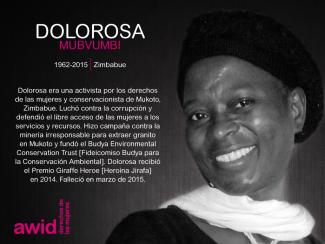
Dolorosa Mubvumbi

Les défenseuses des droits humains s’auto-identifient comme des femmes ou des personnes lesbiennes, bisexuelles, transgenres, queer, intersexes (LBT*QI) ou autres qui défendent les droits. Elles sont exposées à des risques et à des menaces de nature genrée à cause du travail qu’elles accomplissent en faveur des droits humains et/ou en conséquence directe de leur identité de genre ou de leur orientation sexuelle.
Les défenseuses des droits humains subissent une violence et une discrimination systématique du fait de leur identité, mais aussi à cause de la lutte indéfectible qu’elles mènent en faveur des droits, de l’égalité et de la justice.
Le programme Défenseuses des droits humains collabore avec des partenaires internationaux et régionaux ainsi qu’avec les membres de l’AWID pour éveiller les consciences à propos de ces risques et menaces, pour plaider en faveur de mesures féministes et holistiques de protection et de sécurité et enfin pour promouvoir activement une culture du souci de soi et du bien-être collectif au sein de nos mouvements.
Les défenseuses des droits humains sont exposées aux mêmes types de risques que toutes les autres personnes qui défendent les droits humains, les communautés et l’environnement. Mais elles se heurtent également à des violences fondées sur le genre et à des risques spécifiques de nature genrée parce qu’elles remettent en cause les normes de genre en vigueur au sein de leur culture et de leur société.
En défendant les droits, les défenseuses des droits humains sont exposées aux risques suivants :
Nous travaillons en collaboration avec des réseaux internationaux et régionaux ainsi qu’avec nos membres pour :
Nous travaillons à la promotion d’une approche holistique de la protection des défenseuses, qui suppose notamment :
Nous souhaitons contribuer à l’avènement d’un monde plus sûr pour les défenseuses des droits humains, leurs familles et leurs communautés. Nous pensons que le fait que les défenseuses œuvrent en faveur des droits et de la justice ne devrait pas leur faire courir de risques ; leur action devrait être appréciée et célébrée.
Promouvoir la collaboration et la coordination entre organisations de défense des droits humains et des droits des femmes au niveau international, et ce dans le but de d’apporter des réponses plus efficaces dans le domaine de la sureté et du bien-être des défenseuses des droits humains ;
Soutenir les réseaux régionaux de défenseur-es et les organisations, parmi lesquels l’Initiative mésoaméricaine des défenseuses des droits humains et la Coalition des défenseuses des droits humains du Moyen-Orient et d’Afrique du Nord, dans leur travail de promotion et de renforcement de l’action collective en faveur de la protection des défenseuses – en mettant en avant l’importance de la création de réseaux de solidarité et de protection, de la promotion du souci de soi ainsi que du plaidoyer et de la mobilisation en faveur de la sécurité des défenseuses ;
Faire en sorte que les défenseur-e-s des droits humains et les risques qui les menacent soient plus visibles et mieux reconnus, en rassemblant des informations sur les agressions dont elles sont victimes et en produisant et diffusant des documents sur leurs luttes, leurs stratégies et les difficultés qu’elles rencontrent ;
Organiser des réponses urgentes fondées sur la solidarité internationale dès que des défenseuses des droits humains sont en danger, par le biais de nos réseaux internationaux et régionaux mais aussi grâce à nos membres.
par Amal Amer
Je prie en famille pour la première fois en six ans, recouvert.e d’un keffieh que j’ai déniché dans une poubelle. (...)
illustration : « Les anges aussi sortent la nuit », par Chloé Luu >
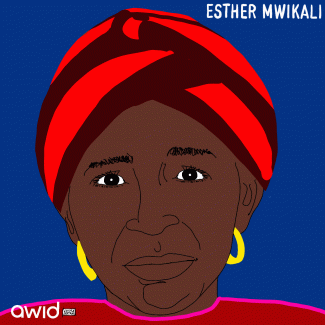
Esther Mwikali habitait dans le village de Mithini, dans le comté de Murang’a au Kenya. Activiste des droits fonciers, importante et appréciée, elle travaillait sur les abus à l’égard de squatters vivant sur des terres revendiquées par des magnats. Esther a participé à une enquête qui comprenait également des violations de droits fonciers à Makaya par de puissants individus.
Suite à l’absence d’Esther lors d’une réunion de village, une équipe de patrouille est partie à sa recherche. Le 27 août 2019, deux jours après sa disparition, on retrouva son corps dans une ferme proche de sa propriété, montrant des signes de torture. Elle fut sauvagement assassinée.
« Esther était reconnue pour son travail auprès des membres de la communauté, empêchant les évictions de terres revendiquées des magnats. Les activistes du coin n’ont aucun doute sur le lien entre son meurtre et les luttes constantes pour les terres dans la région. C’est un tragique rappel de la fréquence alarmante d’assassinats extrajudiciaires régulièrement menés au Kenya » - Global Wittness Report, juillet 2020
« Nous associons la mort de Mwikali aux luttes pour les terres par ici. Nous demandons au gouvernement de mener une enquête sur ce sujet au plus tôt. » - James Mburu, porte-parole des squatters
« Des mesures devraient être prises à l’égard des individus suspectés d’avoir menacé les squatters, et notamment la famille Mwikali. » - Alice Karanja, National Coalition of Human Rights Defenders (coalition nationale des défenseur·e·s des droits humains)
« L’impact de son travail et sa ténacité demeureront encore en vie pour les prochaines décennies au Kenya. CJGEA console avec les personnes endeuillées et appelle à la justice. » - Center for Justice and Governmental Action (Centre pour la justice et l’action gouvernementale, CJGEA) communiqué de presse, 13 septembre 2019
Avant d’aborder la méthodologie de recherche WITM, il est important que vous connaissiez les données de base et que vous sachiez à quoi vous attendre.
En ce qui concerne la méthodologie de recherche WITM de l’AWID, nous recommandons d’étudier toute la boîte à outils.
Bien que cette boîte à outils ait été conçue pour démocratiser la recherche WITM, il existe des contraintes en termes de capacités liées à l’expérience de votre organisation dans le domaine des ressources et de la recherche qui pourraient influencer son aptitude à utiliser cette méthodologie.
Utilisez la Fiche de travail « Êtes-vous prêts-tes ? » pour évaluer votre niveau de préparation à mener votre propre recherche WITM. Plus vos réponses aux questions de cette fiche de travail seront nombreuses, plus vous serez capable d’entreprendre votre recherche.
Avant de commencer toute recherche, nous vous recommandons de procéder à l’évaluation des liens que votre organisation a établis avec votre communauté et de la confiance qu’elle inspire.
Dans de nombreux contextes, les organisations pourraient hésiter à partager ouvertement leurs données financières avec d’autres pour des raisons diverses allant des inquiétudes que suscite la façon dont les données seront utilisées, à la crainte de la concurrence pour le financement en passant par les préoccupations au sujet des restrictions gouvernementales croissantes imposées aux organisations de la société civile.
Lorsque vous établirez des relations et que vous mènerez des recherches informelles pendant la période précédant le lancement de votre initiative, la clarté des objectifs fixés contribuera à instaurer la confiance. La transparence permettra aux personnes qui participent à la recherche de comprendre pourquoi vous recueillez des données et en quoi cela profitera à l’ensemble de la communauté.
Nous vous recommandons vivement de faire en sorte que les données soient recueillies de manière confidentielle et partagées anonymement. Cela permettra aux personnes qui participent à votre recherche de partager plus facilement avec vous des informations sensibles.
Nous vous invitons à consulter notre Fiche de travail « Êtes-vous prêts-tes ? » pour mesurer vos propres progrès.
Get started with these resources.
COP30 Political Education Toolbox Play the Climate Justice Organizing Deckgame
Read the Feminist Economic Alternatives Brief Download the Climate Justice Zine
by Dr. Pragati Singh
In 2019, I was invited by the BBC to speak at the 100 women conference in Delhi, India, on the subject of ‘The future of love, relationships, and families.’ The audience seated in the large hall consisted mostly of young Indians- college students, professionals, activists etc (...)
artwork: “Angels go out at night too” by Chloé Luu >
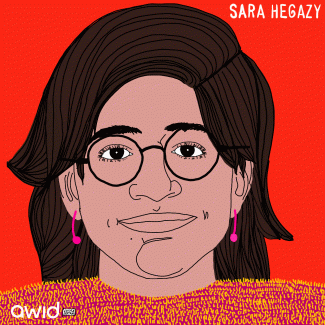
Sara Hegazy, a bold Egyptian LGBTQI+ rights activist, lived in a society where the members of her community, their bodies and lives often face lethal prejudice. The roots of Sara’s resistance were in the deconstruction of a dominant, oppressive and patriarchal system, and its anti-rights actors.
"[In Egypt], every person who is not male, Muslim, Sunni, straight, and a supporter of the system, is rejected, repressed, stigmatized, arrested, exiled, or killed. This matter is related to the patriarchal system as a whole, since the state cannot practice its repression against citizens without a pre-existing oppression since childhood." - Sara Hegazy wrote on March 6, 2020
The suppression of Sara’s voice by the Egyptian government reached its violent peak in 2017, when she was arrested for raising a rainbow flag at the Mashrou’ Leila (Lebanese band whose lead vocalist is openly gay) concert in Cairo. What followed were charges of joining an illegal group along with “promoting sexual deviancy and debauchery”.
"It was an act of support and solidarity — not only with the [Mashrou' Leila] vocalist but for everyone who is oppressed...We were proud to hold the flag. We wouldn't have imagined the reaction of society and the Egyptian state. For them, I was a criminal — someone who was seeking to destroy the moral structure of society." - Sara Hegazy
Sara was jailed for three months, where she was tortured and sexually assaulted. In January 2018, after being released on bail, she sought asylum in Canada where she was safe but imprisoned by the memories of the abuse and violence her body and soul had gone through.
"I left this experience after three months with a very intense, serious case of PTSD [post-traumatic stress disorder]. Prison killed me. It destroyed me." - Sara Hegazy told NPR
Sara took her own life on 14 June 2020, leaving a handwritten note in Arabic:
“To my siblings – I tried to find redemption and failed, forgive me.”
“To my friends – the experience [journey] was harsh and I am too weak to resist it, forgive me.
“To the world – you were cruel to a great extent, but I forgive.”
Her legacy and courage will be carried forward by those who love her and believe in what she fought for.
“To Sarah: Rest, just rest, spared from this relentless violence, this state-powered lethal patriarchy. In rage, in grief, in exhaustion, we resist.” - Rasha Younes, an LGBT rights researcher at Human Rights Watch. Read the complete text
Mashrou’ Leila’s lead vocalist sings tribute to Sara Hegazy
Cette section vous guidera pour vous permettre d’obtenir des résultats de recherche représentatifs et fiables.
Dans cette section :
- Recueillez vos données
1. Avant le lancement
2. Lancement
3. Pendant le lancement- Préparez vos données en vue de l’analyse
1. Nettoyez vos données
2. Codifiez les réponses aux questions ouvertes
3. Supprimez les données inutiles
4. Assurez la sécurité- Créez votre rapport de synthèse
- Analysez vos données
1. Programmes statistiques
2. Éléments d’analyse suggérés
Si vous prévoyez de recueillir des données issues des demandes soumises aux institutions d’octroi de subventions, ce moment est opportun pour communiquer avec elles.
Lorsque vous recueillez ces données, réfléchissez aux types de demandes de subventions que vous souhaitez examiner. Votre cadre de recherche vous orientera sur cette question.
De plus, il n’est peut-être pas nécessaire de revoir chaque demande soumise à l’organisation. Il sera plus utile et efficace de ne passer en revue que les demandes admissibles (qu’elles aient ou non été financées).
Par ailleurs, vous pouvez aussi demander aux institutions d’octroi de subventions de partager leurs données avec vous.
Voir un modèle de lettre à envoyer aux institutions d’octroi de subventions
Votre sondage est terminée et vous avez une mine de renseignements ! Vous devez maintenant faire en sorte que vos données soient les plus exactes possibles.
Selon la taille de votre échantillon et la quantité de sondages remplis, cette étape peut être longue. Ce processus sera accéléré et gagnera en précision si vous disposez d’une bonne réserve de personnel qui a le souci du détail.
Vous aurez peut-être recueilli, en plus de vos sondages, des données issues des demandes soumises aux institutions d’octroi de subventions. Utilisez les mêmes étapes pour traiter ces données. Ne vous découragez pas si vous ne pouvez comparer les deux ensembles de données ! Les bailleurs de fonds recueillent des renseignements différents de ceux que vous aurez obtenus de vos sondages. Dans le rapport final et les produits de votre recherche, vous pouvez analyser et présenter les ensembles de données de manière distincte (données issues des sondages et des institutions d’octroi de subventions).
Il existe deux types de questions ouvertes qui exigent une codification.
Questions appelant des réponses ouvertes
Pour ces questions, vous devrez codifier les réponses afin de cerner les tendances.
Vous aurez à affronter les difficultés suivantes :
Si vous avez recours à plus d’une personne pour examiner et codifier, vous devrez vous assurer que la codification est systématique. Voilà pourquoi nous recommandons de limiter les questions ouvertes et d’être le plus précis possible si vous posez ce type de questions.
Par exemple, si vous posez cette question ouverte : « Quelles difficultés spécifiques avez-vous rencontrées cette année en matière de levée de fonds ? ».
Les réponses pourraient être : « le manque de ressources humaines » ou « pas assez de personnel ». Ces réponses peuvent être regroupées et codifiées sous une même catégories « manque de personnel ». Ceci vous permettra d’obtenir le nombre de personnes qui ont répondu de manière semblable.
Questions appelant des réponses fermées
Si vous avez proposé aux personnes répondantes de préciser leurs réponses, vous devrez procéder au « surcodage » de ces réponses.
Pour certaines questions du sondage, vous aurez peut-être proposé l’option « autre ». Lorsque cette option est offerte, on l’accompagne fréquemment d’une zone de texte où les personnes peuvent préciser leurs réponses.
Différentes méthodes de « surcodage » :
Analysez la fréquence des résultats
Pour chaque question quantitative, vous pouvez décider de retirer les 5 % ou les 1 % les plus élevés et les moins élevés afin d’éviter que des données aberrantes* ne biaisent vos résultats. Vous pouvez aussi traiter l’effet de biais en employant une moyenne médiane plutôt qu’une moyenne arithmétique. Pour calculer la médiane, il faut d’abord ordonner les données (les trier dans l’ordre ascendant). La médiane est le nombre qui se situe au point milieu. Cependant, il faut garder à l’esprit qu’il est possible que vous estimiez que les données aberrantes soient utiles. Elles vous donneront une idée de la gamme et de la diversité des personnes participant au sondage et vous choisirez peut-être de réaliser une étude de cas qui porte sur ces données aberrantes.
* Une donnée aberrante est un point de données qui est beaucoup plus grand ou beaucoup plus petit que la majorité des points de données. Par exemple, imaginons que vous viviez dans un quartier de classe moyenne avec pour voisin un millionnaire. Vous décidez de connaître l’échelle de revenu chez les familles de classe moyenne de votre quartier. Pour ce faire, vous devez retirer le revenu du millionnaire de votre ensemble de données, puisqu’il s’agit d’une donnée aberrante. Sinon, la moyenne du revenu de classe moyenne semblera beaucoup plus élevée qu’elle ne l’est en réalité.
Retirez tout le sondage concernant les répondant-e-s qui ne correspondent pas à votre population cible. Habituellement, vous les reconnaîtrez par le nom de l’organisation ou encore par leurs réponses aux questions qualitatives.
Pour assurer la confidentialité de l’information partagée par les répondant-e-s, vous pouvez à cette étape remplacer les noms des organisations par une nouvelle série de numéros d’identité et sauvegarder la codification, conservant les noms et les numéros d’identification dans un dossier distinct.
En collaboration avec votre équipe, déterminez la manière de stocker et de protéger le dossier de codification et les données.
Par exemple, les données seront-elles stockées dans un ordinateur ou un serveur protégé par mot de passe, auquel seule l’équipe de recherche aurait accès ?
Un rapport de synthèse dresse la liste de toutes les questions posées lors du sondage ainsi que les réponses obtenues en pourcentages inscrits sous chaque question. Ce document présente les résultats collectifs de toutes les réponses individuelles.
Conseils :
- Il est important d’être systématique : on doit appliquer les mêmes règles à chaque donnée aberrante lorsque l’on détermine si elle devrait demeurer ou être retirée de l’ensemble des données.
- Pour toutes les réponses ouvertes (« autre ») qui sont « surcodées », assurez-vous que la codification est en adéquation. Désignez une personne afin qu’elle vérifie la cohérence et la fiabilité des codes de façon aléatoire et qu’elle révise les codes si nécessaire.
- Si possible, tentez de toujours travailler en équipe de deux personnes afin que quelqu’un puisse vérifier le travail.
Maintenant que vos données sont nettoyées et triées, que veulent dire toutes ces informations ? Voici la partie la plus stimulante, où vous commencez à analyser pour dégager les tendances.
Est-ce qu’il existe des types de bailleurs de fonds particulièrement importants (gouvernement par rapport aux sociétés privées) ? Est-ce qu’il y a des régions qui reçoivent plus de financements ? Vos données révéleront des renseignements fort intéressants.
Échantillons plus petits (moins de 150 réponses) : peuvent être analysés en interne à l’aide d’une feuille de calcul Excel.
Échantillons plus grands (plus de 150 réponses) : peuvent être analysés en interne à l’aide d’Excel, si votre analyse se résume à compter l’ensemble des réponses, des moyennes ou d’autres analyses simples.
Si vous prévoyez des analyses plus poussées, comme des analyses à variables multiples, nous recommandons alors d’avoir recours à un logiciel statistique comme - SPSS, Stata, R (gratuit)
REMARQUE: SPSS et Stata sont dispendieux alors que R est gratuit.
Ces trois types de logiciels exigent des connaissances de la part du personnel et il n’est pas facile de les maîtriser rapidement.
Essayez de trouver des stagiaires ou du personnel temporaire, provenant notamment des universités locales. De nombreux étudiant-e-s doivent apprendre l’analyse statistique au cours de leurs programmes et ils-elles pourraient avoir un accès gratuit aux logiciels SPSS ou Stata par l’intermédiaire de l’université. Ces étudiant-e-s sauront probablement utiliser le logiciel R, qui peut être téléchargé et utilisé gratuitement.

• 2 - 3 mois
• 1 personne (ou plus) chargée de la recherche
• Traducteur(s)-trice(s), si vous voulez traduire votre sondage
• 1 personne (ou plus) pour diffuser le sondage auprès des populations choisies
• 1 personne (ou plus) chargée de l'analyse des données
• Liste d’organisations, de donateurs et d’activistes agissant à titre consultatif
• Un prix de récompense pour encourager les gens à répondre à votre sondage (optionnel)
• Une marque de reconnaissance pour vos conseillers-ères (optionnel)
• Survey Monkey
• Survey Gizmo (en anglais)
• Exemple : Enquête mondiale WITM
• Exemple de lettre aux bailleurs de fonds demandant accès aux bases de données
• Tutoriel : Simple introduction au nettoyage des données (en anglais)
• Outils de visualisation (en anglais)
Movements marching globally for climate justice.
📅 Saturday, November 15, 2025
📍 Multiple Locations
By joining AWID, you are becoming part of worldwide feminist organizing, a collective power that is rooted in working across movements and is based on solidarity.
por Haddy Jatou Gassama
La tribu mandinga de la República de Gambia tiene la costumbre de medir la primera wrapa[1] utilizada para cargar bebés recién nacidxs sobre la espalda de su madre. (...)
arte: «Sacred Puta» [Puta sagrada], Pia Love >
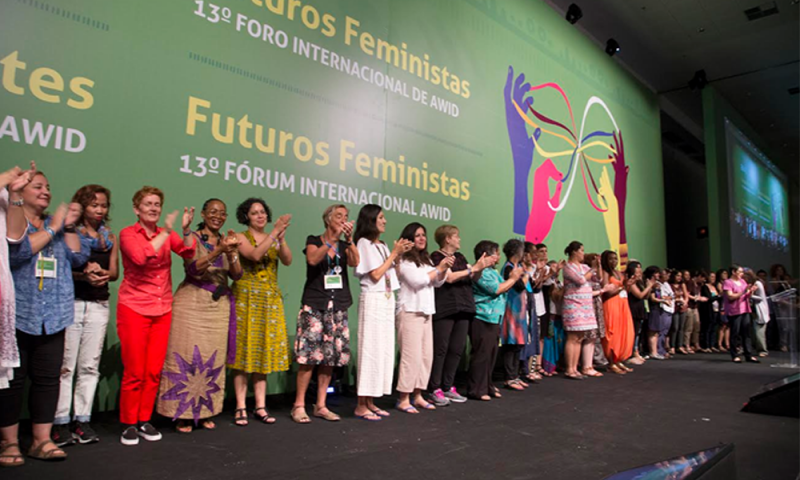
Thank you to all of you who have joined us, physically or virtually, for the past four days of learning, celebrating, envisioning, dreaming and building our Feminist Futures together at the 2016 AWID Forum!
We are incredibly inspired, amazed, and re-energized by all the collective work we have done together in creating our diverse futures.