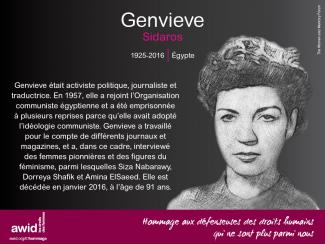
Genvieve Sidaros

Young feminist activists play a critical role in women’s rights organizations and movements worldwide by bringing up new issues that feminists face today. Their strength, creativity and adaptability are vital to the sustainability of feminist organizing.
At the same time, they face specific impediments to their activism such as limited access to funding and support, lack of capacity-building opportunities, and a significant increase of attacks on young women human rights defenders. This creates a lack of visibility that makes more difficult their inclusion and effective participation within women’s rights movements.
AWID’s young feminist activism program was created to make sure the voices of young women are heard and reflected in feminist discourse. We want to ensure that young feminists have better access to funding, capacity-building opportunities and international processes. In addition to supporting young feminists directly, we are also working with women’s rights activists of all ages on practical models and strategies for effective multigenerational organizing.
We want young feminist activists to play a role in decision-making affecting their rights by:
Fostering community and sharing information through the Young Feminist Wire. Recognizing the importance of online media for the work of young feminists, our team launched the Young Feminist Wire in May 2010 to share information, build capacity through online webinars and e-discussions, and encourage community building.
Researching and building knowledge on young feminist activism, to increase the visibility and impact of young feminist activism within and across women’s rights movements and other key actors such as donors.
Promoting more effective multigenerational organizing, exploring better ways to work together.
Supporting young feminists to engage in global development processes such as those within the United Nations
Collaboration across all of AWID’s priority areas, including the Forum, to ensure young feminists’ key contributions, perspectives, needs and activism are reflected in debates, policies and programs affecting them.
Tandis que les dirigeant·es du monde entier se réunissent au Brésil, les mouvements féministes manifestent, se rassemblent et bouleversent le statu quo à la COP30 et partout ailleurs ! Nous voilà en route vers Belém au Brésil, aux côtés d’autres féministes, pour assister à la COP30 du 10 au 21 novembre 2025. Nous continuerons d’y dénoncer les fausses solutions.
กำหนดเส้นตายในการปิดรับรายละเอียดกิจกรรมใหม่ : 1 กุมภาพันธ์ 2567
ด้วยเจตนารมณ์ของประเด็นสาระหลักของเวทีนี้ เราจึงขอเชิญท่านร่วมเสนอหัวข้อและรูปแบบของกิจกรรม อันหลากหลายซึ่งจะ
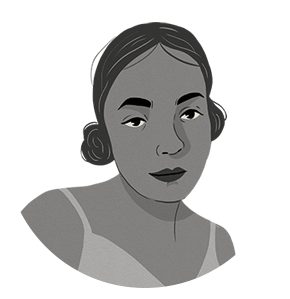
Zuhour Mahmoud est la stratège en communication de Kohl. Écrivaine, rédactrice et DJ à ses heures, elle est basée à Berlin. Son travail se concentre sur les approches critiques de la musique, de la technologie et de la politique et sur leurs cycles de vie au sein de la sphère numérique.
Regístrate para ser miembrx de AWID y conectar con más de 9,600 movimientos feministas globales y co-crear una variedad de plataformas y espacios diseñados especialmente para activistas y organizaciones, desde espacios de aprendizaje hasta espacios de solidaridad y encuentros entre miembrxs.
La comunidad de membresía de AWID está disponible como una app. Descarga la app y comienza a conectar con movimientos!
 |
 |

Notre rapport annuel 2013 retrace les temps forts du travail que nous avons réalisé au cours de l'année, afin de contribuer à l'avancement des droits des femmes et de l'égalité des genres à travers le monde.
When I was 6, I learned that my grandfather owned a movie theater. My mother recounted to me how it had opened in the early 1960s, when she was also about 6 years old. She remembered that they screened The Sound of Music on the first night...

You are welcome to submit up to 2 activities as the organizer. You can still be a partner on other applications.
Organizado por la Alianza para los Movimientos Feministas con AWID, Prospera y el Consorcio Walking the Talk.
🎧 Habrá interpretación disponible con Wordly. ¡No olvides traer tus auriculares!
🏢
Resourcing Hub (Sala de exposiciones).
Sesión 1: Financiar la solidaridad en tiempos de transición
📅 Martes, 28 de abril | 3:30 - 4:30 pm
Sesión 2: Financiamiento autónomo: Cómo los movimientos feministas se sostienen a sí mismos
📅 Miércoles, 29 de abril | 9:30 - 11:00 am
Sesión 3: Financiando futuros feministas: Un programa de conversación sobre lo que sigue para el financiamiento de los movimientos
📅 Jueves, 30 de abril | 10:30 - 11:30 am
This report looks back and celebrates the first year of AWID’s new strategic plan as we took our first steps towards our desired outcomes of supporting feminist movements to thrive, challenging anti-rights agendas and co-creating feminist realities.
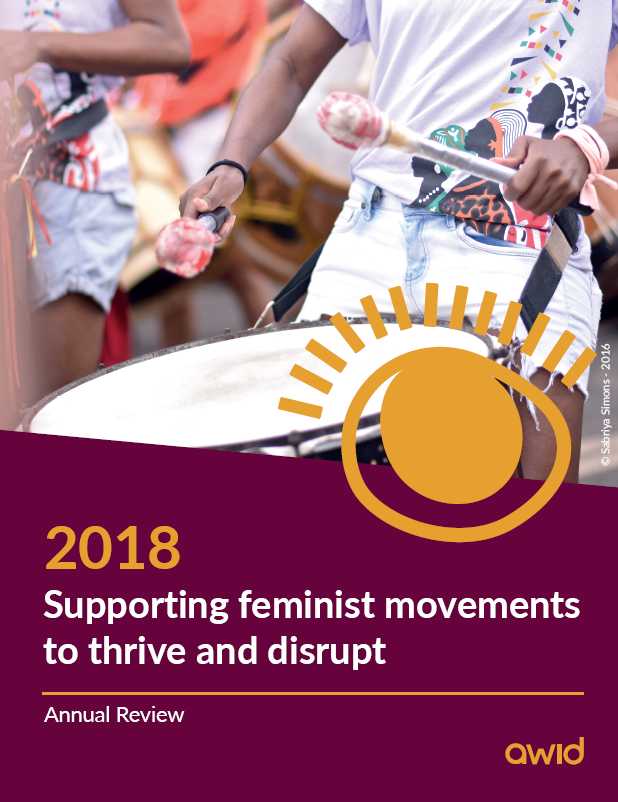
We worked with feminists to disrupt anti-rights agendas, achieving important victories fought and won within the United Nations system when ground-breaking language on structural discrimination, sexual rights, and states’ obligations were included in a number of resolutions. Yes, the multilateral system is in crisis and in need of serious strengthening but these victories are important as they contribute to the legitimacy of feminist demands, providing feminist movements with more pressure points and momentum to advance our agendas.
We tried and tested different ways to build knowledge with feminist movements through webinars, podcasts and ‘live’ conversations. We developed facilitation guides with popular educators to reclaim knowledge in the interest of social and gender justice, even about a topic as seemingly opaque as illicit funding flows. We commissioned blogs and opinions about how feminist groups fund and resource themselves and threw light on the threats facing our human rights systems.
Within AWID, we practiced and learned from our shared leadership approach, and told the story of the trials and tribulations of co-leading a global, virtual organization. We don’t have a definitive answer to what feminist leadership looks like, but we know, a year on, that a continued commitment to collective experimentation and learning has enabled us to keep building an organization that we are all excited to contribute to.
As we look back on this year, we want to thank all our friends and supporters, colleagues and companions, who have given their time and shared their wealth of knowledge and wisdom with us. We want to thank our members who helped frame our strategic plan and joined us to make feminist demands. We could not do this work without you.
هل اختبرتم من قبل لحظات من الصفاء الذهني العميق أثناء أو بعد ممارسة الجنس؟
📅 Du 27 au 28 avril
De Nami à Naarm est un rassemblement féministe intensif de deux jours visant à créer des ponts entre les féministes du Pacifique, aux Fidji, et la conférence Women Deliver. Leur programme comprendra des sessions de stratégie et d’apprentissage axées sur la justice de genre et environnementale, s’appuyant sur leur programme Power to Poverty ainsi que sur le travail des petit·e·s agriculteur·rice·s locaux·ales et des défenseur·euse·s des terres.
Our strategic plan “Feminist Realities” completed its final year at the end of 2022. For the past five years, this bold framework pushed us to go beyond feminist futures and to recognize the feminist solutions and ways of life that already exist in the here and now. Realities that must be uplifted, celebrated, and popularized. The Feminist Economies We Love multimedia story project and Our:Resource knowledge hub on autonomous ways to resource feminist activism are just two examples of this visionary work, always deeply collective with diverse feminist movements.
Download the full 2022 Annual review
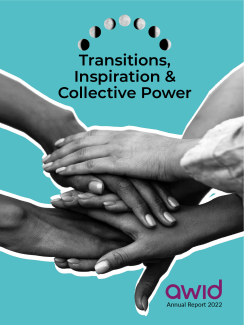
With this reflection on the year, we invite you to celebrate with us beautiful closures and promising beginnings. Change and transitions are an inseparable part of life and movements, which we seek to embrace with intention and care.
17 h, ce soir.


L’écriture sur l’invitation—
frêle et brusque—
je l’ai vue cinq fois en cinq ans.
Mon corps se réveille,
fébrile.
Je dois d’abord me baiser moi-même.
La marée est haute ce soir et
je
jouis.
Je veux tout ralentir,
goûter le temps et l’espace, les graver
en mémoire.
*
Je ne suis jamais allée dans cette partie de la ville auparavant.
Les endroits inconnus m’excitent,
la façon dont les membres et les veines et les os
résistent à la pourriture,
leur sort incertain.
Arrivée à la porte, je réfléchis à deux fois.
Le couloir est tout noir
et ça me fait faire une pause.
De l’autre côté,
un portail d’odeurs et de couleurs
s’ouvre comme une malédiction,
dans un après-midi ensoleillé.


La brise
fait danser mes cheveux,
pique leur curiosité,
les obligent à se déplacer.
J’entends le fauteuil roulant vrombir,
façonnant les ombres.
Puis je les vois :
un visage de lynx
et un corps comme le mien
et je me retrouve à désirer les deux
de nouveau.
La créature me fait signe d’approcher.
Ses gestes écrivent une phrase;
tandis que je m’avance,
je note ses détails :
flétrir, chair, bonheur
À sa commande, la vigne recouvre le couloir
étreignant des pierres chaudes,
serpentant le long du mur.
Cela devient un verbe,
« escalader »,
et je suis réorientée quand leurs griffes pointent
vers le lit de vigne au centre.
J’entends les roues derrière moi,
puis ce son.
Il résonne
comme aucun autre.
Ses longues ailes noires
montent vers le plafond
puis iel se précipite vers l’avant.
La vision féline scrute chaque détail,
chaque changement,
chaque désir.
Le désir peut-il liquéfier vos muscles?
Peut-il agir plus doux que le
plus puissant des tranquillisants?


Un lynx coud le monde
à travers nos différences,
tissant de la dentelle autour de mes genoux.
Le désir peut-il écraser la distance du monde, comprimant les secondes?
Iel se rapproche encore,
oeil de lynx rencontrant oeil humain,
reniflant l’air,
transformant le corps en
urgence.
Iel a battu des ailes.
Remuées,
les vignes s’emmêlent autour de ma taille/de mes pertes.
Sa langue amincit le temps,
terrains mouvants,
apaise, avec sa magie,
ce qui remue dessous.
Je vois le monde en toi,
et le monde est épuisé.
Puis iel plaide :
Laisse-moi me régaler de toi.