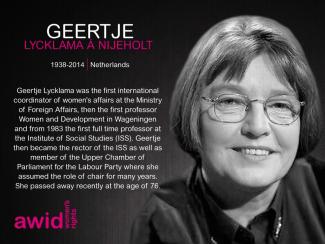
Geertje Lycklama à Nijeholt
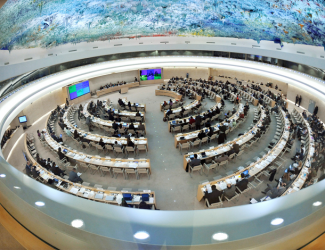
The Human Rights Council (HRC) is the key intergovernmental body within the United Nations system responsible for the promotion and protection of all human rights around the globe. It holds three regular sessions a year: in March, June and September. The Office of the UN High Commissioner for Human Rights (OHCHR) is the secretariat for the HRC.
Debating and passing resolutions on global human rights issues and human rights situations in particular countries
Examining complaints from victims of human rights violations or activist organizations on behalf of victims of human rights violations
Appointing independent experts (known as “Special Procedures”) to review human rights violations in specific countries and examine and further global human rights issues
Engaging in discussions with experts and governments on human rights issues
Assessing the human rights records of all UN Member States every four and a half years through the Universal Periodic Review
AWID works with feminist, progressive and human rights partners to share key knowledge, convene civil society dialogues and events, and influence negotiations and outcomes of the session.
Perçue comme une figure transformatrice sur les fronts de la lutte pour la libération et pour la liberté, Andaiye a été l’une des premières membres de l’Alliance du peuple travailleur (WPA), un parti socialiste en Guyane de lutte contre le régime autoritaire et participait activement à sa direction. Tout au long de sa vie, Andaiye a placé la justice pour la classe ouvrière et les droits des femmes vivant en milieu rural au centre de son action militante, et s’est battue pour l’élimination des obstacles ethniques entre les femmes indo-guyaniennes et celles afro-guyaniennes.
Andaiye fut l’une des membres fondatrices des Red Thread Women, une organisation de défense pour la juste rémunération du travail en soins réalisé par les femmes, en plus d’avoir travaillé à l’Université des Indes occidentales et avec l’organisation CARICOM. N’hésitant jamais à défier les gouvernements, elle a pointé du doigt les déséquilibres en matière de genre dans les conseils de l’État, les lois discriminatoires à l’égard des travailleur·euse·s du sexe, réclamé le droit à l’avortement en Jamaïque et s’est érigée contre les accords commerciaux, tels que le Marché unique des Caraïbes (CSME) qui permettait la libre circulation des travailleuses domestiques migrantes mais n’octroyait pas ce même droit à leurs enfants.
Elle a publié plusieurs essais universitaires, rédigé des articles d’opinion et révisé les derniers ouvrages de Walter Rodney, l’activiste politique guyanien et coleader du WPA assassiné en 1980. Survivante du cancer, Andaiye a été l’une des fondatrices de la Ligue guyanienne contre le cancer et du Groupe d’action des survivant·e·s du cancer. Elle a également siégé au conseil exécutif de l’Association caribéenne pour la recherche et l’action féministes (CAFRA), dirigé le Help and Shelter et été membre du conseil de la Commission nationale guyanienne pour les femmes. Elle a par ailleurs reçu de nombreux prix, dont le prestigieux Golden Arrow of Achievement (quatrième prix le plus important du Guyana).
Andaiye est décédée le 31 mai 2019, à l’âge de 77 ans. Les nombreux hommages que lui ont rendus des activistes, ami·e·s et celles et ceux que sa vie aura inspiré·e·s ont parlé avec éloquence de son incroyable héritage et de la grandeur de son humanité.
En voici quelques-uns :
“« Andaiye m’a profondément marquée... elle représenttait tellement de choses pour moi : une éducatrice, une combattante, elle m’a appris l’autocritique, à réfléchir plus clairement, elle m’a enseigné la survie, ce qu’est le courage sans limite, la compassion, à dépasser les apparences et traiter les gens comme des gens, sans se laisser impressionner par le statut, la classe, la race... rien de tout ça. » Peggy Antrobus, activiste féministe, auteure, universitaire, La Barbade
« Le genre d’idéalisme confiant que démontrait Andaiye, cette disposition à affronter le monde et une croyance tenace qu’on pouvait vraiment le changer... Cette politique de l’espoir... Comment honorer sa vie, son héritage et sa mémoire autrement qu’en poursuivant le travail éthiquement et en continuant à s’autocritiquer? Et de faire en sorte de placer le travail de soins des femmes au centre. » - Tonya Haynes, La Barbade
« Je peux l’entendre se moquer de notre engouement collectif. Donc, je ris tout en pleurant. Chapeau bas, chère Andaiye, et merci pour tout. Que le voyage de ton esprit soit aimant et lumineux. Passe le bonjour à Walter et aux ancêtres. » - Carol Narcisse, La Jamaïque
يتبيّن من هذه التويتات الفكاهة المقرونة بالإثارة والاهتياج الجنسيّ، التي تتّسم بها المقاربة النسوية لكتابة الرسائل ذات المضامين الجنسية، دون أن تُسقط عن نفسها الالتزام بالمساواة والعدالة.
En s’appuyant sur nos 20 années d’efforts pour la mobilisation de davantage de financements de meilleure qualité pour des changements sociaux menés par des féministes, l’AWID vous invite à répondre à la nouvelle version de notre enquête phare intitulée WITM
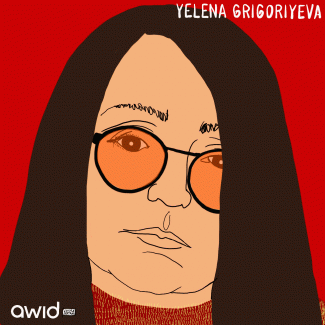
She was part of democratic, anti-war and LGBT movements. In her activism, Yelena was a fierce critic of President Vladimir Putin and his administration, expressing her opposition against Russia’s annexation of Ukraine’s Crimea peninsula and the ill-treatment of prisoners.
Yelena came out as bisexual earlier in 2019.
"Her coming out was a surprise to me, and I didn't approve of it. I told her 'Listen, Lena, you already have a target painted on you because of your political activity. You've just pinned another to your chest."
- Olga Smirnova
Yelena did receive multiple death threats and according to some of her acquaintances, was listed on a homophobic website that called on its visitors to hunt down LGBT persons. She reported the threats to the police, however the Russian state failed to provide protection.
But even in a society where political opposition, as well as members of the LGBT community and advocates for their rights, face continuous and increasing violence, Yelena kept campaigning for social justice and equality.
“She did not miss a single action. And they detained her so often that I already lost count,”
- Olga Smirnova (fellow opposition activist and friend).
Yelena was murdered on 21 July 2019, not far from home. A suspect was arrested but according to some sources, many friends and fellow activists believe that the suspect is a scapegoat and that this was a targeted political killing.
For Yelena’s relatives and friends, her case remains unsolved even though the suspect confessed.
In 2013, Russia passed legislation banning the spreading of what it described as ‘gay propaganda’. In 2014, Human Rights Watch published a report relating to this.
L'exposition #MeToo en Chine a été organisée pour la première fois en 2019 et a effectué une tournée dans 5 villes. L'objectif de l'exposition est de mettre davantage en avant les expériences personnelles des victimes et des activistes et, en prenant part à ces histoires, d'inspirer notre public à se joindre à la lutte. L'exposition est elle-même devenue une partie de la lutte #MeToo; elle a fait face à d’innombrables défis lors de sa tournée à travers la Chine et a même risqué la fermeture à plus d'une occasion.
Cuando la gente se reúne a escala global, como personas individuales y como movimientos, se genera una fuerza arrolladora. Únete a nosotrxs en Bangkok, Tailandia, y de manera virtual, en diciembre de 2024.
Actualmente contamos en nuestra membresía con cientos de organizaciones destacadas e innovadoras que trabajan en temas relacionados con los derechos de las mujeres y el desarrollo. Los criterios de afiliación son los mismos que para las personas a título individual, aunque las cuotas y los beneficios son diferentes, con el fin de atender a las necesidades de las instituciones afiliadas.
Magaly Quintana era conocida por muchxs en Nicaragua como 'La Maga'. Fue una historiadora feminista, activista y defensora inquebrantable de los derechos de las mujeres que exigía justicia para las víctimas de femicidio.
Magaly se comprometió a documentar y elaborar estadísticas sobre las mujeres y niñas que fueron asesinadas como resultado de la violencia sexual en el país.
Magaly también criticó al gobierno por la reforma de la Ley 779 que trata la violencia contra las mujeres. Como resultado del arduo trabajo de los movimientos de mujeres nicaragüenses, esta ley, antes de su reforma, incluía importantes disposiciones para penalizar el femicidio. Magaly argumentó que estas reformas legislativas debilitaban la ley, y limitaban la definición de los femicidios a homicidios, invisibilizando, como resultado, los delitos violentos contra las mujeres.
La organización feminista de Magaly se fundó a principios de los ‘80. Fue la directora de Mujeres Católicas por el Derecho a Decidir, que defiende el derecho al aborto terapéutico tras su prohibición en 2006. En 2018, apoyó las protestas contra el gobierno de Daniel Ortega.
Magaly nació en mayo de 1952 y falleció en mayo de 2019.
"Hasta luego, mi querida Magaly Quintana. Muchas gracias, gracias por tu legado. Te veremos de nuevo, tan fuerte y poderosa como siempre."- Erika Guevara Rosas (Directora Americana de Amnistía Internacional).
Nicole Barakat is a queer femme, SWANA artist born and living on Gadigal Country (so-called Sydney, Australia). She works with deep listening and intuitive processes with intentions to transform the conditions of everyday life. Her work engages unconventional approaches to art-making, creating intricate works that embody the love and patience that characterises traditional textile practices.
Apprenez-en davantage sur les prochains événements CSW69 co-organisés par l'AWID ci-dessous
Janet Benshoof était une avocate des droits humains oeuvrant aux États-Unis et défenseure de l’égalité des femmes et de leurs droits sexuels et reproductifs.
Elle a milité pour l’élargissement de l’accès à la contraception et à l’avortement dans le monde entier, et s’est battue contre des décisions anti-avortement dans le territoire américain de Guam. Arrêtée en 1990 pour son opposition à la loi anti-avortement la plus restrictive de son pays, elle a remporté une mise en demeure [MB1] au tribunal local à Guam qui a bloqué la loi, pour ensuite remporter l’affaire devant la Cour d’Appel de Ninth Circuit, décision qui devait supprimer définitivement celle-ci.
« Les femmes à Guam sont dans une situation absolument dramatique. Je n’ai nullement l’intention d’arrêter d’en parler », Janet Benshoof pour People Magazine
Janet a créé plusieurs précédents juridiques, dont l’approbation par l’US Food and Drug Administration de la contraception d’urgence, ainsi que l’application du droit international afin de garantir leurs droits aux victimes de viol lors des poursuites pour crimes de guerre de l’époque de Saddam Hussein, devant la Cour Suprême iraqienne.
Janet était présidente et fondatrice du Global Justice Center, ainsi que fondatrice du Center for Reproductive Rights, la première organisation internationale pour les droits humains, centrée sur le choix reproductif et l’égalité. Elle a siégé pendant 15 ans en tant que directrice du projet pour les droits reproductifs de l’American Civil Liberties Union, où elle a mené de nombreuses procédures juridiques qui ont contribué à façonner la loi constitutionnelle des États-Unis sur l’égalité de genre, la liberté d’expression et les droits reproductifs.
« Janet était connue pour son brillant esprit juridique, son sens de l’humour vif et son courage face à l’injustice », Anthony D. Romero.
Nommée l’une des « 100 avocat·e·s les plus influent·e·s d’Amérique » par le National Law Journal, Janet a reçu de nombreux prix et distinctions.
Née en mai 1947, Janet est décédée en décembre 2017.
Este proyecto se desarrolla en colaboración con:


✉️ Sur inscription uniquement. Inscrivez-vous ici
📅 Mercredi 12 mars 2025
🕒 17.00h-19.00h EST
🏢 Chef's Kitchen Loft with Terrace, 216 East 45th St 13th Floor New York
Organisé par : Women Enabled International et AWID
The Monterrey Conference on Financing for Development marked the beginning of discussions on the Financing for Development agenda.