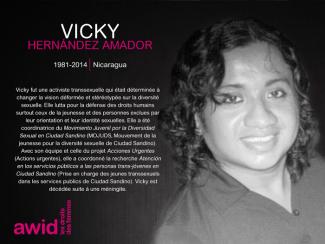
Vicky HernaÌndez Amador

In September 2016, the 13th AWID international Forum brought together in Brazil over 1800 feminists and women’s rights advocates in a spirit of resistance and resilience.
This section highlights the gains, learnings and resources that came out of our rich conversations. We invite you to explore, share and comment!
One of the key takeaways from the 2016 Forum was the need to broaden and deepen our cross-movement work to address rising fascisms, fundamentalisms, corporate greed and climate change.
With this in mind, we have been working with multiple allies to grow these seeds of resistance:
And through our next strategic plan and Forum process, we are committed to keep developing ideas and deepen the learnings ignited at the 2016 Forum.
AWID Forums started in 1983, in Washington DC. Since then, the event has grown to become many things to many peoples: an iterative process of sharpening our analyses, vision and actions; a watershed moment that reinvigorates participants’ feminisms and energizes their organizing; and a political home for women human rights defenders to find sanctuary and solidarity.
AGROECOLOGY AND FOOD SOVEREIGNTY AS RESISTANCE |
Today, large-scale industrial food production uses single-crop plantations, genetically modified organisms and other pesticides that destroy the land and knowledge of local communities. |
Agroecology is a resistance to corporate-driven agriculture. It prioritizes smaller scale agriculture, multiple crops and diversified food production, and the centering of local knowledge and practices. Agroecology goes hand-in-hand with demands for food sovereignty, or the “right of peoples to healthy and culturally appropriate food produced through ecologically sound and sustainable methods, and their right to define their own food and agriculture systems”(Via Campesina, Declaration of Nyéléni).
The role of women, indigenous and rural communities and people of color from the Global South is absolutely essential when it comes to food systems. Feminist agroecologists are working to dismantle oppressive gender roles and systems of patriarchy embedded within food production. As shown by the heroines of NSS, they are generating a liberatory agroecology by strengthening community resilience, empowering women peasants and farmers, and preserving local traditions, territories, and knowledge of food-producing communities.
Le financement extérieur inclut les subventions et autres formes de financement de la part de fondations philanthropiques, de gouvernements, de financeurs bilatéraux, multilatéraux ou d’entreprise et de donateur·rices individuel·les, qu’elles et ils soient de votre pays ou de l’étranger. Il exclut les ressources que les groupes, organisations et/ou mouvements génèrent de manière autonome (ressource en anglais), telles que les cotisations d’adhésion, contributions volontaires du personnel, de membres et/ou de soutiens, les collectes de fonds communautaires, les locations de salles et ventes de services. Les définitions des différents types de financement, ainsi que de courtes descriptions des différents bailleurs de fonds, sont incluses dans l’enquête pour une meilleure compréhension.

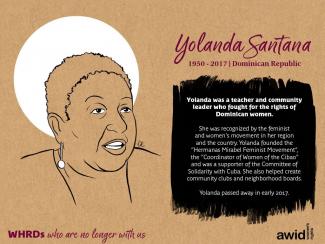
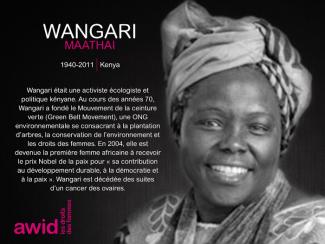
Les trois défenseuses des droits humains de la région Pacifique auxquelles nous rendons hommage cette année ont travaillé dans les médias, fait campagne pour les droits des personnes handicapées ou plaidé en faveur des droits des femmes. Leur contribution restera irremplaçable et nous leur rendons honneur. Nous vous invitons à vous joindre à nous pour commémorer la vie de ces femmes, leur travail et l’héritage qu’elles nous ont laissé. Faites circuler ces mèmes auprès de vos collègues et amis ainsi que dans vos réseaux et twittez en utilisant les hashtags #WHRDTribute et #16Jours.
S'il vous plaît cliquez sur chaque image ci-dessous pour voir une version plus grande et pour télécharger comme un fichier


Yes, the survey is accessible to people with a diverse range of hearing, movement, sight, and cognitive abilities.
.


Este kit inclui mensagens modelo apropriadas para Twitter, Facebook e LinkedIn, além de imagens que podem ser usadas para acompanhar essas mensagens.
Este kit é muito simples de usar. Basta seguir estes passos para:
Combine estas mensagens com as imagens para Twitter
Eu vou para o #AWIDForum. O lugar para conectar com movimentos de direitos das mulheres & justiça social. Vamos!: http://forum.awid.org/forum16/pt-br
Contando os dias para re-imaginar #FuturosFeministas com outr@s ativistas por direitos das mulheres & justiça social @ #AWIDForum! Participe: http://forum.awid.org/forum16/pt-br
Estou muito animada/o para participar do #AWIDForum em Maio, e agora já podemos nosinscrever! Vamos! http://forum.awid.org/forum16/pt-br
As inscrições já estão abertas para o #AWIDForum! Costa do Sauípe, Brasil, 8 de 11 set. de 2016 http://forum.awid.org/forum16/pt-br
Participe do #AWIDForum, um encontro histórico entre ativistas de todo o mundo em defesa dos direitos das mulheres & justiça social http://forum.awid.org/forum16/pt-br
Participe do #AWIDForum para comemorar as conquistas dos movimentos sociais & analisar aprendizados para seguir em frente http://forum.awid.org/forum16/pt-br
#AWIDForum – mais que um evento, uma chance de romper com a opressão & avançar a justiça http://forum.awid.org/forum16/pt-br
Participe do #AWIDForum para comemorar, traçar estratégias, revigorar os movimentos sociais e a nós mesm@s http://forum.awid.org/forum16/pt-br
Vamos construir #FuturosFeministas junt@s. Inscreva-se no #AWIDForum 2016. Costa do Sauípe, Brasil http://forum.awid.org/forum16/pt-br
Una-se a nós para re-imaginar & co-criar #FuturosFeministas no #AWIDForum 2016. Inscreva-se http://forum.awid.org/forum16/pt-br
#FuturosFeministas: aproveite o momento @ #AWIDForum para avançar visões compartilhadas por um mundo mais justo http://forum.awid.org/forum16/pt-br
Seremos 2.000 ativistas de movimentos sociais @ #AWIDForum, traçando estratégias para nossos #FuturosFeministas http://forum.awid.org/forum16/pt-br
Nós somos mais do que uma luta por uma só bandeira. Una-se a nós no #AWIDForum http://forum.awid.org/forum16/pt-br
Participe do #AWIDForum, um espaço para criar estratégias entre movimentos sociais & alavancar o nosso poder coletivo http://forum.awid.org/forum16/pt-br
Mobilize solidariedade & poder coletivo entre movimentos sociais no #AWIDForum http://forum.awid.org/forum16/pt-br
Romperas barreiras entre os movimentos sociais. Re-imaginar & co-criar nossos futuros. Tudo isso no #AWIDForum http://forum.awid.org/forum16/pt-br
Solidariedade é um verbo. Vamos colocá-lo em ação no #AWIDForum http://forum.awid.org/forum16/pt-br
Doadores engajados com os direitos das mulheres e movimentos sociais no #AWIDForum: http://forum.awid.org/forum16/pt-br
Mídia e movimentos sociais: amplificando #FuturosFeministas no #AWIDForum: http://forum.awid.org/forum16/pt-br
Combine estas mensagens com as imagens para Facebook
Nota: estas mensagens também podem ser usadas no Twitter via Mensagens Diretas privadas, que não têm limite de caracteres. Você pode compartilhar as imagens preparadas e adicionar estas mensagens modelo.
A espera acabou! já podemos nos inscrever no Fórum AWID 2016. Será maravilhoso reconectar com companheiras/os ativistas e re-imaginar nossos futuros feministas. Vejo vocês lá em Sauípe! http://forum.awid.org/forum16/pt-br
Estou muito animada/o para participar do Fórum AWID em Maio, e agora já podemos nosinscrever! Vamos! http://forum.awid.org/forum16/pt-br
Estou curtindo a ideia de re-imaginar futuros feministas com 2.000 pessoas de inúmeros movimentos incríveis de direitos das mulheres e justiça social no Fórum AWID. Inscreva-se e a gente se vê por lá! http://forum.awid.org/forum16/pt-br
As inscrições já estão abertas para o Fórum AWID 2016 na Costa do Sauípe, Bahia! Este não é apenas qualquer evento – é um espaço único para ativistas em defesa dos direitos das mulheres e justiça social de todo o mundo se encontrarem e re-imaginarem nossos futuros feministas. Você não vai querer perder! http://forum.awid.org/forum16/pt-br
Una-se a nós no Fórum AWID 2016 na Bahia! Ativistas e movimentos de todo o mundo irão se encontrar para comemorar, criar estratégias, inspirar e renovar nossas lutas coletivas e a nós mesm@s. Inscreva-se agora! http://forum.awid.org/forum16/pt-br
O Fórum AWID 2016 será um encontro histórico entre ativistas de todo o mundo por direitos das mulheres & justiça social. Una-se a nós lá para romper as barreiras, fortalecer a solidariedade e alavancar nosso poder coletivo. Inscreva-se agora! http://forum.awid.org/forum16/pt-br
O Fórum AWID 2016 será um encontro histórico entre ativistas de todo o mundo em defesa direitos das mulheres & justiça social. Una-se a nós lá para romper as barreiras, fortalecer a solidariedade e alavancar nosso poder coletivo. Inscreva-se agora! http://forum.awid.org/forum16/pt-br
Download das suas imagens favoritas

El tiempo estimado para responder la encuesta es de 30 minutos.
.
Après avoir évalué la capacité et les objectifs de recherche de votre organisation, vous pourriez choisir entre autres méthodes de collecte de données, de mener une enquête pour vos recherches.
Dans cette section :
- Pourquoi réaliser un sondage ?
- Déterminez la population cible
1. Sondage en ligne
2. Sondage sur papier- Élaborez vos questions
1. Questions courtes et claires
2. Langage simple et universel
3. Questions « ouvertes » et « fermées »
4. Organisation logique
5. Moins de 20 minutes
6. Simple et intéressant- Testez et traduisez
1. Vos conseiller-ère-s
2. Rédaction et mise à l’essai
3. Traduction- Ciblez la population pertinente
1. Taille de l’échantillon
2. Niveau de participation
3. Bases de données et liste de contacts
Un sondage constitue un excellent moyen de rassembler des informations sur chacune des organisations afin de capter les tendances collectives.
Par exemple, la taille du budget d’une organisation ne vous renseigne pas beaucoup sur une tendance de financements destinés aux droits des femmes. En revanche, si vous connaissez les budgets de 100 ou 1 000 organisations, vous pouvez commencer à tracer le portrait de la situation collective du financement à l’appui des droits des femmes.
Alors que vous élaborez votre sondage, gardez à l’esprit le cadre de référence de votre recherche établi dans la section précédente.
N’oubliez pas : Votre cadre vous aide à déterminer quels renseignements vous tentez d’obtenir avec votre sondage. Les données recueillies devraient vous permettre de réaliser vos objectifs, de répondre à vos questions principales et de créer vos produits finaux.
C'est une étape importante : plus vous identifiez clairement la population que vous souhaitez sonder, plus vous pourrez affiner vos questions.
Selon vos objectifs de recherche, vous pourriez créer des sondages distincts auprès des organisations de droits des femmes, des baillerus de fonds et des donateurs. Vous pourriez également concentrer votre sondage sur les groupes de femmes et mener des interviews auprès des bailleurs de fonds et des donateurs, puisque la réalisation d’un sondage auprès de chaque population peut exiger des ressources considérables.
Il se peut que les questions posées aux groupes de femmes diffèrent de celles que vous posez aux bailleurs de fonds. Si vous prévoyez de sonder plus d’une population, nous vous invitons à adapter votre collecte de données en fonction de chacune d’entre elles.
Dans le même temps, certaines des questions principales posées à chaque population pourraient se chevaucher pour permettre une analyse comparative des réponses obtenues.
Si vous pouvez atteindre votre population cible en ligne, il est utile et efficace d’élaborer un sondage en ligne.
Nous recommandons deux outils en ligne, qui proposent des versions gratuites :
Survey Gizmo vous permet de convertir vos données en format accessible SPSS, un logiciel statistique utile dans le cadre d’une analyse avancée des données.
La-les personne-s chargée-s de l’analyse des données sera-seront la-les mieux placé-e-s pour déterminer quels sont les outils les plus appropriés à votre recherche en fonction des compétences du personnel et des plans d’analyse.
Pour faciliter l’accessibilité, considérez la possibilité de produire un formulaire en version PDF, que vous pourrez joindre à un courriel. Cela permettra aux organisations qui ont des connexions Internet sporadiques, ou à celles qui doivent payer son utilisation à la minute, de télécharger l’sondage et de la remplir hors ligne.
Vous pourriez décider que l’approche en ligne n’est pas assez accessible ou inclusive pour la population visée.
Dans ce cas, vous devrez élaborer un sondage sur papier et des méthodes pour atteindre les populations qui ne sont pas « branchées » (par le truchement d’activités communautaires ou par la poste avec des enveloppes-réponses préaffranchies).
Facilitez la tâche de ceux et celles qui répondront à votre sondage.
Si les questions sèment la confusion ou exigent des réponses complexes, vous risquez de constater que les gens ne terminent pas le sondage ou encore qu’ils fournissent des réponses inutilisables pour votre analyse.
Veillez à ce que les questions ne demandent qu’un élément d’information à la fois.
Par exemple :
Plusieurs mots ou acronymes qui vous sont familiers pourraient être totalement inconnus des personnes qui répondront à votre sondage, par exemple, « mobilisation des ressources », « ODD » ou « S&E ». Assurez-vous de choisir un langage plus universel pour formuler vos questions.
S’il vous faut employer le jargon, des phrases ou des mots que vos collègues connaissent bien, mais qui ne sont pas largement adoptés, fournissez une définition qui rendra votre sondage plus facile à comprendre.
Assurez-vous d’écrire en toutes lettres les acronymes que vous utilisez. Par exemple, si vous parlez de S&E, écrivez ou dites « Suivi et évaluation ».
Questions fermées :
Une seule réponse est possible (comme « oui » ou « non » ou encore un nombre). Les personnes qui remplissent le sondage ne peuvent répondre en utilisant leurs propres termes et devront généralement choisir parmi des catégories prédéterminées que vous aurez créées, ou encore saisir un nombre précis. Les réponses aux questions fermées sont plus faciles à mesurer collectivement et elles sont fréquemment quantitatives.
Exemple d’une question fermée : Quel est le budget de votre organisation ?
Questions ouvertes :
Il s’agit de questions qualitatives, souvent descriptives. Les personnes répondent à ces questions en utilisant leurs propres termes. Ce sont des questions qui se prêtent mieux aux interviews qu’aux sondages.
Ces questions sont plus difficiles à analyser sur le plan collectif que ne le sont les questions fermées, particulièrement si votre échantillon est vaste. Cependant, si les questions ouvertes sont très précises, les réponses seront plus faciles à analyser.
Concevez Autant que possible vos questions de sondage de telle sorte que les personnes qui y répondront pourront faire leur choix à partir d’une liste d’options, plutôt que de poser des questions ouvertes. Vous gagnerez du temps sur le plan du nettoyage et de l’analyse des données.
Exemple d’une question ouverte : Cette année, à quels défis particuliers avez-vous fait face en matière de levée de fonds ?
Familiarisez-vous avec les différents genres de questions
Il existe plusieurs manières de poser des questions ouvertes. En voici quelques exemples, que vous pouvez étudier pour déterminer le genre de questions qui correspond le mieux aux types de données que vous souhaitez recueillir :
En savoir plus sur les différents types de questions
Si vous prévoyez de mener cette recherche à intervalles réguliers (par exemple, tous les deux ans), nous vous recommandons d’élaborer un sondage de base que vous pourrez répéter afin de suivre les tendances au fil du temps.
Ensemble 1 : Questions de présélection
Cette présélection permet d’identifier les personnes pouvant répondre au sondage.
Les sondages en ligne que nous avons proposés vous permettent de mettre fin au sondage si la personne qui y répond ne satisfait pas à vos critères d’admissibilité. Au lieu de remplir le sondage, ces personnes seront dirigées vers une page où on les remercie de leur intérêt, tout en leur expliquant que ce sondage est destiné à un type différent de répondant-e-s.
Par exemple, il se peut que vous ne souhaitiez sonder que les groupes de droits des femmes d’un lieu particulier. Les questions de présélection peuvent déterminer le lieu où se trouve la personne et éviter que les gens qui sont autre part ne poursuivent le sondage.
Ensemble 2 : Questions standardisées de base sur la démographie
Ces questions recueillent des données propres à la personne qui répond, comme le nom et le lieu de l’organisation. Ces données peuvent chevaucher les réponses aux questions de présélection.
Si les ressources le permettent, vous pouvez stocker ces réponses dans une base de données et ne poser ces questions que la première année où une organisation participe à votre sondage.
Ainsi, lorsque vous répèterez le sondage ultérieurement, les organisations pourront remplir plus facilement et rapidement le formulaire, augmentant ainsi les chances qu’il soit complètement rempli.
Ensemble 3 : Questions standardisées et obligatoires sur le financement
Ces questions vous permettront de réaliser le suivi sur la durabilité des revenus et du financement. Si votre sondage est menée annuellement ou tous les deux ans, vous pourrez ainsi capter les tendances au fil du temps.
Ensemble 4 : Questions sur des enjeux particuliers
Ces questions tiennent compte du contexte actuel. Elles peuvent se référer aux changements survenus sur la scène politique ou économique. Elles peuvent être facultatives et liées au financement, portant notamment sur les attitudes à l’égard de la levée de fonds.
Par exemple, l'enquête mondiale WITM de l’AWID en 2011 posait des questions sur les nouvelles tendances en matière de financements que le secteur privé accordait aux « femmes et aux filles ».
Les sondages les plus courts sont les meilleurs : votre sondage ne devrait pas dépasser 20 minutes afin de respecter l’emploi du temps des répondants-tes et de leur permettre d’y répondre complètement.
Il peut être tentant de poser une multitude de questions en espérant recueillir un grand nombre d’informations. Cependant, les sondages trop longs sont fatigants et risquent de lasser les personnes répondantes ou encore de les éloigner de votre organisation.
De plus, plus vous aurez de questions plus votre sondage sera laborieux à analyser.
Conseils généraux
- Demandez des détails budgétaires précis plutôt que d’offrir une échelle (selon notre expérience, les montants spécifiques sont plus utiles lors de l’analyse).
- Précisez la devise ! Si nécessaire, dans les réponses sur les aspects financiers, demandez à tout le monde de convertir leurs réponses dans la même devise ou demandez aux personnes qui répondent au sondage de préciser la devise qu’elles utilisent.
- Assurez-vous de recueillir assez de renseignements démographiques sur chaque organisation, afin de contextualiser les résultats et de nuancer les tendances dégagées.
Par exemple : Si vous analysez où est l’argent dans un pays particulier, il sera utile de savoir d’où provient chacune des organisations et/ ou à quel niveau (rural, urbain, local, national) elles évoluent. Cela permet de capter les tendances les plus importantes, comme la plus grande disponibilité des fonds pour les groupes urbains.
Le fait de mobiliser vos partenaires dès le départ vous permettra d’établir des relations plus approfondies et assurera une recherche plus inclusive et de meilleure qualité.
Ces personnes vous fourniront des commentaires sur la version préliminaire de votre sondage, piloteront les mises à l’essai et examineront l’analyse préliminaire des résultats de le sondage et d’autres collectes de données.
Ces conseiller-ère-s annonceront également le sondage à leurs publics lorsqu’elle sera prête à être lancée. Si vous prévoyez un sondage en plusieurs langues, assurez-vous de compter sur des partenaires qui parlent ces langues.
Si vous choisissez de collecter vos données à l’aide d’un sondage et d’interviews, les partenaires qui vous auront guidé dans la conception de votre sondage peuvent aussi être interviewé-e-s.
Lorsque la version préliminaire de votre sondage est terminée, testez-la auprès de vos partenaires avant de la présenter à votre population cible. Vous serez ainsi en mesure de détecter et d’ajuster les problèmes techniques ou les questions prêtant à confusion.
De plus, vous pourrez mesurer concrètement le temps nécessaire pour remplir le formulaire.
Lorsque le sondage est achevé et qu’il a été testé dans votre langue maternelle, il peut être traduit.
Assurez-vous de tester les versions traduites de votre sondage. Dans un souci de clarté, certaines des personnes qui testeront le sondage devront la traduire dans leur langue maternelle.
La taille de l’échantillon représente le nombre de personnes ayant rempli votre sondage.
Votre échantillon devrait refléter les caractéristiques de la population plus vaste que vous souhaitez analyser.
Par exemple : Imaginons que vous souhaitez analyser les millions de groupes de droits des femmes à Valyria, mais vous n’avez ni le temps ni les ressources pour sonder chaque groupe.
Vous pouvez à la place ne sonder que 500 groupes. Ces groupes seront l’échantillon représentatif de tous les groupes de femmes de la région.
Tailles d’échantillons recommandées
Bien qu’il ne soit pas nécessaire de déterminer la taille exacte de votre échantillon avant de lancer votre sondage, le fait de l’avoir estimé vous permettra de déterminer le moment où vous aurez atteint un nombre suffisant de répondant-e-s ou si vous devez prévoir un prolongement des dates de le sondage possible, si vous estimez que vous n’avez pas contacté assez de personnes.
Un élément qui est encore plus important que la taille de l’échantillon est le nombre de personnes de la population ciblée qui seront en mesure de participer à un sondage.
Si de larges portions ou d’importantes tranches de la population sont systématiquement exclues (soit en raison de la langue, de l’accessibilité, du moment, de problèmes de base de données, d’accès à l’Internet ou d’autres facteurs), il est impossible de mesurer précisément la fiabilité statistique des données de sondage.
Dans notre exemple : vous devez vous assurer que tous les groupes de femmes de Valyria ont eu l’occasion de participer à le sondage.
Si un segment des groupes de femmes de Valyria n’utilise par l’Internet, et que vous recrutez des participant-e-s uniquement à partir de méthodes en ligne, vous ignorez alors dans votre échantillon final une tranche considérable de la population ciblée. Par conséquent, votre échantillon n’est pas représentatif de tous les groupes de femmes de Valyria.
Vous ne pouvez tirer de conclusions exactes de vos données si des tranches de population sont exclues de votre échantillon. L’utilisation d’un échantillon représentatif, vous permettra d’éviter cette erreur.
Pour connaître la composition des groupes de femmes dans votre région de recherche (région, population, etc.), il pourrait être utile d’examiner les bases de données.
C’est en connaissant la composition générale des groupes de femmes que vous avez l’intention de cibler que vous aurez une meilleure idée de l’allure que prendra votre échantillon : il devrait représenter une mini-version de la population d’ensemble.
Une fois que les personnes auront répondu au sondage, vous pourrez mesurer si la population que vous avez touchée (votre taille d’échantillon) correspond à la composition de l’ensemble de la population ciblée. Si ce n’est pas le cas, vous pourriez choisir de déployer des activités de sensibilisation auprès des tranches de population qui selon vous ont été exclues ou prolonger la période d’ouverture de votre sondage.
L’incertitude face à la représentativité de votre échantillon ne doit pas vous paralyser : faites tous les efforts pour étendre votre recherche le plus loin et le plus largement possible.

4. Recueillez et analysez vos données
Only 18% of trans and travesti people in Argentina have access to formal work.