Co-Creating Feminist Realities
What are Feminist Realities?
Feminist Realities are the living, breathing examples of the just world we are co-creating. They exist now, in the many ways we live, struggle and build our lives.
Feminist Realities go beyond resisting oppressive systems to show us what a world without domination, exploitation and supremacy look like.
These are the narratives we want to unearth, share and amplify throughout this Feminist Realities journey.
Transforming Visions into Lived Experiences
Through this initiative, we:
-
Create and amplify alternatives: We co-create art and creative expressions that center and celebrate the hope, optimism, healing and radical imagination that feminist realities inspire.
-
Build knowledge: We document, demonstrate & disseminate methodologies that will help identify the feminist realities in our diverse communities.
-
Advance feminist agendas: We expand and deepen our collective thinking and organizing to advance just solutions and systems that embody feminist values and visions.
-
Mobilize solidarity actions: We engage feminist, women’s rights and gender justice movements and allies in sharing, exchanging and jointly creating feminist realities, narratives and proposals at the 14th AWID International Forum.
The AWID International Forum
As much as we emphasize the process leading up to, and beyond, the four-day Forum, the event itself is an important part of where the magic happens, thanks to the unique energy and opportunity that comes with bringing people together.
We expect the next Forum to:
-
Build the power of Feminist Realities, by naming, celebrating, amplifying and contributing to build momentum around experiences and propositions that shine light on what is possible and feed our collective imaginations
-
Replenish wells of hope and energy as much needed fuel for rights and justice activism and resilience
-
Strengthen connectivity, reciprocity and solidarity across the diversity of feminist movements and with other rights and justice-oriented movements
Learn more about the Forum process
We are sorry to announce that the 14th AWID International Forum is cancelled
Given the current world situation, our Board of Directors has taken the difficult decision to cancel Forum scheduled in 2021 in Taipei.
Related Content
January 2015: 1st drafting session on the outcome document for the 3rd FfD Conference
The 1st drafting session on the outcome document for the 3rd Financing for Development Conference
- In January 2015 a series of drafting sessions towards the final outcome document started at UN headquarters in New York.
- Prior to the first drafting session the co-facilitators of the Addis conference preparatory process presented an elements paper for the so-called “zero-draft” outcome document, as the basis for the intergovernmental negotiations of the outcome document.
- During the sessions, women’s rights organisations emphasised the need to treat the FfD and means of implementations (MOI) under the post 2015 processes separately, because FfD provides a unique opportunity for states to address the structural causes of inequality.
Snippet - CSW68 - AWID at CSW Post - EN

How much does registration cost?
This information will only be available when registration opens.
Snippet - WITM Why now_col 2 - EN
Resourcing feminist movements is fundamental to securing a more just and peaceful present and liberated future.
While funders committed significantly more money to gender equality over the last decade, still only 1% of philanthropic and development funding has actually been moved to directly resource feminist-led social change.
In solidarity with movements that continue to be invisibilized, marginalized and without access to core, long-term, flexible and trust-based funding, the WITM survey highlights the actual state of resourcing, challenges false solutions, and points to how funding models must change for movements to thrive and meet the complex challenges of our times.
I am an individual activist, not working with any group, organization and/or movement at this moment, should I still fill the survey?
No, we appreciate your work but are not asking for responses from individuals at this time.
Do I have to respond to all questions at once or can I come back to complete it later?
If you wish to save your responses and come back to the survey later, you are able to do this whenever needed. KOBO will save your draft responses on the top left corner of the survey page and reload your record when you return to the survey. Just make sure to continue from the same computer and browser.
Snippet - WITM Who should - RU
КОМУ СТОИТ ПРОЙТИ ЭТОТ ОПРОС?
Опрос предназначен для групп, организаций и движений, работающих исключительно или главным образом по вопросам защиты прав женщин, ЛГБТКИ+, гендерной справедливости во всех контекстах, на всех уровнях и во всех регионах. Если одно из этих направлений является основным видом деятельности вашей группы, коллектива, сети или любого другого типа организации – независимо от того, зарегистрирована она или нет, недавно создана или существует уже давно, мы приглашаем вас принять участие в этом опросе.

* На данном этапе мы не ожидаем ответов от частных лиц или женских и феминистских фондов.
Узнайте больше об опросе:
загляните в часто задаваемые вопросы
Snippet - WITM To make - PT

Para dar ênfase à complexidade do financiamento de várias formas de organização feminista;
Women’s Rights & Gender Equality in focus on TheGuardian.com
The in-focus section features the pressing issues affecting women, girls and transgender people around the world, and shines a spotlight on the critical work being carried out by women's rights movements.
AWID and Mama Cash are advisory partners who offer ideas to the Guardian editorial team and help link the Guardian team with diverse women’s rights advocates, organizations and movements around the world.
With the Guardian’s global reach of over 82 million unique browsers a month and its position of influence with policy makers, AWID and Mama Cash see this partnership as an important opportunity to:
- bring a rights based analysis to a broad and powerful audience
- increase the visibility of diverse women’s rights organizing and make the case for the key role they play in advancing women’s rights
- raise the visibility of women human rights defenders at risk
- influence key global development policy processes and debates and support more diverse voices to frame debates and set priorities about women’s, girls and transgender people’s rights and the changes that are needed at global, regional and national levels.

If you would like to share suggestions for women’s rights issues, strategies, process or events that you would like to see covered by the in-focus section, you can pitch your ideas here. All suggestions collected through this online form will be shared directly with the Guardian editorial team.The Guardian is solely responsible for all journalistic output and all editorial content is strictly independent.
If you have questions about this project, email: contact@awid.org and/or hello@mamacash.org.
Snippet - WITM About the survey - PT
Sobre o inquérito
- GLOBAL E DIVERSO: Reflete sobre as realidades de financiamento da organização feminista em escala global e separadas por regiões
- CONTEXTUALIZADO: Dá enfâse às vozes, perspetivas e experiências vividas dos movimentos feministas com toda a sua riqueza, coragem e diversidade, nos seus respetivos contextos
- CRIADO EM COLABORAÇÃO: Desenvolvido e testado em colaboração conjunta com membres da AWID e parceires do movimento
- COMPLEMENTAR: Contribui para os testemunhos existentes e aprofunda os mesmos sobre o estado de financiamento para a organização feminista, de direitos das mulheres e de justiça de género por ativistas, financiadores feministas e aliados
- MULTILINGUE: Disponível em árabe, inglês, francês, português, russo e espanhol.
- CONFIDENCIAL: Damos prioridade à sua privacidade e ao seu anonimato. A AWID jamais divulgará informações sobre uma organização específica ou informações que permitam identificar uma organização através da respetiva localização ou características. A nossa política de privacidade detalhada está disponível aqui.
- ACESSÍVEL: Acessível para pessoas com uma variedade diversificada de habilidades auditivas, de movimento, visuais e cognitivas, sendo que demora aproximadamente 30 minutos a ser realizado.
- REPRODUZÍVEL: Pode ser reproduzido através dos movimentos nos seus respetivos contextos; ferramentas de inquérito e conjuntos de dados estarão disponíveis publicamente para abranger mais inquéritos e advocacia coletiva.
Defending LGBTQI Rights
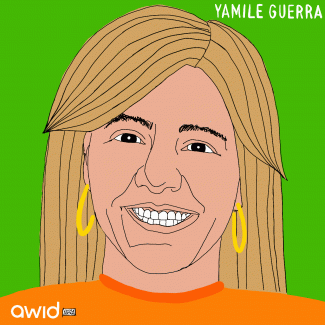
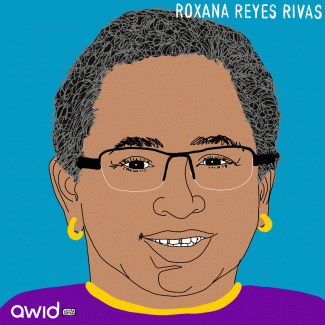
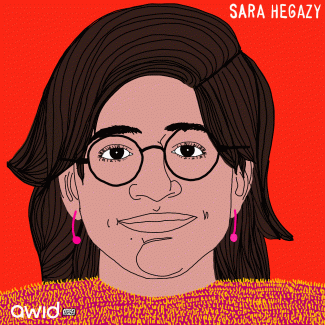
Student, Writer, Leader, Advocate. Each of the four women honored below had their own way of activism but what they had in common is that they all promoted and defended Lesbian Gay Bisexual Transgender Queer and Intersex rights. Join us in remembering and honoring these Women Human Rights Defenders, their work and legacy by sharing the memes below and tweeting by using the hashtags #WHRDTribute and #16Days.
Please click on each image below to see a larger version and download as a file


Snippet - WITM FAQ - PT
Perguntas Frequentes
5. Conduct interviews
Interviews produce in-depth information that you cannot easily obtain from surveys. While surveys focuses mainly on quantifiable data and closed questions, interviews allow for expert opinions from activists and donors, and open-ended questions which can provide context to survey data results.
In this section
- General tips
1. Before conducting your interviews
2. During the interviews- Specialized interviews
1. Donor interviews
2. Women’s rights organizations and activists interviews- Preliminary findings
General tips
1. Before conducting your interviews
Send the interviewees a concept note with your objectives for the interview and for your overall research, as well as a list of questions.
This allows them to prepare answers for more complicated questions and look up information that they may not have immediately on hand.
2. During the interviews
- You can conduct interviews while your survey is running, in order to save time.
- Try to keep your interviews as consistent as possible in order to facilitate systematic analysis of results. This means asking the same questions. Coding identical responses to each question will allow you to uncover hidden trends.
- The interviews can also be used to flesh out some of the survey findings
Do not base your questions on assumptions about your interviewees’ knowledge.
Instead, first clarify what they know – this will reveal information as well.
- DON’T: “Given the current funding trends in Switzerland, do you know of any opportunities for collaboration? This question assumes that the interviewee knows current funding trends and that their understanding of funding trends matches yours.
- DO: First ask “What is your understanding of current funding trends in Switzerland?”, followed by “Do you know of any opportunities for collaboration?” This will reveal what their understanding is, giving you even more information than the first question.
Specialized interviews
1. Donor interviews
Interviews with donors will allow you to build deeper relationships with them, which will be useful when you conduct post-research advocacy. They will also provide you with deeper insight into funders’ decision-making processes.
Suggested topics of focus for donor interviews:
- What are their funding priorities? Why and how did they select those priorities? For example, why do they choose project-funding over core support or vice versa?
- What are annual amounts allocated to the advancement of women’s human rights? This will strengthen overall reliability of data collected.
- Have they noticed any funding trends, and what do they believe are the origins and politics behind these trends?
- What is their theory of social change and how does that impact their relationships with women’s rights organizations?
View samples of donor interviews
2. Women’s rights organizations and activists interviews
Interviews with women’s rights organizations and activists will provide you with insight into their on-the-ground realities. Again, these interviews will allow you to build deeper relationships that can be incorporated into your advocacy, particularly to encourage collaboration between donors and activists.
Suggested topics of focus for women’s rights organizations and activist interviews:
- Long-term funding priority trends noted by women’s organizations and their impact.
- Successful examples of feminist and collaborative resource mobilization strategies that build strong and complementary movements.
- “Making the case” for why it is important to support women’s organizations and organizing.
- How different actors understand the social change process and their role in advancing/achieving gender equality and women’s rights.
View samples of women’s organizations and activists interviews
Preliminary findings
Through the course of your WITM research, we recommend analyzing your preliminary findings. Presenting your preliminary findings opens up opportunities to conduct more interviews and get feedback on your research process and initial results. This feedback can be incorporated into your final research.
AWID conducts “WITM convenings” to share preliminary results of survey data and interviews. These gatherings allow participants (activists, women’s rights organizations, and donors) to debate and discuss the results, clarifying the context, creating more ownership amongst members of the movement, and providing more input for final research.
For example, the Resource Mobilization Hub for Indigenous Women’s Rights at the World Summit on Indigenous Philanthropy was used as a space to debut preliminary results.
Previous step
4. Collect and analyze your data
Next step

Estimated time:
• 1.5 - 3 months
People needed:
• 1 or more research person(s)
Resources needed:
• List of donors and women’s rights organizations and activists to interview
• Prepared interview questions
• Concept Note (You can use the research framing you created in the “Frame your research” section)
Resources available:
• AWID Sample Interview Questions: Donors
• AWID Sample Interview Questions: Activists & Women’s Rights Organizations
Previous step
4. Collect and analyze your data