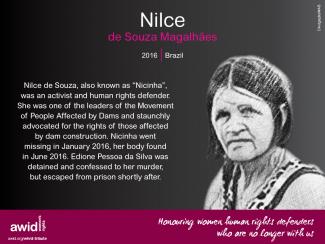
Nilce de Souza Magalhães

Feminist Realities are the living, breathing examples of the just world we are co-creating. They exist now, in the many ways we live, struggle and build our lives.
Feminist Realities go beyond resisting oppressive systems to show us what a world without domination, exploitation and supremacy look like.
These are the narratives we want to unearth, share and amplify throughout this Feminist Realities journey.
Create and amplify alternatives: We co-create art and creative expressions that center and celebrate the hope, optimism, healing and radical imagination that feminist realities inspire.
Build knowledge: We document, demonstrate & disseminate methodologies that will help identify the feminist realities in our diverse communities.
Advance feminist agendas: We expand and deepen our collective thinking and organizing to advance just solutions and systems that embody feminist values and visions.
Mobilize solidarity actions: We engage feminist, women’s rights and gender justice movements and allies in sharing, exchanging and jointly creating feminist realities, narratives and proposals at the 14th AWID International Forum.
As much as we emphasize the process leading up to, and beyond, the four-day Forum, the event itself is an important part of where the magic happens, thanks to the unique energy and opportunity that comes with bringing people together.
Build the power of Feminist Realities, by naming, celebrating, amplifying and contributing to build momentum around experiences and propositions that shine light on what is possible and feed our collective imaginations
Replenish wells of hope and energy as much needed fuel for rights and justice activism and resilience
Strengthen connectivity, reciprocity and solidarity across the diversity of feminist movements and with other rights and justice-oriented movements
Learn more about the Forum process
We are sorry to announce that the 14th AWID International Forum is cancelled
Given the current world situation, our Board of Directors has taken the difficult decision to cancel Forum scheduled in 2021 in Taipei.
AWID does not provide group discounts, but we do provide registration discounts to members. (Click here to learn more about becoming a member)
The rising power of anti-rights actors is not happening in a vacuum. Understanding the rise of ultra-nationalism, unchecked corporate power, growing repression, and diminishing civic space is key to contextualize the anti-rights threats we face today.
We work towards a world based on social, environmental, and economic justice; and interdependence, solidarity, and respect. We work towards dismantling systems of oppressive power and against all its manifestations, including patriarchy, fundamentalisms, militarisms, fascisms and corporate power that threaten our lives and our world. We want a just world where resources and power are shared in ways that enable everyone to thrive.
by Maryum Saifee
When you do a search for “Female Genital Mutilation” or “FGM” online, an image of four line-drawings of the female anatomy pop up next to its Wikipedia entry. (...)
artwork: “Dreams” by Neesa Sunar >
نرحب بالطلبات عبر مجموعة كاملة من المواضيع والتقاطعات المهمة للحركات النسوية وحركات العدالة الجندرية.
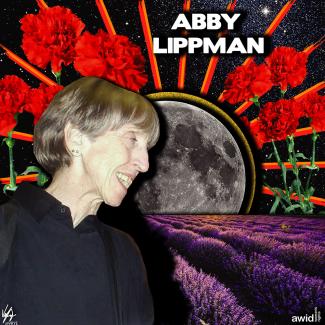
Abby was a pioneering feminist, human-rights activist and former McGill University epidemiologist.
Abby was renowned for championing social causes and for her insightful critiques of reproductive technologies and other medical topics. Specifically, she campaigned against what she called the "geneticization" of reproductive technologies, against hormone replacement therapy and for better, longer research before the approval of discoveries such as the vaccines against the human papillomavirus.
On the news of her passing, friends and colleagues described her fondly as an “ardent advocate” for women’s health.
Anti-rights actors adopt a double strategy. As well as launching outright attacks on the multilateral system, anti-rights actors also undermine human rights from within. Anti-rights actors engage with the aim of co-opting processes, entrenching regressive norms, and undermining accountability.
Jacqueline was a pioneering Malian/Burkinabe feminist, nationalist and educator.
She taught English in Senegal, before being recruited in 1961 as an English teacher at the Lycée Philippe Zinda Kaboré in Ouagadougou, Burkina Faso. Through her activism, she was involved in the popular uprising of January 3, 1966. Between 1961 and 1966, Jacqueline was also responsible for the trade union press, Voices of the Teachers. She was appointed as the head of the Normal Course for Young Girls (now known as Nelson Mandela High School) until 1974, and dedicated herself to girls’ education and advancing women’s rights.
In 1984 she was awarded the Paul G. Hoffmann Award for outstanding work in national and international development.

เวทีการประชุมนานาชาติ AWID เป็นทั้งกิจกรรมชุมชนระดับโลกและพื้นที่ของการเปลี่ยนแปลงของปัจเจก บุคคลอย่างสิ้นเชิง เป็นการประชุมที่ไม่เหมือนใคร คือเป็นที่รวบรวมนักสตรีนิยม นักปกป้องสิทธิสตรี ความยุติธรรมทางเพศ LBTQI+ และพันธมิตรในขบวนการเคลื่อนไหวเพื่อมนุษยชาติอันหลากหลาย เพื่อเชื่อมต่อ เยียวยาและเติบโต เวทีนานาชาตินี้เป็นพื้นที่ที่นักสตรีนิยมจากทั่วทุกมุมโลก รวมถึงจากประเทศในกลุ่มโลกใต้ และชุมชนชายขอบที่ไม่ได้รับการเหลียวแลมาอย่างยาวนาน เป็นศูนย์กลางในการวาง ยุทธศาสตร์ร่วมกัน และเคลื่อนไหวเพื่อความยุติธรรมทางสังคม เพื่อเปลี่ยนอำนาจ สร้างพันธมิตร และ สร้างโลกที่แตกต่างและดีขึ้น
เมื่อผู้คนทั่วโลกมารวมตัวกันทั้งในฐานะปัจเจกบุคคลและองค์กรเคลื่อนไหว เราสามารถสร้างพลังอันยิ่งใหญ่ จึงขอเชิญท่านร่วมกิจกรรมกับเราที่กรุงเทพฯ ประเทศไทยในปี 2567 มาร้องเพลง เต้นรำ วาดฝัน และลุกขึ้นพร้อมกัน
วันที่: 2–5 ธันวาคม 2567
สถานที่: กรุงเทพฯ ประเทศไทย; และทางออนไลน์
ผู้เข้าร่วม: นักสตรีนิยมจากทั่วโลกเข้าร่วมด้วยตนเอง ณ สถานที่จัดงานประมาณ 2,500 คน และเข้าร่วม
ทางออนไลน์ 3,000 คน
with Dr. Vandana Shiva, Dr. Dilar Dirik, and Nana Akosua Hanson.