Adolfo Lujan | Flickr (CC BY-NC-ND 2.0)
Mass demonstration in Madrid on International Women's Day
Multitudinaria manifestación en Madrid en el día internacional de la mujer

Priority Areas

Supporting feminist, women’s rights and gender justice movements to thrive, to be a driving force in challenging systems of oppression, and to co-create feminist realities.

Advancing Universal Rights and Justice

Uprooting Fascisms and Fundamentalisms

Across the globe, feminist, women’s rights and gender justice defenders are challenging the agendas of fascist and fundamentalist actors. These oppressive forces target women, persons who are non-conforming in their gender identity, expression and/or sexual orientation, and other oppressed communities.


Discriminatory ideologies are undermining and co-opting our human rights systems and standards,  with the aim of making rights the preserve of only certain groups. In the face of this, the Advancing Universal Rights and Justice (AURJ) initiative promotes the universality of rights - the foundational principle that human rights belong to everyone, no matter who they are, without exception.

We create space for feminist, women’s rights and gender justice movements and allies to recognize, strategize and take collective action to counter the influence and impact of anti-rights actors. We also seek to advance women’s rights and feminist frameworks, norms and proposals, and to protect and promote the universality of rights.


Our actions

Through this initiative, we:

  • Build knowledge: We support feminist, women’s rights and gender justice movements by disseminating and popularizing knowledge and key messages about anti-rights actors, their strategies, and impact in the international human rights systems through AWID’s leadership role in the collaborative platform, the Observatory on the Universality of Rights (OURs)*.
  • Advance feminist agendas: We ally ourselves with partners in international human rights spaces including, the Human Rights Council, the Commission on Population and Development, the Commission on the Status of Women and the UN General Assembly.
  • Create and amplify alternatives: We engage with our members to ensure that international commitments, resolutions and norms reflect and are fed back into organizing in other spaces locally, nationally and regionally.
  • Mobilize solidarity action: We take action alongside women human rights defenders (WHRDs) including trans and intersex defenders and young feminists, working to challenge fundamentalisms and fascisms and call attention to situations of risk.  


Related Content

Nicole Barakat

nicole barakat -verge exhibition april 2018
We transcend time and place, Hand cut found paper (2017)
nicole barakat -verge exhibition april 2018
We will remember who we are and We will persist Cotton embroidered hand cut lamé on wool silk cloth (2018)
nicole barakat -verge exhibition april 2018
​​We will return home, Silk embroidered hand cut lamé on cotton velveteen (2018)
verge march 18 - document photography
We will heal in the now, Hand cut silk, wool, lamé, cotton, direct digital print silk satin on linen (2018)


we are infinite

An exhibition by Nicole Barakat, embodying her reconnection with the diaspora of objects from her ancestral homelands in the South West Asia and North Africa (SWANA) region.
 
Barakat presents a collection of textile works as manifestations of her practice of engaging with displaced, and often stolen objects held within Western museum collections including the Louvre, British Museum and Nicholson Museum. 
 
To by-pass the gatekeepers and breach the vitrines holding these ancestral objects, Barakat reclaims pre-colonial, non-linear, receptive forms of knowing that are often devalued and dismissed by colonial and patriarchal institutions - engaging with coffee cup divination, dream-work, intuitive listening and conversations with the objects themselves (source).

About Nicole Barakat

Nicole Barakat portrait
Nicole Barakat is a queer femme, SWANA artist born and living on Gadigal Country (so-called Sydney, Australia). She works with deep listening and intuitive processes with intentions to transform the conditions of everyday life. Her work engages unconventional approaches to art-making, creating intricate works that embody the love and patience that characterises traditional textile practices. 

Her works include hand-stitched and hand-cut cloth and paper drawings, sculptural forms made with her own hair, cloth and plant materials as well as live work where she uses her voice as a material. 

Nicole’s creative practice is rooted in re-membering and re-gathering her ancestral knowing, including coffee divination and more recently working with plants and flower essences for community care and healing. 

Могу ли я связаться с кем-либо, если у меня возникнут вопросы?

Если у вас есть какие-либо вопросы или сомнения, пожалуйста, свяжитесь с нами через форму здесь, указав «Опрос «Где деньги?» (WITM Survey) в качестве заголовка вашего сообщения. или напишите нам по адресу witm@awid.org

MANGO

Jurema Araújo Portrait

Jurema Araújo is a teacher-poet from Rio de Janeiro. She contributed to the magazine Urbana, edited by the poets Brasil Barreto and Samaral (RIP) and to the book Amor e outras revoluções (Love and Other Revolutions) with several other writers. In collaboration with Angélica Ferrarez and Fabiana Pereira, she co-edited O livro negro dos sentidos (The Black Book of Senses), a creative anthology on black women’s sexuality in Brazil. Jurema is 54-years-old; she has a daughter, three dogs, a cat, and many friends.

Mango Cover

Suck it with me? 

Mango is my favorite fruit.
I open my mouth
and suck it all,
Its flesh caught between my teeth
that turn soft not to hurt it
and I press it between my tongue and the roof of my mouth,
then I take it out to suck on every part of it
with the juice running down my mouth
drenching myself in this tasty nectar
and putting it all in my mouth again
because mango is seed and honey;
it is fiber and flavor.
And when it is over, I am entranced,
honeydewed, sweetened,
my lips all wet.
Ohhh, what is mango for if not for smearing.

Chupa Comigo? 

A fruta que eu mais gosto é manga!
Porque eu abro a boca
E meto toda pra chupar!
Se os dentes a prendem
Fazem macio para não machucar
E eu pressiono entre minha língua e meu céu
Depois tiro pra sugar cada parte
Sentindo o caldo escorrer boca afora
Me molhando com esse néctar gostoso
E metendo toda na boca de novo
Pois manga é caroço e é mel,
É fiapo e sabor
E quando acaba, estou extasiada
Melada, docinha
Com os lábios molhados!
Aaahhh, manga é pra se lambuzar!


Introducing The Black Book of Senses

I’ll admit it: when Angélica and Fabi invited me to curate a collection of erotic texts by black women, I didn’t know what curatorship was. I understood the erotic well, but curatorship... I smiled, feeling shy and flattered. I think I thanked them – at least I hope I did – and thought to myself: what the fuck is it?! This fancy word I’ll have to learn the meaning of while doing it, what is it?

Now at this point, I know what it is to be a curator: it is making love with someone else’s texts, with someone else’s art, with the intention of putting a book together. And that is exactly what I did. I undressed each text of every author of this book with a literary lasciviousness. And I got involved in the words and senses of others. I was penetrated by poems I didn’t write; tales I didn’t even dare to imagine turned me upside down, messing with my feelings, with my libido. And it was a wonderful and unusual orgasm: ethereal, corporeal, sublime, at once intellectual and sensitive.
These texts pulsated like a clit hardened by desire, drenched, dripping joy in every reading. Words that swallowed me with their naughty significance, making me dive deeper into this wet universe. 

These black women went to the bottom of their arousals and turned their deepest erotic fantasies into art. These works are impregnated with each writer’s own way of experiencing sexuality: freely, blackly, for ourselves, in our own way, empowered.

I chose to spread the texts throughout different parts of the book, each one organized according to the most delicate, explosive, evident, or implicit content they presented.

To open the door to this “invulved blackessence,” we have our Preliminaries section, with texts that introduce readers to this world of delights. It is a more general, delicate caress to acknowledge the subjects addressed by the texts in the rest of the book.

Then comes the heat of Touch, addressing what the skin can feel. That energy which burns or freezes our bodies, makes our hormones explode and starts to awaken the other senses. And although there are many of us who are voyeurs, the contact of skin with a wet and warm mouth is exciting, like wandering through the softness of whomever is with you. We are seduced by the firm or gentle touch that gives us goosebumps and that lovely discomfort that runs from the neck down to the back and only stops the next day. And the warmth of the lips, the mouth, the wet tongue on the skin – oh, the tongue in the ear, hmmm – or skin on skin, clothes moving over the body, almost like an extension of the other’s hand. If there is no urgency, that wildest arousal of the pressure of a tight grab, a bit of pain – or a lot, who knows?

The Sound – or melody? – section shows us that attraction also happens through hearing: the voice, the whispers, the music that enables the connection between the bodies and can become the theme of desire. For some of us, someone with a beautiful voice would only need their vocal cords, because that harsh or heavy or melodious sound would be auditory sex. Their loud swearing or sweet words whispered in the ear would be enough to give us hair-raising shivers from neck to coccyx.

Decorative element


In Flavor, we know the tongue does a good job tasting the most hidden places and wandering through the body to delight itself. Sometimes this organ is used, boldly, to taste the other’s nectar. The idea of someone sharing their strawberry or a delicious, juicy mango through bites and licks – or licks and bites – melts us. But nothing is more delicious than tasting the caves and hills of the person you are with. Stick your tongue deep inside to taste a piece of fruit... or spend hours tasting the head of a cock in your mouth, or suck on a delicious breast to taste the nipples. This is all about memorizing someone by their Flavor.

There are texts in which the nose is what triggers desire. The Smell, my dear readers, can awaken us to the delights of desire. Sometimes we meet a person who smells so good, we want to swallow them right through our nose. When you run through the other person’s body with your nose, starting with the neck – wow, that delightfully uncomfortable shiver that runs down the spine and undresses the soul! The shameless nose then moves to the back of the neck and captures the scent of the other in such a way that in the absence of that person, smelling their same scent evokes, or conversely, invades in us olfactory memories that bring the arousing smell of that person back.

We then get to Look – for me, the betrayer of senses – in which we perceive desire from a point of “view.” It is through sight that the texts present desire and arousal, through which the other senses are brought about. Sometimes a smile is all it takes to drive us crazy. The exchange of glances? That look that says “I want you now.” That look of possession that comes to an end when you stop fucking, or not. That one is very particular; it draws the other who won’t be able to look away for long. Or the sidelong glance – when one looks away when the other turns their head, like a cat-and-mouse game? Once we are caught red-handed, there’s nothing else to do besides breaking into a wide smile.

Finally, the explosion. Wandering through All senses, the texts mix feelings that seem like an alert, so there is the greatest pleasure, that orgasm.

Of course, there is nothing explicitly separating these poems and tales. Some are subtle. Arousal engages all our senses and, most importantly, our heads. That’s where it happens, and it connects our whole body. I organized the poems according to how they came to me in each reading. Feel free to disagree! But to me, there is a sense through which desire goes and then explodes. Realizing which one it is, is delightful. 

Being able to turn arousal into art means freeing ourselves from all the prejudice, prisons, and stigma this white-centric society has trapped us in.

Every time a black writer transforms the erotic into art, she breaks these harmful racist chains that cripple her body, repress her sexuality, and turn us into the object of another’s greed. Writing erotic poetry is taking back the power over her own body and roaming fearlessly through the delights of desire for herself, for others, for life.

The literary erotic is who we are when turned into art. Here we show the best of us, our views of love drenched by pleasure, seasoned by the erogenous, spread through our bodies, and translated by our artistic consciousness. We are multiple and we share this multiplicity of sensations in words dripping with arousal. Yes, even our words drip with our sexual desire, drenching our verses, turning our sexual urges into paragraphs. To come, for us, is a breakthrough.

It is necessary to make our minds, bodies, and sexuality black, to reestablish our pleasure, and take back our orgasms. Only then will we be free. This whole process is a breakthrough, and it happens painfully. But there is happiness in finding ourselves to be very different from where we had been placed. 

I feel like I am yours, I am ours. Taste, delight yourselves, feast on these beautiful words with us. 


This text is adapted from the introductions to “O Livro Negro Dos Sentidos” [The Black Book of Senses], an erotic collection of poems by 23 black female writers.
 

Cover image for Communicating Desire
 
Explore Transnational Embodiments

This journal edition in partnership with Kohl: a Journal for Body and Gender Research, will explore feminist solutions, proposals and realities for transforming our current world, our bodies and our sexualities.

Explore

Cover image, woman biting a fruit
 

التجسيدات العابرة للحدود

نصدر النسخة هذه من المجلة بالشراكة مع «كحل: مجلة لأبحاث الجسد والجندر»، وسنستكشف عبرها الحلول والاقتراحات وأنواع الواقع النسوية لتغيير عالمنا الحالي وكذلك أجسادنا وجنسانياتنا.

استكشف المجلة

Snippet - Join CSW69 Conversations Intro_EN

Join us through the #FreezeFascisms conversations!

As we navigate the global polycrisis, movements are tirelessly building power beyond traditional power structures. The wave of US presidential executive orders is intended to scare us, but no amount of fascist ideology can erase our existence and resistance.

We invite you to be a part of the solidarity-building campaign to expose and resist fascist forces undermining feminist and gender justice movements in your contexts!

  • Spark conversations in a brave space: Share stories of struggles and resistance to fascisms in your contexts on the AWID Community Platform. Not a member yet? Join here
  • Support movements that have been impacted: Amplify fundraisers, resourcing opportunities, mutual aid efforts using the #FreezeFascisms (we’re still on X, Instagram, LinkedIN, and we’re also on Bluesky)
  • Organize around alternatives: We’ve been building our community of practice on feminist economic alternatives & autonomous resourcing. Sign up to be part of it here.

An alternative future is possible, we just have to keep believing

By Michel’le Donnelly 

The Crear | Resister | Transform Feminist Festival in September was such a breath of fresh air in these uncertain, turbulent and painful times.

The space created by this festival has been so necessary. Necessary for the souls of those who are seeking comfort during these bleakest of times. Necessary for those craving community in what feels like an increasingly isolating world and above all, necessary for those fighting against the very systems that have brought many of us to our knees, especially over the past two years.

“Crisis is not new to feminist and social movements, we have a long history of surviving in the face of oppression and building our communities and our own realities.”

Advocating for alternative visions and alternative realities to the one we are currently living in is a fundamental building block of the feminist agenda. So many amazing people are doing the work of exploring different ways for us to exist in this world. These alternatives are people-centred. They are equitable and just. These worlds are filled with love, tenderness and care. The visions outlined are almost too beautiful to imagine, yet we must force ourselves to imagine because this is the only way we can continue.

Over the past 10 months, I have been incredibly fortunate to be working with a feminist collective that is not just imagining an alternative reality but actively living it. We are inspired by the work of so many other feminist movements across the globe who have not let the white supremacist, capitalist patriarchy deter their visions. This collective has held me together when all I wanted to do was fall apart. Much like the story shared by Maria Bonita on Day 4 of the festival, the liberation I have found in feminist movements is far too great to only be experienced by me. This is something we need to share, that we need to shout from the rooftops as we invite others to join.

Day 4 of the festival brought with it a captivating conversation between Felogene Anumo, Dr Dilar Dirik, Nana Akosua Hanson and Vandana Shiva who encouraged festival attendees to believe that not only is an alternative future possible - but that it is indeed urgent. Feminists have been talking about alternative worlds for so many years and hearing about these from the panellists was not just eye-opening but also comforting. Comforting in the sense that it made me feel safe to know that there are indeed strong, global feminist networks working across international and national borders, seeking to decolonise the established frameworks of our current realities.

What does an alternative reality look like?

During the session, Dr Dirik highlighted the fact that belief, sacrifice and patience are most needed to abolish the oppressive systems we currently live in. Collaboration, partnership, creativity, solidarity and autonomy. These are key pillars to building a global feminist society and they should be embraced by all feminist movements around the world. 

Practical examples of these realities can be found across the globe, including the Soulaliyate Women's Land-Use Rights Movement. Referring to the tribal women in Morocco who live on collective land, the Soulalyate Women’s Movement is the first grassroots nationwide mobilisation for land rights in Morocco. Whilst initially the movement was quite small, it grew into a nationwide agenda that challenged the gendered nature of laws regulating land in the country. In 2019, the group contributed to overhauling the national framework legislation on the management of community property through the adoption of three sets of laws guaranteeing the equality of women and men. 

Another practical example is Zuleymi Trans House in Peru. Operating since 2016, the house is a refuge for migrant trans women, girls and teens who the state has left behind. It has provided safe shelter for 76 migrant trans women from Venezuela, along with 232 from jungle areas, Indigenous communities and the north coast of Peru.

Knowing about these feminist movements who are doing the work to make alternative futures a reality is incredibly inspiring and just what is needed, especially as I struggle to grapple with the neverending stream of bad news that seems to flow uninterrupted.

“Capitalist patriarchy is like a cancer. It doesn’t know when to stop growing” - Dr Vandana Shiva

AWID has always been a movement inspired by the feminist realities that we can live in. Through their festivals, as well as feminist realities magazine and toolkit, we have been shown a different way of doing things. We can imagine a world where care is prioritised, where feminist economies and gender justice are the norm. Creating alternative futures is how we fight back, it’s how we resist the violence that is perpetrated against our bodies every day.

The Crear | Resister | Transform Festival has allowed me to feel so connected to a global community, many of whom I will never meet. Knowing that we are all working towards and claiming another world has lit a fire in my soul and I cannot wait to see what the next festival will have in store.

If you missed it, make sure to watch the: "She is on her way: Alternatives, feminisms and another world" session from Day 4 of the festival below. And remember, as Dr Shiva said so eloquently: “Women’s energies will continue life on earth. We will not be defeated.”

Snippet - CSW69 - Other events - EN

Find AWID staff at these partners' events!

2024 Forum Announcement

An image with a purple to yellow gradient background and the words "AWID 2024 Forum Announcement" over it. In the background there is a faded photo of the audience during the 2016 Forum.

It’s time for the next AWID Forum in 2024!

When thousands of feminists come together, we create a sweeping force of solidarity that has the power to change the world. The AWID Forum will be a moment for us to rest and heal together, connect across borders, and discover brave new strategic directions.

The date and location will be announced next year, as soon as we can. We’re excited and we know you’re excited too. Stay tuned!

Make sure to follow us on social media and subscribe to our mailing list to stay informed!

Snippet - WCFM type of funder - EN

Type of funder:

Filter your search by funders from different sectors i.e., philanthropic foundations, multilateral funders, women’s and feminist funds

Clone of Privacy Policy

Effective as of 25 Apr 2023. 

Please click here to view the previous version of our Privacy Policy.

This Privacy Policy describes how the Association for Women’s Rights in Development and our subsidiaries and affiliates (“AWID,” “we,” “us” or “our”) handles personal information that we collect through our website that links to this Privacy Policy (the “Site”), as well as through social media, our marketing activities, our live events and other activities described in this Privacy Policy (“Service”).  

You can download a printable copy of this Privacy Policy here

Index

Personal information we collect

How we use your personal information

How we share your personal information

Your choices

Other sites and services 

Security

International data transfers

Children

Changes to this Privacy Policy

How to contact us

Notice to European users

Personal information we collect

Information you provide to us.  Personal information you may provide to us through the Service or otherwise includes:

  • Contact data, such as your first and last name, salutation, email address, billing and mailing addresses, professional title and company name, and phone number.
  • Demographic data, such as your city, state, country of residence, postal code, date of birth, gender, pronouns, preferred language of communication, and information about how you identify (race/ethnicity, disabilities, migrant, sex worker, etc.).
  • Communications data, based on our exchanges with you, including when you contact us through the Service, social media, or otherwise. 
  • Marketing data, such as your preferences for receiving our marketing communications and details about your engagement with them.
  • User-generated content data, such as profile pictures, photos, images, music, videos, comments, questions, messages, works of authorship, and other content or information that you generate, transmit, or otherwise make available on the Service, as well as associated metadata.  Metadata includes information on how, when, where and by whom a piece of content was collected and how that content has been formatted or edited.  Metadata also includes information that users can add or can have added to their content, such as keywords, geographical or location information, and other similar data. 
  • Payment data needed to complete transactions, including payment card information or bank account number.
  • Other data not specifically listed here, which we will use as described in this Privacy Policy or as otherwise disclosed at the time of collection.

Automatic data collection.  We, our service providers, and our business partners may automatically log information about you, your computer or mobile device, and your interaction over time with the Service, our communications and other online services, such as:

  • Device data, such as your computer or mobile device’s operating system type and version, manufacturer and model, browser type, screen resolution, RAM and disk size, CPU usage, device type (e.g., phone, tablet), IP address, unique identifiers, language settings, mobile device carrier, radio/network information (e.g., Wi-Fi, LTE, 3G), and general location information such as city, state or geographic area.
  • Online activity data, such as pages or screens you viewed, how long you spent on a page or screen, the website you visited before browsing to the Service, navigation paths between pages or screens, information about your activity on a page or screen, access times and duration of access, and whether you have opened our emails or clicked links within them.

Cookies and similar technologies. Some of the automatic collection described above is facilitated by cookies, which are small text files that websites store on user devices and that allow web servers to record users’ web browsing activities and remember their submissions, preferences, and login status as they navigate a site. Cookies used on our sites include both “session cookies” that are deleted when a session ends, “persistent cookies” that remain longer, “first party” cookies that we place and “third party” cookies that our third-party business partners and service providers place. 

How we use your personal information

We may use your personal information for the following purposes or as otherwise described at the time of collection:


Service delivery and business operations.  We may use your personal information to:

  • provide, operate and improve the Service;
  • communicate with you about the Service, including by sending announcements, updates, security alerts, and support and administrative messages;
  • communicate with you about events or contests in which you participate;
  • understand your needs and interests, and personalize your experience with the Service and our communications; and
  • provide support for the Service, and respond to your requests, questions and feedback.

Research and development.  We may use your personal information for research and development purposes, including to analyze and improve the Service. As part of these activities, we may create aggregated, de-identified and/or anonymized data from personal information we collect.  We make personal information into de-identified or anonymized data by removing information that makes the data personally identifiable to you.  We may use this aggregated, de-identified or otherwise anonymized data and share it with third parties for our lawful business purposes, including to analyze and improve the Service and promote our business.

Marketing.  We and our service providers may collect and use your personal information to send you direct marketing communications.  You may opt-out of our marketing communications as described in the Opt-out of marketing section below. 

Compliance and protection.  We may use your personal information to:

  • comply with applicable laws, lawful requests, and legal process, such as to respond to subpoenas or requests from government authorities;
  • protect our, your or others’ rights, privacy, safety or property (including by making and defending legal claims); 
  • audit our internal processes for compliance with legal and contractual requirements or our internal policies; 
  • enforce the terms and conditions that govern the Service; and 
  • prevent, identify, investigate and deter fraudulent, harmful, unauthorized, unethical or illegal activity, including cyberattacks and identity theft.  

With your consent.  In some cases, we may specifically ask for your consent to collect, use or share your personal information, such as when required by law.  

Cookies and similar technologies. In addition to the other uses included in this section, we may use the Cookies and similar technologies described above for the following purposes:

  • Technical operation. To allow the technical operation of the Service, such as by remembering your selections and preferences as you navigate the site.
  • Functionality. To enhance the performance and functionality of our services.
  • Analytics. To help us understand user activity on the Service, including which pages are most and least visited and how visitors move around the Service, as well as user interactions with our emails. For example, we use Google Analytics for this purpose. You can learn more about Google Analytics and how to prevent the use of Google Analytics relating to your use of our sites here: https://tools.google.com/dlpage/gaoptout?hl=en

Retention. We generally retain personal information to fulfill the purposes for which we collected it, including for the purposes of satisfying any legal, accounting, or reporting requirements, to establish or defend legal claims, or for fraud prevention purposes.  To determine the appropriate retention period for personal information, we may consider factors such as the amount, nature, and sensitivity of the personal information, the potential risk of harm from unauthorized use or disclosure of your personal information, the purposes for which we process your personal information and whether we can achieve those purposes through other means, and the applicable legal requirements.   

When we no longer require the personal information we have collected about you, we may either delete it, anonymize it, or isolate it from further processing.  

How we share your personal information

We may share your personal information with the following parties and as otherwise described in this Privacy Policy or at the time of collection.  

Affiliates.  Our corporate parent, subsidiaries, and affiliates, for purposes consistent with this Privacy Policy.

Service providers.  Third parties that provide services on our behalf or help us operate the Service or our business (such as hosting, information technology, customer support, email delivery, marketing, consumer research and website analytics). 

Payment processors. Any payment card information you use to make a purchase on the Service is collected and processed directly by our payment processors, such as Stripe.  Stripe may use your payment data in accordance with its privacy policy, https://stripe.com/en-gb/privacy. You may also sign up to be billed by your mobile communications provider, who may use your payment data in accordance with their privacy policies.

Third parties designated by you. We may share your personal data with third parties where you have instructed us or provided your consent to do so. We will share personal information that is needed for these other companies to provide the services that you have requested. Moreover, you may choose to translate user-generated content using Google Translate. Google may use your user-generated content in accordance with its privacy policy, https://policies.google.com.Professional advisors.  Professional advisors, such as lawyers, auditors, bankers and insurers, where necessary in the course of the professional services that they render to us.

Authorities and others. Law enforcement, government authorities, and private parties, as we believe in good faith to be necessary or appropriate for the compliance and protection purposes described above. 

Other users.  Your profile and other user-generated content data (except for messages)     may be visible to other users of the Service. For example, other users of the Service may have access to your information if you chose to make your profile or other personal information available to them through the Service, such as when you provide comments, reviews, survey responses, or share other content.   This information can be seen, collected and used by others, including being cached, copied, screen captured or stored elsewhere by others (e.g., search engines), and we are not responsible for any such use of this information.

Your choices 

In this section, we describe the rights and choices available to all users. Users who are located in the United Kingdom, Switzerland, and the European Economic Area can find additional information about their rights below.

Opt-out of marketing communications.  You may opt-out of marketing-related emails by following the opt-out or unsubscribe instructions at the bottom of the email, or by contacting us.  Please note that if you choose to opt-out of marketing-related emails, you may continue to receive service-related and other non-marketing emails.  

Declining to provide information. We need to collect personal information to provide certain services.  If you do not provide the information we identify as required or mandatory, we may not be able to provide those services.

Delete your content or end your membership. You can choose to delete certain content you have provided to us.  If you wish to request to end your membership, please contact us.

Other sites and services

The Service may contain links to websites, mobile applications, and other online services operated by third parties.  In addition, our content may be integrated into web pages or other online services that are not associated with us.  These links and integrations are not an endorsement of, or representation that we are affiliated with, any third party.  We do not control websites, mobile applications or online services operated by third parties, and we are not responsible for their actions. We encourage you to read the privacy policies of the other websites, mobile applications and online services you use.

Security 

We employ a number of technical, organizational and physical safeguards designed to protect the personal information we collect.  However, security risk is inherent in all internet and information technologies and we cannot guarantee the security of your personal information. 

International data transfer

We are headquartered in the United States and may use service providers that operate in other countries. Your personal information may be transferred to the United States or other locations where privacy laws may not be as protective as those in your state, province, or country.  

Users in the United Kingdom, Switzerland, and the European Economic Area should read the important information provided below about transfer of personal information outside of the European Union. 

Children  

The Service is not intended for use by anyone under 18 years of age. If you are a parent or guardian of a child from whom you believe we have collected personal information in a manner prohibited by law, please contact us.  If we learn that we have collected personal information through the Service from a child without the consent of the child’s parent or guardian as required by law, we will comply with applicable legal requirements to delete the information.

Changes to this Privacy Policy 

We reserve the right to modify this Privacy Policy at any time. If we make material changes to this Privacy Policy, we will notify you by updating the date of this Privacy Policy and posting it on the Service or other appropriate means.  Any modifications to this Privacy Policy will be effective upon our posting the modified version (or as otherwise indicated at the time of posting). In all cases, your use of the Service after the effective date of any modified Privacy Policy indicates your acknowledgment that the modified Privacy Policy applies to your interactions with the Service and our business.

How to contact us

  • Email: Contact Us 
  • Mail: 192 Spadina Ave, Suite 300, Toronto, ON L1T 0G7
  • Phone: 416 594 3773

Notice to European Users

Where this Notice to European users applies. The information provided in this “Notice to European users” section applies only to individuals located in the EEA or the UK (EEA and UK jurisdictions are together referred to as “Europe”).

Personal information. References to “personal information” in this Privacy Policy should be understood to include a reference to “personal data” (as defined in the GDPR) – i.e., information about individuals from which they are either directly identified or can be identified. It does not include “anonymous data” (i.e., information where the identity of individual has been permanently removed). The personal information that we collect from you is identified and described in greater detail in the section “Personal information we collect”.

Controller. AWID is the controller in respect of the processing of your personal information covered by this Privacy Policy for purposes of European data protection legislation (i.e., the EU GDPR and the so-called ‘UK GDPR’ (as and where applicable, the “GDPR”)). See the How to contact us section above for our contact details. 

Our legal bases for processing. In respect of each of the purposes for which we use your personal information, the GDPR requires us to ensure that we have a “legal basis” for that use. 

Our legal bases for processing your personal information described in this Privacy Policy are listed below.

  • Where we need to process your personal information to deliver our Services to you (including our Site) (“Contractual Necessity”).
  • Where it is necessary for our legitimate interests and your interests and fundamental rights do not override those interests (“Legitimate Interests”). More detail about the specific legitimate interests pursued in respect of each Purpose we use your personal information for is set out in the table below.
  • Where we need to comply with a legal or regulatory obligation (“Compliance with Law”).
  • Where we have your specific consent to carry out the processing for the Purpose in question (“Consent”).  

We have set out below, in a table format, the legal bases we rely on in respect of the relevant Purposes for which we use your personal information – for more information on these Purposes and the data types involved, see How we use your personal information above.

Purpose

Categories of personal information involved

Legal basis

Service delivery and operations

  • Contact data
  • Demographic data
  • User-generated content data
  • Communications data
  • Payment data

Contractual Necessity 

Research and development 

Any and all data types relevant in the circumstances

Legitimate interest. We have legitimate interest in understanding what may be of interest to our customers, improving customer relationships and experience, delivering relevant content to our customers, measuring and understanding the effectiveness of the content we serve to customers.


Consent, in respect of any optional cookies used for this purpose.

Direct marketing

  • Contact data
  • User-generated content data
  • Payment data
  • Communications data
  • Marketing data

Legitimate Interests. We have a legitimate interest in promoting our operations and goals as an organisation and sending marketing communications for that purpose.

Consent, in circumstances or in jurisdictions where consent is required under applicable data protection laws to the sending of any given marketing communications.

Compliance and protection

Any and all data types relevant in the circumstances

Compliance with Law.

Legitimate interest. Where Compliance with Law is not applicable, we and any relevant third parties have a legitimate interest in participating in, supporting, and following legal process and requests, including through co-operation with authorities. We and any relevant third parties may also have a legitimate interest of ensuring the protection, maintenance, and enforcement of our and their rights, property, and/or safety.

Further uses 

Any and all data types relevant in the circumstances

The original legal basis relied upon, if the relevant further use is compatible with the initial purpose for which the Personal Information was collected. 

Consent, if the relevant further use is not compatible with the initial purpose for which the personal information was collected.

Retention. We retain personal information for as long as necessary to fulfill the purposes for which we collected it, including for the purposes of satisfying any legal, accounting, or reporting requirements, to establish or defend legal claims, or for compliance and protection purposes, unless specifically authorized to be retained longer.  

To determine the appropriate retention period for personal information, we consider the amount, nature, and sensitivity of the personal information, the potential risk of harm from unauthorized use or disclosure of your personal information, the purposes for which we process your personal information and whether we can achieve those purposes through other means, and the applicable legal requirements. 

When we no longer require the personal information, we have collected about you, we will either delete or anonymize it or, if this is not possible (for example, because your personal information has been stored in backup archives), then we will securely store your personal information and isolate it from any further processing until deletion is possible. If we anonymize your personal information (so that it can no longer be associated with you), we may use this information indefinitely without further notice to you.

Other information

No obligation to provide personal information. You do not have to provide personal information to us. However, where we need to process your personal information either to comply with applicable law or to deliver our Services to you, and you fail to provide that personal information when requested, we may not be able to provide some or all of our Services to you. We will notify you if this is the case at the time.

No Automated Decision-Making and Profiling. As part of the Services, we do not engage in automated decision-making and/or profiling, which produces legal or similarly significant effects. We will let you know if that changes by updating this Privacy Policy.

Security. We have put in place procedures designed to deal with breaches of personal information. In the event of such breaches, we have procedures in place to work with applicable regulators. In addition, in certain circumstances (including where we are legally required to do so), we may notify you of breaches affecting your personal information.

Your rights

General. European data protection laws give you certain rights regarding your personal information. If you are located in Europe, you may ask us to take any of the following actions in relation to your personal information that we hold:

  • Access. Provide you with information about our processing of your personal information and give you access to your personal information.
  • Correct. Update or correct inaccuracies in your personal information.
  • Delete. Delete your personal information where there is no lawful reason for us continuing to store or process it, where you have successfully exercised your right to object to processing (see below), where we may have processed your information unlawfully or where we are required to erase your personal information to comply with local law. Note, however, that we may not always be able to comply with your request of erasure for specific legal reasons that will be notified to you, if applicable, at the time of your request. 
  • Portability. Port a machine-readable copy of your personal information to you or a third party of your choice, in certain circumstances. Note that this right only applies to automated information for which you initially provided consent for us to use or where we used the information to perform a contract with you.
  • Restrict. Restrict the processing of your personal information, if, (i) you want us to establish the personal information's accuracy; (ii) where our use of the personal information is unlawful but you do not want us to erase it; (iii) where you need us to hold the personal information even if we no longer require it as you need it to establish, exercise or defend legal claims; or (iv) you have objected to our use of your personal information but we need to verify whether we have overriding legitimate grounds to use.
  • Object. Object to our processing of your personal information where we are relying on legitimate interests (or those of a third party) and there is something about your particular situation that makes you want to object to processing on this ground as you feel it impacts on your fundamental rights and freedom – you also have the right to object where we are processing your personal information for direct marketing purposes.
  • Withdraw Consent. When we use your personal information based on your consent, you have the right to withdraw that consent at any time. This will not affect the lawfulness of any processing carried out before you withdraw your consent.  

Exercising These Rights. You may submit these requests by email. See the How to contact us section above for our contact details. We may request specific information from you to help us confirm your identity and process your request. Whether or not we are required to fulfill any request you make will depend on a number of factors (e.g., why and how we are processing your personal information), if we reject any request you may make (whether in whole or in part) we will let you know our grounds for doing so at the time, subject to any legal restrictions.  Typically, you will not have to pay a fee to exercise your rights; however, we may charge a reasonable fee if your request is clearly unfounded, repetitive or excessive. We try to respond to all legitimate requests within a month. It may take us longer than a month if your request is particularly complex or if you have made a number of requests; in this case, we will notify you and keep you updated.

Your Right to Lodge a Complaint with your Supervisory Authority. In addition to your rights outlined above, if you are not satisfied with our response to a request you make, or how we process your personal information, you can make a complaint to the data protection regulator in your habitual place of residence. 

  • For users in the European Economic Area – the contact information for the data protection regulator in your place of residence can be found here: https://edpb.europa.eu/about-edpb/board/members_en.
  • For users in the UK – the contact information for the UK data protection regulator is below:

The Information Commissioner’s Office

Water Lane, Wycliffe House

Wilmslow - Cheshire SK9 5AF

Tel. +44 303 123 1113

Website: https://ico.org.uk/make-a-complaint/

Data Processing outside Europe; we are a US-based company and many of our service providers, advisers, partners or other recipients of data are also based in the US. This means that, if you use the Services, your personal information will necessarily be accessed and processed in the US. It may also be provided to recipients in other countries outside Europe.  

It is important to note that that the US is not the subject of an ‘adequacy decision’ under the GDPR – basically, this means that the US legal regime is not considered by relevant European bodies to provide an adequate level of protection for personal information, which is equivalent to that provided by relevant European laws. 

Where we share your personal information with third parties who are based outside Europe, we try to ensure a similar degree of protection is afforded to it in accordance with applicable privacy laws by making sure one of the following mechanisms is implemented: 

  • Transfers to territories with an adequacy decision. We may transfer your personal information to countries or territories whose laws have been deemed to provide an adequate level of protection for personal information by the European Commission or UK Government (as and where applicable) (from time to time).
  • Transfers to territories without an adequacy decision. 
    • We may transfer your personal information to countries or territories whose laws have not been deemed to provide such an adequate level of protection (e.g., the US, see above).  
    • However, in these cases:
      • we may use specific appropriate safeguards, which are designed to give personal information effectively the same protection it has in Europe – for example, standard-form contracts approved by relevant authorities for this purpose; or 
      • in limited circumstances, we may rely on an exception, or ‘derogation’, which permits us to transfer your personal information to such country despite the absence of an ‘adequacy decision’ or ‘appropriate safeguards’ – for example, reliance on your explicit consent to that transfer. 

You may contact us if you want further information on the specific mechanism used by us when transferring your personal information out of Europe.

Snippet2 - WCFM type of funding- EN

Court icon

Type of funding:

Be it core funding, programmes & projects or rapid response/ emergency grants.

Snippet - COP30 - Links

$2.7 trillion for the military. $300 billion for climate justice. We're here to flip the script.

Get started with these resources.

COP30 Political Education Toolbox Play the Climate Justice Organizing Deckgame

Read the Feminist Economic Alternatives Brief Download the Climate Justice Zine

Snippet - COP30 - Political Education Toolbox - EN

📚 Political Education Toolbox

Expose corporate capture. Understand false solutions. Build alternatives. Everything you need to run your own "Whose COP Is It?" campaign.

Access Toolbox #1 

Access Toolbox #2

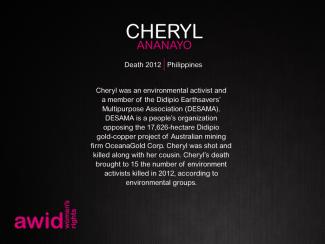
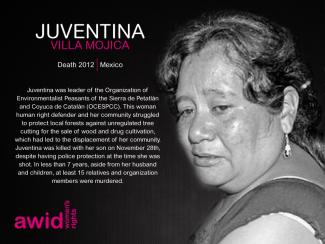
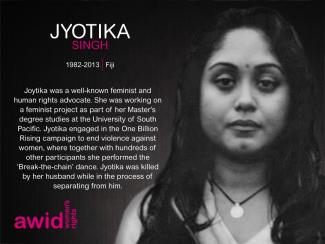
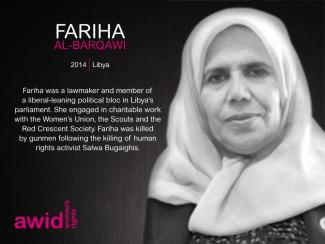
Memory as Resistance: A Tribute to WHRDs no longer with us

AWID’s Tribute is an art exhibition honouring feminists, women’s rights and social justice activists from around the world who are no longer with us. 


In 2020, we are taking a turn

This year’s tribute tells stories and shares narratives about those who co-created feminist realities, have offered visions of alternatives to systems and actors that oppress us, and have proposed new ways of organising, mobilising, fighting, working, living, and learning.

49 new portraits of feminists and Women Human Rights Defenders (WHRDs) are added to the gallery. While many of those we honour have passed away due to old age or illness, too many have been killed as a result of their work and who they are.

This increasing violence (by states, corporations, organized crime, unknown gunmen...) is not only aimed at individual activists but at our joint work and feminist realities.

The stories of activists we honour keep their legacy alive and carry their inspiration forward into our movements’ future work.

Visit the online exhibit

The portraits of the 2020 edition are designed by award winning illustrator and animator, Louisa Bertman

AWID would like to thank the families and organizations who shared their personal stories and contributed to this memorial. We join them in continuing the remarkable work of these activists and WHRDs and forging efforts to ensure justice is achieved in cases that remain in impunity.

“They tried to bury us. They didn’t know we were seeds.” - Mexican Proverb 


The Tribute was first launched in 2012

It took shape with a physical exhibit of portraits and biographies of feminists and activists who passed away at AWID’s 12th International Forum, in Turkey. It now lives as an online gallery, updated every year.

To date, 467 feminists and WHRDs are featured.

Visit the online exhibit

Related Content

WE-Change: Las voces de las mujeres LBT* en el Caribe se escuchan más fuerte

WE-Change: Las voces de las mujeres LBT* en el Caribe se escuchan más fuerte

En todo el Caribe, la incidencia por el reconocimiento y la realización de los derechos de lesbianas, gays, personas bisexuales y trans* (LGBT*) tiene lugar en un contexto excluyente, homofóbico y transfóbico.


Women’s Empowerment for Change [Empoderamiento de las Mujeres para el Cambio, WE-Change], afiliada a AWID desde su creación en mayo de 2015, crea conciencia acerca de los derechos de las mujeres lesbianas, bisexuales y trans* (LBT*) en Jamaica y el Caribe y los defiende. Es una organización de base comunitaria, liderada por mujeres. Veinte mujeres LBT* crearon WE-Change con el objetivo de fortalecer el movimiento de mujeres dentro de la comunidad LGBT* e incrementar la participación de las mujeres LBT* en la promoción y defensa de la justicia social en Jamaica y la región, reconociendo que en el Caribe los espacios de incidencia LGBT* en general están dominados por los hombres, se centran en ellos y suelen marginar a las mujeres.

“Las personas LGBT* cada vez defienden más sus derechos, la igualdad ante la ley, la equidad en los servicios sociales y la protección, y exigen ser tratadas con la dignidad intrínseca con la que nacieron. Yo soy una de esas personas LGBT*. Y tengo un compromiso permanente con la eliminación de todas las formas de estigma y discriminación contra mi comunidad en general y contra las mujeres de mi comunidad en particular”. – Latoya Nugent, Cofundadora y Directora Adjunta de WE-Change

A los pocos meses de haber sido creado, este grupo organizó sesiones de capacitación en nociones básicas de derecho aplicado a la violencia doméstica y sobre la Ley de Violencia Doméstica, además de preparar a facilitadoras para que supieran cómo dar respuesta a y abordar la violencia de género y la causada por la pareja. Para esta actividad se asoció con el Jamaica Forum of Lesbians, All-Sexuals and Gays [Foro Jamaiquino de Lesbianas, Pansexuales y Gays, J-FLAG]; aquí podrás escuchar lo que dijeron las participantes (en inglés).

“WE-Change quiere una sociedad en la que se reconozcan, respeten y protejan los derechos de cada persona, y en la que garantes de obligaciones y proveedores de cuidados se comprometan a crear un ambiente que permita a todas las personas aportar al desarrollo sostenible de Jamaica”.

Al mismo tiempo que procura crear espacios alternativos y seguros en los que la comunidad LBT* pueda expresarse y reducir la homofobia y la transfobia, WE-Change también promueve el autocuidado y el bienestar a través de clases de danza, el yoga y entrenamiento físico (fitness boot camp). Por ejemplo: en la ‘danza aeróbica’, a las participantes se les enseñan “distintos pasos de danza al ritmo de los últimos éxitos de la soca y el dancehall (géneros musicales caribeños)”. Y para celebrar el amor durante #Pride2015 [Orgullo 2015], las mujeres de WE-Change hicieron el video siguiente (en inglés) porque ¡#LoveWins [El amor triunfa]!

Region
El Caribe
Source
WE-Change

El cultivo de 'agroemprendedoras' en Ghana

El cultivo de 'agroemprendedoras' en Ghana

Nana Adjoa Sifa Amponsah, una joven de Ghana, sueña con «una sociedad en la que las jóvenes que se gradúan sientan orgullo de ser 'agroemprendedoras' a cargo de emprendimientos agrícolas y en la que haya una buena relación precio-calidad para los productos de la agricultura a pequeña escala».


Nana confía en que las agroemprendedoras lograrán influir sobre la economía de Ghana e impulsarla, «produciendo alimentos saludables y campesinas ricas».

«Creo firmemente que si hay un sector que puede ayudar a reducir cinco de los problemas más urgentes del mundo —desempleo, inseguridad alimentaria, pobreza, hambre y desnutrición— es la agricultura».

Emprendedora social certificada por el Institute of Social Entrepreneurs [Instituto de Emprendedores Sociales, ahora conocido como Kanthari], Nana tiene experiencia directa de campo en seguridad alimentaria, gestión estratégica y agricultura adquirida en África, Asia y Europa. Con los años, Nana se ha convertido en una experta en gestión de proyectos y ha generado muchos proyectos y programas que ayudan a generar cambios duraderos. También está capacitada en movilización de recursos y en planificación de eventos y proyectos.

En la actualidad, Nana es la Presidenta de Direct Impact Foundation [Fundación Impacto Directo], una organización con sede en Ghana que se propone cerrar la brecha educativa entre las zonas rurales y las urbanas. También es la creadora de Guzakuza, un emprendimiento social que combina la agricultura y el espíritu emprendedor para generar mentalidades agroemprendedoras. Guzakuza es una palabra suajili que significa «cultivar para cambiar vidas». Para Nana, se trata de un enfoque para hacer frente a los problemas más urgentes, al que por su sigla en inglés ella llama ‘la solución ACT’ (incidencia , cooperativas y capacitación).

«La pregunta más importante que hago todo el tiempo es ¿cuál sería el cambio más profundo? ¿Cómo vamos a alimentar a una población que se estima será de 9 mil millones en 2050 si somos todas abogadas, médicas e ingenieras?»

Nana está afiliada a AWID desde comienzos de 2014. Le gusta viajar, escribir y cocinar, y le apasionan la fotografía y la agricultura.


Escucha su “Dream Speech” [Discurso sobre mi sueño] (en inglés) en el que podrás encontrar más información sobre la ‘solución ACT’.

« Cultiver l’agro-entrepreneuriat » au Ghana

« Cultiver l’agro-entrepreneuriat » au Ghana

Nana Adjoa Sifa Amponsah, une jeune femme ghanéenne, rêve d'une « société dans laquelle les jeunes diplômées seraient fières d'être des agro-entrepreneuses – entrepreneuses du secteur agricole – et où la petite agriculture serait rémunérée à sa juste valeur ». Elle est convaincue de la capacité des agro-entrepreneuses à faire évoluer et à stimuler l'économie du Ghana, qui pourrait ainsi « produire une nourriture saine et un secteur agricole prospère ».


« Je suis convaincue du fait que l'agriculture est un secteur qui, à lui seul, peut apporter beaucoup à la résolution des problèmes mondiaux les plus pressants : le chômage, l'insécurité alimentaire, la pauvreté, la faim et la malnutrition. »

Titulaire d'un diplôme d'entrepreneuse sociale de l'Institute of Social Entrepreneurs (aujourd'hui appelé Kanthari), en Inde, Nana possède une expérience de terrain dans les domaines de la sécurité alimentaire, du management stratégique et de l'agriculture en Afrique, en Asie et en Europe. Aujourd'hui, Nana est une experte de la gestion de projet qui a lancé de nombreux projets et programmes visant à l’obtention de changements durables. Elle est également spécialisée dans les activités de levée de fonds et de planification d'évènements et de projets.

Actuellement, Nana est la présidente de la Direct Impact Foundation, une organisation implantée au Ghana qui vise à combler le fossé entre éducation urbaine et éducation rurale. Elle est également à l’initiative de la création de Guzakuza, une entreprise sociale qui a vocation à concilier agriculture et entrepreneuriat pour favoriser l'épanouissement d'une mentalité agro-entrepreneuriale. Guzakuza est un mot swahili que l’on pourrait traduire par « des pépinières qui changent la vie ». Nana y voit une approche susceptible de résoudre les problèmes les plus pressants, approche qu’elle désigne aussi par l’expression « solution PDF » (Plaidoyer, Coopératives et Formation).

« Je reviens toujours à la même question : quel est véritablement le grand changement que nous devons espérer ? Comment allons-nous nourrir une population qui atteindra les 9 milliards de personnes en 2050 si nous sommes tous et toutes des avocat-e-s, des médecins et des ingénieur-e-s ? »

Nana est membre de l'AWID depuis début 2014. Elle adore voyager, écrire et cuisiner. Ses deux grandes passions sont la photographie et l'agriculture.


Écoutez Nana vous présenter ses rêves.

Vous en apprendrez plus sur la « solution PDF » (en anglais).

Growing ‘Agripreneurs’ in Ghana

Growing ‘Agripreneurs’ in Ghana

Nana Adjoa Sifa Amponsah, a young woman from Ghana, dreams of “a society where young women graduates are proud to be ‘agripreneurs’, agricultural entrepreneurs, and where the smallholder farmer gets value for money”.


She is confident that women agripreneurs will influence and drive Ghana's economy, “grow healthy food and wealthy farmers”.

“I strongly believe that agriculture is one single sector that can help reduce five of the world's most pressing problems which are unemployment, food insecurity, poverty, hunger and malnutrition.”

A certified social entrepreneur from the India-based Institute of Social Entrepreneurs (now called Kanthari), Nana has direct field experience in food security, strategic management and agriculture in Africa, Asia and Europe. Over the years, Nana has become a project management expert and has initiated numerous projects and programs that help create lasting change. Nana is also skilled in fundraising and events and projects planning.

Currently, Nana is the President of Direct Impact Foundation in Ghana, an organization aiming to bridge the gap between rural and urban education. She is also an initiator of Guzakuza, a social enterprise committed to combining agriculture and entrepreneurship to create agrpreneurial mindsets. Guzakuza is a Swahili word meaning ‘grow to touch lives’. She sees it as an approach to tackle the most pressing problems, calling it ‘solution ACT’ which stands for Advocacy, Cooperatives, and Training.

“The big question I keep asking is what would be the greatest change? How do we feed the population on track to 9 billion in 2050 if we are all lawyers, doctors and engineers?”

Nana has been a member of AWID since early 2014. She loves to travel, write and cook and is passionate about photography and farming.


Listen to her “Dream Speech” where you can also find out more about ‘solution ACT’.

La Floraison en République démocratique du Congo

La Floraison en République démocratique du Congo

« Notre voix » pour améliorer le bien-être social, culturel et économique des femmes et des filles

Créée en 2008, La Floraison se donne pour mission de mobiliser, consolider et appuyer les énergies de jeunes femmes activistes des droits humains dans le territoire de Fizi[1], zone rurale de la province du Sud-Kivu en République démocratique du Congo, afin d’améliorer leur bien-être social, culturel et économique. Sa mission s’inscrit dans le cadre d’une vision plus globale de l’éclosion d’une nouvelle catégorie de jeunes femmes soucieuses de leur développement et résolument engagées à être des actrices de progrès socioculturel et économique dans leur environnement. C’est ainsi qu’est né le slogan « Jeunes femmes au service de la communauté », porté par l’association depuis sa création

« Je me suis sacrifiée à passer tout mon temps au service des vulnérables et surtout des femmes victimes de violences sexuelles», Magdeleine Rusia Abwe, assistante psychosociale dans le cadre d’un des projets de La Floraison.

La Floraison 2
© La Floraison

L’organisation utilise une approche qu’elle intitule « Notre voix », qui va de la sensibilisation et l’information via une troupe théâtrale, un journal écrit et des radios communautaires, au plaidoyer et à la mobilisation des ressources de groupements féminins. « « Notre voix » est la preuve de notre souci et de notre engagement vers un monde sans violence », dit Loy Honore, Fondatrice de La Floraison.

Une maison d’écoute pour les survivantes de violences sexuelles et basées sur le genre  

Depuis trois ans, La Floraison appuie la prise en charge psychosociale et la réinsertion socioéconomiques des femmes et des filles qui ont survécu aux violences sexuelles et basées sur le genre, dans les aires de santé de Nemba, Katenga et Rubana, en territoire de Fizi. Dans le cadre d’une maison d’écoute, ce projet cherche à informer les communautés sur les violences sexuelles faites aux femmes et aux filles, les services disponibles, les droits des femmes et leur cadre légal d’exécution, ainsi qu’à fournir aux victimes un accompagnement, une orientation vers des services de soutien médical et juridique et assurer leur réinsertion économique à travers des Associations Villageoises d’Epargne et de Crédit (AVEC), tout en renforçant l’activisme communautaire contre les violences basées sur le genre. 

En plus des activités d’identification, d’écoute, de soutien et d’orientation des survivantes de violences sexuelles et basées sur le genre, La Floraison assure une médiation entre les survivantes qui ont été rejetées et leurs familles. De façon complémentaire, le projet comprend des activités de sensibilisation communautaire sur les violences sexuelles et basées sur le genre, la création et le renforcement de Comités d’Alerte et de Surveillance, la résolution de conflits sociaux et communautaires et la consolidation d’un plaidoyer en faveur des droits des femmes.


« Au sein du groupe, j’ai trouvé quelque chose qui dépasse même l’argent : la solidarité ! »

Une survivante burundaise de la violence, âgée de 17 ans et bénéficiaire de l’assistance proposée par La Floraison, raconte son histoire :

La Floraison 4
© La Floraison

« A 15 ans, j’ai mis au monde mon premier enfant avec un vieux et fidèle client qui a proposé une vache à ma mère. Le comportement brutal de ce vieux soulard – coups, menaces de mort –  n’a pas permis une entente dans le foyer. Je suis rentrée à la maison mais ma mère n’a pas été satisfaite de ma réaction. En octobre 2013, un vieil homme congolais âgé de plus de 49 ans a voulu m’amener avec lui en RDC, ma mère a donné son accord pour me marier sans me demander mon avis et le prétendant lui a remis 3 chèvres et deux paires de pagnes[2] pour ma dot.

Quand nous sommes arrivés en RDC, j’ai trouvé qu’il avait 3 femmes et que j’étais devenue la quatrième ; il avait des enfants plus âgés que moi.  Après un mois, les trois premières femmes n’ont pas accepté que je reste dans la parcelle agricole. Le mari m’a abandonnée sans aucun soutien. Je suis allée voir le chef de village mais la communication a posé problème en raison de la différence de langue. Sans ration ni moyen de survie, j’ai commencé à cultiver pour les gens pour que je puisse manger. Quand mon mari apprenait que je travaillais pour quelqu’un, il venait le menacer en disant que j’étais son épouse et que personne ne pouvait m’utiliser sans son consentement. Je ne comprenais rien car tout se passait dans une langue que je ne comprends pas. Plusieurs personnes avaient peur de me faire travailler. Un jour,  trois hommes se sont introduits dans ma maison non protégée vers minuit. Ils m’ont violée à tour de rôle. L’un d’eux a entendu mes cris en Kirundi – il était aussi burundais – et a demandé à ses amis de me laisser en vie. Il m’a conseillée de partir car mon mari avait l’intention de me tuer. Le matin, les voisins sont venus à mon secours.

Je n’ai dit à personne ce qui m’est arrivée cette nuit – le viol – car selon nos coutumes, si l’entourage apprend que vous avez subi le viol, personne ne peut plus se marier avec vous. Au vu de ces menaces, le chef de village m’a installée chez lui et la police est venue faire des investigations. Ça n’a pas été facile de m’assister car j’étais installée illégalement en RDC, mais ils ont commencé à chercher mon mari.  Ma vie était devenue très difficile car j’avais déjà vendu tous les biens que j’avais pour ma survie et celle de mon enfant. J’ai demandé au chef de village de me faire partir au Burundi, il fallait plus de 30$, ce n’était pas facile.

La Floraison 3
© La Floraison

Un jour, une femme travaillant au centre de santé est venue me chercher et m’a demandé de venir au centre de santé pour un entretien en privé. J’avais peur, mais lorsque je suis arrivée sur le lieu, elle m’a très bien accueillie, elle m’a rassurée, mais l’émotion était si grande que les pleurs n’ont pas permis un entretien libre. Elle m’a donnée un nouveau rendez-vous et cette fois-là, je lui ai révélé tout ce qui m’est arrivée à partir du Burundi. L’infirmier m’a aussi reçu et je suis allée à Sebele[3] pour les soins. Elle m’a beaucoup aidée par des conseils et des visites, même si je ne parle pas convenablement le Swahili. Je passais la voir au centre de santé et un jour elle m’a accompagnée au poste de la police pour suivre le déroulement de mon dossier et a demandé à la police de faciliter mon rapatriement vers le Burundi.

Elle m’a aussi conseillée de rejoindre un groupe d’épargne et crédit créé dans le village pour que je puisse bénéficier du crédit pour me permettre de mener des petites activités commerciales.  Au sein du groupe, j’ai trouvé quelque chose qui dépasse même l’argent : la solidarité ! Je ne savais pas que je pouvais trouver des personnes généreuses à mes côtés surtout pendant ces moments de dures épreuves. J’ai eu un petit crédit de 16000FC qui me permet de commercialiser les fretins (12000FC) et la farine de maïs (4000FC). Je ne peux plus mourir de faim.

Mentalement je me sens bien, mais j’ai encore besoin de regagner mon pays pour vivre avec ma mère. »


[1] Le territoire de Fizi comprend quatre collectivités rurales, 27 groupements, 142 localités et 1.634 villages. Ses structures de base sont en mauvais état, notamment pour l’éducation, la santé, l’emploi, les transports et les loisirs. La région n’est pas électrifiée et peu de ménages disposent d’un accès à l’eau potable et aux infrastructures hygiéniques appropriées.

[2] Vêtements.

[3] Localité du territoire de Fizi.

Source
La Floraison

Blossoming in the Democratic Republic of Congo

Blossoming in the Democratic Republic of Congo

“Our voice” to advance the social, cultural and economic well-being of women and girls

Founded in 2008, La Floraison’s mission is to mobilize, convene and support young women human rights activists in Fizi territory[1], a rural area in the South Kivu province of the Democratic Republic of Congo, to advance their social, cultural and economic wellbeing. Its mission is part of a broader vision for the emergence of a new group of young women concerned about their development and resolutely committed to becoming agents of sociocultural and economic progress within their environment. This brought about the slogan “Young women serving the community” which has been part of the association since its launch.

“I sacrificed all of my time to serve the most vulnerable, especially women victims of sexual violence,” Magdeleine Rusia Abwe, psychosocial assistant of one of the Floraison projects. 

La Floraison 2
© La Floraison

The organization uses an approach they call ‘Our Voice’ which ranges from awareness-building and information-sharing via a theatrical troupe, a newspaper and community radio, to advocacy, and mobilizing resources for women’s groups. ‘Our Voice’ is proof of our support and engagement toward a world without violence,” says Loy Honore, founder of La Floraison. 

A counseling center for survivors of sexual and gender-based violence 

For three years, La Floraison has supported the psychosocial care and socioeconomic reintegration of women and girls who are survivors of sexual and gender-based violence within the Nemba, Katenga and Rubana health centers in Fizi territory. Through the counselling center the project seeks to inform communities about sexual violence against women and girls, available services, and women’s rights and their legal implementation, as well as provide victims with counseling, referral to medical and legal support services and ensure their economic reintegration through Village Saving and Lending Associations (VSLA), while strengthening community activism against gender-based violence.

In addition to documenting, counselling, supporting, and providing referrals to survivors of sexual and gender-based violence, La Floraison mediates between survivors who have been shunned and their families. To compliment, the project includes community outreach on sexual and gender-based violence, creating and strengthening Committees for Surveillance and Alert, social and community conflict resolution, and women’s rights advocacy.


“Through the group, I found something worth more than money: solidarity!”

A 17 year old Burundian survivor of violence, and beneficiary of La Floraison support, tells her story:

La Floraison 4
© La Floraison

“At 15, I gave birth to my first child with an old loyal client who offered a cow to my mother. The brutality of that old drunkard – beatings, death threats – wouldn’t allow for a moment’s peace at home. I came home but my mother wasn’t pleased with my behaviour. In October 2013, an old Congolese man, older than 49, presented the need to bring me to the DRC with him, my mother gave him her permission for marriage without asking me and the suiter gave 3 goats and 2 pairs of loincloths[2] as my dowry.

When we arrived in the DRC, I found out that he had 3 wives and that I had become the fourth; he had children older than me. After a month, the three first wives didn’t want me on the plot of land. The husband abandoned me without any support. I went to see the village chief but there was a language barrier. Without any ration or means of survival, I started to cultivate for people so that I could eat. When my husband learned that I was working for someone, he would come and threaten them by saying that I was his wife and that no one could use me without his consent. I did not understand anything because everything was happening in a language I don’t understand. Many people were scared to give me work. One day, three men came to my unprotected home around midnight. They raped me one by one. One of them heard my screams in Kirundi – who was also Burundian – and asked his friends to let me live. He advised me to leave because my husband was planning to kill me. In the morning, the neighbours came to my rescue.         

I didn’t tell anyone what happened to me that night – the rape – because according to our customs, if others find out that you have been raped, no one can marry you any longer. In light of these threats, the village chief brought me to his home and the police came to investigate. It was not easy to help me because I was in the DRC illegally, but they began to look for my husband. My life became very difficult because I had already sold all of the goods I had for survival, and those of my child. I asked the village chief to send me to Burundi. That cost more than $30, it was not easy.

La Floraison 3
© La Floraison

One day, a women working at the health centre came to look for me and asked me to come to the health centre for a private meeting. I was scared, but when I arrived at the location, she welcomed me very kindly, she reassured me, but I was so emotional and the meeting couldn’t take place because of all my crying. She gave me a new meeting, and this time, I told her everything that happened beginning from Burundi. The nurse also saw me and I went to Sebele[3] for care. She helped me a lot, with counselling and visits, even though I don’t speak fluent Swahili. I would go and see her at the health center and one day she came with me to the police station to follow-up on the progress of my case and asked the police officer to facilitate my repatriation to Burundi.

She also recommended that I join a savings and credit group founded in the village so that I could receive a loan to conduct small business transactions. Through the group, I found something worth more than money: solidarity! I didn’t know that I could find such generous people by my side, especially during such hardship. I received a small loan of 16,000FC, which allows me to sell fry (12,000FC) and corn flour (4,000FC). I can’t starve to death anymore.     

Mentally, I feel good, but I still need to return to my country to live with my mother.”


[1] Fizi territory includes four rural communities, 27 groups, 142 towns and 1,634 villages. The infrastructure is in poor condition, particularly for education, health, employment, transportation and recreation. The area lacks electricity and few households have access to potable water and proper sanitation.

[2] Clothing.

[3] Town in Fizi territory

Source
La Floraison

Flores en la República Democrática del Congo

Flores en la República Democrática del Congo

"Nuestra voz” para promover el bienestar social, cultural y económico de las mujeres y las niñas

La Floraison fue fundada en 2008 y su misión es movilizar, reunir y brindar apoyo a mujeres jóvenes activistas por los derechos humanos en el territorio de Fizi[1] –un área rural de la provincia de Kivu del Sur en la República Democrática del Congo– con el propósito de fomentar el bienestar social, cultural y económico de estas jóvenes. Su misión forma parte una visión más amplia para el surgimiento de un nuevo grupo de jóvenes preocupadas por su desarrollo y firmemente decididas a convertirse en agentes de progreso sociocultural y económico en su entorno. Así surgió el eslogan “Mujeres jóvenes al servicio de la comunidad”, que ha sido parte de la asociación desde su lanzamiento. 

“Sacrifiqué todo mi tiempo para servir a las personas más vulnerables, en especial a las mujeres víctimas de violencia sexual”, Magdeleine Rusia Abwe, asistente psicosocial de uno de los proyectos de La Floraison. 

La Floraison 2
© La Floraison

La organización trabaja desde un enfoque al que denomina “Nuestra voz” y que incluye la concienciación y la información a través de una radio, un grupo de teatro y un periódico comunitarios, así como la incidencia y la movilización de recursos para los grupos de mujeres. ‘Nuestra voz’ es prueba de nuestro apoyo y compromiso con la construcción de un mundo sin violencia”, afirma Loy Honore, fundadora de La Floraison.

Un centro de atención para sobrevivientes de violencia sexual y de género 

Desde hace tres años, La Floraison apoya la atención psicosocial y la reintegración socioeconómica de las mujeres y las niñas sobrevivientes de violencia sexual y de género en centros de salud de Nemba, Katenga y Rubana, en el territorio de Fizi. A través de los centros de atención, el proyecto busca informar a las comunidades sobre la violencia sexual contra las mujeres y las niñas, los servicios disponibles y los derechos de las mujeres y su implementación legal. La iniciativa se propone también asesorar a las víctimas, derivarlas a servicios médicos y de apoyo legal y asegurar su reintegración económica a través de las Asociaciones Aldeanas de Ahorro y Préstamo, a la vez que fortalece el activismo comunitario contra la violencia de género. 

Además de documentar, asesorar, apoyar y derivar a las sobrevivientes de violencia sexual y de género, La Floraison media entre las sobrevivientes que han sido rechazadas y sus familias. Como complemento, el proyecto incluye la divulgación entre la comunidad sobre la violencia sexual y de género a través de la creación de comités de vigilancia y alerta, la resolución de conflictos sociales y comunitarios y la promoción y defensa de los derechos de las mujeres.  


“A través del grupo encontré algo más valioso que el dinero: ¡la solidaridad!”

Una joven burundiana de 17 años sobreviviente de violencias y beneficiaria del apoyo de La Floraison, cuenta su historia:

La Floraison 4
© La Floraison

“A los 15 años di a luz a mi primer hijo con un viejo buen cliente que le ofreció una vaca a mi madre. La brutalidad de ese viejo borracho –me propinaba golpizas y amenazas de muerte– no daban un momento de paz en el hogar. Volví a la casa de mi madre, pero ella no aprobó mi comportamiento. En octubre de 2013, un congoleño mucho mayor que yo, de más de 49 años, planteó la necesidad de llevarme con él a la República Democrática del Congo. Mi madre dio su permiso para el matrimonio sin consultarme y el pretendiente entregó 3 cabras y 2 pares de taparrabos[2] como dote.

Cuando llegamos a la RDC, descubrí que él tenía tres esposas y que yo me había converitdo en la cuarta; él tenía hijos mayores que yo. Al cabo de un mes las tres primeras esposas no me querían en la parcela de tierra. El esposo me abandonó sin ningún apoyo. Fui a ver al jefe de la aldea pero estaba la barrera del idioma. Sin comida ni medios de superviviencia, empecé a cultivar para otras personas para poder comer. Cuando mi esposo se enteraba de que yo estaba trabajando para alguien, venía y los amenazaba diciendo que yo era su esposa y que nadie podía usarme sin su consentimiento. Yo no entendía nada porque todo sucedía en un idioma que no comprendo. Muchas personas tenían miedo de darme trabajo. Un día, tres hombres llegaron a mi hogar desprotegido alrededor de la medianoche. Me violaron uno a uno. Uno de ellos oyó mis gritos en kirundi –él también era de Burundi– y le pidió a sus amigos que me dejaran vivir. Me aconsejó que huyera porque mi esposo planeaba matarme. Por la mañana, los vecinos vinieron a rescatarme.

No Ie dije a nadie lo que me había sucedido esa noche –la violación– porque de acuerdo con nuestras costumbres, si los demás saben que has sido violada, ya nadie querrá casarse contigo. A la luz de estas amenazas, el jefe de la aldea me llevó a su casa y la policía empezó a investigar. No era fácil ayudarme porque estaba en la RDC ilegalmente, pero empezaron a buscar a mi esposo. Mi vida se volvió muy difícil porque para sobrevivir había vendido todo lo que tenía, y también las cosas de mi hijo. Le pedí al jefe de la aldea que me enviara a Burundi. Eso costaba más de $30, y no era fácil.

La Floraison 3
© La Floraison

Un día, una mujer que trabajaba en el centro de salud vino a verme y me dijo que fuera al centro de salud para una cita privada. Yo tenía miedo, pero cuando llegué al lugar, ella me recibió con mucha amabilidad, me reconfortó, pero yo estaba muy conmovida y la reunión no pudo tener lugar a causa de mi llanto. Me dio una nueva cita, y esa vez le conté todo lo sucedido desde el principio en Burundi. También me vio la enfermera y fui a Sebele[3] para que me atendieran. Ella me ayudó mucho, con asesoramiento y visitas, aunque yo no hablaba swahili fluidamente. Yo iba a verla al centro de salud y un día fue conmigo a la estación de policía para ver cómo iba mi caso y le pidió al funcionario policial que facilitara mi repatriación a Burundi.

Ella también me recomendó que me uniera a un grupo de ahorro y crédito fundado en la aldea ya que así podría recibir un préstamo y hacer pequeñas transacciones comerciales. A través del grupo encontré algo más valioso que el dinero: ¡la solidaridad! No sabía que podría encontrar personas tan generosas a mi lado, en especial durante momentos tan duros. Recibí un pequeño préstamo de 16.000FC, que me permite vender pescado (12.000FC) y harina de maíz (4.000FC). Ya no moriré de hambre.

Mentalmente me siento bien, pero todavía necesito regresar a mi país a vivir con mi madre”.


[1] El territorio de Fizi incluye cuatro comunidades rurales, 27 grupos, 142 pueblos y 1634 aldeas. La infraestructura es insuficiente, en especial para la educación, la salud, el empleo, el transporte y la recreación. El área carece de electricidad y pocos hogares tienen acceso a agua potable y a saneamiento adecuado.

[2] Vestimenta.

[3] Poblado en el territorio de Fizi

Source
La Floraison