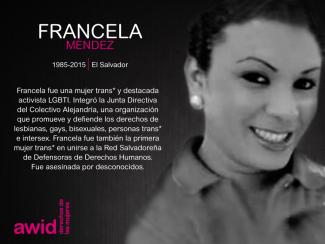
Francela Mendez

Les défenseuses des droits humains s’auto-identifient comme des femmes ou des personnes lesbiennes, bisexuelles, transgenres, queer, intersexes (LBT*QI) ou autres qui défendent les droits. Elles sont exposées à des risques et à des menaces de nature genrée à cause du travail qu’elles accomplissent en faveur des droits humains et/ou en conséquence directe de leur identité de genre ou de leur orientation sexuelle.
Les défenseuses des droits humains subissent une violence et une discrimination systématique du fait de leur identité, mais aussi à cause de la lutte indéfectible qu’elles mènent en faveur des droits, de l’égalité et de la justice.
Le programme Défenseuses des droits humains collabore avec des partenaires internationaux et régionaux ainsi qu’avec les membres de l’AWID pour éveiller les consciences à propos de ces risques et menaces, pour plaider en faveur de mesures féministes et holistiques de protection et de sécurité et enfin pour promouvoir activement une culture du souci de soi et du bien-être collectif au sein de nos mouvements.
Les défenseuses des droits humains sont exposées aux mêmes types de risques que toutes les autres personnes qui défendent les droits humains, les communautés et l’environnement. Mais elles se heurtent également à des violences fondées sur le genre et à des risques spécifiques de nature genrée parce qu’elles remettent en cause les normes de genre en vigueur au sein de leur culture et de leur société.
En défendant les droits, les défenseuses des droits humains sont exposées aux risques suivants :
Nous travaillons en collaboration avec des réseaux internationaux et régionaux ainsi qu’avec nos membres pour :
Nous travaillons à la promotion d’une approche holistique de la protection des défenseuses, qui suppose notamment :
Nous souhaitons contribuer à l’avènement d’un monde plus sûr pour les défenseuses des droits humains, leurs familles et leurs communautés. Nous pensons que le fait que les défenseuses œuvrent en faveur des droits et de la justice ne devrait pas leur faire courir de risques ; leur action devrait être appréciée et célébrée.
Promouvoir la collaboration et la coordination entre organisations de défense des droits humains et des droits des femmes au niveau international, et ce dans le but de d’apporter des réponses plus efficaces dans le domaine de la sureté et du bien-être des défenseuses des droits humains ;
Soutenir les réseaux régionaux de défenseur-es et les organisations, parmi lesquels l’Initiative mésoaméricaine des défenseuses des droits humains et la Coalition des défenseuses des droits humains du Moyen-Orient et d’Afrique du Nord, dans leur travail de promotion et de renforcement de l’action collective en faveur de la protection des défenseuses – en mettant en avant l’importance de la création de réseaux de solidarité et de protection, de la promotion du souci de soi ainsi que du plaidoyer et de la mobilisation en faveur de la sécurité des défenseuses ;
Faire en sorte que les défenseur-e-s des droits humains et les risques qui les menacent soient plus visibles et mieux reconnus, en rassemblant des informations sur les agressions dont elles sont victimes et en produisant et diffusant des documents sur leurs luttes, leurs stratégies et les difficultés qu’elles rencontrent ;
Organiser des réponses urgentes fondées sur la solidarité internationale dès que des défenseuses des droits humains sont en danger, par le biais de nos réseaux internationaux et régionaux mais aussi grâce à nos membres.
If you’re looking to have an impact through your work in feminist, social justice and other non-profit organizations, we hope this page provides a start.
Here you will find open vacancies and call for applications from AWID and the Alliance for Feminist Movements, when available. Follow us on social media to be in the loop.
by Judyannet Muchiri
October last year I left for Kenya to begin what I have come to think of as my most important work yet. (...)
artwork: “Healing Together” by Upasana Agarwal >
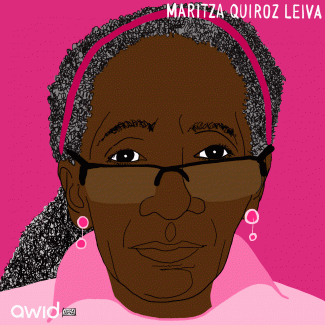
Maritza Quiroz Leiva was an Afro Colombian social activist, a community leader and women human rights defender. Among the 7.7 million Colombians internally displaced by 50 years of armed conflict, Maritza dedicated her advocacy work to supporting the rights of others, particularly in the Afro Colombian community who suffered similar violations and displacement.
Maritza was the deputy leader of the Santa Marta Victim's Committee, and an important voice for those seeking justice in her community, demanding reparations for the torture, kidnapping, displacement, and sexual violence that victims experienced during the armed conflict. She was also active in movement for land redistribution and land justice in the country.
On 5 January 2019, Maritza was killed by two armed individuals who broke into her home. She was 60 years old.
Maritza joined five other Colombian social activists and leaders who had been murdered just in the first week of 2019. A total of 107 human rights defenders were killed that year in the country.
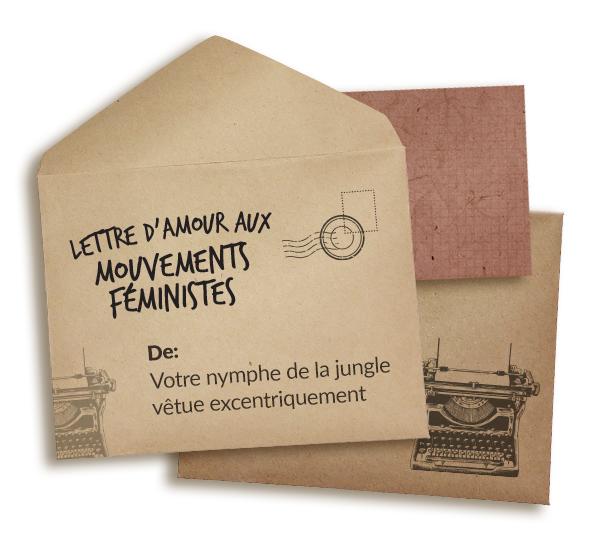
Chers êtres splendides,
Je sais que vous y êtes presque. Vous le sentez, non? La manière dont les choses doivent changer et que vous devez recentrer.
Ceci est une lettre pour vous dire de le faire. Choisissez votre guérison. Choisissez d’aller bien. Mieux que bien. Choisissez d’être entières, être heureuses. De pleurer pour vous-même et pour personne d’autre. Choisissez de laisser le monde dehors et de lui dire « Je reviens dans cinq minutes ». Ou dans cinq jours. Ou dans cinq ans.
Ou jamais.
Choisissez de ne pas tout prendre. Choisissez de ne rien en prendre. Parce que rien de tout cela n’est à vous. Et ça ne l’a jamais été. On vous dit depuis votre naissance que c’est à vous. Les problèmes de votre famille. Les problèmes de votre amoureuxse. Les problèmes du quartier. Les problèmes du monde. Cette petite voix constante qui vous dit que ces problèmes vous appartiennent. Ils sont à vous. C’est à vous de les tenir, à vous de les supporter. À vous de les régler.
C’était un mensonge.
Un bobard.
Une arnaque.
Une escroquerie.
Les problèmes de l’univers ne sont pas les vôtres.
Les seuls problèmes qui sont à vous sont les vôtres. Tout le reste peut aller se faire voir.
Permettez-vous de tout lâcher et de partir en courant dans la jungle. Faites connaissance avec une nymphe vêtue de marguerites, ouvrez une petite librairie dans les racines d’un arbre. Dansez toute nue et hurlez à la lune. Discutez avec Ochun sur les berges de la rivière.
Ou buvez simplement une tasse de thé quand vous avez besoin de prendre le temps de vous poser.
Donnez-vous la permission de disparaître dans la brume et réapparaissez trois pays plus loin en tant que mystérieuse chocolatière au passé un peu trouble avec un penchant pour les habits excentriques et les cigares.
Ou arrêtez de prendre les appels du travail cette fin de semaine.
Nagez jusqu’à une île déserte avec votre amoureuxse et habillez-vous de noix de coco avec lesquelles vous aurez fait un rhum que vous savourerez au coucher du soleil.
Ou dites non quand vous n’avez pas la capacité de faire de la place à quelqu’un.
Les options pour vous retenir sont innombrables.
Quoi que vous fassiez, sachez que le monde continuera de tourner. C’est là toute la beauté et la douleur de l’expérience. Qui ou quoi que vous choisissiez plutôt que vous-même et votre âme, le monde continuera toujours de tourner.
Donc, choisissez-vous.
Le matin, quand la première lueur apparaît, choisissez-vous. Quand arrive midi et qu’il est l’heure de pleurer pendant vos heures de travail, choisissez-vous. Le soir, quand vous réchauffez des restes parce que vous n’avez pas eu le temps de cuisiner, choisissez-vous. Quand l’anxiété vous réveille et que l’existence fait silence à 3 h 45 du matin.
Choisissez-vous.
Parce que le monde continuera toujours à tournoyer, de guingois, et que vous méritez d’avoir quelqu’un·e qui essaie toujours de le redresser pour vous.
Avec amour,
Votre nymphe de la jungle vêtue excentriquement
Roxana Reyes Rivas, filósofa, feminista, lesbiana, poeta, política y activista por los derechos humanos de las mujeres y las personas LGBTI en Costa Rica. Dueña de una pluma afilada y un humor agudo, con la risa a flor de piel. Nació en 1960 y creció en San Ramón de Alajuela, cuando era una zona rural, y su vida entera rompería con los mandatos de lo que significaba ser mujer.
Desde El Reguero (grupo de lesbianas en Costa Rica) organizó festivales lésbicos por más de 10 años, espacios lúdico-formativos de encuentro en momentos donde el gobierno y la sociedad costarricense perseguía y criminalizaba la existencia lésbica. Para cientos de mujeres los festivales lésbicos eran el único lugar donde podían ser ellas mismas y encontrarse con otras como ellas.
Roxana decía que fundar partidos políticos era uno de sus pasatiempos. “Es importante que en Costa Rica la gente entienda que hay otras formas de hacer política, que muchos temas es necesario resolverlos colectivamente”. Fue una de lxs fundadores de los partidos Nueva Liga Feminista y VAMOS, un partido centrado en los derechos humanos.
“El oficio de la filosofía es meter la puya, ayudar a que la gente empiece a preguntarse cosas. La filósofa que no irrita a nadie, no está haciendo bien su trabajo”. Durante 30 años, Roxana fue profesora de filosofía en universidades públicas costarricenses. De su mano generaciones enteras de estudiantes reflexionaron sobre los dilemas éticos en la ciencia y la tecnología.
La herramienta favorita de Roxana era el humor, ella creó el premio del Chiverre Incandescente, un reconocimiento a la estupidez que otorgaba vía redes sociales a diferentes figuras públicas, ridiculizando sus exabruptos y afirmaciones anti-derechos.
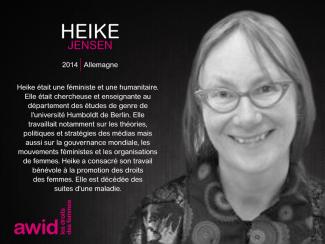
Un cáncer agresivo se llevó a Roxana a fines del 2019, antes de que alcanzara a publicar la compilación de sus poemas, un último regalo de la mente creativa de una feminista que siempre levantó la voz para denunciar la injusticia.
Me complace compartir con ustedes una de mis fechas destacadas como feminista con discapacidad. Fue el 30 de mayo de 2014, cuando nosotras, la Nationwide Organization of Visually-Impaired Empowered Ladies (NOVEL) [Organización Nacional de Mujeres con Discapacidad Visual Empoderadas]), participamos en la Semana de la Moda de Filipinas 2014, en el marco de nuestra campaña de promoción del bastón blanco. Dos mujeres ciegas recorrieron la pasarela para promover el bastón blanco como uno de los símbolos de la igualdad de género, el empoderamiento, la plena inclusión y la participación igualitaria en la sociedad de mujeres y niñas con discapacidad visual.
Su desfile frente a la multitud fue para mí una experiencia sumamente impactante, ya que fui quien propuso nuestro proyecto a Runway Productions (esperé pacientemente un año hasta que fue aprobado), sabiendo que ellas no eran modelos: una había sido coronada como Ms. Philippines Vision [Srta. Filipinas Visión], y la otra era la segunda finalista del concurso 2013 de Ms. Philippines on Wheels, Signs and Vision [Srta. Filipinas sobre Ruedas, Señas y Visión] de Tahanang Walang Hagdanan, Inc. (House with No Steps [Casa Sin Escalones]). Dependían de su orientación y ensayaron la noche antes del evento, pero no practicaron con modelos profesionales. Antes de que comenzara el desfile, hablé con ellas por teléfono móvil para estimular su confianza y para rezar juntas pidiendo la ayuda de Dios. Cuando bajaron de la pasarela respiré profundamente y se me caían las lágrimas. ¡Me sentía eufórica porque lo habíamos logrado, a pesar de los desafíos que habíamos tenido que superar! ¡Nuestro mensaje al mundo de que las mujeres y las jóvenes con discapacidad visual pueden caminar con dignidad, libertad e independencia, sobre una base de igualdad con otras, mediante el uso de nuestro dispositivo de asistencia (los bastones blancos) había sido transmitido exitosamente! Fuimos tendencia en las redes sociales, y nos presentaron en los canales de televisión.
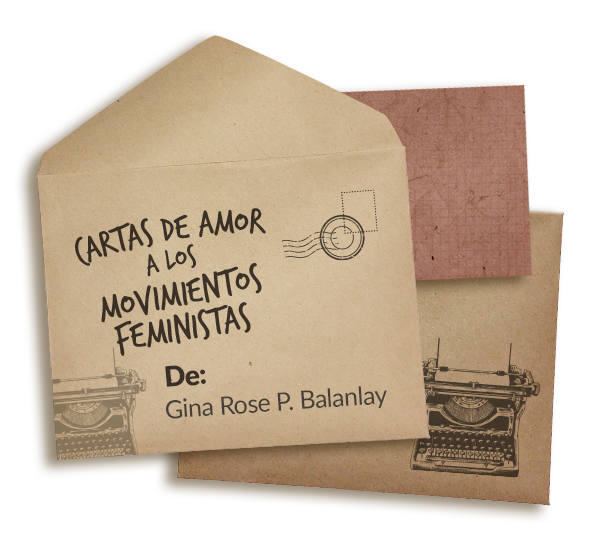
Mi vida como feminista con discapacidad comenzó como una forma de sanar mi espíritu quebrantado y de ver un camino diferente para encontrar mi propósito en la vida después de que me convertí en víctima-sobreviviente a causa de un brutal ataque con ácido en 2007, cuando esperaba mi transporte para volver a casa desde la oficina. Mis ojos quedaron severamente dañados, al punto que quedé con la visión reducida.
No sabía cuán plena de alegría y propósito podía ser mi vida nuevamente, hasta que conocí a mujeres líderes del movimiento de género y discapacidad que me convencieron para que continuara. Sus palabras de aliento me atrajeron y fueron la música más dulce para mis oídos. Mi corazón roto salta como un colibrí en vuelo cada vez que pienso en ellas y en el feminismo que me estimuló para participar en hacer la diferencia para nuestras invisibles hermanas con discapacidades y para quienes continúan experimentando discriminación. Al día de hoy me siento consumida por el deseo de estar con el movimiento. No puedo ocultar mi entusiasmo cada vez que presento propuestas de proyectos a diferentes sectores involucrados, a favor del empoderamiento, el desarrollo y el fomento de nuestras hermanas con discapacidades y cuando me presento en coloquios locales, nacionales e internacionales para difundir nuestras voces, incluso a mi costo y cargo.
Inesperadamente, fui seleccionada como representante mujer de nuestro país ante la Asamblea General 2012 de la Unión Mundial de Ciegos (WBU en inglés) en Tailandia, a pesar de que era una recién llegada al movimiento de personas con discapacidad. Me sentí inspirada para conectarme, reunir y empoderar a nuestras hermanas con discapacidad visual respecto de sus derechos, y para conocer sus problemas interrelacionados. En 2013, lanzamos oficialmente la Nationwide Organization of Visually-Impaired Empowered Ladies (NOVEL) para apoyar el empoderamiento de nuestras hermanas con discapacidades, construir coaliciones con movimientos de mujeres y de discapacidades diversas y promover el desarrollo inclusivo del género y la discapacidad.
Mi participación como co-representante de las mujeres con discapacidades en la presentación del Informe Sombra CEDAW, convocado en 2016 por la Oficina Legal y de Derechos Humanos de las Mujeres (WLB, por sus siglas en inglés) con los grupos marginalizados de mujeres, me abrió muchas puertas, tales como el trabajo con diferentes organizaciones de mujeres y la asistencia a los Días Internacionales de la Inclusión 2017 en Berlín, Alemania, junto con tres líderes filipinas con discapacidades, para compartir nuestras buenas prácticas y, principalmente, nuestro compromiso con el movimiento de mujeres de nuestro país.
Mi recorrido como feminista con discapacidad ha sido para mí una montaña rusa emocional. La promoción de la plena inclusión de nuestras hermanas con discapacidades y su participación igualitaria y efectiva en la sociedad me ha dado felicidad y autoestima. También me he sentido frustrada y disgustada cada vez que di todo de mí y recibí a cambio comentarios negativos. No obstante, me siento así porque estoy enamorada del movimiento.
Me veo en el futuro trabajando en solidaridad con el movimiento para garantizar que nuestras hermanas con y sin discapacidades puedan disfrutar y participar en la sociedad de forma completa e igualitaria.
Mucho amor,
Gina Rose P. Balanlay
Feminista con discapacidad
Filipinas
Todos nuestros procesos de cambio se basan en las relaciones que construimos en espacios como los Foros de AWID donde se baila juntxs, tu humor se trasluce, tu yo real, cuentas historias... eso es lo que hace la diferencia.
- Nicky Mcintyre, Estados Unidos
1,174 feminist, women's rights & LGBTQI+ organizations
from 129 countries participated in AWID's 2024 survey.
The data reveals the state of resourcing for feminist movements between 2021-2023, amid current major defunding trends in aid and philanthropy.
Une enquête personnelle sur la vie mystérieuse de la tante de la réalisatrice Sally, une aristocrate éthiopienne devenue rebelle communiste qui a disparu après la révolution conduisant au renversement de l'empereur Haile Selassie.
23 juin à 12 h 30 EST sur IG en direct
“Je n’avais pas prévu d’être chanteuse; c’est le chant qui avait prévu de m’habiter” - Dorothy Masuka (interview avec Mail & Guardian)
L’une de ses chansons, intitulée "Dr Malan" (du nom de l'homme politique pro-apartheid D.F. Malan) a été censurée. Elle a poursuivi avec l’enregistrement de "Lumumba" (1961), une chanson sur l'assassinat du leader anticolonialiste Patrice Lumumba. Le travail et l'activisme de Dorothy ont alors attiré l'attention de la section spéciale de la police sud-africaine, ce qui la contraignit à un exil politique qui s’étendit sur plus de 3 décennies. Tout au long de cette période, elle travailla avec des groupes pro-indépendantistes, dont le Congrès national africain. En 1992, alors que l'apartheid commençait à s'effondrer et que Nelson Mandela fut libéré de prison, elle retourna en Afrique du Sud.
Parmi ses autres œuvres, on peut citer sa première chanson, enregistrée en 1953 et intitulée "Hamba Notsokolo", qui fut un tube des années 1950 et un grand classique. Elle composa également "El Yow Phata Phata", une chanson adaptée par Miriam Makeba qui contribua à offrir une popularité internationale à "Pata, Pata".
Ancrés dans la résistance, la musique et l’activisme de Dorothy étaient entrelacés et laissent un merveilleux héritage inspirant. Elle était également très connue sous le nom de “Auntie Dot”.
Le 23 février 2019, Dorothy s’est éteinte à Johannesburg à 83 ans des suites d’une maladie.
Regardez l'interview de Dorothy Masuka pour Mail & Guardian (seulement en anglais)
Écoutez sa musique :