Venecia Natinga

Les jeunes activistes féministes jouent un rôle crucial au sein des organisations et des mouvements pour les droits des femmes à travers le monde. Ce sont elles qui soulèvent les nouveaux problèmes auxquels les féministes sont confrontées aujourd'hui. Leur force, leur créativité et leur adaptabilité sont vitales pour assurer la viabilité des organisations féministes.
Pourtant, elles sont confrontées à toute une série d’obstacles particuliers, notamment l'accès limité au financement et au soutien, le manque de possibilités de renforcement des capacités et une augmentation considérable des agressions sur les jeunes défenseuses des droits humains. Ces obstacles entraînent un manque de visibilité qui rend leur intégration et leur participation effective au sein des mouvements pour les droits des femmes encore plus difficiles.
Le Programme d’activisme des jeunes féministes de l'AWID a été mis en place pour veiller à ce que les voix des jeunes femmes soient entendues et représentées dans le discours féministe. Nous voulons faire en sorte que les jeunes féministes aient un meilleur accès à du financement, à des opportunités de renforcer leurs capacités et aux processus internationaux.
En plus de soutenir directement les jeunes féministes, nous travaillons également avec des activistes des droits des femmes de tout âge pour élaborer des modèles et des stratégies d’organisation multigénérationnelles plus efficaces.
Nous souhaitons que les jeunes féministes puissent jouer un rôle actif dans les prises de décisions qui concernent leurs droits. Nos actions incluent :
Favoriser la mise en commun et le partage d'informations par la Plateforme de jeunes féministes. Étant donné l'importance des médias en ligne pour le travail des jeunes féministes, notre équipe a lancé la Plateforme de jeunes féministes en mai 2010. Elle a pour objectifs d’échanger des renseignements, de renforcer les capacités des membres par le truchement de webinaires et de discussions en ligne, et d'encourager la consolidation d’une communauté de jeunes féministes.
Soutenir la recherche et le renforcement des connaissances sur l'activisme des jeunes féministes, pour accroître la visibilité et l'influence de leur activisme au sein et entre les mouvements pour les droits des femmes et auprès d'autres acteurs-trices clés, tels les donateurs.
Faire la promotion de la collaboration multigénérationnelle, en explorant de meilleures façons de travailler ensemble.
Inciter les jeunes féministes à s’engager dans les processus internationaux relatifs au programme de développement, notamment ceux des Nations Unies.
S’assurer leur collaboration dans tous les domaines prioritaires de l'AWID, y compris le Forum, pour faire en sorte que leurs contributions, leurs perspectives, leurs besoins et leur activisme se traduisent dans les débats, les politiques et les programmes qui les concernent.
Explora estos proyectos elaborados por los equipos de AWID para promover la defensoría de derechos y perspectivas feministas.
How do you react when the world seemingly descends upon you? For Tidinha, it is one where she found herself being able to be heard as she questions the choice of location, while also discovering shared visions and dreams and realizing that she is not alone.
As we are submitting the application almost one year before the actual event.
Yes! Currently the form requests to list presenters even if they are not confirmed yet. We understand that changes are likely to occur within a year.
Hakima Abbas, AWID
"Nous utilisons les outils dont nous disposons pour partager notre résistance, nos stratégies et continuer à renforcer notre pouvoir d'agir et de créer de nouveaux mondes courageux et justes."
Cette politique régit toutes les pages hébergées sur le site www.awid.org, et tout autre site web géré par l'AWID, ainsi que les pages d’inscription à ces sites. Elle ne s'applique pas aux pages hébergées par des organisations autres que l'AWID auxquelles nous pouvons nous associer, et dont les politiques de confidentialité peuvent différer. Veuillez lire le document suivant pour comprendre notre politique de confidentialité concernant la nature, le but, l'utilisation et le partage de vos données personnelles collectées via ce site web.
D’une manière générale, vous pouvez naviguer sur ce site web sans nous soumettre vos informations personnelles. Cependant, dans certaines circonstances, nous vous demanderons de nous fournir certaines données personnelles.
Lorsque vous êtes sur le site web et que nous vous demandons des données personnelles, ces informations ne sont pas partagées en dehors de l’AWID.
1.1.1 Les données que vous fournissez pour obtenir des mises à jour de l'AWID :
Lorsque vous vous inscrivez pour avoir accès au site web - par exemple, que vous vous abonnez pour recevoir des courriels de notre part ou que vous demandez à devenir membre – nous vous demandons de fournir des données personnelles telles que votre nom, pays, langue, courriel pour recevoir les mises à jour. Vous nous transmettez ces informations grâce à des formulaires sécurisés et elles sont stockées sur des serveurs sécurisés.
1.1.2 Les données de paiement que vous envoyez pour devenir membre ou vous inscrire à un événement :
En devenant membre ou en vous inscrivant à des événements, vous devrez peut-être également fournir des données de paiement. L’AWID ne stocke aucune information de carte de crédit sur ses serveurs et utilise des systèmes de paiement sécurisés pour traiter ces informations.
1.1.3 Les informations facultatives que vous avez choisi de nous fournir (avec votre consentement) :
Lorsque vous communiquez avec l’AWID ou que vous fournissez des informations facultatives via des formulaires en-ligne ou utilisez le site pour communiquer avec d'autres membres, nous recueillons ces informations et toute information que vous choisissez de donner.
1.1.4 Les données que nous recueillons via des formulaires de contact ou lorsque vous communiquez directement avec nous :
Lorsque vous communiquez avec nous, nous recueillons ces données ainsi que toute autre information que vous choisissez de nous fournir.
Nous collectons et stockons également certaines autres informations concernant l'utilisation de notre site web par nos utilisateurs-trices afin que des tiers puissent nous fournir des rapports et des analyses concernant l'utilisation et les modes de navigation des utilisateurs-trices.
Pour plus d'informations sur les cookies, veuillez consulter la page suivante : www.allaboutcookies.org/fr/.
Si vous ne souhaitez pas recevoir de cookies, vous pouvez facilement modifier le paramétrage de votre navigateur web pour refuser de recevoir des cookies, ou pour demander d’être informé-e lorsque vous recevez un nouveau cookie. Cliquez ici pour voir comment procéder.
L'AWID utilise les informations collectées à propos de vous pour :
Si vous vous êtes abonné-e aux bulletins électroniques de l'AWID ou à des mises à jour par courrier électronique ou si vous êtes devenu-e membre, nous vous enverrons régulièrement des informations, ainsi qu’indiqué dans la section correspondante du site web. Vous pouvez vous désabonner à tout moment des bulletins électroniques ou des mises à jour par courriel en suivant les liens vers les informations de désabonnement incluses dans nos courriels.
L'exactitude des données vous concernant personnellement est importante pour l'AWID. Nous sommes en permanence à la recherche de moyens pour vous faciliter l’accès aux données que l'AWID conserve à votre sujet via notre site web et à la possibilité et les modifier. Si vous changez votre adresse e-mail, ou si l'une des autres informations que nous détenons est inexacte ou n’est plus d’actualité, merci de nous contacter ici.
Si vous avez consenti à ce que l’AWID utilise vos données personnelles, vous pouvez néanmoins changer d’avis à tout moment en nous contactant et en spécifiant l’autorisation que vous annulez. Veuillez noter que le retrait de votre consentement n'affecte pas la légalité des activités de traitement basées sur ce consentement avant son retrait.
Excepté dans le cas détaillé ci-dessous, l'AWID ne divulgue aucune de vos informations personnelles et ne vend ni ne loue des listes contenant vos informations à des tiers. L'AWID peut divulguer des informations quand elle a votre permission de le faire ou dans des circonstances particulières, par exemple lorsqu’elle croit de bonne foi que la loi l'exige.
Nous mettons continuellement en œuvre et mettons à jour les mesures de sécurité administratives, techniques et physiques afin de protéger vos données contre tout accès non autorisé, perte, destruction ou altération de celles-ci. Certaines des mesures de protection que nous utilisons pour protéger vos informations sont les pare-feu, le cryptage des données et les contrôles d'accès aux informations. Si vous savez, ou avez des raisons de croire, que vos informations d'identification AWID ont été perdues, volées, détournées ou autrement compromises, ou en cas d'utilisation non autorisée réelle ou suspectée de votre compte d'adhésion à l’AWID, veuillez nous contacter.
Cette politique est susceptible d’être modifiée de temps à autre. La dernière version de la politique sera postée sur notre site web, ainsi que la date de sa dernière mise à jour. En cas de modification(s) apportées à cette politique, vous recevrez une mise à jour par courriel. Au cas où vous ne seriez pas d'accord avec la politique ainsi révisée, vous aurez la possibilité d'annuler votre (vos) abonnement(s) chez nous. N’hésitez pas à nous contacter. Tous vos commentaires au sujet de cette politique sont les bienvenus !
Dernière mise à jour : mai 2019
ภาษาที่ AWID ใช้งานคือ ภาษาอังกฤษ ภาษาฝรั่งเศส และภาษาสเปน โดยภาษาไทยจะถูกเพิ่มเข้ามาในฐานะภาษาท้องถิ่น รวมถึงภาษามือและมาตราการในการช่วยให้เข้าถึงอื่นๆ โดยภาษาอื่นๆอาจถูกเพิ่มเข้ามาหากมีงบประมาณเพียงพอ สามารถเข้ามาดูการอัปเดทว่ามีการเพิ่มภาษาอื่นใดบางได้เรื่อยๆ เราใส่ใจในความยุติธรรมด้านภาษาและจะพยายามให้มีภาษามากที่ที่สุดเท่าที่งบประมาณจะสามารถครอบคลุมได้ เราหวังว่าเราจะสามารถสร้างโอกาสมากมายให้พวกเราสามารถสื่อสารกันหรือนำเสนอในภาษาของตัวเองได้
 |
Assembly as Pleasure: Weaving Feminist Collaborative ProjectsGhiwa Sayegh, Kohl: A Journal for Body and Gender Research Witchcraft, shamanism and other insurgent knowledge against patriarchySofía Blanco Sixtos, Colectiva Feminista MAPAS |
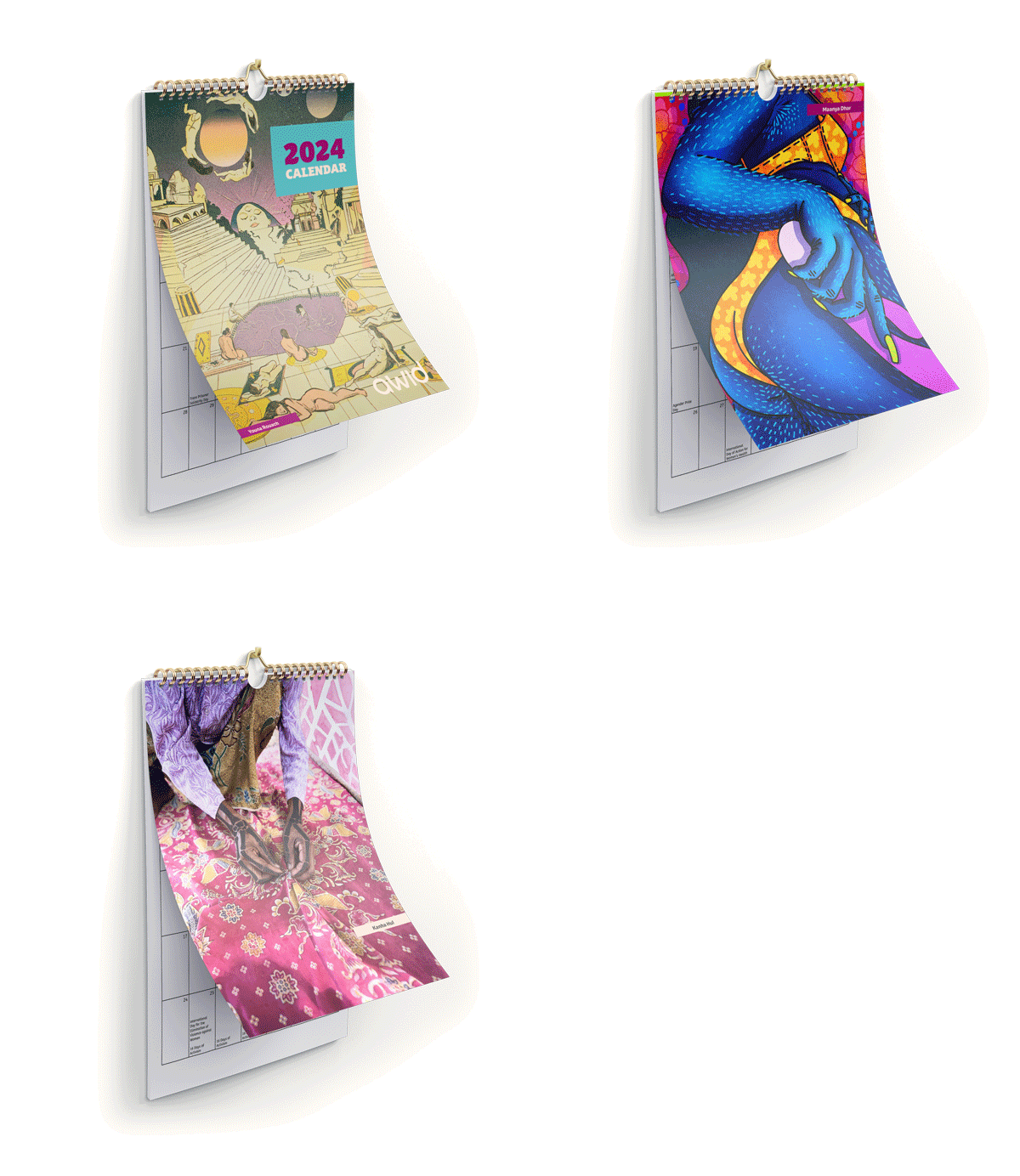
This calendar invites us to immerse ourselves in the inspiring world of feminist artistry. Each month, as it gently unfolds, brings forth the vivid artwork of feminist and queer artists from our communities. Their creations are not mere images; they are profound narratives that resonate with the experiences of struggle, triumph, and undying courage that define our collective quest. These visual stories, bursting with color and emotion, serve to bridge distances and weave together our diverse experiences, bringing us closer in our shared missions.
This calendar is our call to you: Use it, print it, share it. Let it be a daily companion in your journey, a constant reminder of our interconnectedness and our shared visions for a better world.
Let it inspire you, as it inspires us, to keep moving forward together.

Get it in your preferred language! |
| English |
| Français |
| Español |
| Português |
| عربي |
| Русский |
| Thai |

กรุณาคำนวณค่าใช้จ่ายโดยรวมถึงค่าเดินทางมายังกรุงเทพมหานคร ค่าที่พัก ค่าเบี้ยเลี้ยง ค่าวีซ่า ค่าสนับสนุนในการเข้าถึงต่างๆ และอื่นๆ ยังไม่รวมถึงค่าลงทะเบียนที่จะมีการประกาศเร็วๆนี้ โรงแรมในบริเวณสุขุมวิท กรุงเทพฯ มีราคาตั้งแต่ 1,700-6,800 บาทต่อคืน สำหรับการพักสองคน
โดยหากเป็นสมาชิก AWID จะได้รับส่วนลดค่าลงทะเบียน หากคุณยังไม่ได้เป็นสมาชิก เราขอเชิญชวนให้คุณสมัครสมาชิกและเข้าร่วมชุมชนเฟมินิสต์ระดับโลก

Voulez-vous vous inspirer des stratégies de résistance créatives des féministes du monde entier ? Souhaitez-vous découvrir des initiatives féministes qui nous montrent comment nous pouvons tou.te.s vivre dans un monde plus juste ? Voulez-vous en savoir plus sur les modèles de soins et de guérison féministes à apporter à votre propre communauté ? Est-ce un oui retentissant que nous entendons ? OUI!
Alors consultez Crear | Résister | Transform : un festival pour les mouvements féministes. Ce festival s'est déroulé virtuellement tout au long du mois de septembre 2021 sur toutes les plateformes de l'AWID, et vous pouvez désormais en faire l'expérience à votre rythme.
Les sessions ci-dessous sont pour vous et tou.te.s les incroyables militant.e.s féministes et de justice sociale que vous connaissez. Rassemblons-nous pour partager nos stratégies de résistance, co-créer de la magie féministe et transformer ce monde ensemble.
Les exposant.e.s ont participé en parlant leur langue préférée et à AWID, nous avons inclus des sous-titres sur les vidéos pour votre accessibilité.

เราทราบดีว่าการเดินทางครั้งแรกอาจจะน่าตื่นเต้นและบางครั้งอาจสร้างความกังวล จากการตระหนักถึงข้อท้าทายต่างๆต่อเรื่องนี้ เราจะจัดเตรียมข้อมูลมากขึ้นกว่านี้สำหรับการเดินทางมายังกรุงเทพฯเมื่อมีการเปิดรับลงทะเบียนในปีหน้า
Related Content
Al Jazeera: Shifa Gardi: Tributes paid to reporter killed in Mosul
BBC News: Mosul Battle: Kurdish reporter Shifa Gardi killed in Iraq