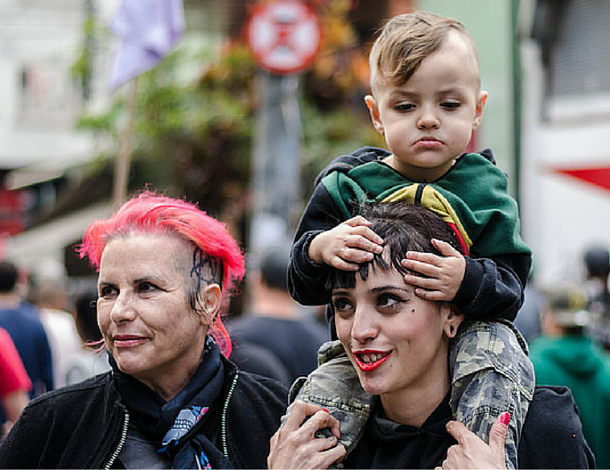
Flickr/Leonardo Veras (CC BY 2.0)

Análisis Especiales

AWID es un organización feminista internacional de membresía, que brinda apoyo a los movimientos que trabajan para lograr la justicia de género y los derechos de las mujeres en todo el mundo.

Protección de la familia

El contexto

Esta sección de análisis especial ofrece un análisis feminista crítico y acceso a los recursos clave relacionados con la «protección de la familia» en los espacios internacionales de derechos humanos.

Durante los últimos años, venimos observando una nueva y preocupante tendencia en el ámbito internacional de derechos humanos, donde se están empleando discursos sobre la «protección de la familia» para defender violaciones cometidas contra miembros de la familia, de modo de reforzar y justificar la impunidad y para coartar la igualdad de derechos en el seno de la familia y la vida familiar. 

La campaña para «proteger a la familia» es impulsada por proyectos conservadores que tienen como fin imponer interpretaciones «tradicionales» y patriarcales de familia; quitando los derechos de las manos de sus miembros para ponerlos en las de la institución «familia».

Los proyectos de «protección de la familia» tienen su origen en los siguientes fenómenos:

  • el auge del tradicionalismo,
  • el auge del conservadurismo cultural, social y religioso, y
  • posturas hostiles a los derechos humanos de las mujeres, los derechos sexuales, los derechos de las niñas y los niños y los derechos de las personas con identidades de género y orientaciones sexuales no normativas.  

Desde 2014 un grupo de estados opera como bloque en espacios de derechos humanos, bajo el nombre «Group of Friends of the Family» [Grupo de amigos de la familia], y a partir de entonces se han aprobado resoluciones sobre la «Protección de la familia» todos los años.

Esta agenda se ha extendido más allá del Consejo de Derechos Humanos (HRC, por sus siglas en inglés).  Hemos visto cómo el lenguaje regresivo sobre «la familia» se ha introducido en la Comisión de la Condición Jurídica y Social de las Mujeres (CSW, por sus siglas en inglés), y hemos asistido a intentos por incluir este lenguaje en las negociaciones sobre los Objetivos de Desarrollo Sostenible.


Nuestro enfoque

AWID trabaja con asociadxs y aliadxs para resistir conjuntamente las agendas regresivas de «Protección de la familia» y otras, y para defender la universalidad de los derechos humanos.

En respuesta a la creciente influencia de actores regresivos en los espacios de derechos humanos, AWID se ha unido con aliadxs para formar el Observatorio de la Universalidad de los Derechos (OURs, por sus siglas en inglés).  OURs es un proyecto colaborativo que monitorea, analiza y comparte información sobre iniciativas anti-derechos tales como la «Protección de la familia».

Derechos en Riesgo, el primer informe de OURs, traza un mapa de los actores que conforman el cabildeo global anti-derechos e identifica sus discursos y estrategias principales, señalando los efectos que estos discursos y estrategias están teniendo sobre nuestros derechos humanos.

El informe expone a la «Protección de la familia» como una agenda que ha promovido la colaboración entre una amplia gama de actores regresivos en las Naciones Unidas. La describe como un marco estratégico que aloja «múltiples posiciones patriarcales y anti-derechos, cuyo marco, a su vez, apunta a justificar e institucionalizar estas posiciones».
Contenido relacionado

Snippet - WITM Why now_col 1 - RU

Почему сейчас?

A monochromatic orange illustration of a woman with curly hair with her hand on her chin. She seems to inquisitive or posing a question.

Феминистские движения, движения за права женщин, гендерную справедливость, ЛГБТКИ+ и смежные движения по всему миру переживают критический момент, сталкиваясь с мощной негативной реакцией на ранее завоеванные права и свободы. Последние годы привели к быстрому росту авторитаризма, жестоким репрессиям в отношении гражданского общества и криминализации правозащитниц(-ков) с разнообразной гендерной самоидентификацией, эскалации войн и конфликтов во многих частях света, продолжающейся экономической несправедливости, – и все это на фоне кризиса в области здравоохранения, экологии и климата.

Voici votre guide pratique et les infographies «Vers un écosystème de financement féministe»

Snippet FEA Georgia this is only the beginning (FR)

Géorgie

Syndicat Réseau Solidarité


ON NE FAIT QUE

COMMENCER

Selena “Rocky” Malone

Rocky showed inspirational leadership and direction in working with Lesbian, Gay, Bisexual, Transgender, Intersex, Queer, Brotherboy and Sistergirl (LGBTIQBBSG) youth at risk.

Rocky started her career with the Queensland Police Service as a Police Liaison Officer. Making a difference was important to her. She led an impressive career working with young LGBTIQBBSG people as the Manager of Open Doors Youth Service.

Rocky worked through complex situations with clients relating specifically to gender and sexual identity. She was a natural in this line of work - a strong community leader, a quiet achiever, a loyal friend, a compassionate nurturer, and a change maker. Rocky was a founding member of IndigiLez Leadership and Support Group.

In 2016 at the Supreme Court in Brisbane, Former High Court Justice Michael Kirby mentioned Rocky by name when praising the work of the LGBTI Legal Service over the years. Rocky fought extremely hard for the human rights of the LGBTIQBBSG community, pushed boundaries and created change in a respectful, loving way.  


Rocky Malone, Australia

Snippet - WITM Our objectives - AR

أهداف استطلاع "أين المال"

تقديم تحليل محدّث، قوي، مبني على الأدلة ومسيّر نحو النشاط عن وقائع التمويل النسوي للتنظيمات النسوية ووضع البيئة التمويلية النسوية لأعضاء وعضوات AWID، الشركاء/ الشريكات في الحركة والممولين/ات.

1

تحديد وإظهار الفرص للتحول لتمويل أفضل وأكبر للحركات النسوية، لكشف الحلول الزائفة ووقف التوجه الذي يجعل التمويل يتحرك ضد الأجندات التقاطعية أو أجندات العدالة الجندرية.

2

تحديد الرؤى المقترحات والأجندات النسوية، لتمويل يحقق العدالة.

3

لتعبئة الاستطلاع

The AWID Forum Access Fund

We strive to make the AWID Forum a truly global gathering with participation from a diverse array of movements, regions and generations. To this end, AWID mobilizes resources for a limited Access Fund (AF) to assist some participants with the costs of attending the Forum. 

The 14th AWID International Forum will take place 11-14 January 2021, in Taipei, Taiwan. 


How will  the Access Fund be allocated?

For this AWID Forum, there will be no application process. 

Access Fund grants will be allocated by invitation only to:

  • Two  persons per activity selected for the Forum program (decided by those organizations, groups or individuals organizing the activity) 
  • Participants who identify as part of Priority Forum  Constituencies (PFCs) recommended by the organizations, networks and groups who are co-creating the Forum with AWID. 
  • PFCs are those which we consider would strengthen our collective power as movements, are not centered in mainstream feminist movements, and whose Feminist Realities we would like to honor, celebrate and visibilize: 
    - Black feminists 
    - Indigenous feminists
    - Trans, gender non-conforming and intersex feminists
    - Feminists with disabilities 
    - Feminist sex workers and informal workers, including migrant workers
    - Feminists affected by migration 
    - Women affected by drug policy
    - Feminists from the Forum regions (with a focus on the Pacific and mainland China) 

In addition, AWID will fund approximately 100 participants from the Forum’s location. Forum Committee Members (Content and Methodology, Access and Host) as well as those in the Artists Working Group [link] are also granted Access Fund support.

What does the Access Fund cover?

For selected participants, the Access Fund will cover the cost of their:

  • Flight
  • Accommodation
  • Visa
  • Local transportation in Taipei
  • Travel medical insurance

The Access Fund will NOT cover their: 

  • Forum registration fee
  • Transportation to and from the airport in their city of departure
  • Other incidental costs

Apart from the Access Fund, how can I fund my participation at the Forum?

We have listed other ideas on how to fund your participation at the AWID Forum on the Funding Ideas page. 

More Funding Ideas

Snippet FEA collaborator and allies Photo 1 (EN)

The photo shows Sopo Japaridze, one of the co-founders of the Solidarity Network Union. Sopo has long brown hair, with bangs, and brown eyes, and wears a red mask of the Solidarity Network Union. The picture is taken at night.

Diakite Fatoumata Sire

Diakite estuvo activamente comprometida con la defensa de las mujeres en la vida política y pública de Mali.

Trabajó para apoyar la capacitación de candidatas electorales y habló en contra de la práctica de la mutilación genital femenina (MGF). Fue una firme defensora de la salud y los derechos reproductivos.


Diakite Fatoumata Sire, Mali

Кому следует принять участие в опросе?

Группы, организации и движения, работающие исключительно или главным образом в интересах женщин, девочек, гендерной справедливости, прав ЛГБТКИ+ людей во всех регионах и на всех уровнях, как недавно созданные, так и давно существующие.

AWID Member Community Guidelines

Co-creating welcoming and safe spaces

The co-creation of our feminist realities starts with ourselves and how we treat each other. We are dedicated to creating and protecting safe and supportive spaces for our communities both online and in person. We also consider that safe and welcoming spaces are co-owned and co-created.

We  expect our members to act in a manner that is ethical, responsible and consistent with the values of AWID and assume collective responsibility to ensure an atmosphere of mutual respect and solidarity. 


All AWID members are encouraged to: 

  • Connect with others, help break isolation and further solidarity.  It’s easy to feel lost and alone, and a little friendliness and responsiveness goes a long way.

  • Interact and engage peacefully. Differences in opinion will naturally arise, so please think of these differences as useful for expanding your thinking and ways of seeing the world.

  • Help build a space that recognizes and validates multiple lived experiences and diversities of bodies and gender expressions. Recognize that we all carry intersectional identities.

  • Use inclusive language. Be respectful of how people want to be referred to in terms of gender identity or expression (like pronouns), and practice inclusive language. 

  • Listen and make adjustments in your behavior and ways of engaging if someone says they feel uncomfortable. Don’t ask others questions that you wouldn't want to be asked yourself.

  • Help challenge oppressive behavior, which includes harassment, verbal or physical violence, violation of consent, and any action that perpetuates classism, ageism, ableism, racism, misogyny, heterosexism, transphobia and other oppressions.  If needed, please reach out to AWID staff. 

  • Practice speaking and listening with an open mind and heart and without judgement.

  • Be honest, open and heartfelt. Speak and share authentically about your experiences, your challenges, your hopes and dreams, and your vision for your own life and your community.

  • Practice active listening and self-awareness. Be aware of how much time and space you are taking up- leave room for others, practice active listening and learning.

  • Be mindful and credit others for their work and activism. Remember that we are all working collectively to contribute to change-- Ensure that you recognize the contribution of others and credit them when appropriate e.g. in discussions, or in articles, pictures etc.

  • Stay safe! We encourage you to take measures to protect yourself online and in person, especially if you have reason to believe that speaking out will put you in danger. Members may use aliases or profile images that conceal their identity. For more information please refer to the Digital Security First Aid Kit for Human Rights Defenders produced by APC - Association for Progressive Communications. 

  •  Respect the privacy needs of others! Do not share or forward any information without explicit permission.


Our Values

Solidarity 

We take a position in solidarity with each other and diverse struggles for justice and freedoms. We strive to mobilize and strengthen collective action and practice meaningful ways of working with each other.

Human rights

We believe in a full application of the principle of rights including those enshrined in international laws and affirm the belief that all human rights are interrelated, interdependent and indivisible. We are committed to working towards the eradication of all discriminations based on gender, sexuality, religion, age, ability, ethnicity, race, nationality, class or other factors.

Responsibility, Accountability, and Integrity

We strive for transparency, responsible use of our resources, fairness in our collaborations and accountability and integrity with our members, partners, funders and the movements with(in) which we work. We are committed to reflecting on our experiences, sharing our learnings openly, and striving to change our practices accordingly.

Intersectionality

We believe that for feminist movements to be transformative and strong we must continue to work across our similarities and differences. We also must interrogate power and privilege both within and outside our movements.

Bodily autonomy, integrity and freedoms

We celebrate everyone's right to choose their identities, relationships, goals, work, dreams and pleasures, and what they do with their mind, body and spirit. We believe in working towards access to resources, information and safe and enabling environments that allow this to happen.

Justice and systemic change

We work towards a world based on social, environmental, and economic justice; and interdependence, solidarity, and respect. We work towards dismantling systems of oppressive power and against all its manifestations, including patriarchy, fundamentalisms, militarisms, fascisms and corporate power that threaten our lives and our world. We want a just world where resources and power are shared in ways that enable everyone to thrive.


Please note:  

AWID reserves the right to delete comments, suspend or revoke membership when our community guidelines have been violated. AWID members are not authorised to represent AWID in any official capacity unless stipulated in writing. Members cannot use AWID spaces to proselytize or recruit members to join a religious faith or organisation. Members cannot use AWID spaces to request funds for personal use although links to external fundraising efforts or activism campaigns are permissible.
 

Snippet FEA Workers demonstrations in Georgia 2 (ES)

La imagen muestra una protesta en la que una multitud sostiene una pancarta en georgiano que dice: "8 de marzo para las mujeres trabajadoras".

Andaiye

Andaiye' en swahili significa 'una hija vuelve a casa'. Nació como Sandra Williams el 11 de septiembre de 1942 en Georgetown, Guyana, y cambió su nombre por el de 'Andaiye' en 1970, cuando los movimientos del Black Power [Poder Negro] arrasaron en su país y en la región del Caribe. 

Andaiye fue considerada una figura transformadora al frente de las luchas por la liberación y la libertad. Fue una de lxs primerxs integrantes y líder activa de la Working People’s Alliance [Alianza de la Gente Trabajadora] (WPA, por sus siglas en inglés), un partido socialista de la Guyana que luchó contra el régimen autoritario existente y continuó,  a lo largo de su vida, centrando su activismo en la justicia para la clase trabajadora y los derechos de las mujeres rurales, y en la superación de las barreras étnicas entre las mujeres Indo y Afro-Guyanesas.

Andaiye fue cofundadora de la Red Thread Women [Hilo Rojo Mujeres], una organización que aboga para que el trabajo de cuidados de las mujeres fuese remunerado justamente, también trabajó en la Universidad de West Indies y con el CARICOM. Andaiye señaló, sin ningún temor a desafiar a los gobiernos, los desequilibrios de género en las juntas estatales, la discriminación de lxs trabajadorxs sexuales en las leyes existentes, reclamó el derecho al aborto en Jamaica, y se pronunció abiertamente contra los acuerdos comerciales como el Caribbean Single Market and Economy [Mercado y Economía Únicos del Caribe] (CSME, por sus siglas en inglés) que permitía la libre circulación de las trabajadoras domésticas migrantes, pero no otorgaba esos mismos derechos a sus hijxs. 

Andaiye publicó varios ensayos académicos, escribió columnas de prensa y también editó  los últimos libros de Walter Rodney, un activista político guyanés y líder de la AMP, que fue asesinado en 1980. Andaiye sobrevivió a un cáncer y fue una de lxs fundadorxs de la Guyana Cancer Society [Sociedad de Guyana Contra el Cáncer] y del Cancer Survivors’ Action Group [Grupo de Acción de Sobrevivientes del Cáncer]. También fue integrante de la Junta Directiva de la Caribbean Association for Feminist Research and Action [Asociación Caribeña para la Investigación y la Acción Feminista] (CAFRA, por sus siglas en inglés), y Directora del Help and Shelter [Ayuda y Refugio] e integrante de la Junta Directiva de la Guyana National Commission on Women [Comisión Nacional de Guyana sobre las Mujeres]. Andaiye recibió varios premios a lo largo de su vida, entre ellos, la Flecha de Oro de los Logros de Guyana (el cuarto premio nacional más importante del país).

Andaiye falleció el 31 de mayo de 2019 a la edad de 77 años. Los homenajes que posteriormente le rindieron activistas, amigxs y personas inspiradas por su vida dan cuenta, elocuentemente, de su asombroso legado y su hermosa humanidad.

Algunos ejemplos:

"Andaiye tuvo un profundo efecto en mí... fue tantas cosas: una educadora, una luchadora; me enseñó a ser autocrítica, a pensar con más claridad, me enseñó sobre la supervivencia, sobre lo increíble que puede ser el coraje, sobre la compasión, a ir más allá de las apariencias externas y a tratar a la gente como personas y no dejarse distraer por su estatus, clase, raza... o cualquier otra cosa". Peggy Antrobus, activista feminista, autora, académica, Barbados.

"El tipo de idealismo convencido que Andaiye expresó, su voluntad de confrontar el mundo y su creencia obstinada en  que realmente lo puedes cambiar... Esa política de la esperanza... ¿De qué otra forma podemos rendir homenaje a su vida, legado y memoria si no es haciendo nuestro trabajo de forma ética y con una autocrítica continua? Y situando el trabajo de cuidados de las mujeres en el centro de todo esto." - Tonya Haynes, Barbados.

"Puedo escuchar sus ocurrencias en nuestro entusiasmo colectivo. Así, a través de las lágrimas, puedo reír. Mis más profundas reverencias a ti, querida Andaiye, gracias por todo. Te deseo amor y luz para el viaje de tu espíritu. Saluda a Walter y a todxs lxs ancestrxs". - Carol Narcisse, Jamaica.

Leer otros tributos a Andaiye (en inglés)

O nosso grupo, organização e/ou movimento não recebeu ou mobilizou financiamento de financiadores externos. Devemos participar no inquérito?

Sim! Reconhecemos e valorizamos diferentes motivos pelos quais as feministas nos seus respetivos contextos não dispõem de financiamento externo: desde não serem elegíveis para se candidatar a subsídios e/ou receber dinheiro do exterior, até dependerem de recursos gerados autonomamente como uma estratégia política por si só. Queremos saber mais sobre vocês, independentemente da vossa experiência com financiamento externo.

Yo, Imposible proyección: la guía de participación

Snippet FEA Workers Persecution S4 (FR)

Un agent des forces de l'ordre en tenue anti-émeute rose tenant un bâton

LA PERSÉCUTION DES TRAVAILLEUR·EUSES

Le magazine des Réalités féministes

Le magazine des Réalités féministes

Nous vous présentons une sélection motivante de puissantes histoires et d’images de transformations et de résistances créées par des activistes, des écrivain·e·s et des artistes du monde entier.

Explorez le magazine