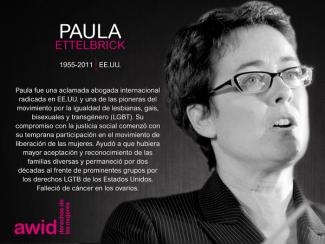
Paula Ettelbrick

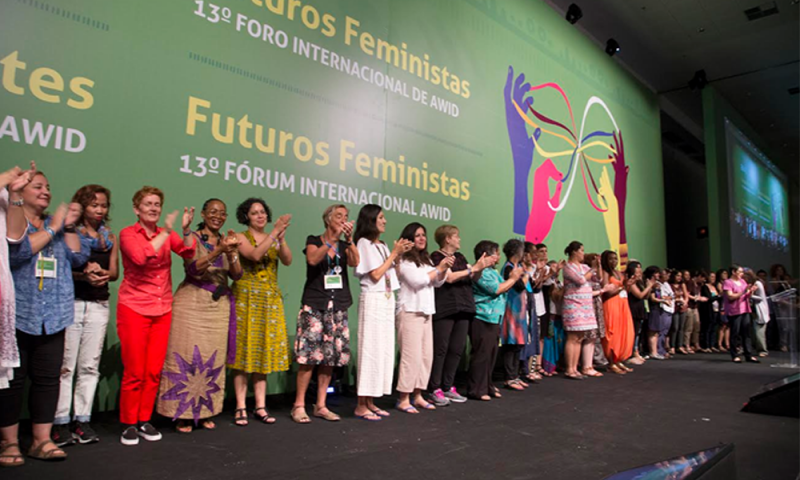
En septiembre de 2016, 1800 feministas y activistas por los derechos de las mujeres de todos los rincones de nuestros movimientos se congregaron en las costas de Bahia, en el 13º Foro Internacional de AWID.
En esta sección se destacan los logros, los aprendizajes y los recursos que surgieron de las ricas conversaciones mantenidas. Te invitamos a analizar, compartir y comentar.
Uno de los aportes más importantes del Foro fue la necesidad de ampliar y profundizar nuestro trabajo entre movimientos, frente a la confluencia de los fascismos en auge, fundamentalismos, codicia corporativa y cambio climático.
Nuestras Iniciativas Semilla han ayudado a 20 ideas que surgieron en el Foro para crecer en forma de acciones concretas
El vídeo «Defendiendo a las Personas y al Planeta» y la guía «Tejiendo la resistencia a través de la acción» estan protagonizados por defensoras de derechos humanos y presentan estrategias concretas para confrontar al poder corporativo
Con nuestras animaciones El estado de nuestros movimientos feministas y Justicia climática y ambiental, los movimientos ahora tienen herramientas creativas para apoyar su trabajo.
La compilación de las expresiones artísticas «Los Movimientos Importan», sigue inspirando una organización más fuerte y creativa en todo el mundo.
Los movimientos también pueden beneficiarse de nuevas metodologías para imaginar nuestros futuros feministas (¡pronto!)
AWID se ha comprometido, mediante su próximo plan estratégico y su proceso del Foro, a continuar y profundizar las relaciones, las lecciones y los procesos iniciados en el Foro 2016 y basándonos en el momento actual.
Los Foros de AWID comenzaron en 1983 en Washington DC. Desde entonces, el evento ha crecido hasta convertirse en muchas cosas para muchas personas: un proceso iterativo para darle forma a nuestros análisis, objetivos y acciones; un hito crucial que fortalece los feminismos de lxs participantes e infunde energías a sus procesos de organización; un hogar político donde lxs defensoras de derechos humanos encuentran un santuario y solidaridad.
Avant d’aborder la méthodologie de recherche WITM, il est important que vous connaissiez les données de base et que vous sachiez à quoi vous attendre.
En ce qui concerne la méthodologie de recherche WITM de l’AWID, nous recommandons d’étudier toute la boîte à outils.
Bien que cette boîte à outils ait été conçue pour démocratiser la recherche WITM, il existe des contraintes en termes de capacités liées à l’expérience de votre organisation dans le domaine des ressources et de la recherche qui pourraient influencer son aptitude à utiliser cette méthodologie.
Utilisez la Fiche de travail « Êtes-vous prêts-tes ? » pour évaluer votre niveau de préparation à mener votre propre recherche WITM. Plus vos réponses aux questions de cette fiche de travail seront nombreuses, plus vous serez capable d’entreprendre votre recherche.
Avant de commencer toute recherche, nous vous recommandons de procéder à l’évaluation des liens que votre organisation a établis avec votre communauté et de la confiance qu’elle inspire.
Dans de nombreux contextes, les organisations pourraient hésiter à partager ouvertement leurs données financières avec d’autres pour des raisons diverses allant des inquiétudes que suscite la façon dont les données seront utilisées, à la crainte de la concurrence pour le financement en passant par les préoccupations au sujet des restrictions gouvernementales croissantes imposées aux organisations de la société civile.
Lorsque vous établirez des relations et que vous mènerez des recherches informelles pendant la période précédant le lancement de votre initiative, la clarté des objectifs fixés contribuera à instaurer la confiance. La transparence permettra aux personnes qui participent à la recherche de comprendre pourquoi vous recueillez des données et en quoi cela profitera à l’ensemble de la communauté.
Nous vous recommandons vivement de faire en sorte que les données soient recueillies de manière confidentielle et partagées anonymement. Cela permettra aux personnes qui participent à votre recherche de partager plus facilement avec vous des informations sensibles.
Nous vous invitons à consulter notre Fiche de travail « Êtes-vous prêts-tes ? » pour mesurer vos propres progrès.
Sí, aún así deseamos saber de ustedes aunque no hayan recibido financiamiento en los tres, dos o cualquiera de los años comprendidos entre 2021 y 2023.
L'Argentine a une longue histoire d’autogestion et de coopérativisme, avec des lieux de travail dirigés par et pour les travailleur·euses.
En 2001, le pays a connu l'une des pires crises économiques de son histoire.
En réponse à la récession et comme forme de résistance et de résilience, les travailleur·euses de tout le pays ont commencé à occuper leurs lieux de travail.
La Coopérative Textile Nadia Echazú a été la première coopérative créée par et pour les personnes trans et travesti en quête d'autonomie économique et de conditions de vie dignes.
Elle offre des opportunités d'emploi, l’accès à la sécurité sociale, des revenus durables et des droits économiques aux communautés qu'elle sert.
Le financement du développement est, pour les droits des femmes et les droits humains de toutes et tous, un champ qui comporte des menaces et des possibilités spécifiques. Le financement du développement et des politiques à visées transformatrices peut être un facteur déterminant dans la mise en œuvre des changements systémiques nécessaires pour garantir le respect, la protection et la réalisation des droits humains des femmes.
L’année 2015 est une année importante pour le processus sur le FdD. La troisième Conférence internationale sur le FdD (site en anglais) a eu lieu du 13 au 16 juillet à Addis Abeba, en Éthiopie. En outre, les gouvernements mettent actuellement la dernière main au programme de développement pour l'après-2015 et notamment aux accords qui détermineront les modalités de financement des nouveaux objectifs pour le développement durable.
L’étape actuelle du processus sur le FdD est une occasion importante pour définir un cadre de financement susceptible de garantir le financement efficace de la mise en œuvre du programme de développement de l’après-2015 et des Objectifs pour le développement durable (ODD). Elle pourrait également permettre d’aborder les conditions structurelles et les changements systémiques nécessaires à la pleine réalisation d’autres priorités et engagements, tels que les conventions sur les droits humains et le Programme d'action de Beijing.
Au cours de ces treize dernières années, les organisations féministes et de défense des droits des femmes se sont résolument engagées dans le processus sur le FdD.
Cette section vous guidera pour vous permettre d’obtenir des résultats de recherche représentatifs et fiables.
Dans cette section :
- Recueillez vos données
1. Avant le lancement
2. Lancement
3. Pendant le lancement- Préparez vos données en vue de l’analyse
1. Nettoyez vos données
2. Codifiez les réponses aux questions ouvertes
3. Supprimez les données inutiles
4. Assurez la sécurité- Créez votre rapport de synthèse
- Analysez vos données
1. Programmes statistiques
2. Éléments d’analyse suggérés
Si vous prévoyez de recueillir des données issues des demandes soumises aux institutions d’octroi de subventions, ce moment est opportun pour communiquer avec elles.
Lorsque vous recueillez ces données, réfléchissez aux types de demandes de subventions que vous souhaitez examiner. Votre cadre de recherche vous orientera sur cette question.
De plus, il n’est peut-être pas nécessaire de revoir chaque demande soumise à l’organisation. Il sera plus utile et efficace de ne passer en revue que les demandes admissibles (qu’elles aient ou non été financées).
Par ailleurs, vous pouvez aussi demander aux institutions d’octroi de subventions de partager leurs données avec vous.
Voir un modèle de lettre à envoyer aux institutions d’octroi de subventions
Votre sondage est terminée et vous avez une mine de renseignements ! Vous devez maintenant faire en sorte que vos données soient les plus exactes possibles.
Selon la taille de votre échantillon et la quantité de sondages remplis, cette étape peut être longue. Ce processus sera accéléré et gagnera en précision si vous disposez d’une bonne réserve de personnel qui a le souci du détail.
Vous aurez peut-être recueilli, en plus de vos sondages, des données issues des demandes soumises aux institutions d’octroi de subventions. Utilisez les mêmes étapes pour traiter ces données. Ne vous découragez pas si vous ne pouvez comparer les deux ensembles de données ! Les bailleurs de fonds recueillent des renseignements différents de ceux que vous aurez obtenus de vos sondages. Dans le rapport final et les produits de votre recherche, vous pouvez analyser et présenter les ensembles de données de manière distincte (données issues des sondages et des institutions d’octroi de subventions).
Il existe deux types de questions ouvertes qui exigent une codification.
Questions appelant des réponses ouvertes
Pour ces questions, vous devrez codifier les réponses afin de cerner les tendances.
Vous aurez à affronter les difficultés suivantes :
Si vous avez recours à plus d’une personne pour examiner et codifier, vous devrez vous assurer que la codification est systématique. Voilà pourquoi nous recommandons de limiter les questions ouvertes et d’être le plus précis possible si vous posez ce type de questions.
Par exemple, si vous posez cette question ouverte : « Quelles difficultés spécifiques avez-vous rencontrées cette année en matière de levée de fonds ? ».
Les réponses pourraient être : « le manque de ressources humaines » ou « pas assez de personnel ». Ces réponses peuvent être regroupées et codifiées sous une même catégories « manque de personnel ». Ceci vous permettra d’obtenir le nombre de personnes qui ont répondu de manière semblable.
Questions appelant des réponses fermées
Si vous avez proposé aux personnes répondantes de préciser leurs réponses, vous devrez procéder au « surcodage » de ces réponses.
Pour certaines questions du sondage, vous aurez peut-être proposé l’option « autre ». Lorsque cette option est offerte, on l’accompagne fréquemment d’une zone de texte où les personnes peuvent préciser leurs réponses.
Différentes méthodes de « surcodage » :
Analysez la fréquence des résultats
Pour chaque question quantitative, vous pouvez décider de retirer les 5 % ou les 1 % les plus élevés et les moins élevés afin d’éviter que des données aberrantes* ne biaisent vos résultats. Vous pouvez aussi traiter l’effet de biais en employant une moyenne médiane plutôt qu’une moyenne arithmétique. Pour calculer la médiane, il faut d’abord ordonner les données (les trier dans l’ordre ascendant). La médiane est le nombre qui se situe au point milieu. Cependant, il faut garder à l’esprit qu’il est possible que vous estimiez que les données aberrantes soient utiles. Elles vous donneront une idée de la gamme et de la diversité des personnes participant au sondage et vous choisirez peut-être de réaliser une étude de cas qui porte sur ces données aberrantes.
* Une donnée aberrante est un point de données qui est beaucoup plus grand ou beaucoup plus petit que la majorité des points de données. Par exemple, imaginons que vous viviez dans un quartier de classe moyenne avec pour voisin un millionnaire. Vous décidez de connaître l’échelle de revenu chez les familles de classe moyenne de votre quartier. Pour ce faire, vous devez retirer le revenu du millionnaire de votre ensemble de données, puisqu’il s’agit d’une donnée aberrante. Sinon, la moyenne du revenu de classe moyenne semblera beaucoup plus élevée qu’elle ne l’est en réalité.
Retirez tout le sondage concernant les répondant-e-s qui ne correspondent pas à votre population cible. Habituellement, vous les reconnaîtrez par le nom de l’organisation ou encore par leurs réponses aux questions qualitatives.
Pour assurer la confidentialité de l’information partagée par les répondant-e-s, vous pouvez à cette étape remplacer les noms des organisations par une nouvelle série de numéros d’identité et sauvegarder la codification, conservant les noms et les numéros d’identification dans un dossier distinct.
En collaboration avec votre équipe, déterminez la manière de stocker et de protéger le dossier de codification et les données.
Par exemple, les données seront-elles stockées dans un ordinateur ou un serveur protégé par mot de passe, auquel seule l’équipe de recherche aurait accès ?
Un rapport de synthèse dresse la liste de toutes les questions posées lors du sondage ainsi que les réponses obtenues en pourcentages inscrits sous chaque question. Ce document présente les résultats collectifs de toutes les réponses individuelles.
Conseils :
- Il est important d’être systématique : on doit appliquer les mêmes règles à chaque donnée aberrante lorsque l’on détermine si elle devrait demeurer ou être retirée de l’ensemble des données.
- Pour toutes les réponses ouvertes (« autre ») qui sont « surcodées », assurez-vous que la codification est en adéquation. Désignez une personne afin qu’elle vérifie la cohérence et la fiabilité des codes de façon aléatoire et qu’elle révise les codes si nécessaire.
- Si possible, tentez de toujours travailler en équipe de deux personnes afin que quelqu’un puisse vérifier le travail.
Maintenant que vos données sont nettoyées et triées, que veulent dire toutes ces informations ? Voici la partie la plus stimulante, où vous commencez à analyser pour dégager les tendances.
Est-ce qu’il existe des types de bailleurs de fonds particulièrement importants (gouvernement par rapport aux sociétés privées) ? Est-ce qu’il y a des régions qui reçoivent plus de financements ? Vos données révéleront des renseignements fort intéressants.
Échantillons plus petits (moins de 150 réponses) : peuvent être analysés en interne à l’aide d’une feuille de calcul Excel.
Échantillons plus grands (plus de 150 réponses) : peuvent être analysés en interne à l’aide d’Excel, si votre analyse se résume à compter l’ensemble des réponses, des moyennes ou d’autres analyses simples.
Si vous prévoyez des analyses plus poussées, comme des analyses à variables multiples, nous recommandons alors d’avoir recours à un logiciel statistique comme - SPSS, Stata, R (gratuit)
REMARQUE: SPSS et Stata sont dispendieux alors que R est gratuit.
Ces trois types de logiciels exigent des connaissances de la part du personnel et il n’est pas facile de les maîtriser rapidement.
Essayez de trouver des stagiaires ou du personnel temporaire, provenant notamment des universités locales. De nombreux étudiant-e-s doivent apprendre l’analyse statistique au cours de leurs programmes et ils-elles pourraient avoir un accès gratuit aux logiciels SPSS ou Stata par l’intermédiaire de l’université. Ces étudiant-e-s sauront probablement utiliser le logiciel R, qui peut être téléchargé et utilisé gratuitement.

• 2 - 3 mois
• 1 personne (ou plus) chargée de la recherche
• Traducteur(s)-trice(s), si vous voulez traduire votre sondage
• 1 personne (ou plus) pour diffuser le sondage auprès des populations choisies
• 1 personne (ou plus) chargée de l'analyse des données
• Liste d’organisations, de donateurs et d’activistes agissant à titre consultatif
• Un prix de récompense pour encourager les gens à répondre à votre sondage (optionnel)
• Une marque de reconnaissance pour vos conseillers-ères (optionnel)
• Survey Monkey
• Survey Gizmo (en anglais)
• Exemple : Enquête mondiale WITM
• Exemple de lettre aux bailleurs de fonds demandant accès aux bases de données
• Tutoriel : Simple introduction au nettoyage des données (en anglais)
• Outils de visualisation (en anglais)
Nous demandons ces données pour faciliter l’examen des réponses, éviter les doublons et pouvoir vous contacter si votre groupe n’a pas pu terminer le questionnaire et/ou vous répondre si vous avez des doutes ou des questions. Des informations sur la manière dont nous utilisons les informations personnelles collectées lors de notre travail sont disponibles ici.
One of the founding leaders of the cooperative was Lohana Berkins, an activist, defender and promoter of transgender identity. Lohana played a crucial role in the struggle for the rights of trans and travesti people.
This brought about, among many other things, the passing of the Gender Identity Law. It is one of the most progressive legislations in the world, guaranteeing fundamental rights to trans and travesti people. Now, people can change their names and genders only with an affidavit, and have access to comprehensive healthcare without judicial or medical intervention/approval (Outright International, 2012).
En caso de tener preguntas relacionadas con el Llamado a Proponer Actividades, por favor escríbenos utilizando nuestro formulario de contacto. Seleccione «llamado de actividad» como asunto de mensaje.
Thank you to all of you who have joined us, physically or virtually, for the past four days of learning, celebrating, envisioning, dreaming and building our Feminist Futures together at the 2016 AWID Forum!
We are incredibly inspired, amazed, and re-energized by all the collective work we have done together in creating our diverse futures.
We will analyze the survey responses, derive insights and trends, and present the results during the 15th AWID International Forum in Bangkok, and online, in December 2024. Register to attend the Forum here!

LA EXCLUSIÓN, ESTIGMA Y ABUSO INSTITUCIONAL
que las personas trans y travesti siguen enfrentando diariamente
Esta información estará disponible recién cuando abramos el proceso de inscripción.
En este momento, muchos sistemas de conocimientos comunitarios están en riesgo.
Los cambios vertiginosos que se dan a nivel económico, político y cultural están arrasando con ambientes, prácticas y medios de vida. Diversas formas de conocimiento están siendo borradas como prácticas, mercantilizadas y colonizadas por una globalización que se lo devora todo y a cambio de la promesa de logros en el corto plazo o paliativos.
El Buen Vivir /Vivir Bien, un concepto adaptado de los conocimientos de los pueblos indígenas andinos, se define como el logro colectivo de una vida en plenitud, basada en las relaciones armónicas y equilibradas entre los seres humanos y todos los seres vivientes, con reciprocidad y en complementariedad. Implica reconocer que los seres humanos formamos parte de la naturaleza, dependemos de ella y somos interdependientes entre nosotrxs.
Una visión que integra la producción y la reproducción como procesos inseparables de la economía, la producción de riqueza y las condiciones de vida es inherente al Buen Vivir / Vivir Bien.
Una mirada del Buen Vivir /Vivir Bien desde una óptica feminista valora las relaciones y los recursos que se movilizan en los ciclos de producción y reproducción — a favor de un equilibrio que no tiene que ver solo con el mercado — para garantizar la continuidad y los cambios siempre que sean compatibles con la justicia económica y la sostenibilidad de la vida.
Desde una perspectiva feminista también se ha criticado la concepción binaria del género y de la complementariedad entre hombres y mujeres en el Buen Vivir /Vivir Bien. Las concepciones binarias dejan poco espacio para un análisis más profundo del heteropatriarcado y de las relaciones de género disidentes.
Sin embargo, uno de los principales aportes que ofrece el principio del Buen Vivir / Vivir Bien cuando se le otorga un lugar central en los marcos de referencia políticos, económicos y sociales, es que la igualdad deja de ser el paradigma de los derechos individuales y su lugar pasa a ser ocupado por la transformación de la sociedad como un todo.

الاستطلاع هذا مخصّص للمجموعات، المنظمات والحركات التي تعمل بالأساس أو فقط على حقوق النساء، أفراد مجتمع الميم - عين، والحقوق الجندرية، في جميع السياقات، على جميع المستويات، وفي جميع المناطق. إن كان واحد من هذه المبادئ اساسًا لمجموعتكم/ن، تنظيمكم/ن أو شبكتكم/ن، أو أي نوع تنظيم آخر، إن كان مسجلاً أم لا، جديداً أو طويل العمر، ندعوكم/ن للإجابة على الاستطلاع.

*في الوقت الحالي، لا نطلب من الأفراد أو الصناديق النسوية أو النسائية تعبئة الاستطلاع.
تعرف على المزيد حول الاستطلاع: راجع/ي الأسئلة الشائعة