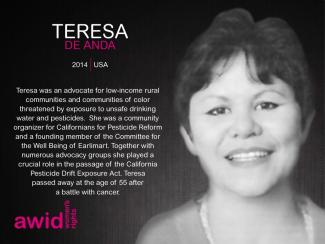
Teresa De Anda

Young feminist activists play a critical role in women’s rights organizations and movements worldwide by bringing up new issues that feminists face today. Their strength, creativity and adaptability are vital to the sustainability of feminist organizing.
At the same time, they face specific impediments to their activism such as limited access to funding and support, lack of capacity-building opportunities, and a significant increase of attacks on young women human rights defenders. This creates a lack of visibility that makes more difficult their inclusion and effective participation within women’s rights movements.
AWID’s young feminist activism program was created to make sure the voices of young women are heard and reflected in feminist discourse. We want to ensure that young feminists have better access to funding, capacity-building opportunities and international processes. In addition to supporting young feminists directly, we are also working with women’s rights activists of all ages on practical models and strategies for effective multigenerational organizing.
We want young feminist activists to play a role in decision-making affecting their rights by:
Fostering community and sharing information through the Young Feminist Wire. Recognizing the importance of online media for the work of young feminists, our team launched the Young Feminist Wire in May 2010 to share information, build capacity through online webinars and e-discussions, and encourage community building.
Researching and building knowledge on young feminist activism, to increase the visibility and impact of young feminist activism within and across women’s rights movements and other key actors such as donors.
Promoting more effective multigenerational organizing, exploring better ways to work together.
Supporting young feminists to engage in global development processes such as those within the United Nations
Collaboration across all of AWID’s priority areas, including the Forum, to ensure young feminists’ key contributions, perspectives, needs and activism are reflected in debates, policies and programs affecting them.
La communauté AWID est une plateforme en ligne de réseautage social conçue tout spécialement pour l’AWID. Espace féministe ayant vocation à connecter, résister et célébrer, c’est un endroit où les conversations féministes critiques, le pouvoir et la puissance du collectif et la solidarité sont à l’œuvre. Cet espace est également ouvert pour dialoguer après les différents événements, pour penser, assimiler, digérer les apprentissages politiques difficiles, et pour prendre soin de la communauté.
Devenez membre de l’AWID pour pouvoir faire partie de la Communauté AWID dès aujourd’hui.
Perçue comme une figure transformatrice sur les fronts de la lutte pour la libération et pour la liberté, Andaiye a été l’une des premières membres de l’Alliance du peuple travailleur (WPA), un parti socialiste en Guyane de lutte contre le régime autoritaire et participait activement à sa direction. Tout au long de sa vie, Andaiye a placé la justice pour la classe ouvrière et les droits des femmes vivant en milieu rural au centre de son action militante, et s’est battue pour l’élimination des obstacles ethniques entre les femmes indo-guyaniennes et celles afro-guyaniennes.
Andaiye fut l’une des membres fondatrices des Red Thread Women, une organisation de défense pour la juste rémunération du travail en soins réalisé par les femmes, en plus d’avoir travaillé à l’Université des Indes occidentales et avec l’organisation CARICOM. N’hésitant jamais à défier les gouvernements, elle a pointé du doigt les déséquilibres en matière de genre dans les conseils de l’État, les lois discriminatoires à l’égard des travailleur·euse·s du sexe, réclamé le droit à l’avortement en Jamaïque et s’est érigée contre les accords commerciaux, tels que le Marché unique des Caraïbes (CSME) qui permettait la libre circulation des travailleuses domestiques migrantes mais n’octroyait pas ce même droit à leurs enfants.
Elle a publié plusieurs essais universitaires, rédigé des articles d’opinion et révisé les derniers ouvrages de Walter Rodney, l’activiste politique guyanien et coleader du WPA assassiné en 1980. Survivante du cancer, Andaiye a été l’une des fondatrices de la Ligue guyanienne contre le cancer et du Groupe d’action des survivant·e·s du cancer. Elle a également siégé au conseil exécutif de l’Association caribéenne pour la recherche et l’action féministes (CAFRA), dirigé le Help and Shelter et été membre du conseil de la Commission nationale guyanienne pour les femmes. Elle a par ailleurs reçu de nombreux prix, dont le prestigieux Golden Arrow of Achievement (quatrième prix le plus important du Guyana).
Andaiye est décédée le 31 mai 2019, à l’âge de 77 ans. Les nombreux hommages que lui ont rendus des activistes, ami·e·s et celles et ceux que sa vie aura inspiré·e·s ont parlé avec éloquence de son incroyable héritage et de la grandeur de son humanité.
En voici quelques-uns :
“« Andaiye m’a profondément marquée... elle représenttait tellement de choses pour moi : une éducatrice, une combattante, elle m’a appris l’autocritique, à réfléchir plus clairement, elle m’a enseigné la survie, ce qu’est le courage sans limite, la compassion, à dépasser les apparences et traiter les gens comme des gens, sans se laisser impressionner par le statut, la classe, la race... rien de tout ça. » Peggy Antrobus, activiste féministe, auteure, universitaire, La Barbade
« Le genre d’idéalisme confiant que démontrait Andaiye, cette disposition à affronter le monde et une croyance tenace qu’on pouvait vraiment le changer... Cette politique de l’espoir... Comment honorer sa vie, son héritage et sa mémoire autrement qu’en poursuivant le travail éthiquement et en continuant à s’autocritiquer? Et de faire en sorte de placer le travail de soins des femmes au centre. » - Tonya Haynes, La Barbade
« Je peux l’entendre se moquer de notre engouement collectif. Donc, je ris tout en pleurant. Chapeau bas, chère Andaiye, et merci pour tout. Que le voyage de ton esprit soit aimant et lumineux. Passe le bonjour à Walter et aux ancêtres. » - Carol Narcisse, La Jamaïque
En participant à une activité exclusive pour les membres, j'ai été particulièrement touchée de voir que chacun·e y avait sa place et qu’il n’y avait pas le moindre jugement. Toute la session a été dynamique et vivante.- Kirthi Jayakumar, Fondatrice, The Gender Security Project, Inde
As we navigate the global polycrisis, movements are tirelessly building power beyond traditional power structures. The wave of US presidential executive orders is intended to scare us, but no amount of fascist ideology can erase our existence and resistance.
We invite you to be a part of the solidarity-building campaign to expose and resist fascist forces undermining feminist and gender justice movements in your contexts!
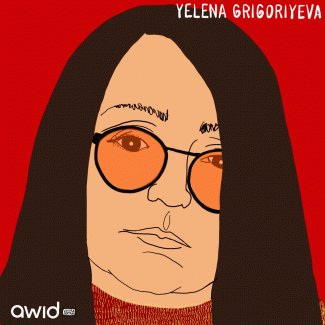
She was part of democratic, anti-war and LGBT movements. In her activism, Yelena was a fierce critic of President Vladimir Putin and his administration, expressing her opposition against Russia’s annexation of Ukraine’s Crimea peninsula and the ill-treatment of prisoners.
Yelena came out as bisexual earlier in 2019.
"Her coming out was a surprise to me, and I didn't approve of it. I told her 'Listen, Lena, you already have a target painted on you because of your political activity. You've just pinned another to your chest."
- Olga Smirnova
Yelena did receive multiple death threats and according to some of her acquaintances, was listed on a homophobic website that called on its visitors to hunt down LGBT persons. She reported the threats to the police, however the Russian state failed to provide protection.
But even in a society where political opposition, as well as members of the LGBT community and advocates for their rights, face continuous and increasing violence, Yelena kept campaigning for social justice and equality.
“She did not miss a single action. And they detained her so often that I already lost count,”
- Olga Smirnova (fellow opposition activist and friend).
Yelena was murdered on 21 July 2019, not far from home. A suspect was arrested but according to some sources, many friends and fellow activists believe that the suspect is a scapegoat and that this was a targeted political killing.
For Yelena’s relatives and friends, her case remains unsolved even though the suspect confessed.
In 2013, Russia passed legislation banning the spreading of what it described as ‘gay propaganda’. In 2014, Human Rights Watch published a report relating to this.
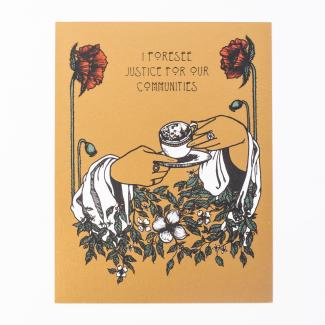
La taseografía es el estudio de los posos de café y/o de las hojas de té para la adivinación. Es una práctica que ha sido transmitida por las mujeres del lado armenio de mi familia, y me fue enseñada por mi madre, que a su vez la aprendió de su madre y así sucesivamente. Cuando miraba a mi Nana leer los posos del café armenio preparado para la familia y lxs amigxs, veía muchas veces como ella veía lo que quería decir. Estas impresiones dicen algunas de las cosas que quiero ver en el mundo: espero que sean las mismas cosas que ustedes quieren ver.
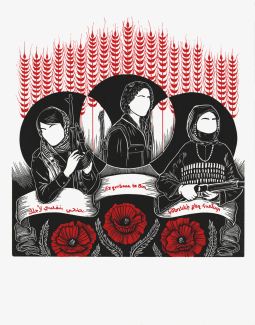
Esta impresión celebra la resiliencia, el sacrificio y la fortaleza de lxs luchadorxs por la libertad de SWANA, a través de la historia y la solidaridad existente. La inspiración original provino de un artículo que leí sobre una exposición en Tatvan, un distrito de Bitlis, que mostraba la presencia armenia en la región. Mis antepasadxs eran de Bitlis, que ahora se encuentra dentro de las fronteras de la Turquía moderna.

La taseografía (el estudio de la lectura de los posos de café) es una práctica cultural que las mujeres armenias han utilizado durante cientos de años para hablar entre sí. Es un lenguaje codificado para iniciar conversaciones, construir conexiones interrelacionadas y entretejidas.
![]Ali Chavez Leeds portrait](/sites/default/files/styles/max_325x325/public/2021-10/portrait.jpeg?itok=0yU3PqLe)
Do you have questions regarding the AWID Forum or related activities? We have answers!
✉️ By registration only. Register here
📅 Tuesday, March 11, 2025
🕒 6.00-8.00pm EST
🏢 Chef's Kitchen Loft with Terrace, 216 East 45th St 13th Floor New York
Organizer: AWID
Magaly Quintana era conocida por muchxs en Nicaragua como 'La Maga'. Fue una historiadora feminista, activista y defensora inquebrantable de los derechos de las mujeres que exigía justicia para las víctimas de femicidio.
Magaly se comprometió a documentar y elaborar estadísticas sobre las mujeres y niñas que fueron asesinadas como resultado de la violencia sexual en el país.
Magaly también criticó al gobierno por la reforma de la Ley 779 que trata la violencia contra las mujeres. Como resultado del arduo trabajo de los movimientos de mujeres nicaragüenses, esta ley, antes de su reforma, incluía importantes disposiciones para penalizar el femicidio. Magaly argumentó que estas reformas legislativas debilitaban la ley, y limitaban la definición de los femicidios a homicidios, invisibilizando, como resultado, los delitos violentos contra las mujeres.
La organización feminista de Magaly se fundó a principios de los ‘80. Fue la directora de Mujeres Católicas por el Derecho a Decidir, que defiende el derecho al aborto terapéutico tras su prohibición en 2006. En 2018, apoyó las protestas contra el gobierno de Daniel Ortega.
Magaly nació en mayo de 1952 y falleció en mayo de 2019.
"Hasta luego, mi querida Magaly Quintana. Muchas gracias, gracias por tu legado. Te veremos de nuevo, tan fuerte y poderosa como siempre."- Erika Guevara Rosas (Directora Americana de Amnistía Internacional).
Préparée par Jess X. Snow
avec l’aide de Kamee Abrahamian et Zoraida Ingles
Révisée par Kamee Abrahamian
Dans toute l’Asie et le Pacifique, et dans sa diaspora tout entière, des femmes et des trans farouches se battent pour un avenir où iels pourraient être libres. Alors que l’élévation du niveau des mers menace les îles du Pacifique et les côtes de l’Asie continentale, la lutte pour protéger la Terre et les océans s’intensifie dans le monde entier. La mémoire géologique de notre planète enregistre toutes les expériences qu’elle a vécues : la montée des colonisations, de l’industrialisation et de la destruction de l’environnement est liée à la montée de l’État-nation patriarcal binaire. Le pouvoir au sein de la Terre de se réincarner et d’éclore face à la violence doit alors être mis en lien avec les femmes, la maternité, l’indigénéité et toutes les forces expansives, sacrées et queer. Les Réalités féministes unissent la lutte pour la protection des droits des femmes, des trans et des personnes LGBTQ+ avec celle pour la protection de la Terre, et ce n’est pas une coïncidence. Des mères et filles protégeant le Mauna Kea au Royaume de Hawai’i aux relations complexes entre mères et enfants chez les réfugié·e·s du Vietnam, en passant par les réveils sexuels de personnes queer dans l’Inde conservatrice, la réclamation de la construction de maisons en Mongolie intérieure et la lutte pour la libération des personnes LGBTQ aux Philippines, cet ensemble de films est une constellation des manières selon lesquelles les femmes, personnes queer et trans en Asie-Pacifique défendent de nos jours les multiples voies vers notre libération collective, au-delà des océans et des frontières.
Tous ces films témoignent du sens fort accordé aux lieux : des activistes autochtones protègent leurs terres sacrées, des jeunes déconstruisent les récits coloniaux sur leurs terres et découvrent des vérités cachées, les liens complexes de maternité et de soins sont examinés, et des personnages se tournent vers leur propre corps et leur sexualité comme autant de sanctuaires, lorsque la famille et la ville qui les entourent menacent leur sécurité.
De Jess X. Snow
« Un film envoûtant avec des plans époustouflants qui invoquent la résistance écologique féministe et comment elle prend directement source dans l'histoire culturelle et la terre… »
- Jessica Horn, stratège féministe panafricain·e, écrivain·e et cocréateur·rice de The temple of her skin (Le temple de sa peau)
Dans le documentaire expérimental Afterearth, quatre femmes se battent pour protéger les volcans, les océans, la terre et l’air pour les générations futures. En s’appuyant sur de la musique, de la poésie et le témoignage poignant qui rend honneur aux lieux qu’atteint l’océan Pacifique – Hawai’i, les Philippines, la Chine et l’Amérique du Nord, Afterearth est une méditation poétique sur la relation intergénérationnelle et féministe de quatre femmes avec les terres et les plantes dont elles sont issues.
De Jalena Keane Lee
Dans Standing Above the Clouds, des mères et filles activistes indigènes de Hawai’i se tiennent côte à côte pour protéger leur montagne sacrée, Mauna Kea, contre sa transformation en un site de construction des plus grands télescopes au monde. En tant que protectrices de Mauna Kea, ce film souligne l’interconnexion entre Aloha ʻĀina (l’amour de la terre) et l’amour pour ses aîné·e·s et les générations à venir.
De Quyên Nguyen-Le
Dans ce court-métrage narratif expérimental, Nước (Eau/Terre natale) un·e ado genderqueer vietnamo-américain·e questionne les récits dominants sur la guerre du Vietnam à Los Angeles, Californie. Par le jeu de séquences oniriques fortes et d’intrusions de la réalité, ce film suit le parcours qui lui permet de recomposer et de comprendre l’expérience de sa mère, réfugiée de la guerre du Vietnam.
De Kimi Lee
Dans Kama’āina, une jeune queer de seize ans doit se débrouiller pour vivre dans les rues de Oahu, jusqu’à ce qu’elle finisse par pouvoir se réfugier, sur les conseils d’une tata, à Pu’uhonua o Wai’anae, le plus gros camp organisé de sans-abris de Hawai’i.
By Karishma Dev Dube
Dans Devi (« déesse » en hindi), Tara, une jeune lesbienne « dans le placard », s’oppose à la fois à sa famille et à la tradition pour vivre son attirance pour la servante de la maison. Située à New Delhi, Devi est une histoire de révélation tout autant qu’un commentaire sur les lignes sociales et de classe qui divisent les femmes de l’Inde contemporaine.
De Yuan Yuan
Dans Heading South, Chasuna, une fillette de 8 ans élevée par sa mère sur le Plateau de la Mongolie intérieure, rend visite à son père abusif à la grande ville. Pendant qu’elle est chez son père, on lui présente une nouvelle venue dans la famille. Elle doit alors reconnaître et accepter que sa véritable maison est inséparable de sa mère et de la terre.
De Johnny Symons & S. Leo Chiang
Dans le long métrage Outrun, nous suivons le parcours de la première femme transgenre au Congrès des Philippines. Face à l’oppression d’une nation majoritairement catholique, son parcours victorieux devient un cri de victoire pour les droits des personnes LGBTQ+ du monde entier.
Alliant le documentaire, le récit et des formes expérimentales, ces films illustrent que l’attention de la communauté, l’amour de soi et une écoute profondément transformatrice entre celleux que nous aimons sont une entrée dans les Réalités féministes auxquelles nous donnons vie aujourd’hui. De toute l’Asie Pacifique et sa diaspora, ces histoires nous montrent que, face à la violence, la tendresse est la plus féroce des résistances.
Regardez notre conversation avec les cinéastes
Facebook: @AWIDWomensRights
Instagram: @awidwomensrights
Twitter ENG: @awid
Twitter ES: @awid_es
Twitter FR: @awid_fr
LinkedIn: Association for Women's Rights in Development (AWID)