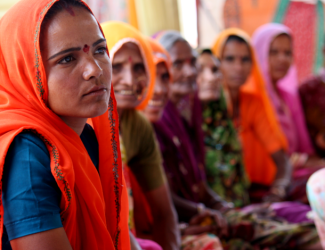
WHRDs are self-identified women and lesbian, bisexual, transgender, queer and intersex (LBTQI) people and others who defend rights and are subject to gender-specific risks and threats due to their human rights work and/or as a direct consequence of their gender identity or sexual orientation.
WHRDs are subject to systematic violence and discrimination due to their identities and unyielding struggles for rights, equality and justice.
The WHRD Program collaborates with international and regional partners as well as the AWID membership to raise awareness about these risks and threats, advocate for feminist and holistic measures of protection and safety, and actively promote a culture of self-care and collective well being in our movements.
Risks and threats targeting WHRDs
WHRDs are exposed to the same types of risks that all other defenders who defend human rights, communities, and the environment face. However, they are also exposed to gender-based violence and gender-specific risks because they challenge existing gender norms within their communities and societies.
By defending rights, WHRDs are at risk of:
Physical assault and death
Intimidation and harassment, including in online spaces
Judicial harassment and criminalization
Burnout
A collaborative, holistic approach to safety
We work collaboratively with international and regional networks and our membership
to raise awareness about human rights abuses and violations against WHRDs and the systemic violence and discrimination they experience
to strengthen protection mechanisms and ensure more effective and timely responses to WHRDs at risk
We work to promote a holistic approach to protection which includes:
emphasizing the importance of self-care and collective well being, and recognizing that what care and wellbeing mean may differ across cultures
documenting the violations targeting WHRDs using a feminist intersectional perspective;
promoting the social recognition and celebration of the work and resilience of WHRDs ; and
building civic spaces that are conducive to dismantling structural inequalities without restrictions or obstacles
Our Actions
We aim to contribute to a safer world for WHRDs, their families and communities. We believe that action for rights and justice should not put WHRDs at risk; it should be appreciated and celebrated.
Promoting collaboration and coordination among human rights and women’s rights organizations at the international level to strengthen responses concerning safety and wellbeing of WHRDs.
Supporting regional networks of WHRDs and their organizations, such as the Mesoamerican Initiative for WHRDs and the WHRD Middle East and North Africa Coalition, in promoting and strengthening collective action for protection - emphasizing the establishment of solidarity and protection networks, the promotion of self-care, and advocacy and mobilization for the safety of WHRDs;
Increasing the visibility and recognition of WHRDs and their struggles, as well as the risks that they encounter by documenting the attacks that they face, and researching, producing, and disseminating information on their struggles, strategies, and challenges:
Mobilizing urgent responses of international solidarity for WHRDs at risk through our international and regional networks, and our active membership.
"He dado testimonio de la discriminación que vi en las calles, he sufrido burlas y abusos verbales ahí. También he hecho numerosas amistades y he conocido a mucha gente. Puede que haya peligros ahí fuera, pero soy una sobreviviente y aquí es donde estaré por ahora." - Sainimili Naivalu
Sainimili Naivalu fue una feminista y activista por los derechos de las personas con discapacidades de la aldea de Dakuibeqa en la isla de Beqa, Fiji.
Exigió a las autoridades políticas y a otras partes interesadas que proporcionaran políticas y servicios favorables a la movilidad de las personas con discapacidad, como la construcción de rampas en pueblos y ciudades para aumentar su accesibilidad. Sin embargo, las barreras físicas no fueron las únicas que Sainimili se esforzó por cambiar. Por experiencia propia, sabía que era necesario que se produjeran cambios más complejos en las esferas sociales y económicas. Muchos de los retos a los que se enfrentan las personas con discapacidad tienen su origen en actitudes que llevan a la discriminación y al estigma.
Como sobreviviente y luchadora, Sainimili contribuyó a la creación conjunta de realidades feministas que fomentasen la inclusión y cambiasen las actitudes hacia las personas con discapacidad. Como afiliada a la Asociación de Lesiones de la Espina Dorsal de Fiji (SIA, por sus siglas en inglés) y a través del proyecto del Foro para Personas con Discapacidades del Pacífico “Pacífico Habilita”, Sainimili asistió a la formación de la Organización Internacional del Trabajo "Inicie su Negocio" en Suva, lo que le permitió transformar sus ideas en su propio negocio. Fue emprendedora en el puesto 7 del mercado de Suva, donde ofrecía servicios de manicura, y también se encargaba del puesto del mercado de las mujeres de SIA, donde vendía artesanías, sulus y otros objetos. El plan de Sainimili era expandir su negocio y convertirse en una importante empleadora de personas con discapacidad.
Además de su activismo, también fue medallista y campeona juvenil de tenis de mesa.
Sainimili era única, con una personalidad vivaz. Siempre podías saber si Sainimili estaba en una habitación porque su risa y sus historias eran los primero que notabas. - Michelle Reddy
Sainimili falleció en 2019.
Anti-Rights Trends in Regional Human Rights Systems
Chapter 6
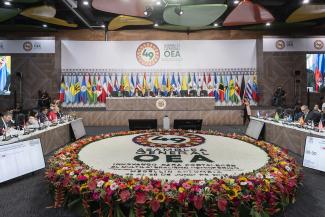
In the African Commission and the Inter-American System, anti-rights actors push essentialist notions of culture and gender to hamper progress on rights and undermine accountability. As we see, anti-rights actors are exerting influence in regional human rights systems, as well as international spaces.
The African Commission on Human and Peoples' Rights has begun framing women’s and sexual rights as jeopardising its ability to deal with “real rights” and contrary to “African values”, setting a worrying anti-rights precedent. The withdrawal of the Coalition of African Lesbians’ observer status is an example of this trend, and points to the way space for feminist, Pan-Africanist engagement is being stifled.
In the Organization of American States (OAS) and the Inter-American Human Rights System, anti-rights strategies include the NGOization of religious groups, the use of secular discourses, and the co-optation of discrimination frameworks. Anti-rights influence has materialized in a number of ways, including the intimidation of trans activists and the blocking the introduction of progressive language in resolutions.
Table of Contents
Silencing Feminists in the African Human Rights System
Anti-rights Groups in Latin America: Organization of American States (OAS) General Assembly and the Inter-American Human Rights System
AWID presenta este Manual WITM para apoyar a personas y organizaciones que quieran investigar por su cuenta las tendencias en el financiamiento para una región, temática o población en particular, adaptando las metodologías de investigación de AWID.
El Manual WITM de AWID es producto de diez años de experiencia. Las investigaciones de WITM y este Manual son una demostración política y práctica de los recursos y pasos necesarios para realizar investigaciones en acción de buena calidad.
El equipo WITM también ofrece apoyo técnico y político antes y durante el proceso de investigación. Te invitamos a leer el Manual y a ponerte en contacto con nosotras en fundher@awid.org si necesitas más información.
Join us through the #FreezeFascisms conversations!
As we navigate the global polycrisis, movements are tirelessly building power beyond traditional power structures. The wave of US presidential executive orders is intended to scare us, but no amount of fascist ideology can erase our existence and resistance.
We invite you to be a part of the solidarity-building campaign to expose and resist fascist forces undermining feminist and gender justice movements in your contexts!
Spark conversations in a brave space: Share stories of struggles and resistance to fascisms in your contexts on the AWID Community Platform. Not a member yet? Join here
Support movements that have been impacted: Amplify fundraisers, resourcing opportunities, mutual aid efforts using the #FreezeFascisms (we’re still on X, Instagram, LinkedIN, and we’re also on Bluesky)
Organize around alternatives: We’ve been building our community of practice on feminist economic alternatives & autonomous resourcing. Sign up to be part of it here.
Sylvia Rivera était une militante pour les droits civiques, travestie et travailleuse du sexe.
Connue comme la drag queen de couleur de New York, Sylvia était une infatigable et féroce défenseure des marginalisé·e·s et exclu·e·s au début des années 1970, alors que le mouvement pour les « droits des gays » prenait de l’ampleur aux États-Unis.
Dans un discours bien connu prononcé pour Chistopher Street Day en 1973, Sylvia s’est exclamée, parmi une foule de membres de la communauté LGBT :
« Vous me dites tous d’aller me cacher, la queue entre les jambes.
Je ne supporterai plus ces conneries.
On m’a battue.
On m’a cassé le nez.
On m’a jetée en prison.
J’ai perdu mon travail.
J’ai perdu mon appartement.
Tout ça pour la libération gay, et vous me traitez de la sorte?
C’est quoi votre putain de problème à tous?
Réfléchissez à ça! »
En 1969, à l’âge de 17 ans, Sylvia a participé aux célèbres émeutes de Stonewall en jetant, paraît-il, le deuxième cocktail molotov en signe de protestation contre la descente de la police dans le bar gay de Manhattan. Elle a continué à être une figure centrale des soulèvements qui ont suivi, organisant des rassemblements et ripostant aux brutalités policières.
En 1970, Sylvia a collaboré avec Marsha P. Johnson à la création de Street Transvestite Action Revolutionaries (S.T.A.R.), collectif et organisation politique qui mettait sur pied des projets de soutien mutuel pour les personnes trans vivant dans la rue, celles et ceux aux prises avec la toxicomanie ou en détention, et spécialement pour les personnes trans de couleur et celles et ceux vivant dans la pauvreté.
Refusant les étiquettes, Sylvia a incité les personnes du mouvement de libération gay à penser différemment, et ce, tout au long de sa vie. Elle a déclaré :
« J’ai quitté ma maison en 1961, à l’âge de 10 ans. Je me suis démenée sur la 42e rue. Le début des années 1960 n’était pas génial pour les drag queens, les garçons efféminés ou les garçons qui se maquillaient comme on le faisait. À l’époque, on se faisait battre par la police, par tout le monde. Je n’ai pas vraiment fait mon coming out en tant que drag queen avant la fin des années 1960. C’était vraiment la débandade lorsque des drag queens se faisaient arrêter. Je me rappelle la première fois où je me suis fait arrêter, je n’étais même pas habillée entièrement en drag. Je marchais dans la rue et les flics m’ont tout simplement attrapée. Les gens maintenant prétendent que je suis une lesbienne, parce que je suis avec Julia, ce à quoi je leur je réponds : « Non, je suis juste moi. Je ne suis pas une lesbienne. » J’en ai marre d’être étiquetée. Je ne suis même pas en faveur de l’étiquette de transgenre. J’en ai marre de vivre avec des étiquettes. Je veux juste être qui je suis. Je suis Sylvia Rivera »
Par son activisme et son courage, Sylvia Rivera a présenté un miroir où se reflétait tout ce qui n’allait pas dans la société, mais aussi la possibilité d’une transformation. Sylvia est née en 1951 et décédée en 2002.
Suscríbete para recibir nuestras noticias
Snippet FEA No feminist economies without feminist unions (FR)
Pas d’économies féministes sans syndicats féministes!
Par le biais de l'organisation syndicale, Sopo, Sabrina et Linda se battent non seulement pour les droits des femmes, des travailleur·euses essentiel·les, des travailleur·euses migrant·e·s et des travailleur·euses du sexe, mais pour les droits de tous·tes les travailleur·euses .
La lutte pour mettre fin à l'exploitation des travailleur·euses est une lutte féministe. C’est pourquoi il n’y a pas d’économies féministes sans syndicats féministes.
FRMag - The Triple (FR)
Les invalides en triple : parlons sexe, chéri !
par Nandini Tanya Lallmon
Olajumoke « Jay » Abdullahi et Kym Oliver sont des féministes révolutionnaires à plus d'un titre. (...)
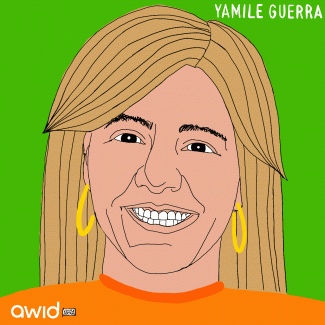
Yamile Guerra was a well-known lawyer, community leader and political activist in the Santander region of Colombia.
She was actively working to resolve disputes between local communities and developers, advocating against illegal land appropriation. Yamile had occupied various political posts, including as the Secretary General for the Santander government in Bogota and also aspired for the Mayor’s Office of Bucaramanga. In the last few years of her life, Yamile became increasingly active in environmental causes, particularly in the defense of the biodiverse wetlands of Santurbán against development, a region which supplies nearly 2 million people with freshwater.
According to her family and friends, Yamile received daily threats against her life and had asked the authorities for protection.
“She was very very aware of this issue [land litigation] and she said many times that she felt insecure.” - Alixon Navarro Munoz, journalist and friend of Guerra family
On July 20, 2019 Yamile was shot to death by two men in Floridablanca, Santander. She had just finished discussing a land dispute with them. A suspect was later arrested for her murder and admitted to being paid to carry out her assassination. According to reports, Yamile was the third member of her family to have been killed in relation to land disputes. Her father, Hernando Guerra was murdered several years previously.
Yamile’s assassination is part of a wave of violence and systematic killing of hundreds of social activists and human rights defenders in Colombia. According to the Institute for Development and Peace Studies (INDEPAZ), at the time of Yamile’s death, over 700 community leaders and human rights activists had been killed since the country signed a peace agreement in August 2016. Most were murdered for confronting illegal drug trafficking and mining operations, with indigenous people, Afro-Colombians and women human rights defenders being most at risk.
Less than a week after Yamile’s death, thousands of Colombians marched all over towns and cities, holding up black and white photos of activists who had been killed, with signs that read: "Without leaders there can be no peace" and "No more bloodshed”.
Yamile Guerra was only 42 years old at the time of her assassination.
MANGO
Jurema Araújo is a teacher-poet from Rio de Janeiro. She contributed to the magazine Urbana, edited by the poets Brasil Barreto and Samaral (RIP) and to the book Amor e outras revoluções (Love and Other Revolutions) with several other writers. In collaboration with Angélica Ferrarez and Fabiana Pereira, she co-edited O livro negro dos sentidos (The Black Book of Senses), a creative anthology on black women’s sexuality in Brazil. Jurema is 54-years-old; she has a daughter, three dogs, a cat, and many friends.
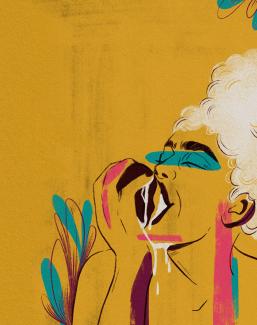
Suck it with me?
Mango is my favorite fruit.
I open my mouth
and suck it all,
Its flesh caught between my teeth
that turn soft not to hurt it
and I press it between my tongue and the roof of my mouth,
then I take it out to suck on every part of it
with the juice running down my mouth
drenching myself in this tasty nectar
and putting it all in my mouth again
because mango is seed and honey;
it is fiber and flavor.
And when it is over, I am entranced,
honeydewed, sweetened,
my lips all wet.
Ohhh, what is mango for if not for smearing.
Chupa Comigo?
A fruta que eu mais gosto é manga!
Porque eu abro a boca
E meto toda pra chupar!
Se os dentes a prendem
Fazem macio para não machucar
E eu pressiono entre minha língua e meu céu
Depois tiro pra sugar cada parte
Sentindo o caldo escorrer boca afora
Me molhando com esse néctar gostoso
E metendo toda na boca de novo
Pois manga é caroço e é mel,
É fiapo e sabor
E quando acaba, estou extasiada
Melada, docinha
Com os lábios molhados!
Aaahhh, manga é pra se lambuzar!
Introducing The Black Book of Senses
I’ll admit it: when Angélica and Fabi invited me to curate a collection of erotic texts by black women, I didn’t know what curatorship was. I understood the erotic well, but curatorship... I smiled, feeling shy and flattered. I think I thanked them – at least I hope I did – and thought to myself: what the fuck is it?! This fancy word I’ll have to learn the meaning of while doing it, what is it?
Now at this point, I know what it is to be a curator: it is making love with someone else’s texts, with someone else’s art, with the intention of putting a book together. And that is exactly what I did. I undressed each text of every author of this book with a literary lasciviousness. And I got involved in the words and senses of others. I was penetrated by poems I didn’t write; tales I didn’t even dare to imagine turned me upside down, messing with my feelings, with my libido. And it was a wonderful and unusual orgasm: ethereal, corporeal, sublime, at once intellectual and sensitive.
These texts pulsated like a clit hardened by desire, drenched, dripping joy in every reading. Words that swallowed me with their naughty significance, making me dive deeper into this wet universe.
These black women went to the bottom of their arousals and turned their deepest erotic fantasies into art. These works are impregnated with each writer’s own way of experiencing sexuality: freely, blackly, for ourselves, in our own way, empowered.
I chose to spread the texts throughout different parts of the book, each one organized according to the most delicate, explosive, evident, or implicit content they presented.
To open the door to this “invulved blackessence,” we have our Preliminaries section, with texts that introduce readers to this world of delights. It is a more general, delicate caress to acknowledge the subjects addressed by the texts in the rest of the book.
Then comes the heat of Touch, addressing what the skin can feel. That energy which burns or freezes our bodies, makes our hormones explode and starts to awaken the other senses. And although there are many of us who are voyeurs, the contact of skin with a wet and warm mouth is exciting, like wandering through the softness of whomever is with you. We are seduced by the firm or gentle touch that gives us goosebumps and that lovely discomfort that runs from the neck down to the back and only stops the next day. And the warmth of the lips, the mouth, the wet tongue on the skin – oh, the tongue in the ear, hmmm – or skin on skin, clothes moving over the body, almost like an extension of the other’s hand. If there is no urgency, that wildest arousal of the pressure of a tight grab, a bit of pain – or a lot, who knows?
The Sound – or melody? – section shows us that attraction also happens through hearing: the voice, the whispers, the music that enables the connection between the bodies and can become the theme of desire. For some of us, someone with a beautiful voice would only need their vocal cords, because that harsh or heavy or melodious sound would be auditory sex. Their loud swearing or sweet words whispered in the ear would be enough to give us hair-raising shivers from neck to coccyx.
In Flavor, we know the tongue does a good job tasting the most hidden places and wandering through the body to delight itself. Sometimes this organ is used, boldly, to taste the other’s nectar. The idea of someone sharing their strawberry or a delicious, juicy mango through bites and licks – or licks and bites – melts us. But nothing is more delicious than tasting the caves and hills of the person you are with. Stick your tongue deep inside to taste a piece of fruit... or spend hours tasting the head of a cock in your mouth, or suck on a delicious breast to taste the nipples. This is all about memorizing someone by their Flavor.
There are texts in which the nose is what triggers desire. The Smell, my dear readers, can awaken us to the delights of desire. Sometimes we meet a person who smells so good, we want to swallow them right through our nose. When you run through the other person’s body with your nose, starting with the neck – wow, that delightfully uncomfortable shiver that runs down the spine and undresses the soul! The shameless nose then moves to the back of the neck and captures the scent of the other in such a way that in the absence of that person, smelling their same scent evokes, or conversely, invades in us olfactory memories that bring the arousing smell of that person back.
We then get to Look – for me, the betrayer of senses – in which we perceive desire from a point of “view.” It is through sight that the texts present desire and arousal, through which the other senses are brought about. Sometimes a smile is all it takes to drive us crazy. The exchange of glances? That look that says “I want you now.” That look of possession that comes to an end when you stop fucking, or not. That one is very particular; it draws the other who won’t be able to look away for long. Or the sidelong glance – when one looks away when the other turns their head, like a cat-and-mouse game? Once we are caught red-handed, there’s nothing else to do besides breaking into a wide smile.
Finally, the explosion. Wandering through All senses, the texts mix feelings that seem like an alert, so there is the greatest pleasure, that orgasm.
Of course, there is nothing explicitly separating these poems and tales. Some are subtle. Arousal engages all our senses and, most importantly, our heads. That’s where it happens, and it connects our whole body. I organized the poems according to how they came to me in each reading. Feel free to disagree! But to me, there is a sense through which desire goes and then explodes. Realizing which one it is, is delightful.
Being able to turn arousal into art means freeing ourselves from all the prejudice, prisons, and stigma this white-centric society has trapped us in.
Every time a black writer transforms the erotic into art, she breaks these harmful racist chains that cripple her body, repress her sexuality, and turn us into the object of another’s greed. Writing erotic poetry is taking back the power over her own body and roaming fearlessly through the delights of desire for herself, for others, for life.
The literary erotic is who we are when turned into art. Here we show the best of us, our views of love drenched by pleasure, seasoned by the erogenous, spread through our bodies, and translated by our artistic consciousness. We are multiple and we share this multiplicity of sensations in words dripping with arousal. Yes, even our words drip with our sexual desire, drenching our verses, turning our sexual urges into paragraphs. To come, for us, is a breakthrough.
It is necessary to make our minds, bodies, and sexuality black, to reestablish our pleasure, and take back our orgasms. Only then will we be free. This whole process is a breakthrough, and it happens painfully. But there is happiness in finding ourselves to be very different from where we had been placed.
I feel like I am yours, I am ours. Taste, delight yourselves, feast on these beautiful words with us.
This text is adapted from the introductions to “O Livro Negro Dos Sentidos” [The Black Book of Senses], an erotic collection of poems by 23 black female writers.
ExploreTransnational Embodiments
This journal edition in partnership with Kohl: a Journal for Body and Gender Research, will explore feminist solutions, proposals and realities for transforming our current world, our bodies and our sexualities.
نصدر النسخة هذه من المجلة بالشراكة مع «كحل: مجلة لأبحاث الجسد والجندر»، وسنستكشف عبرها الحلول والاقتراحات وأنواع الواقع النسوية لتغيير عالمنا الحالي وكذلك أجسادنا وجنسانياتنا.
We are living in a world where the destruction of Nature fuels our current global economy.
FRMag - Roots of Love and Resilience
Kunyit Asam: The Roots of Love and Resilience
by Prinka Saraswati
The menstrual cycle usually lasts between 27 and 30 days. During this time, the period itself would only go on for five to seven days. During the period, fatigue, mood swings, and cramps are the result of inflammation. (...)
Hevrin Khalaf fue una destacada líder política siria-kurda de la región autónoma de Rojava, donde las mujeres kurdas están arriesgando sus vidas para resistir la ofensiva turca y construir un sistema feminista.
Hevrin fue Secretaria General del Future Syria Party [Partido de la Futura Siria] (FSP, por sus siglas en inglés), un grupo que tenía como objetivo la construcción de puentes, la reconciliación entre diferentes grupos étnicos y el trabajo hacia una "Siria democrática, pluralista y descentralizada".
Hevrin fue un símbolo de este esfuerzo de reconciliación. También trabajó para promover la igualdad entre mujeres y hombres y fue una representante para periodistas, trabajadorxs de ayuda humanitaria y diplomáticxs que visitaban la región.
Hevrin era también una ingeniera civil de Derik, y fue una de las fundadoras de Foundation for Science and Free Though [(Fundación para la Ciencia y el Libre Pensamiento] en 2012.
El 12 de octubre de 2019 fue torturada y asesinada por la milicia Ahrar al-Sharqiya, sustentada por Turquía, durante una operación militar contra las Fuerzas Democráticas Sirias en Rojava.
"El asesinato de Khalaf es un punto de inflexión en la historia moderna de Siria. Demuestra una vez más el viejo proverbio kurdo "no hay amigxs sino montañas". Siempre seré amigo[NC1] de Khalaf y su visión de un mundo mejor." - Ahed Al Hendi
A Collective Love Print
The Circle’s Conspiracy of Writers | Wazina Zondon
Also known as the Teta Research Network, The Conspiracy of Writers was founded in 2021 in the context of Kohl’s weekly writing circles. The Network is a transnational group of queer and feminist writers who engage in collective writing, thinking, and world-making.
Wazina Zondon is an Afghan raised in New York City. Her storycollecting and storytelling work centers collective memories and rites of passage in the diaspora. Currently, she is working on Faith: in Love/faith in love which (re)traces her parent’s love story and family’s inherited love print.
Love is a contraband in Hell,
cause love is acid
that eats away bars.
But you, me, and tomorrow
hold hands and make vows
that struggle will multiply.
The hacksaw has two blades.
The shotgun has two barrels.
We are pregnant with freedom.
We are a conspiracy.
It is our duty to fight for freedom.
It is our duty to win.
We must love each other and support each other.
We have nothing to lose but our chains.
- “Love” by Assata Shakur
“If we can inherit trauma, can we inherit an imprint related to love?”
That is the question Wazina Zondon asks in her collective memoir Loveprint. Loveprint is a wandering, an overlap, a deviation that (re)creates, at the intersection of interviews and personal essays, our family’s stories and insights on love, partnership and romance. Under Wazina’s guidance, the circle’s conspiracy of writers came together and attempted to reproduce this literal blueprint in the form of collective writing, where our different stories, our genders and sexual identities complement and contradict each other. With our voices overlapping, we complete each other’s sentences to create a conversation, a memorial, pieces of ourselves that speak to a “we.”
What are the origins of your love print?
I am a so-called “happy accident.” There is much narration about this – an accidental life, one that is entirely wanted at the same time. I feel this shaped my way of loving, I don’t just fall in love; I risk the slips that lead to the fall. Perhaps it made me an amor fati kind of person.
I was told that I was an unwanted child. So I grew up to become an unwanted adult. The origins of my love print are based on being eternally unwelcomed. I am not a fruit of love or any happy feelings but rather one pain and burden. I don’t have a love print – at least not in this sense.
I know for a fact that both my parents were in love at some point, but mental health is such a demon, and until one confronts their demons, there is no winning.
I will never associate “love” with my parents or normative family. Love growing up was full of violence and responsibilities I didn’t sign up for or was even ready for. For the longest time, it felt like life and love were about carrying a big rock uphill. While my parents “loved each other,” it was a toxic ethos of violence, jealousy, and insecurity to grow up in. I grew up wanting to crave stability, and this is what is me now. I am a risk taker, but never in my “love space.”
I don’t know why my mother chose to host a child (me) within her. She does not love in this form.
My mother tells me that if I have to think about “finding” love, I should never look at her marriage as a template. My love print comes instead from my raising dogs for the last two decades (18 years to be precise). The other way around is true as well – they raised me. I understand more and more about love and its many layers in their company.
I haven’t known love from a “print.” In our household we don’t talk about love. I had to teach myself how to love. It was hard work. Still, I fail and still, I keep on trying and I fail everyday. Perhaps failure is my love print.
My love print is the care, warmth, and understanding I give to others
surrounding me, whether a stranger, a friend, a relative, a lover. My love print is political – uncalculated and unthought of.
I was born under heavy shelling.
My love print is the negative
print of that.
Lessons learned about love
I know more about what love is not than I know about what love is.
Love is neither anxiety nor panic.
Love is not asking permission to live or breathe. It is always about love and there is no love without freedom.
Everything you do is about using your heart except love. Love is about using your mind.
Sometimes I fear that my love language is lost in translation.
--- There are many ways
to map the origins
of how to
how not to
love
not love
love just enough
love far too much
some love
some loss
to love
to love lost ---
I cannot stand the idea of the couple. I cannot stand the idea of living alone while aging either. I am tired of doing the chores alone, moving houses alone, paying rent and bills alone... I imagine getting a stroke alone, and it scares me. I have no plan of “partnering up.” I want a world where I can get married to a friend, buy a house with a friend, not have sex.
Loving many does not corrupt a love shared between two, and whether love is romantic or not is really not that important.
When I reflect on the shoddy state of my relationships, I realize that I am in the relationship I was trained to be in. With all my “radicalness” I have not yet unlearned shitty gendered norms.
My need for stability feels “not radical” enough. I want to get out of this labeling. I want something I never had. I want to make it beautiful. I want to feel beautiful and safe – and only stability makes me feel that. Safe, sound, knowing home is neither about violence nor strife.
--- Love print – love to smell the books to see
where they were printed
I try to think of the origin of my
understanding and practice of love
Do we need origin, it is not the same as purity?
No purity or origin of love.
Why is it understanding and practice,
and not “emotion” that comes to mind? ---
When I call my parents, I don’t hang up the phone after we’ve said
goodbye, so I can hear the sounds of home.
What do we need to be/feel loved in death?
During my Sunni burial, I want all the women and men to come together for my burial. What’s with not being able to go say goodbye to dead people from a different sex? It will be Sunni because my mother would want it to be. It will be eco-friendly; no need for the headstone. I love all burial rituals. Quran is good, but I also want music. I really like Asmahan, Um Kulthum, and The Stone Roses.
I have a Monday-Friday playlist and two different ones for the weekend: one for Saturday and one for Sunday playlist. I would like those who loved me to play the music that I used to listen to, respecting the days – with some margin of tolerance as long as they stick to the playlists.
I want to be surrounded by the one(s) who have loved me, even for a moment. And in music and embowered in fresh cut flowers. I don’t want to be discovered dead; I want to pass away mid-laugh with loved ones.
I want to be remembered as someone who loved.
I don’t need to feel loved in death. I need the people around me to feel I loved them, even after I die. Being loved in death is about those who are alive. So I think more about how we come together as a living and loving community in the death of those we love and live with. How we take their memories with us. How we become archives of their lives.
--- Sometimes, you can only love people in their death. ---
I have to think back to the body being connected to a space. My family is very tiny and although we come from different places, it is as if every generation moved somewhere new. Perhaps this is the reason why death is not connected to a special place, a cemetery. It is common in our family to bury the dead without names or gravestones, or to distribute the ashes in the wind. I feel at peace with this kind of spaceless remembrance. The idea that my ashes fertilize new life gives me the sense of being loved, being remembered through recreation. My grandmother died earlier this year due to complications after the vaccination. Two hours after she died, my family sat laughing tears about her jokes, her hilarious way to tell stories. We laughed and loved, and it was as though she sat with us again. This is what would make me feel at peace – fertilizing soil, fertilizing conversations, and collective remembrance.
--- There were
Two streets that I used
To walk
To run
To play
To stay
There were
Five hours when the sun
Was hot
The sky was blue
The earth was green
There was
A flower I could
Smell
Touch
Squeeze
Crush
There were
The friends I could
Caress
The food
I could
inhale
The language
That would roll off my
lips
There might still be
Those many places
And things
And people
After me ---
Perhaps a promise that I will be “spatially commemorated” as a plant and taken care of in turns until it becomes a tree is enough. No name, no plaques – just the plant/tree, and knowing that it will be cared for. As for my body, I want to be cremated without any rituals and my bone ashes set free in the Arabian sea.
I need my body to be treated as subversively as it’s lived.
I do not want to be buried next to my family. In this tiny drawer next to all of the people who never knew me. Trapped in death as I was in life. I want to be cremated, and my ashes finally set free.
I want to be allowed to pass, not hang in the in-between, so it is a presence, an active process, a trespassing.
I will ask of you:
To release me and let me pass
To not let nostalgia muddy this moment because I will ask only for the normalcy of your expressions
I have snuck the gentle glimpses and hoarded away the already small and large ways you loved me in order to be sustained. I kept myself alive on these
To set a finite amount of time to grieve
To be be reminded there is no separation in the beauty of loving; it is infinite and it regenerates without the body
I want to be remembered for the love I put into the world.
I want my body to be given away, and my organs
to further fuel love in (an)other live(s).
--- The smell of jasmine ---
ExploreTransnational Embodiments
This journal edition in partnership with Kohl: a Journal for Body and Gender Research, will explore feminist solutions, proposals and realities for transforming our current world, our bodies and our sexualities.
نصدر النسخة هذه من المجلة بالشراكة مع «كحل: مجلة لأبحاث الجسد والجندر»، وسنستكشف عبرها الحلول والاقتراحات وأنواع الواقع النسوية لتغيير عالمنا الحالي وكذلك أجسادنا وجنسانياتنا.