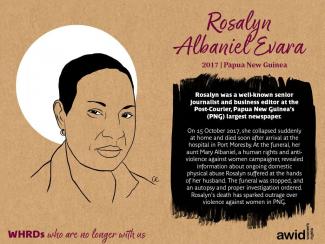
Rosalyn Albaniel Evara

WHRDs are self-identified women and lesbian, bisexual, transgender, queer and intersex (LBTQI) people and others who defend rights and are subject to gender-specific risks and threats due to their human rights work and/or as a direct consequence of their gender identity or sexual orientation.
WHRDs are subject to systematic violence and discrimination due to their identities and unyielding struggles for rights, equality and justice.
The WHRD Program collaborates with international and regional partners as well as the AWID membership to raise awareness about these risks and threats, advocate for feminist and holistic measures of protection and safety, and actively promote a culture of self-care and collective well being in our movements.
WHRDs are exposed to the same types of risks that all other defenders who defend human rights, communities, and the environment face. However, they are also exposed to gender-based violence and gender-specific risks because they challenge existing gender norms within their communities and societies.
We work collaboratively with international and regional networks and our membership
We aim to contribute to a safer world for WHRDs, their families and communities. We believe that action for rights and justice should not put WHRDs at risk; it should be appreciated and celebrated.
Promoting collaboration and coordination among human rights and women’s rights organizations at the international level to strengthen responses concerning safety and wellbeing of WHRDs.
Supporting regional networks of WHRDs and their organizations, such as the Mesoamerican Initiative for WHRDs and the WHRD Middle East and North Africa Coalition, in promoting and strengthening collective action for protection - emphasizing the establishment of solidarity and protection networks, the promotion of self-care, and advocacy and mobilization for the safety of WHRDs;
Increasing the visibility and recognition of WHRDs and their struggles, as well as the risks that they encounter by documenting the attacks that they face, and researching, producing, and disseminating information on their struggles, strategies, and challenges:
Mobilizing urgent responses of international solidarity for WHRDs at risk through our international and regional networks, and our active membership.
Esta política rige para todas las páginas alojadas en https://www.awid.org/ y para cualquier otro sitio web bajo el control de AWID (el «Sitio web») y para las suscripciones a estos sitios. No se aplica a páginas alojadas por otras organizaciones distintas a AWID, hacia las cuales podemos dirigir un hipervínculo y cuyas políticas de privacidad pueden ser diferentes. Por favor, lee la siguiente política para que puedas comprender nuestra política de privacidad en cuanto a su naturaleza, propósito, uso y divulgación de tu información personal e identificable que es recogida a través de este sitio web.
En general, puedes navegar este sitio web sin enviarnos información personal. Sin embargo, en algunas circunstancias, te pediremos esa información personal.
Cuando te encuentras en el sitio web y se te pide información personal, estás compartiendo esa información sólo con AWID.
1.1.1 La información que nos das para recibir actualizaciones de AWID:
Cuando te registras para usar el sitio (por ejemplo, te suscribes para recibir correos electrónicos o para solicitar membresía) nos das la información necesaria acerca de ti, como tu nombre, país, idioma, para recibir actualizaciones por correo electrónico. Nos das esta información a través de formularios seguros y es almacenada en servidores seguros.
1.1.2 La información de pago que nos das para hacerte miembrx o para anotarte en algún evento:
Además, puede ser necesario que nos des información sobre el pago cuando te haces miembrx o cuando te anotas para eventos. AWID no almacena en sus servidores ninguna información relativa a tarjetas de crédito y usa portales seguros para procesar la información relativa a pagos.
1.1.3 La información opcional que decidiste darnos (con consentimiento)
Cuando te comunicas con AWID o nos das información opcional a través de formularios en el sitio web o utilizas el sitio para comunicarte con otrxs miembrxs, recogemos información sobre tu comunicación y cualquier otra información que elijas dar.
1.1.4 Información que nos das a través de los formularios de contacto o cuando te comunicas directamente con nosotrxs
Cuando te comunicas con nosotrxs, recogemos tu comunicación y toda otra información que decidas darnos.
Además, cuando interactúas con el Sitio web, nuestros servidores pueden llevar un registro de actividad que no te identifica personalmente («Información no personal»). Por lo general, recogemos las siguientes categorías de información no personal:
Para más información sobre las cookies, por favor consulta All about cookies.
Si no deseas recibir cookies puedes cambiar fácilmente tu navegador web para que rechace las cookies o notificarte cuando recibes una nueva cookie. Puedes mirar aquí cómo hacerlo.
AWID utiliza la información que recogemos acerca de ti para:
Si te has subscrito a los boletines electrónicos de AWID o a nuestras actualizaciones por correo electrónico o si te has hecho miembrx, te enviaremos comunicaciones regularmente en la forma especificada en el área correspondiente del sitio web. Puedes cancelar la suscripción de cualquiera de los boletines electrónicos o actualizaciones de correo electrónico en cualquier momento siguiendo los pasos indicados para ello en nuestros correos.
Es importante para AWID que tu información de identificación individual sea precisa. Siempre estamos buscando cómo hacer más fácil que puedas revisar y corregir la información que AWID tiene acerca de ti en nuestro sitio web. Si cambias tu dirección de correo electrónico, o si cualquier otra información que tengamos es incorrecta o desactualizada, por favor escríbenos a esta dirección.
Con excepción de lo explicado más abajo, AWID no revelará ninguna información personal acerca de ti que sea identificable, y no venderá ni alquilará a tercerxs listados conteniendo tu información. AWID podrá revelar información cuando tenga tu permiso para hacerlo o bajo circunstancias especiales, por ejemplo cuando crea de buena fe que la ley se lo exige.
De manera permanente implementamos y actualizamos las medidas administrativas, técnicas y de seguridad física para proteger tu información de accesos no autorizados, pérdida, destrucción o alteración. Algunas de las salvaguardas que usamos para proteger tu información son cortafuegos, encriptación de datos y controles de acceso a la información. Si sabes o tiene razones para creer que tus credenciales de membresía a AWID se han perdido, han sido robadas, malversadas o comprometidas de alguna forma o en caso de que sepas o sospeches de uso no autorizado de tu cuenta de membresía a AWID, por favor ponte en contacto con nosotrxs a través de nuestra página.
Esta política puede cambiar periódicamente. La política modificada será publicada en este sitio web y al final del texto se actualizará la fecha de Última actualización. Se enviará un correo electrónico con la actualización de la política revisada y si no estás de acuerdo con ella tendrás la opción de cancelar tu suscripción o suscripciones con nosotrxs. También puedes escribirnos aquí. ¡Agradecemos tus opiniones!
Última actualización: mayo de 2019
For now, the survey on KOBO is available in Arabic, English, French, Portuguese, Russian and Spanish. You will have the chance to select your language of choice at the beginning of the survey.
Yes! We are currently exploring innovating technologies to allow for meaningful connection and participation.
Vous voulez vous joindre au nombre croissant de personnes qui disent « ça suffit ! » face aux infiltrations des antidroits à l’ONU ?
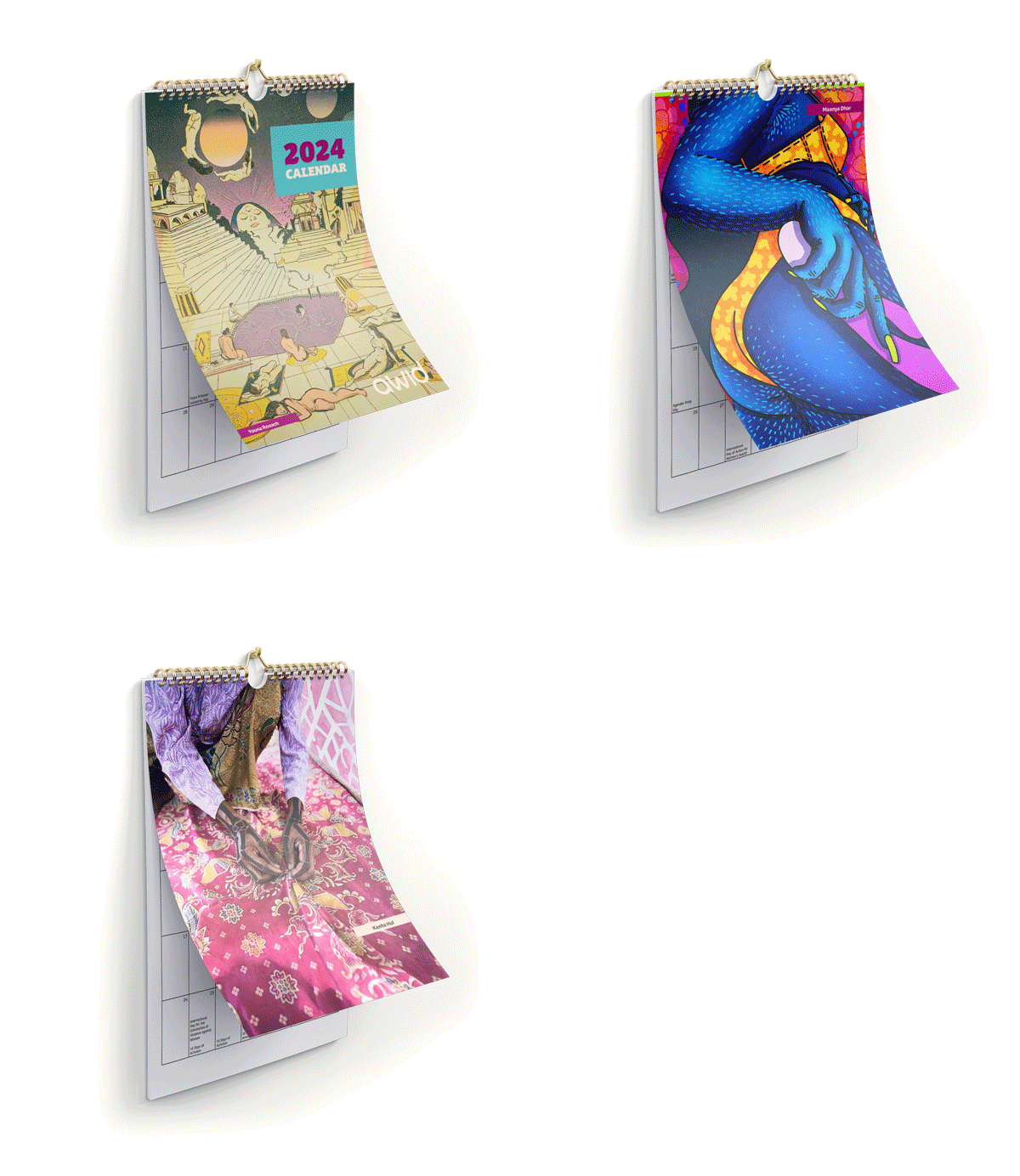
Ce calendrier nous invite à nous immerger dans le monde inspirant de l'art féministe. Chaque mois, au fur et à mesure de son déploiement délicat, il présentera les œuvres vivantes d'artistes féministes et queer de nos communautés. Leurs créations ne sont pas de simples images; ce sont des récits profonds qui résonnent avec des expériences de lutte, de triomphe et de courage indéfectible établissant notre quête collective. Ces histoires visuelles, débordantes de couleurs et d'émotions, servent à combler les distances et à tisser ensemble nos expériences diverses, nous rapprochant dans nos missions partagées.
Ce calendrier constitue notre appel à vous : utilisez-le, imprimez-le, partagez-le. Laissez-le être votre partenaire quotidien dans votre parcours, un rappel constant de notre interconnexion et de nos visions partagées pour un monde meilleur.
Laissez-le vous inspirer, tout comme il nous inspire, afin d’avancer ensemble.

Obtenez-le dans votre langue préférée ! |
| English |
| Français |
| Español |
| Português |
| عربي |
| Русский |
| Thai |
Dado que la encuesta ¿Dónde está el dinero? se centra en las realidades de la dotación de recursos para las organizaciones feministas, la mayoría de las preguntas indagan acerca del financiamiento de tu agrupación entre 2021 y 2023. Para responder la encuesta, necesitarás tener a mano cierta información como, por ejemplo, presupuestos anuales y las fuentes clave de financiamiento.
Nos hemos hecho la misma pregunta y creemos que no hay respuestas simples. Para muchas personas, el Foro de AWID puede ser uno de los pocos viajes internacionales que realicen en su vida. La pandemia nos enseñó las posibilidades pero también las limitaciones de los espacios virtuales para la construcción de movimientos: no hay nada como la conexión en persona. Los movimientos necesitan conexiones transfronterizas para construir nuestro poder colectivo frente a las amenazas que enfrentamos, especialmente la crisis climática. Creemos que el próximo Foro de AWID puede ser un espacio estratégico para abordar estas cuestiones y explorar alternativas al viaje internacional. El formato híbrido del Foro es una parte importante de esta exploración.

Ghiwa Sayegh est une écrivaine anarcho-queer, éditrice indépendante et archiviste. Elle est la rédactrice fondatrice de Kohl : la Revue de Recherche sur les Corps et le Genre et la cofondatrice d’Intersectional Knowledge Publishers. Elle a une maîtrise en études de genre de l’Université Paris 8 Vincennes – Saint-Denis. Elle est passionnée par la théorie queer, les circulations transnationales et les histoires imaginaires ou inconnues. Ses influences sont Audre Lorde et Sara Ahmed.

Tout à fait. Vos réponses seront supprimées à la fin du processus de traitement et d’analyse des données. Elles ne seront utilisées qu’à des fins de recherche. Les données ne seront JAMAIS partagées en dehors de l’AWID et ne seront traitées que par le personnel de l’AWID et des consultant·es qui collaborent avec nous à la recherche WITM.
La confidentialité de votre vie privée et votre anonymat sont nos priorités. Notre politique de confidentialité est disponible ici.
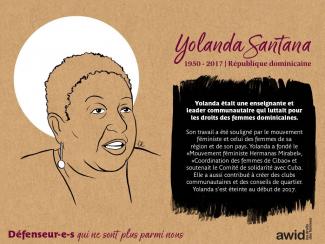
with Nazik Abylgaziva, Amaranta Gomez Regalado, Cindy Weisner, and Lucineia Freitas.

The survey is open until the end of August 2024. Please complete it within this timeframe to ensure your responses are included in the analysis.
Abby was a pioneering feminist, human-rights activist and former McGill University epidemiologist.
Abby was renowned for championing social causes and for her insightful critiques of reproductive technologies and other medical topics. Specifically, she campaigned against what she called the "geneticization" of reproductive technologies, against hormone replacement therapy and for better, longer research before the approval of discoveries such as the vaccines against the human papillomavirus.
On the news of her passing, friends and colleagues described her fondly as an “ardent advocate” for women’s health.