

Mariel Araya

In September 2016, the 13th AWID international Forum brought together in Brazil over 1800 feminists and women’s rights advocates in a spirit of resistance and resilience.
This section highlights the gains, learnings and resources that came out of our rich conversations. We invite you to explore, share and comment!
One of the key takeaways from the 2016 Forum was the need to broaden and deepen our cross-movement work to address rising fascisms, fundamentalisms, corporate greed and climate change.
With this in mind, we have been working with multiple allies to grow these seeds of resistance:
And through our next strategic plan and Forum process, we are committed to keep developing ideas and deepen the learnings ignited at the 2016 Forum.
AWID Forums started in 1983, in Washington DC. Since then, the event has grown to become many things to many peoples: an iterative process of sharpening our analyses, vision and actions; a watershed moment that reinvigorates participants’ feminisms and energizes their organizing; and a political home for women human rights defenders to find sanctuary and solidarity.
Pour toute question supplémentaire, veuillez utiliser notre formulaire de contact. Nous continuerons d’actualiser ce document en fonction des questions que nous recevrons de votre part !
I never knew I have a close family who loves me and wants me to grow, My mum has always been there for me, but I never imagined I would have thousands of families out there who are not related to me by blood.

I found out family are not just people related by blood ties, but people who love you unconditionally, not minding your sexual orientation, your health status, social status, or your race.
Thinking about the precious moments I listened to all my sisters around the world who are strong feminists, people I have not meet physically, but who support me, teach me, fight for me: I am short of words, words cannot express how much I love you mentors and other feminists, you’re a mother, a sister, a friend to millions of girls.
You are amazing, you fought for people you don’t know - and that is what makes you so special.
It gladdens my heart to express this through writing.
I love you all and will continue to love you. I have not seen any one of you physically but it seems we have known each other for decades.
We are feminists and we are proud to be women.
We will keep letting the world know that our courage is our crown.
A love letter from FAITH ONUH, a young feminist from Nigeria
with Dr. Vandana Shiva, Dr. Dilar Dirik, and Nana Akosua Hanson.

Chaque programme comporte plusieurs volets, y compris le développement et la diffusion de connaissances, la recherche-action, les plaidoyers, l’établissement d’alliances et l’organisation de dialogues stratégiques.
Notre Rapport Annuel 2011 vous proposent un sommaire des principales réalisations pendant l'année, dans le cadre de chacune des programmes de l’AWID.
2-5 ธันวาคม 2567 กรุงเทพ ประเทศไทย! เราจะรวมตัวกันที่ศูนย์การประชุมแห่งชาติสิริกิติ์และจัดให้มีการประชุมแบบเสมือนจริงออนไลน์ไปพร้อมกันด้วย
Nuevo
Como participante en línea, puedes facilitar actividades, conectarte y conversar con otras personas, y experimentar de primera mano la creatividad, el arte y la celebración del Foro de AWID. Lxs participantes que se conecten en línea disfrutarán de un programa rico y diverso: desde talleres y conversaciones hasta actividades de sanación y espectáculos musicales. Algunas actividades estarán centradas en la conexión entre participantes en línea, y otras serán verdaderamente híbridas, centradas en la conexión y la interacción entre lxs participantes en línea y quienes estén en Bangkok.

En todo el mundo y en todos los movimientos sociales, las personas que quieren innovar tienden a sentirse solitarias e impotentes frente al «statu quo del movimiento». Históricamente, los Foros de AWID han tenido un papel importante en apoyo de estas personas innovadoras, ofreciéndoles una plataforma en la cual sus ideas y prácticas son bienvenidas y fortalecidas por las ideas y las acciones de otrxs (de diferentes regiones y comunidades) que ya las han explorado. Sara Abu Ghazal, feminista palestina del Líbano, cuenta la historia de lo que significaron los Foros para una nueva generación de feministas de la región de MOAN (Medio Oriente y África del Norte), que introdujo nuevas formas de organización, nuevas interpretaciones del feminismo y nuevos temas en el panorama regional de los derechos de las mujeres.

Desde siempre el feminismo sostiene que lo personal es político. El Festival Crear, Resister, Transform generó espacios en los que el feminismo pudo discutir las cuestiones relativas al cuerpo, el género y las sexualidades, y analizar las interconexiones de estos asuntos entendidos como experiencias profundas del cuerpo y, a la vez, un terreno en los que los derechos están en constante disputa y riesgo en la sociedad.
El poder de los movimientos feministas radica en el modo de organizarnos y emprender acciones coordinadas, no solo en nuestras propias comunidades y movimientos, sino también con otras causas y grupos aliados por la justicia social. El espacio brindó la oportunidad de que los movimientos compartieran y reforzaran los procesos de organización y las estrategias tácticas de forma mutua.
La pandemia mundial sanitaria del COVID-19 ha puesto de manifiesto como nunca antes el fracaso del capitalismo neoliberal, expuesto las fallas de nuestros sistemas y acentuado la necesidad de construir nuevas realidades y las oportunidades para ello. Una recuperación económica y social feminista exige el trabajo conjunto. Esta edición, en alianza con Kohl: una publicación para la investigación sobre cuerpo y género, analizará soluciones, propuestas y realidades feministas para transformar nuestro mundo actual, nuestros cuerpos y nuestras sexualidades.
Puedes explorar los artículos en línea o
Descargar en PDF
AWID is pleased to share our 2016 Annual Report.

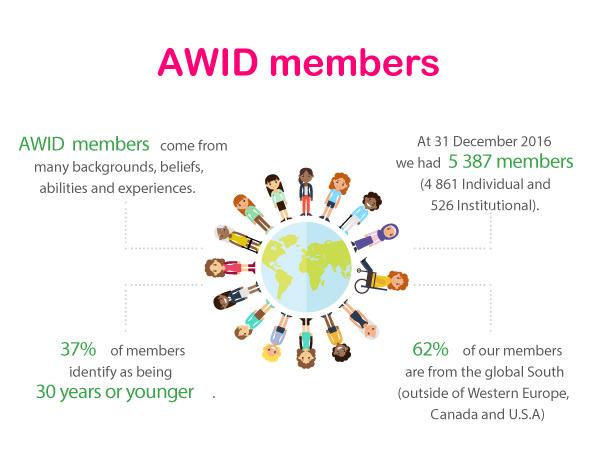
2016 was an incredible year for AWID, we convened the 13th International AWID Forum in Bahia, Brazil, a space for strategizing and alliance building with feminists and other justice movements, which was attended by over 1800 participants from 120 countries and territories across the globe.
We know that women’s rights and feminist movements are key actors in creating sustainable transformative change. Within our movements, organizing, resisting and responding to the challenging context is sharpening, and in our increasingly connected world, the potential for collective action across diverse movements has dramatically grown.
This is the crucial work that AWID seeks to amplify and support every day.
A highlight of 2016 was our ground-breaking 13th International Forum with the theme: “Feminist Futures: Building Collective Power for Rights and Justice”, where we harnessed the thinking and energy of nearly 500 partners, presenters, panelists, moderators, artivists, writers, facilitators, IT innovators, and performers, many of them leaders in their movements. We also supported the convening of the first and historical Black Feminisms Forum (BFF) organised by a working group of Black Feminists from across the world.
AWID, in partnership with other feminist and women’s rights organisations, engaged in advocacy and dialogue to explore better solutions for women’s rights agendas including our work with the Count Me In! consortium .
The experiences of women with disabilities, Black and Afro-descendant women, sex workers, Indigenous women, trans and intersex people, domestic workers and how their lives are impacted by multiple oppressions and violence were placed front and center of the Forum process.
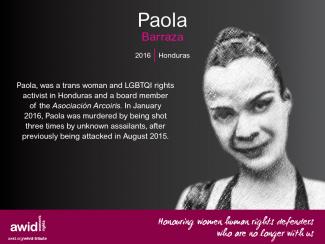
We also launched the 2016 WHRD Tribute to commemorate defenders who are no longer with us, during the 16 Days of activism, and thanks to the contributions from our members,
We drove attention to groups and issues that do not usually receive adequate mainstream media coverage through our partnership with The Guardian and Mama Cash.

AWID ไม่มีส่วนลดสำหรับการลงทะเบียนแบบกลุ่ม แต่เรามีส่วนลดสำหรับสมาชิก (คลิกที่นี่เพื่อดูวิธีการเข้าเป็นสมาชิก)

Apreciaremos propuestas de actividades referidas a todo el rango de áreas temáticas e intersecciones que son importantes para los movimientos feministas y por la justicia de género. En el formulario de propuesta podrás marcar más de un tema que se adecúe a tu actividad.
Effective as of 25 Apr 2023.
Please click here to view the previous version of our Privacy Policy.
This Privacy Policy describes how the Association for Women’s Rights in Development and our subsidiaries and affiliates (“AWID,” “we,” “us” or “our”) handles personal information that we collect through our website that links to this Privacy Policy (the “Site”), as well as through social media, our marketing activities, our live events and other activities described in this Privacy Policy (“Service”).
You can download a printable copy of this Privacy Policy here.
Index
Personal information we collect
How we use your personal information
How we share your personal information
Your choices
Other sites and services
Security
International data transfers
Children
Changes to this Privacy Policy
How to contact us
Notice to European users
Information you provide to us. Personal information you may provide to us through the Service or otherwise includes:
Automatic data collection. We, our service providers, and our business partners may automatically log information about you, your computer or mobile device, and your interaction over time with the Service, our communications and other online services, such as:
Cookies and similar technologies. Some of the automatic collection described above is facilitated by cookies, which are small text files that websites store on user devices and that allow web servers to record users’ web browsing activities and remember their submissions, preferences, and login status as they navigate a site. Cookies used on our sites include both “session cookies” that are deleted when a session ends, “persistent cookies” that remain longer, “first party” cookies that we place and “third party” cookies that our third-party business partners and service providers place.
We may use your personal information for the following purposes or as otherwise described at the time of collection:
Service delivery and business operations. We may use your personal information to:
Research and development. We may use your personal information for research and development purposes, including to analyze and improve the Service. As part of these activities, we may create aggregated, de-identified and/or anonymized data from personal information we collect. We make personal information into de-identified or anonymized data by removing information that makes the data personally identifiable to you. We may use this aggregated, de-identified or otherwise anonymized data and share it with third parties for our lawful business purposes, including to analyze and improve the Service and promote our business.
Marketing. We and our service providers may collect and use your personal information to send you direct marketing communications. You may opt-out of our marketing communications as described in the Opt-out of marketing section below.
Compliance and protection. We may use your personal information to:
With your consent. In some cases, we may specifically ask for your consent to collect, use or share your personal information, such as when required by law.
Cookies and similar technologies. In addition to the other uses included in this section, we may use the Cookies and similar technologies described above for the following purposes:
Retention. We generally retain personal information to fulfill the purposes for which we collected it, including for the purposes of satisfying any legal, accounting, or reporting requirements, to establish or defend legal claims, or for fraud prevention purposes. To determine the appropriate retention period for personal information, we may consider factors such as the amount, nature, and sensitivity of the personal information, the potential risk of harm from unauthorized use or disclosure of your personal information, the purposes for which we process your personal information and whether we can achieve those purposes through other means, and the applicable legal requirements.
When we no longer require the personal information we have collected about you, we may either delete it, anonymize it, or isolate it from further processing.
We may share your personal information with the following parties and as otherwise described in this Privacy Policy or at the time of collection.
Affiliates. Our corporate parent, subsidiaries, and affiliates, for purposes consistent with this Privacy Policy.
Service providers. Third parties that provide services on our behalf or help us operate the Service or our business (such as hosting, information technology, customer support, email delivery, marketing, consumer research and website analytics).
Payment processors. Any payment card information you use to make a purchase on the Service is collected and processed directly by our payment processors, such as Stripe. Stripe may use your payment data in accordance with its privacy policy, https://stripe.com/en-gb/privacy. You may also sign up to be billed by your mobile communications provider, who may use your payment data in accordance with their privacy policies.
Third parties designated by you. We may share your personal data with third parties where you have instructed us or provided your consent to do so. We will share personal information that is needed for these other companies to provide the services that you have requested. Moreover, you may choose to translate user-generated content using Google Translate. Google may use your user-generated content in accordance with its privacy policy, https://policies.google.com.Professional advisors. Professional advisors, such as lawyers, auditors, bankers and insurers, where necessary in the course of the professional services that they render to us.
Authorities and others. Law enforcement, government authorities, and private parties, as we believe in good faith to be necessary or appropriate for the compliance and protection purposes described above.
Other users. Your profile and other user-generated content data (except for messages) may be visible to other users of the Service. For example, other users of the Service may have access to your information if you chose to make your profile or other personal information available to them through the Service, such as when you provide comments, reviews, survey responses, or share other content. This information can be seen, collected and used by others, including being cached, copied, screen captured or stored elsewhere by others (e.g., search engines), and we are not responsible for any such use of this information.
In this section, we describe the rights and choices available to all users. Users who are located in the United Kingdom, Switzerland, and the European Economic Area can find additional information about their rights below.
Opt-out of marketing communications. You may opt-out of marketing-related emails by following the opt-out or unsubscribe instructions at the bottom of the email, or by contacting us. Please note that if you choose to opt-out of marketing-related emails, you may continue to receive service-related and other non-marketing emails.
Declining to provide information. We need to collect personal information to provide certain services. If you do not provide the information we identify as required or mandatory, we may not be able to provide those services.
Delete your content or end your membership. You can choose to delete certain content you have provided to us. If you wish to request to end your membership, please contact us.
The Service may contain links to websites, mobile applications, and other online services operated by third parties. In addition, our content may be integrated into web pages or other online services that are not associated with us. These links and integrations are not an endorsement of, or representation that we are affiliated with, any third party. We do not control websites, mobile applications or online services operated by third parties, and we are not responsible for their actions. We encourage you to read the privacy policies of the other websites, mobile applications and online services you use.
We employ a number of technical, organizational and physical safeguards designed to protect the personal information we collect. However, security risk is inherent in all internet and information technologies and we cannot guarantee the security of your personal information.
We are headquartered in the United States and may use service providers that operate in other countries. Your personal information may be transferred to the United States or other locations where privacy laws may not be as protective as those in your state, province, or country.
Users in the United Kingdom, Switzerland, and the European Economic Area should read the important information provided below about transfer of personal information outside of the European Union.
The Service is not intended for use by anyone under 18 years of age. If you are a parent or guardian of a child from whom you believe we have collected personal information in a manner prohibited by law, please contact us. If we learn that we have collected personal information through the Service from a child without the consent of the child’s parent or guardian as required by law, we will comply with applicable legal requirements to delete the information.
We reserve the right to modify this Privacy Policy at any time. If we make material changes to this Privacy Policy, we will notify you by updating the date of this Privacy Policy and posting it on the Service or other appropriate means. Any modifications to this Privacy Policy will be effective upon our posting the modified version (or as otherwise indicated at the time of posting). In all cases, your use of the Service after the effective date of any modified Privacy Policy indicates your acknowledgment that the modified Privacy Policy applies to your interactions with the Service and our business.
Where this Notice to European users applies. The information provided in this “Notice to European users” section applies only to individuals located in the EEA or the UK (EEA and UK jurisdictions are together referred to as “Europe”).
Personal information. References to “personal information” in this Privacy Policy should be understood to include a reference to “personal data” (as defined in the GDPR) – i.e., information about individuals from which they are either directly identified or can be identified. It does not include “anonymous data” (i.e., information where the identity of individual has been permanently removed). The personal information that we collect from you is identified and described in greater detail in the section “Personal information we collect”.
Our legal bases for processing. In respect of each of the purposes for which we use your personal information, the GDPR requires us to ensure that we have a “legal basis” for that use.
We have set out below, in a table format, the legal bases we rely on in respect of the relevant Purposes for which we use your personal information – for more information on these Purposes and the data types involved, see How we use your personal information above.
|
|
|
|
|
|
|
|
|
|
|
|
|
|
|
|
|
|
|
|
Retention. We retain personal information for as long as necessary to fulfill the purposes for which we collected it, including for the purposes of satisfying any legal, accounting, or reporting requirements, to establish or defend legal claims, or for compliance and protection purposes, unless specifically authorized to be retained longer.
To determine the appropriate retention period for personal information, we consider the amount, nature, and sensitivity of the personal information, the potential risk of harm from unauthorized use or disclosure of your personal information, the purposes for which we process your personal information and whether we can achieve those purposes through other means, and the applicable legal requirements.
When we no longer require the personal information, we have collected about you, we will either delete or anonymize it or, if this is not possible (for example, because your personal information has been stored in backup archives), then we will securely store your personal information and isolate it from any further processing until deletion is possible. If we anonymize your personal information (so that it can no longer be associated with you), we may use this information indefinitely without further notice to you.
Other information
No obligation to provide personal information. You do not have to provide personal information to us. However, where we need to process your personal information either to comply with applicable law or to deliver our Services to you, and you fail to provide that personal information when requested, we may not be able to provide some or all of our Services to you. We will notify you if this is the case at the time.
No Automated Decision-Making and Profiling. As part of the Services, we do not engage in automated decision-making and/or profiling, which produces legal or similarly significant effects. We will let you know if that changes by updating this Privacy Policy.
Security. We have put in place procedures designed to deal with breaches of personal information. In the event of such breaches, we have procedures in place to work with applicable regulators. In addition, in certain circumstances (including where we are legally required to do so), we may notify you of breaches affecting your personal information.
Your rights
General. European data protection laws give you certain rights regarding your personal information. If you are located in Europe, you may ask us to take any of the following actions in relation to your personal information that we hold:
Exercising These Rights. You may submit these requests by email. See the How to contact us section above for our contact details. We may request specific information from you to help us confirm your identity and process your request. Whether or not we are required to fulfill any request you make will depend on a number of factors (e.g., why and how we are processing your personal information), if we reject any request you may make (whether in whole or in part) we will let you know our grounds for doing so at the time, subject to any legal restrictions. Typically, you will not have to pay a fee to exercise your rights; however, we may charge a reasonable fee if your request is clearly unfounded, repetitive or excessive. We try to respond to all legitimate requests within a month. It may take us longer than a month if your request is particularly complex or if you have made a number of requests; in this case, we will notify you and keep you updated.
Your Right to Lodge a Complaint with your Supervisory Authority. In addition to your rights outlined above, if you are not satisfied with our response to a request you make, or how we process your personal information, you can make a complaint to the data protection regulator in your habitual place of residence.
The Information Commissioner’s Office
Water Lane, Wycliffe House
Wilmslow - Cheshire SK9 5AF
Tel. +44 303 123 1113
Website: https://ico.org.uk/make-a-complaint/
Data Processing outside Europe; we are a US-based company and many of our service providers, advisers, partners or other recipients of data are also based in the US. This means that, if you use the Services, your personal information will necessarily be accessed and processed in the US. It may also be provided to recipients in other countries outside Europe.
It is important to note that that the US is not the subject of an ‘adequacy decision’ under the GDPR – basically, this means that the US legal regime is not considered by relevant European bodies to provide an adequate level of protection for personal information, which is equivalent to that provided by relevant European laws.
Where we share your personal information with third parties who are based outside Europe, we try to ensure a similar degree of protection is afforded to it in accordance with applicable privacy laws by making sure one of the following mechanisms is implemented:
You may contact us if you want further information on the specific mechanism used by us when transferring your personal information out of Europe.
por Chinelo Onwualu
El 2 de septiembre de 2021 lxs increíbles activistas feministas y por la justicia social del festival Crear | Résister | Transform de AWID nos juntamos no solo para compartir estrategias, crear juntxs y transformar al mundo sino también para decir cosas sucias en Twitter.
In 2021, AWID, along with many other organizations, was coming to grips with the implications of the on-going global pandemic for how we work and our role in this particular time. The year taught us three critical lessons about navigating this moment as a global feminist movement-support organization.
Download the full 2021 Annual review

Our experience in 2021 reaffirmed the importance of building and sustaining a global feminist community, and AWID’s core mission to support feminist movements as a whole. We believe that at this moment, a strong community bound by a shared vision and collective care is the foundation of all social change and transformation.


สำหรับข้อมูลด้านนี้สามารถอ่านรายละเอียดได้ที่ เปิดรับสมัครกิจกรรม รวมถึงข้อมูลในหัวข้อ “สิ่งที่คุณต้องรู้”