Contenido relacionado
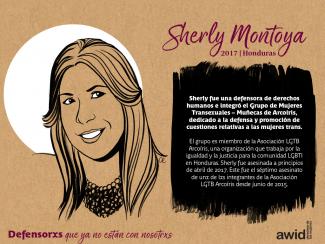
Organización Mundial Contra la Tortura: Honduras: Asesinato de Sherly Montoya, integrante del Grupo de Mujeres Transexuales “Muñecas de Arcoíris”
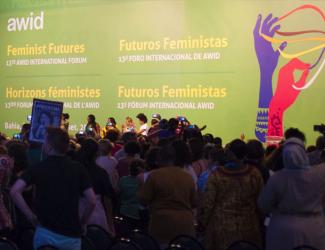
In September 2016, the 13th AWID international Forum brought together in Brazil over 1800 feminists and women’s rights advocates in a spirit of resistance and resilience.
This section highlights the gains, learnings and resources that came out of our rich conversations. We invite you to explore, share and comment!
One of the key takeaways from the 2016 Forum was the need to broaden and deepen our cross-movement work to address rising fascisms, fundamentalisms, corporate greed and climate change.
With this in mind, we have been working with multiple allies to grow these seeds of resistance:
And through our next strategic plan and Forum process, we are committed to keep developing ideas and deepen the learnings ignited at the 2016 Forum.
AWID Forums started in 1983, in Washington DC. Since then, the event has grown to become many things to many peoples: an iterative process of sharpening our analyses, vision and actions; a watershed moment that reinvigorates participants’ feminisms and energizes their organizing; and a political home for women human rights defenders to find sanctuary and solidarity.
Contenido relacionado
Organización Mundial Contra la Tortura: Honduras: Asesinato de Sherly Montoya, integrante del Grupo de Mujeres Transexuales “Muñecas de Arcoíris”
As you may or may not know, AWID is celebrating its 40th Anniversary in 2022 - around the themes of “Gather, Seed, and Disrupt.” To honor this occasion we have invited AWID members, partners and staff to write their own “Love Letter to Feminist Movements”. Together, we have sparked a constellation of feminist movements. Stay close as we forge on the journey ahead and continue to Gather, Seed, and Disrupt.
A note about Our Collection Of Love Letters:
All of these letters are written by activists who are sharing their diverse experiences in feminist movements. Some of them may include difficult or challenging content about abuse, sexual violence, conflict, exclusion and other potential triggering or upsetting pieces. While these letters are filled with love, please take care of yourself when reading the letters.
Le Groupe de travail des femmes sur le financement du développement (Women's Working Group on Financing for Development – WWG on FfD) , une alliance composée d’organisations et de réseaux de défense des droits des femmes, a été créée en octobre 2007 pour mener, dans le cadre des processus des Nations Unies sur le FdD, des activités de plaidoyer en faveur de l’égalité de genre, de l’autonomisation des femmes et des droits humains.
Troisième Dialogue de haut niveau sur le financement du développement, 23-25 octobre 2007
Day 1
¿Qué pasaría si volviéramos a imaginar formas de cuidar a nuestras comunidades?
¿Y si la economía no estaría enfocada en la ganancia de una pequeña élite sino en el cuidado de nuestro bienestar individual y colectivo, y de la Naturaleza?
Estas historias tratan de la construcción de comunidades de cuidado con y para las personas que históricamente y actualmente están excluidas, privadas de sus derechos y deshumanizadas tanto por el Estado como por la sociedad.
Estas son las historias de las feministas que centran el cuidado en la economía.
Launch of the Intergovernmental preparatory process for the 3rd Financing for Development Conference, October 2014
(with special guests!)
📅Tuesday, March 12
🕒6-9.30pm EST
🏢 Blue Gallery, 222 E 46th St, New York
RSVP required
Lorsque vous arriverez au centre-ville de São Paulo, vous verrez le bâtiment Ocupação 9 de Julho (Occupation de l’Avenue du 9 Juillet), un espace culturel et un site important dans la lutte pour le logement social.
C'est le travail du Mouvement des Travailleur·euses Sans-Abri (Movimento dos Sem-Teto do Centro, MSTC), un mouvement de plus de 2000 personnes qui agit dans le centre-ville et convertit les espaces abandonnés en logements pour les travailleur·euses à faible revenu, les enfants, femmes, adultes, personnes âgées, migrant·e·s et réfugié·e·s. Dans ce bâtiment en particulier, 122 familles sont nourries et logées.
Sesiones adicionales para redactar el Documento Final de Adís Abeba
Para saber más sobre este proceso, puedes consultar la CSO Hitchhiker’s Guide (en inglés).
La encuesta está orientada a agrupaciones, organizaciones y movimientos que trabajan específica o primordialmente por los derechos de las mujeres, las personas LBTQI+ y la justicia de género, en todos los contextos, en todos los ámbitos y en todas las regiones. Si alguno de estos es el pilar fundamental de tu agrupación, colectivo, red o cualquier otro tipo de organización —ya sea que esté registrada, sea de reciente creación o de larga data—, te invitamos a responder la encuesta.

*En esta oportunidad, no estamos solicitando respuestas de individuos ni de fondos feministas o de mujeres.
Obtén más información sobre la encuesta:
Consultar las preguntas frecuentes
Black women community organizing in the Cauca Valley in Colombia can be traced back to the country's colonial past, which is marked by the racism, patriarchy, and capitalism that sustained slavery as a means to exploit the region’s rich soils. These organizers are the heroines of a broad movement for black autonomy - one that fights for the sustainable use of the region's forests and natural resources as vital to their culture and livelihood.
For 25 years, the Association of Afro-Descendant Women of the Northern Cauca (Asociación de Mujeres Afrodescendientes del Norte del Cauca, ASOM) has been dedicated to bringing power to Afro-Colombian women’s organizing in northern Cauca.
They became established in 1997 as a response to ongoing human rights violations, the absence of public policies, inadequate management of natural resources, and the lack of opportunities for women in the territory.
They have forged the struggle to secure ethnic-territorial rights, to end violence against women, and gain recognition of women’s roles change-making peace-building in Colombia.
‘A geopolitical Analysis of Financing for Development’ by Regions Refocus 2015 and Third World Network (TWN) with DAWN.
The Zero Draft Language Map, by Regions Refocus
‘Addis Ababa financing conference: Will the means undermine the goals?‘ by RightingFinance