AWID Forum: Co-creating Feminist Futures
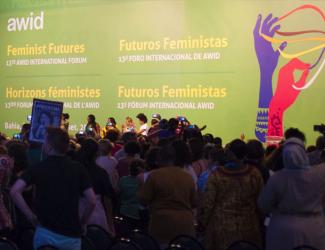
In September 2016, the 13th AWID international Forum brought together in Brazil over 1800 feminists and women’s rights advocates in a spirit of resistance and resilience.
This section highlights the gains, learnings and resources that came out of our rich conversations. We invite you to explore, share and comment!
What has happened since 2016?
One of the key takeaways from the 2016 Forum was the need to broaden and deepen our cross-movement work to address rising fascisms, fundamentalisms, corporate greed and climate change.
With this in mind, we have been working with multiple allies to grow these seeds of resistance:
- Our Seed Initiatives, has helped 20 ideas that emerged at the Forum to grow into concrete actions
- The video “Defending people and planet” and guide “Weaving resistance through action” put courageous WHRDs in the spotlight and present concrete strategies they use to confront corporate power.
- With our animations about the State of Our Feminist Movements and Climate and Environmental Justice, movements now have creative tools to support their advocacy work.
- The compiling artistic expressions of our #MovementsMatter series continues to inspire stronger and more creative organizing around the world.
- Movements can also benefit from new methodologies on Visioning Feminist Futures (Coming up soon!)
And through our next strategic plan and Forum process, we are committed to keep developing ideas and deepen the learnings ignited at the 2016 Forum.
What happens now?
The next AWID Forum will take place in the Asia Pacific region (exact location and dates to be announced in 2018).
We look forward to you joining us!
About the AWID Forum
AWID Forums started in 1983, in Washington DC. Since then, the event has grown to become many things to many peoples: an iterative process of sharpening our analyses, vision and actions; a watershed moment that reinvigorates participants’ feminisms and energizes their organizing; and a political home for women human rights defenders to find sanctuary and solidarity.
Related Content
Janette Sunita
Originaire d'Inde, Janette était une personne formidable, fougueuse, bienveillante et aimante.
Son intolérance à l’égard de l’injustice et sa ferme volonté de défendre les droits de toutes les personnes l’ont amenée à travailler pour TARSHI (une ONG qui travaille sur la sexualité et la santé sexuelle et reproductive) pendant plus de 15 ans. Janette a géré et dirigé avec compétence les aspects financiers, les ressources humaines et les aspects opérationnels de TARSHI, naviguant adroitement dans la bureaucratie labyrinthique à laquelle sont soumises les ONG indiennes.
Son équipe se souvient « elle assurait nos arrières pour que nous puissions naviguer en eaux libres. Femme aux multiples talents, Janette nous a non seulement aidés à acquérir nos propres bureaux, mais elles les a également aménagés pour leur utilisation optimale. Elle aimait les voyages et les animaux et s'intéressait à la thérapie assistée par les animaux ».
Dois-je répondre à toutes les questions en même temps, ou puis-je y répondre en plusieurs fois?
Au besoin, vous avez la possibilité de sauvegarder vos réponses en cours d’enquête, pour y revenir plus tard. KOBO enregistrera vos brouillons de réponses dans le coin supérieur gauche de la page de l'enquête et rechargera votre dossier lorsque vous reviendrez à l'enquête. Assurez-vous simplement de continuer à partir du même ordinateur et du même navigateur.
Snippet FEA Life expectancy of a trans and travesti (FR)

L'espérance de vie d'une personne trans et travesti en Argentine est de 37 ans - l'âge moyen de la population générale est de 77 ans.
Estoy viviendo una situación de violencia en una o más de mis relaciones, ¿AWID puede abogar en mi nombre?
AWID no es una organización que brinde servicios directos ni que defienda casos individuales
Te recomendamos buscar asesoría legal y ponerte en contacto con un refugio para mujeres o un centro de referencia en tu área.
Las "HotPeachPages" son un recurso en línea que ofrece enlaces a albergues para mujeres en todo el mundo. AWID no puede dar fe de la exactitud o la calidad de las instituciones que aparecen en esos listados, pero podría ser un buen lugar por donde empezar si no conoces organizaciones en tu zona.
Fany Puyesky
Kate McInturff
From Peacebuild to the Canadian Feminist Alliance for International Action, Amnesty International, and the Canadian Centre for Policy Alternatives (CCPA), Kate had a lifelong passion for women’s rights and gender equality and dedicated her career to fighting inequality and making the world a more compassionate place.
Kate was a member of the Coordinating Committee of Social Watch and a contributor to the Canadian National Social Watch reports. As a Senior Researcher at the CCPA, Kate received national acclaim for researching, writing, and producing the annual “The Best and Worst Places to be a Woman in Canada” report.
Kate died peacefully surrounded by her family, following a three-year battle with colon cancer. She is described by loved ones as a “Funny, Fearless, Unapologetically Feminist.”
The resourcing realities and state of funding for feminist movements change quickly, is this survey a one-off?
No, it's not. This survey builds on AWID’s 20-year history of mobilizing more and better funding for feminist-led social change and is the third iteration of our Where is the money for feminist organizing? research. Our aim is to repeat the WITM survey every 3 years.
Snippet FEA Exclusion and Stigma (EN)

THE EXCLUSION, STIGMA AND INSTITUTIONAL ABUSE
that trans and travesti people continue to face on a daily basis
2007: la participation de la société civile est renforcée par la création du WWG sur le FdD
Le Groupe de travail des femmes sur le financement du développement (Women's Working Group on Financing for Development – WWG on FfD) , une alliance composée d’organisations et de réseaux de défense des droits des femmes, a été créée en octobre 2007 pour mener, dans le cadre des processus des Nations Unies sur le FdD, des activités de plaidoyer en faveur de l’égalité de genre, de l’autonomisation des femmes et des droits humains.
Troisième Dialogue de haut niveau sur le financement du développement, 23-25 octobre 2007
- Le troisième Dialogue de haut niveau sur le financement du développement a été l’occasion d’un regain de participation de la société civile. En plus des six tables rondes, des audiences ont été consacrées à la société civile et au secteur privé.
- Lors de la séance plénière, l’AWID a prononcé une déclaration au nom de la société civile appelant les gouvernements à accorder une attention plus soutenue au rôle important en tant qu’agentes de développement que jouent les organisations de défense des droits des femmes et à la nécessité de favoriser la mise en œuvre de nouveaux mécanismes de financement destinés aux femmes dans les pays en développement et dans les pays les moins avancés. Cette déclaration exhortait les gouvernements à apporter un soutien plus important à l’architecture de genre des Nations Unies, de façon à ce que le système, dans son ensemble, puisse progresser dans son engagement en faveur de l’égalité des genres, de l’autonomisation des femmes et des droits humains, en ce qui concerne notamment les droits économiques, sociaux, culturels et environnementaux de toutes les personnes.
Laura Pollán
Madiha El Safty
Madiha fue una destacada profesora de Sociología con activa participación en la sociedad civil como defensora de los derechos de las mujeres en la región árabe.
Presidió la Alianza para las Mujeres Árabes y dentro del Consejo Nacional de Mujeres fue miembro del Comité de la Sociedad Civil y del Comité para el Desarrollo de la Gobernación de Minia. Fue autora de numerosas publicaciones en las que analizó y arrojó luz sobre las desigualdades de género y la discriminación contra las mujeres.
Es recordada con cariño por colegas, estudiantes y amigxs.
¿Puedo contactarme con alguien si tengo alguna pregunta o duda?
Si tienes alguna pregunta o duda, contáctanos a través del formulario disponible aquí, indicando «Encuesta ¿Dónde está el dinero?» en el título del mensaje. También puede escribirnos a witm@awid.org.
Snippet FEA Audio Story 3 (ES)
Escucha la historia aquí:
2014: Intergovernmental preparatory process for the 3rd FfD Conference is launched
Launch of the Intergovernmental preparatory process for the 3rd Financing for Development Conference, October 2014
- A preparatory process, co-facilitated by Ambassador George Wilfred Talbot of Guyana and Ambassador Geir O. Pedersen of Norway, was put in place to lead discussions ahead of the 3rd FfD conference to be held in Addis Ababa, Ethiopia in July 2015.
- As part of the preparations, two rounds of substantive informal sessions were held at the UN headquarters in New York to provide input to the drafting sessions of the outcome document.
- The WWG on FfD was re-activated with the aim of bringing feminist and women’s rights perspectives to the discussions and deliberations ahead of and during the 3rd International FfD Conference. AWID, Development Alternatives with Women for a New Era (DAWN) and the Feminist Task Force (FTF) are currently acting as co-facilitators of the group.
- The WWG on FfD’s submitted two oral statements during the first round, and written input to the second round of substantive informal sessions, which highlighted that gender inequality was not visible, nor was the inclusion of other types of discrimination and inequalities. The WWG’s submission highlights gender power relations and the intersections with other categories such as race, disability, ethnicity, age, wealth and sexual identity, which underpin the unequal distribution of opportunities and resources in societies around the world.
- Civil society organizations raised concerns about the space for their engagement in the two substantive informal sessions, including the risk that civil society space to engage in negotiations on the outcome document in January 2015 might be constricted.
Piera Oria
Teresia Teaiwa
Considérée par le Guardian comme l'une des icônes nationales de Kiribati, Teresia était une avocate téméraire.
Elle travaillait en étroite collaboration avec des groupes féministes aux îles Fidji. Ses travaux de recherche ont servi à aborder les problèmes du féminisme et de l'égalité de genre dans le Pacifique. Elle était également corédactrice de l’International Feminist Journal of Politics. En Océanie, son influence a traversé les frontières académiques, ainsi que les mouvements pour la justice sociale.
Snippet - WITM To build - RU

Создать ориентированную на феминистские реалии доказательную базу движения денег их получателей
Snippet FEA how important essential workers are (FR)
La pandémie de COVID-19 a montré au monde l'importance des travailleur·euses essentiel·les. Nous parlons des personnes qui font le ménage, les travailleur·euses domestiques, les infirmier·ères, les d'ambulancier·ères, les personnes travaillant dans les transports, les supermarchés et autres. Leur travail consiste à prendre soin et à garantir le bien-être des autres et à faire fonctionner nos économies.
Mais pendant qu'iels prennent soin de nous..