AWID Forum: Co-creating Feminist Futures
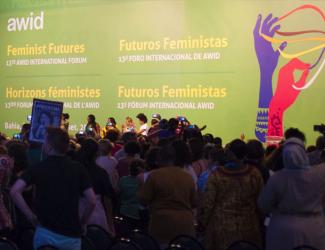
In September 2016, the 13th AWID international Forum brought together in Brazil over 1800 feminists and women’s rights advocates in a spirit of resistance and resilience.
This section highlights the gains, learnings and resources that came out of our rich conversations. We invite you to explore, share and comment!
What has happened since 2016?
One of the key takeaways from the 2016 Forum was the need to broaden and deepen our cross-movement work to address rising fascisms, fundamentalisms, corporate greed and climate change.
With this in mind, we have been working with multiple allies to grow these seeds of resistance:
- Our Seed Initiatives, has helped 20 ideas that emerged at the Forum to grow into concrete actions
- The video “Defending people and planet” and guide “Weaving resistance through action” put courageous WHRDs in the spotlight and present concrete strategies they use to confront corporate power.
- With our animations about the State of Our Feminist Movements and Climate and Environmental Justice, movements now have creative tools to support their advocacy work.
- The compiling artistic expressions of our #MovementsMatter series continues to inspire stronger and more creative organizing around the world.
- Movements can also benefit from new methodologies on Visioning Feminist Futures (Coming up soon!)
And through our next strategic plan and Forum process, we are committed to keep developing ideas and deepen the learnings ignited at the 2016 Forum.
What happens now?
The next AWID Forum will take place in the Asia Pacific region (exact location and dates to be announced in 2018).
We look forward to you joining us!
About the AWID Forum
AWID Forums started in 1983, in Washington DC. Since then, the event has grown to become many things to many peoples: an iterative process of sharpening our analyses, vision and actions; a watershed moment that reinvigorates participants’ feminisms and energizes their organizing; and a political home for women human rights defenders to find sanctuary and solidarity.
Related Content
Quais são os idiomas oficiais do inquérito WITM?
Por enquanto, o inquérito no KOBO está disponível em árabe, inglês, francês, português, russo e espanhol. Terá a oportunidade de selecionar um dos idiomas no início do inquérito.
Andaiye
Andaiye in Swahili means ‘a daughter comes home’. Born Sandra Williams on 11 September 1942 in Georgetown, Guyana, she changed her name to ‘Andaiye’ in 1970 as the Black Power movements swept her country and the wider Caribbean region.
Andaiye was seen as a transformative figure on the frontlines of the struggles for liberation and freedom. She was an early member and active in the leadership of the Working People’s Alliance (WPA), a socialist party in Guyana which fought against authoritarian rule and continued throughout her life to focus on justice for the working-class and rural women’s rights and on bridging ethnic barriers between Indo and Afro-Guyanese women.
Andaiye was a founding member of Red Thread Women, an organization that advocated for women’s care work to be fairly remunerated, worked at the University of the West Indies and with CARICOM. Never afraid to challenge governments, she pointed out gender imbalances in state boards, laws that discriminated against sex workers, called for abortion rights in Jamaica and spoke out against trade agreements such as the Caribbean Single Market and Economy (CSME) that allowed for the free movement of women domestic migrant workers but did not give their children the same rights.
Andaiye published several scholarly essays, wrote newspaper columns and also edited the last books of Walter Rodney, the Guyanese political activist and fellow WPA leader, who was assassinated in 1980. A cancer survivor, Andaiye was one of the founders of the Guyana Cancer Society and the Cancer Survivors’ Action Group. She also served on the executive of the Caribbean Association for Feminist Research and Action (CAFRA), as a Director of Help and Shelter and as Board Member of the Guyana National Commission on Women. She received a number of awards, including the Golden Arrow of Achievement in Guyana (the fourth highest national award).
Andaiye passed away on 31 May 2019 at the age of 77. The subsequent tributes that flowed in from activists, friends and those inspired by her life spoke eloquently to her amazing legacy and her beautiful humanity.
Here are but a few:
“Andaiye had a profound effect on me...she was so many things, an educator, fighter, she taught me to be self-critical, to think more clearly, she taught me about survival, about incredible courage, about compassion, about going beyond external appearances and treating people as people and not being distracted by status, class, race...anything.”
- Peggy Antrobus, Feminist Activist, Author, Scholar, Barbados
“The kind of confident idealism Andaiye expressed, this willingness to confront the world and a stubborn belief that you could actually change it... That politics of hope...How else to honour her life, legacy and memory but to keep doing the work ethically and with ongoing self-critique? And to put women’s caring work at the center of it.”
- Tonya Haynes, Barbados
“I can hear her quip at our collective keening. So through the tears I can laugh. Deep bows to you beloved Andaiye, thank you for everything. Love and light for your spirit’s journey. Tell Walter and all the ancestors howdy.” - Carol Narcisse, Jamaica
Snippet "un"Inclusive Feminism_Fest (FR)
Féminisme "non"Inclusif :
Les filles sans voix dans le mouvement féministe haïtien
Naike Ledan
Semi Kaefra Alisha Fermond, Trans Rights Activist ACIFVH
Natalie Desrosiers
Fédorah Pierre-Louis

Claudia House Morcom
هل عليّ القيام بأي تجهيزات قبل تعبئة الاستطلاع؟
يركّز استطلاع "أين المال" على وقائع التمويل للتنظيمات النسوية، تسأل أغلبية الأسئلة عن تمويل مجموعتكم/ن بين الأعوام 2021-2023. سوف تحتاجون أن تكون لديكم/ن معلومات معيّنة عند تعبئة الاستطلاع مثل ميزانيتكم/ن السنوية ومصادر التمويل الأساسية.
Paula Andrea Rosero Ordóñez
"[Ella] era una persona que se caracterizaba por su arduo trabajo a favor de la defensa de los derechos humanos y la construcción de la paz en Nariño, especialmente en el municipio de Samaniego-Nariño". - Jorge Luis Congacha Yunda para Página10.
Paula Andrea Rosero Ordóñez fue abogada de primera instancia en la oficina del Ministerio Público en Samaniego, Nariño, la principal agencia de defensa de los derechos de la ciudadanía en Colombia.
Paula se especializó en los derechos civiles y políticos, las problemáticas de la impunidad y la justicia, y contribuyó a descubrir abusos de poder, incluida la corrupción. Paula participó también en proyectos para la consolidación de la paz en su ciudad natal, Samaniego, a través del Consejo Municipal de Paz y la Junta Municipal de Mujeres.
Paula recibió amenazas de muerte tras exponer el manejo irregular de los recursos y de denunciar actos de corrupción en el Hospital Lorencita Villegas del municipio nariñense. Fue asesinada el 20 de mayo de 2019, cuando dos hombres se acercaron y le dispararon a corta distancia.
Festival Film Club: Leitis in Waiting & Latin/Central American Program
In this selection of films you will find the voices of filmmakers who are not content with simply recording the feminist realities that palpitate in every corner of this vast and diverse territory. These are works that from their very conceptualization are questioning for what, by whom, and how films and videos are made. They understand film to be an instrument of struggle, something more than images to be enjoyed on a screen. These are individual or collective filmmakers who see film and video making as an instrument to promote discussion, open a debate, and thus serve as a resource for popular and feminist pedagogies.
Sandra Cabrera
Вы просите указать название группы/организации и/или движения и контактную информацию – почему?
Мы запрашиваем эти данные, чтобы облегчить просмотр ответов, избежать дублирования и иметь возможность связаться с вашей организацией в случае, если вы не смогли завершить опрос и/или если у вас возникли сомнения или дополнительные вопросы. Здесь вы можете узнать больше о том, как мы используем личную информацию, которую собираем в ходе нашей работы.
Carol Thomas
Carol Thomas était une pionnière de la défense des droits sexuels et reproductifs des femmes en Afrique du Sud. Gynécologue aguerrie et fondatrice du WomenSpace, elle pratiquait et promouvait des modes de prestation de soins aux femmes non traditionnels, en proposant des soins à la fois de haute qualité, empathiques et accessibles.
« Elle inscrivait cela non seulement dans la joie de la grossesse et des nouveaux bébés, mais également dans les angoisses de la stérilité, des accouchements prématurés et des cancers féminins et dans le déchirement des fausses couches et des mortinaissances. » -Helen Moffett
Carol fonctionnait selon de nouveaux paradigmes, mettant au centre de sa pratique les besoins des femmes ayant le moins d’accès aux services et aux droits dans la société :
« L’environnement socioéconomique dans lequel nous nous trouvons majoritairement implique que les femmes supportent un fardeau disproportionné de maladies et du chômage... En tant que femme noire précédemment désavantagée, je comprends très bien ce qui se passe dans nos communautés. » - Carol Thomas
Son entreprise sociale innovante «iMobiMaMa», s’étant mérité de nombreux prix, prend appui sur les kiosques de téléphonie mobile et la technologie interactive pour connecter directement les femmes avec les services, l’information et le soutien en soins prénataux et de santé sexuelle dans les communautés de toute l’Afrique du Sud.
Carol soutenait les femmes à la fois lors des grossesses désirées et non désirées, et a encadré de nombreux·ses infirmier·ère·s et médecins au cours de sa vie.
On la décrivait également comme la gynécologue chez qui se rendre « pour les trans qui souhaitaient des soins trans affirmatifs. Elle savait y faire lorsque tant d’autres butaient sur les pronoms ou les mots à employer. Ses couvertures chaudes, son écoute attentive et ses mots qui tombaient toujours justes étaient vraiment réconfortants. » - Marion Lynn Stevens
On disait de Carol Thomas qu’elle était au point culminant de sa carrière lorsqu’elle est décédée, le 12 avril 2019, des complications d’une double transplantation pulmonaire.
Les très nombreux hommages qui lui ont été rendus suite à son décès inattendu faisaient mention qu’elle était, entre autres :
« un modèle à suivre, une guerrière, une innovatrice, une leader dynamique, une rebelle, une boule d’énergie, une brillante scientifique, une doctoresse bienveillante ».
Nul doute que Carol Thomas restera dans nos mémoires et que nous lui rendrons hommage pour avoir été tout cela, et bien plus.
Do You Want To Organize Your Own Festival?
Check Out our Super Short Guide To Organising Global Feminist Festivals And Online Events!
Pat Bellanger
O questionário está disponível durante quanto tempo?
O questionário está disponível até o final de julho de 2024. Queira preencher o mesmo dentro deste prazo para garantir que as suas respostas são incluídas na análise.
Janet Benshoof
Janet Benshoof was a human rights lawyer from the United States and an advocate for women’s equality, sexual and reproductive rights.
She campaigned to broaden access to contraceptives and abortions across the world, and battled anti-abortion rulings and in the American territory of Guam. She was arrested in 1990 for opposing her country’s most restrictive abortion law, but won an injunction at the local court in Guam that blocked the law and eventually won at the Ninth Circuit Court of Appeals, striking down the law for good.
“The women in Guam are in a very tragic situation. I never intend to be quiet about that.” - Janet Benshoof for People Magazine
Janet established landmark legal precedents including the US Food and Drug Administrations’ approval of emergency contraception, as well as the application of international law to ensure the rights of rape victims in the Iraqi High Tribunal’s prosecution of Saddam-era war crimes.
Janet was President and founder of the Global Justice Center, as well as founder of the Center for Reproductive Rights, the world’s first international human rights organization focused on reproductive choice and equality. She served 15 years as Director of the American Civil Liberties Union’s Reproductive Rights Project, where she spearheaded litigation shaping US constitutional law on gender equality, free speech, and reproductive rights.
“Janet was known for her brilliant legal mind, her sharp sense of humor, and for her courage in the face of injustice.” - Anthony D. Romero
Named one of the “100 Most Influential Lawyers in America” by the National Law Journal, Janet was the recipient of numerous awards and honors.
She was born in May 1947 and passed away in December 2017.
Snippet FEA Intro (ES)
Ven a conocer las economías feministas que AMAMOS.
Cuando hablamos de economía, hablamos de cómo organizamos nuestras sociedades, nuestros hogares y lugares de trabajo. ¿Cómo vivimos juntxs? ¿Cómo producimos alimentos, organizamos los cuidados y aseguramos nuestra salud? La economía también se trata de cómo accedemos y gestionamos recursos, cómo nos relacionamos con otras personas, con nosotrxs mismxs y con la Naturaleza.
Lxs feministas han estado construyendo alternativas económicas a los sistemas capitalistas explotadores durante siglos. Estas alternativas existen en el aquí y el ahora, y son los pilares de los mundos más justos y más sostenibles que necesitamos y merecemos.
Nos emociona compartir contigo una muestra de alternativas económicas feministas, con colectivos inspiradores de todo el mundo.