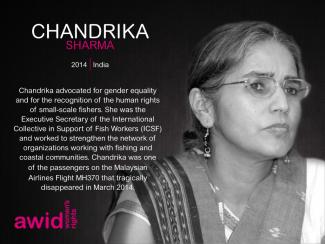
Chandrika Sharma

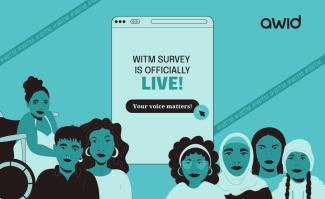
The “Where is the Money?” #WITM survey is now live! Dive in and share your experience with funding your organizing with feminists around the world.
Learn more and take the survey
Around the world, feminist, women’s rights, and allied movements are confronting power and reimagining a politics of liberation. The contributions that fuel this work come in many forms, from financial and political resources to daily acts of resistance and survival.
AWID’s Resourcing Feminist Movements (RFM) Initiative shines a light on the current funding ecosystem, which range from self-generated models of resourcing to more formal funding streams.
Through our research and analysis, we examine how funding practices can better serve our movements. We critically explore the contradictions in “funding” social transformation, especially in the face of increasing political repression, anti-rights agendas, and rising corporate power. Above all, we build collective strategies that support thriving, robust, and resilient movements.
Create and amplify alternatives: We amplify funding practices that center activists’ own priorities and engage a diverse range of funders and activists in crafting new, dynamic models for resourcing feminist movements, particularly in the context of closing civil society space.
Build knowledge: We explore, exchange, and strengthen knowledge about how movements are attracting, organizing, and using the resources they need to accomplish meaningful change.
Advocate: We work in partnerships, such as the Count Me In! Consortium, to influence funding agendas and open space for feminist movements to be in direct dialogue to shift power and money.
✉️ By registration for larger groups. Drop-ins for smaller groups. Register here
📅 Wednesday, March 12, 2025
🕒 2.00-4.00pm EST
🏢 Chef's Kitchen Loft with Terrace, 216 East 45th St 13th Floor New York
Organizer: AWID
The 14th Forum theme is “Feminist Realities: our power in action”.
We understand Feminist Realities as the different ways of existing and being that show us what is possible, despite dominant power systems, and in defiance and resistance to them. We understand these feminist realities as reclamations and embodiments of hope and power, and as multi-dimentional, dynamic and rooted in specific contexts and historical moments.
Read more about Feminist Realities
Regularly updated and searchable directory of 200+ funders across different sectors and regions that support vital gender justice work.
The 14th AWID International Forum will take place 20-23 September 2021 in Taipei, Taiwan.
Filter your search by funders’ priority support areas that speak to your organizing efforts
This new report shines a light on the resourcing realities of feminist and women’s rights organizations amid unprecedented political and financial upheaval. Drawing on over a decade of analysis since AWID last Where is the Money? report it takes stock of the gains, gaps, and growing threats in the funding landscape.
With avenues for civil society (especially those not based in Geneva) to participate in the Human Rights Council becoming more limited because of the financial crisis, spaces to put pressure and hold governments accountable for rights violations are increasingly closed. These measures include charges for hybrid participation and interpretation for side events, visa obstacles, and the limited availability of hybrid informal negotiations on draft resolutions.
Below are resolutions, key resolutions, panels and taking place in these sessions, related to gender and sexuality:
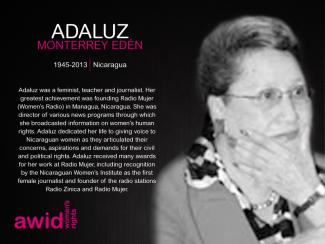
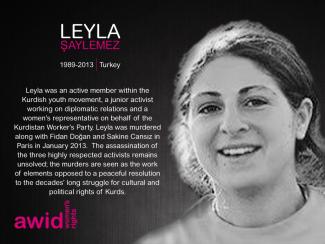
These 21 Women Human Rights Defenders (WHRDs) worked as journalists and more widely in the media sector in Mexico, Colombia, Fiji, Libya, Nepal, United States, Nicaragua, Philippines, Russia, Germany, France, Afghanistan, and the United Kingdom. 17 of them were murdered and in one case the cause of death is still unclear. On this World Press Freedom Day, please join us in commemorating the life and work of these women by sharing the images below with your colleagues, friends and networks using the hashtags #WPFD2016 and #WHRDs.
The contributions of these women were celebrated and honoured in our Tribute to Women Human Rights Defenders (WHRDs) Who Are No Longer With Us.
Please click on each image below to see a larger version and download as a file


In 2013, we published three global reports. These reports confirm that women’s rights organizations are doing the heavy lifting to advance women’s rights and gender equality by using diverse, creative and long-term strategies, all while being underfunded.
Our 2010 global survey showed that the collective income of 740 women’s organizations around the world totaled only USD 104 million. Compare this with Greenpeace International, one organization with a 2010 budget of USD 310 million1. Imagine the impact these groups could have if they were able to access all the financial resources they need and more?
AWID’s WITM research has catalyzed increased funding for women’s rights organizing. WITM research was a driving force behind the Catapult crowdfunding platform, which has raised USD 6.5 million for women’s rights. The Dutch Government cited WITM research as a reason for its unprecedented MDG 3 Fund of EU 82 million. WITM research has also led to the creation of several new funds: FRIDA – The Young Feminist Fund, the Indigenous Women’s Fund, Fundo Elas, the Mediterranean Women’s Fund and the Rita Fund.
While the WITM research has shed important light on the global funding landscape, AWID and partners have identified the need to dig deeper, to analyze funding trends by region, population and issue. In response, organizations are now using AWID’s WITM research methodology to do their own funding trends analyses. For example, in November 2013, Kosova Women’s Network and Alter Habitus – Institute for Studies in Society and Culture published Where is the Money for Women’s Rights? A Kosovo Case Study.
At the same time, AWID continues to collaborate with partners in Where is the Money for Indigenous Women’s Rights (with International Indigenous Women’s Forum and International Funders for Indigenous Peoples) and our upcoming Where is the Money for Women’s Rights in Brazil? (with Fundo Elas).
Several organizations have also conducted their own independent funding trends research, deepening their understanding of the funding landscape and politics behind it. For example, the South Asian Women’s Fund was inspired by AWID’s WITM research to conduct funding trends reports for each country in South Asia, as well as a regional overview. Other examples of research outside of AWID include the collaboration between Open Society Foundations, Mama Cash, and the Red Umbrella Fund to produce the report Funding for Sex Workers Rights, and the first-ever survey on trans* and intersex funding by Global Action for Trans* Equality and American Jewish World Service.