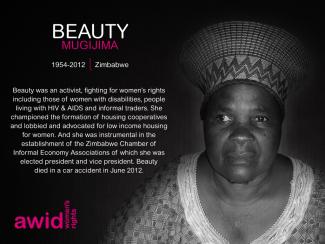
Beauty Mugijima

Feminist Realities are the living, breathing examples of the just world we are co-creating. They exist now, in the many ways we live, struggle and build our lives.
Feminist Realities go beyond resisting oppressive systems to show us what a world without domination, exploitation and supremacy look like.
These are the narratives we want to unearth, share and amplify throughout this Feminist Realities journey.
Create and amplify alternatives: We co-create art and creative expressions that center and celebrate the hope, optimism, healing and radical imagination that feminist realities inspire.
Build knowledge: We document, demonstrate & disseminate methodologies that will help identify the feminist realities in our diverse communities.
Advance feminist agendas: We expand and deepen our collective thinking and organizing to advance just solutions and systems that embody feminist values and visions.
Mobilize solidarity actions: We engage feminist, women’s rights and gender justice movements and allies in sharing, exchanging and jointly creating feminist realities, narratives and proposals at the 14th AWID International Forum.
As much as we emphasize the process leading up to, and beyond, the four-day Forum, the event itself is an important part of where the magic happens, thanks to the unique energy and opportunity that comes with bringing people together.
Build the power of Feminist Realities, by naming, celebrating, amplifying and contributing to build momentum around experiences and propositions that shine light on what is possible and feed our collective imaginations
Replenish wells of hope and energy as much needed fuel for rights and justice activism and resilience
Strengthen connectivity, reciprocity and solidarity across the diversity of feminist movements and with other rights and justice-oriented movements
Learn more about the Forum process
We are sorry to announce that the 14th AWID International Forum is cancelled
Given the current world situation, our Board of Directors has taken the difficult decision to cancel Forum scheduled in 2021 in Taipei.
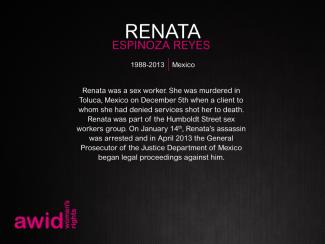

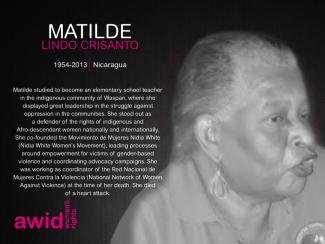
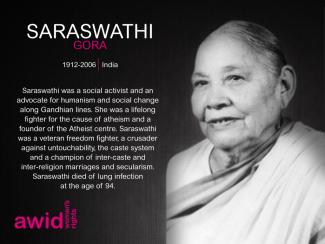
Kay Thi Win, Asia Pacific Network of Sex Workers (APNSW)
Thin Pa Pa Htun, Aye Myanmar Association
Xiao Shuang, Northeast Transgender Support Network
Cathy Ketepa, Friends Frangipani Inc. PNG
Rajeshwari Prajapati, Society for Women Awareness Nepal (SWAN)
For decades, feminist scholars and advocates have articulated important concepts related to gender to understand and challenge oppression and discrimination. Those concepts have now become the target of anti-rights actors who claim that oppressive patriarchal gender roles are “common sense”, strategically painting all other ideas, cultural norms, and forms of social life as a dangerous, conspirative ideology.
Read our Brief on “Gender Ideology” Narratives: A Threat To Human Rights
by Rode Wanimbo
I was born and grew up in Agamua, the Central Highlands of West Papua. My father belongs to the Lani tribe and my mother comes from Walak. (...)
< artwork: “Offerings for Black Life” by Sokari Ekine
Asociación de Mujeres Afrodescendientes del Norte del Cauca
Our first Feminist Film Club program is now available to view: “Tenderness is the Sharpest Resistance” is a film series on Asian/Pacific Feminist Realities curated by Jess X Snow
Women sustain Care | Care Sustains Life | Life Sustains Economy | Who takes care of women? | Not one less1 | Together | Sunday lunch
1Nenhuna a menos literally translates as “not one woman less” or “ni una menos” in Spanish - a famous feminist slogan in Latin America that emerged in Argentina as a response to increasing gender-based violence.
In the African Commission and the Inter-American System, anti-rights actors push essentialist notions of culture and gender to hamper progress on rights and undermine accountability. As we see, anti-rights actors are exerting influence in regional human rights systems, as well as international spaces.
This is Mariama Sonko, an inspiring small-scale rural farmer, eco-feminist and a woman human rights defender.
She lives in Niaguiss, a town in the southwest of Senegal. Growing up in a family and community of rural farmers, she witnessed the essential role of women in food production and seed preservation from a very early age, while also being immersed in the rhythms and working of the land. Mariama has been defending local agricultural knowledge and peasant practices since the 1990s. As a mother of five children, the food she grows herself is the main source of sustenance for her family.
She is currently the president of “Nous Sommes la Solution'' and is involved in promoting agroecological practices and family farming, encouraging food sovereignty, biodiversity and farmer seed preservation, and demanding equitable access to resources and land for women across West Africa.
Source: AWID’s Feminist Realities Festival Crear | Résister | Transform - Day 2/ 2ème jour/ 2º día
with Luam Kidane, Mariama Sonko, Yannia Sofia Garzon Valencia, and Nomsa Sizani.