Sabriya Simon
Marcha da Mulheres Negras 2016

Priority Areas

Supporting feminist, women’s rights and gender justice movements to thrive, to be a driving force in challenging systems of oppression, and to co-create feminist realities.

Co-Creating Feminist Realities

While we dream of a feminist world, there are those who are already building and living it. These are our Feminist Realities!

What are Feminist Realities?

Feminist Realities are the living, breathing examples of the just world we are co-creating. They exist now, in the many ways we live, struggle and build our lives.

Feminist Realities go beyond resisting oppressive systems to show us what a world without domination, exploitation and supremacy look like.

These are the narratives we want to unearth, share and amplify throughout this Feminist Realities journey.

Transforming Visions into Lived Experiences

Through this initiative, we:

  • Create and amplify alternatives: We co-create art and creative expressions that center and celebrate the hope, optimism, healing and radical imagination that feminist realities inspire.

  • Build knowledge: We document, demonstrate & disseminate methodologies that will help identify the feminist realities in our diverse communities.

  • Advance feminist agendas: We expand and deepen our collective thinking and organizing to advance just solutions and systems that embody feminist values and visions.

  • Mobilize solidarity actions: We engage feminist, women’s rights and gender justice movements and allies in sharing, exchanging and jointly creating feminist realities, narratives and proposals at the 14th AWID International Forum.


The AWID International Forum

As much as we emphasize the process leading up to, and beyond, the four-day Forum, the event itself is an important part of where the magic happens, thanks to the unique energy and opportunity that comes with bringing people together.

We expect the next Forum to:

  • Build the power of Feminist Realities, by naming, celebrating, amplifying and contributing to build momentum around experiences and propositions that shine light on what is possible and feed our collective imaginations

  • Replenish wells of hope and energy as much needed fuel for rights and justice activism and resilience

  • Strengthen connectivity, reciprocity and solidarity across the diversity of feminist movements and with other rights and justice-oriented movements

Learn more about the Forum process

We are sorry to announce that the 14th AWID International Forum is cancelled

Given the current world situation, our Board of Directors has taken the difficult decision to cancel Forum scheduled in 2021 in Taipei. 

Read the full announcement

Find out more!

Related Content

Snippet - CSW69 - OURs & friends - EN

OURs & friends at the Feminist Solidarity Space

✉️ By invitation only

📅 Tuesday, March 11, 2025
🕒 2.00-4.00pm EST

🏢 Chef's Kitchen Loft with Terrace, 216 East 45th St 13th Floor New York

Organizer: Observatory on the Universality of Rights (OURs) Consortium

Snippet - CSW69 - What’s a feminist like you - EN

What’s a feminist like you doing in a place like this?

A conversation on international advocacy and global governance

✉️ By registration only. Register here

📅 Friday, March 14, 2025
🕒 2.30pm EST

🏢 Blue Gallery, The Blue Building, 222 East 46th Street

🎙️Facilitated by: Anissa Daboussi, Manager, Advancing Universal Rights and Justice team

Organizer: SRI, AWID

Reason to join 1

Be part of an international feminist membership organization and community. Our members are based in all regions of the world, learning and supporting each other in a global network based on solidarity.

Snippet - WCFM Preferred languages: - EN

Preferred languages:

Boil them down to communications language preferences

Join the Feminist Realities journey (Forum page)

Join the Feminist Realities journey

The AWID Forum is just one stop in the Feminist Realities journey. Let’s travel this path together and explore our power in action!

Join us now

Snippet WCFM Title Menu (EN)

wcfm-logo-horizontal

LEARN MORE GET THE USER GUIDEWHO CAN FUND ME DATABASE  JOIN THE DATABASE

FRMag - Esmeralda takes over the Internet

Esmeralda takes over the Internet : How social media has helped Romani women to reclaim visibility

by Émilie Herbert-Pontonnier

Remember Esmeralda? The exotic "Gypsy" heroine born under the pen of the French literary giant Victor Hugo and popularized by Disney studios with their Hunchback of Notre Dame. (...)

Read

< artwork: “Si las marronas lo permiten” by Nayare Soledad Otorongx Montes Gavilan

Snippet - COP30 - Radical Democracy - EN

Radical Democracy and Climate Justice - the missing debate of COP30

As the world struggles with multiple intersecting crises, local communities and collectives of various kinds are resisting as also creating constructive alternatives.

📅 Wednesday, November 12, 2025
📍 Seminario Mar Nossa Sra Da Assunção, Pará, Brazil

More info here

Film club - Finding Sally

Finding Sally (2020) Amharic | English with English subtitles

A personal investigation into the mysterious life of the director's Aunt Sally, an Ethiopian aristocrat-turned-communist-rebel who disappeared after the revolution that lead to the overthrow of Emperor Haile Selassie.


Live Conversation with Tamara Dawit, the filmmaker of “Finding Sally

June 23 at 12:30pm EST on IG Live

Snippet - COP30 - Deckgame card - EN

🎯 Deckgame: Organize. Strategize. Mobilize.

A hands-on deckgame for collectives to explore feminist economic alternatives and systems of care as crisis response. This deckgame is for all movements navigating global climate crises through play and strategy based on real-life scenarios. A creative avenue to strategize in meetings, workshops, and community gatherings!

Coming soon

Comic: Feminist Superhero Busts Anti-Rights Myths

Comic:

Feminist Superhero Busts Anti-Rights Myths

Follow our feminist superhero as she reclaims the narrative from anti-rights actors across the globe and saves the day, in this comic by illustrator Sophia Andreazza.

Get the comic!

Young Feminist Activism

Organizing creatively, facing an increasing threat

Young feminist activists play a critical role in women’s rights organizations and movements worldwide by bringing up new issues that feminists face today. Their strength, creativity and adaptability are vital to the sustainability of feminist organizing.

At the same time, they face specific impediments to their activism such as limited access to funding and support, lack of capacity-building opportunities, and a significant increase of attacks on young women human rights defenders. This creates a lack of visibility that makes more difficult their inclusion and effective participation within women’s rights movements.

A multigenerational approach

AWID’s young feminist activism program was created to make sure the voices of young women are heard and reflected in feminist discourse. We want to ensure that young feminists have better access to funding, capacity-building opportunities and international processes. In addition to supporting young feminists directly, we are also working with women’s rights activists of all ages on practical models and strategies for effective multigenerational organizing.

Our Actions

We want young feminist activists to play a role in decision-making affecting their rights by:

  • Fostering community and sharing information through the Young Feminist Wire. Recognizing the importance of online media for the work of young feminists, our team launched the Young Feminist Wire in May 2010 to share information, build capacity through online webinars and e-discussions, and encourage community building.

  • Researching and building knowledge on young feminist activism, to increase the visibility and impact of young feminist activism within and across women’s rights movements and other key actors such as donors.

  • Promoting more effective multigenerational organizing, exploring better ways to work together.

  • Supporting young feminists to engage in global development processes such as those within the United Nations

  • Collaboration across all of AWID’s priority areas, including the Forum, to ensure young feminists’ key contributions, perspectives, needs and activism are reflected in debates, policies and programs affecting them.

Related Content

The Abortion Rights Campaign "Breaking the Silence" in Ireland

The Abortion Rights Campaign "Breaking the Silence" in Ireland

The Abortion Rights Campaign (ARC) - advocating for free, safe, and legal abortion in Ireland - has been an AWID member since May 2015. It is a grassroots, non-hierarchical, all-volunteer organization and is autonomous in its pro-choice activism.


ARC partners with numerous social justice, human rights and gender equality groups working on issues that intersect with and are impacted by Ireland’s failure to support full sexual and reproductive health and rights (SRHRs) for women since the 1983 8th Amendment of the Irish Constitution.

Although ARC only formed in January 2013, it currently actively partners with over 15 organizations throughout Ireland and internationally including the women’s councils, transgender, immigrant, traveler and regional/rural groups.

Marching for Choice

As part of this year's Global Day of Action for Access to Safe and Legal Abortion, ARC held its 4th Annual March for Choice on 26 September 2015

The march is part of ARC’s wider mission to secure access to free, safe, and legal abortion, while challenging the restrictive, stigmatized, and patriarchal environment surrounding SRHRs in Ireland.

Cathie Doherty, one of the co-conveners of ARC tells us, “There is an appetite in Ireland for real change, contrary to the statement from the Minister for Health and the Taoiseach. We need to end the hypocrisy of travel and the hypocrisy which forces women who cannot travel to carry pregnancies or to break the law by importing the abortion pill. We can change Ireland. We can have a society which treats us as the valuable human beings that we are.”

In just one year (2013 – 2014), the march grew from 1,000 to 5,000 participants, and there were a reported 10,000 participants at this year's march. Marchers have brought wheelie suitcases to symbolize the thousands of women who have been forced to seek abortion elsewhere. Between January 1980 and December 2014, at least 163,514 women and girls travelled from the Republic of Ireland to access safe abortion services in another country.

Speaking out – Breaking Silence and Stigma

ARC works closely with women who have had abortions to tell their stories. They create a safe space where women can speak and be listened to. Ireland’s ‘Speak-Out’ organized in 2013 and again in 2014 gave a platform to women to talk about their abortions and reproductive health experiences abroad or illegally in Ireland. Some women have shared their stories with the press.

The Comedian and writer Tara Flynn recently spoke publicly about her experience in the Irish Times and said about the March for Choice that she will also MC for, “It’s time to acknowledge real women’s stories – women we all know – and actual facts: hundreds of thousands of women have had to travel and will continue to travel for healthcare they need, or put themselves at risk. Silence has got us nowhere. It’s time to talk.”

Dismantling Myths Through Social Media

For ARC, social media is an effective platform to campaign for and highlight bodily autonomy issues which often more traditional media fail to engage with.

“We strive to incorporate the use of new media and technologies into all of our advocacy work, with the aim of engaging as wide an audience as possible,” ARC said.

Ahead of International Women's Day in 2014, ARC ran the '8 days, 8 myths' campaign, dismantling the stigma and falsehoods surrounding abortion.


4th Annual March for Choice Campaign


Féministe avec la vision, le courage et l’engagement

Féministe avec la vision, le courage et l’engagement

Rama est une jeune chercheuse et écrivaine féministe sénégalaise. Sa première nouvelle, La dernière lettre, a été publiée dans Présence Africaine en 2008, alors qu’elle était âgée d’une vingtaine d’années.

Un an plus tard, elle a été sélectionnée pour - participer à l’Initiative Moremi pour le leadership des femmes en Afrique, MILEAD (site en anglais). La bourse d’études est décernée à 25 jeunes femmes africaines avec la vision, le courage et l’engagement nécessaires pour inspirer et mener des changements dans leurs communautés.

"Devenir soi-même et s’assumer pleinement n’est pas simple, mais c’est la plus importante de toutes les réussites. J’ai méthodiquement appris à désapprendre et réapprendre, à déconstruire et reconstruire tout ce qu’on m’avait appris sur la manière dont les femmes doivent se comporter en société..."

Munie de la bourse Ibrahim Governance and Development 2015, Rama est sur le point de commencer ses études doctorales en développement à l’École des études orientales et africaines de l’Université de Londres. Elle est titulaire d’une maîtrise en développement international, spécialisée en développement économique africain et en questions de genre, et d’un Master en coopération internationale et en développement de l’IEP de Bordeaux, en France.

Rama est conseillère auprès de FRIDA | le Fonds pour les jeunes féministes et membre de l’équipe ’Politiques Economiques et Mondialisation’ du réseau DAWN, Development Alternatives with Women for a new Era (Pour une nouvelle ère d’alternatives de développement avec les femmes, site en anglais). Au cours des années antérieures, elle a travaillé comme assistante-chercheuse à la Commission économique pour l’Afrique des Nations Unies (IDEP), et a collaboré brièvement avec le secteur caritatif en France et dans les bureaux du PNUD situés à l’Ile Maurice.

"Pour réaliser mon moi véritable, j’ai appris que prendre soin de moi et réaliser mes rêves était plus important que toutes ces étiquettes que la société nous colle et qui ne me définissent même pas..."

En 2013, Rama a participé à un ouvrage collectif du Réseau des jeunes chercheurs-euses africain-ne-s sur la démocratie et le développement en Afrique et a également été chroniqueuse pour Nouvel Horizon Sénégal.

"Pour moi, être féministe c’est accepter de questionner tout ce qui est établi par la société pour définir ce que je devrais être, ce que je 'devrais vouloir', car devoir et vouloir sont antinomiques. Le verbe vouloir est puissant lorsqu’il est libéré du 'devrait' ou 'ne devrait pas'. Soyez vous-mêmes, un point c’est tout. "


Écoutez son dernier discours (en anglais)

Rama a parlé au nom du Groupe de travail des femmes sur le financement du développement lors de la 2ème réunion plénière de la 3ème Conférence internationale sur le financement du développement, en 2015 à Addis Abeba, en Éthiopie.

Region
Afrique
Source
AWID

Feminist with vision, courage and commitment

Feminist with vision, courage and commitment

Rama is a young Senegalese feminist, researcher and writer. In her early twenties, she wrote her first novel La dernière lettre, published by Présence Africaine in 2008. A year later she was selected as a MILEAD fellow of the Moremi initiative for Women’s Leadership in Africa. The fellowship is awarded to 25 young African women with extraordinary vision, courage and commitment to lead change in their communities.

"Becoming one's full and unapologetic self is a difficult but the most important of all achievements. I have methodically learned to un-learn and re-learn, to de-construct and re-construct all that I have been taught about how women should socialise..." 

As the 2015 Ibrahim Governance and Development PhD scholar, Rama is about to begin her doctoral studies at the School of Oriental and African Studies, University of London. She already holds an MSc in International Development specializing in African Economic Development and Gender and a Masters’ degree in International Cooperation and Development from the Bordeaux Institute of Political Studies, France.

Rama is an Advisor of FRIDA | The Young Feminist Fund and a member of the Political Economy and Globalisation Team of Development Alternatives with Women for a new Era (DAWN). In previous years, she worked as a Research Assistant at the United Nations African Institute for Economic Development and Planning (IDEP), briefly in the charity sector in France and at the UNDP country office of Mauritius.

"To become my true self, I have learned that my self-care and achievement of my dreams were more important than societal labels that do not even define me..."

In 2013, Rama contributed to a collective book by the Network of young African Researchers on Democracy and Development in Africa and has also been a columnist for Nouvel Horizon Senegal.

"To me being a feminist is accepting that I will have to question everything established by society to define who I should be or what I ‘should want’ because ‘should and want’ are antithetical. Wanting is powerful when liberated from the ‘should’ or ‘should not’. Be You. Period."


Listen to her recent speech

Rama spoke on behalf of the Women's Working Group on Financing for Development, at the 2nd Plenary Meeting of the 3rd International Conference on Financing for Development, Addis Ababa, Ethiopia 2015.

Region
Africa
Source
AWID

Feminista con visión, valentía y compromiso

Feminista con visión, valentía y compromiso

Rama es una joven feminista, investigadora y escritora senegalesa. Tenía poco más de 20 años cuando escribió su primera novela, La dernière lettre, publicada por Présence Africaine en 2008.Un año después fue una de las 25 jóvenes africanas con visión, valentía y compromiso extraordinarios para liderar cambios en sus comunidades que recibieron la beca MILEAD, otorgada por la Moremi Initiative for Women's Leadership in Africa [Iniciativa Moremi para el Liderazgo de las Mujeres en África].

"Convertirse en quien una es, plenamente y sin pedir disculpas, es un logro difícil pero el más importante de todos. He aprendido, en forma metódica, a desaprender y reaprender, a deconstruir y reconstruir todo lo que me han enseñado acerca de cómo se deben mover las mujeres en la sociedad..."

Tras recibir la beca en Gobernanza y Desarrollo 2015 de la Ibrahim Foundation, Rama está a punto de iniciar sus estudios de doctorado en la Escuela de Estudios Orientales y Africanos (SOAS) de la Universidad de Londres. Ya tiene una Licenciatura en Desarrollo Internacional con especialización en Desarrollo Económico Africano y Género, así como una Maestría en Cooperación Internacional y Desarrollo por el Instituto de Estudios Políticos de Burdeos, Francia.

Rama es asesora de FRIDA | El Fondo de Jóvenes Feministas e integrante del equipo sobre economía política y globalización de Mujeres por el Desarrollo Alternativo para una Nueva Era (DAWN por sus siglas en inglés). En años anteriores ha trabajado como asistente de investigación en el Instituto Africano de Desarrollo Económico y Planificación de las Naciones Unidas (IDEP), brevemente en el sector sin fines de lucro en Francia y en la oficina del Programa de las Naciones Unidas para el Desarrollo (PNUD) en la República de Mauricio.

"A fin de llegar a ser quien verdaderamente soy, he tenido que aprender que cuidarme y alcanzar mis sueños era más importante que las etiquetas sociales que ni siquiera me definen..."

En 2013, Rama contribuyó a un libro colectivo de la Network of Young African Researchers on Democracy and Development in Africa [Red de Jóvenes Investigadoras/es Africanas/os sobre la Democracia y el Desarrollo en África] y también ha sido columnista de Nouvel Horizon Senegal.

"Para mí, ser feminista es aceptar que tendré que cuestionar todo lo socialmente establecido para definir quién debo ser y qué ‘debo querer’, porque ‘deber’ y ‘querer’ son términos antitéticos. Cuando se libera del ‘deber’ o del ‘no deber’, el ‘querer’ se vuelve poderoso. Sé tú misma. Y punto."


Escucha su reciente discurso (en inglés)

Rama habló en representación del Grupo de Trabajo de Mujeres sobre Financiación para el Desarrollo en la segunda Sesión Plenaria de la Tercera Conferencia Internacional sobre la Financiación para el Desarrollo, celebrada en Adís Abeba, Etiopía, 2015.

Region
África
Source
AWID

Obumu Habwekigendererwa [Unidad con propósito] continúa el legado de Koogere

Obumu Habwekigendererwa [Unidad con propósito] continúa el legado de Koogere

La historia de Koogere

El imperio Kitara alguna vez se extendió por el oriente de Uganda, el norte de Tanzanía y el oriente de la República Democrática del Congo. Se cuenta que en este imperio una mujer llamada Koogere reinó sobre toda la zona de influencia de los jefes Busongara. Se dice que ella fue una jefa excepcional por su sabiduría, una gran líder y emprendedora que, entre otros logros, llevó la prosperidad económica a sus comunidades. La tradición oral Koogere cuenta la historia de su liderazgo, transmitiendo su legado de una generación a otra en esta comunidad.

“Busongora bwa Koogere mbere ikamwa niboroga, Amagita gatera amaato, amata geser’ente” [Busongara de Koogere, la tierra del ganado y los productos lácteos abundantes]

El legado de Koogere en la actualidad

El Koogere Women Empowerment Programme [Programa de empoderamiento para mujeres Koogere] de la Engabu Za Tooro [Plataforma de Acción Juvenil Tooro, EZT] se inspira en esta tradición oral y se desarrolla a partir de ella. EZT, afiliada a AWID desde comienzos de 2015, es una organización indígena ugandesa creada en 1999 que trabaja con comunidades de Uganda occidental. EZT se dedica a fortalecer las capacidades de estas comunidades, utilizando prácticas culturales para promover la igualdad de género, los derechos de las mujeres indígenas y la autosuficiencia comunitaria. Sus principales actividades están destinadas a promover la movilización y el liderazgo de las mujeres de sectores populares; alentar la producción y comercialización agrícola y cultural por parte de las mujeres, poner fin a la violencia doméstica y promover los derechos económicos de las mujeres.

EZT utiliza imágenes y videos para su trabajo.

Ver un video sobre la tradición oral Koogere (en inglés)

EZT mantiene una colaboración oficial con la Organización de las Naciones Unidas para la Educación, la Ciencia y la Cultura (UNESCO) y está promoviendo que su tradición oral sea incorporada por la UNESCO a la lista mundial de patrimonio cultural inmaterial durante la décima sesión del Comité Intergubernamental para la Salvaguarda del Patrimonio Cultural Inmaterial. La sesión tendrá lugar del 30 de noviembre al 4 de diciembre de 2015 en Windhoek, Namibia, y allí las mujeres indígenas y activistas de género presentarán esta tradición oral.

«Engabu Za Tooro: Apasionadas por la equidad y la inclusión sociales»

Snippet Kohl - Intro EN

TRANSNATIONAL EMBODIMENTS

Feminists have long asserted that the personal is political. Crear, Resister, Transform Festival created spaces for feminists to discuss issues around body, gender and sexualities, and explored the interconnections of how these issues are both deeply embodied experiences, and simultaneously a terrain where rights are constantly disputed and at risk in society.

The power of feminist movements lie in how we organise and take coordinated action, not only amongst our own communities and movements, but with allied social justice causes and groups. This space provided opportunities for movements to share and strengthen organizing and tactical strategies with each other.

The COVID-19 global health pandemic has made the failures of neo-liberal capitalism even more apparent than ever before, exposed the cracks in our systems, and highlighted the need and opportunities to build new realities. A feminist economic and social recovery requires all of us to make it together. This journal edition in partnership with Kohl: a Journal for Body and Gender Research, will explore feminist solutions, proposals and realities for transforming our current world, our bodies and our sexualities.

Explore the articles online or
Download PDF

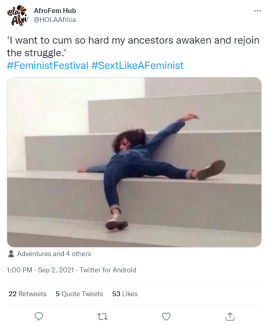
#2 - Sexting like a feminist Tweets Snippet EN

Who doesn’t like a visual cue?

Communicating Desire | Content Snippet AR

التعبير عن الرغبة وغ

وغيرها من الممارسات السياسيّة الأيديولوجيّة المجسَّدة


التعبير عن الرغبة

المضيفة: نحن نميل إلى الاعتقاد أنّ التعبير عن الرغبة يقتصر على العلاقة الحميمة داخل غرفة النوم وعلى علاقاتنا الشخصيّة. ولكن هل يمكننا أيضًا اعتبار هذا النوع من التعبير كبُنية، أو ممارسة أيديولوجيّة توجّه عملنا، وما نحن عليه، وكيف سنكون في هذا العالم؟
لينديوي: أنا أعتقد للأسف أنّ القيود قد فُرضَت في الماضي على التعبير عن الحياة الجنسيّة/ الجنسانيّة. فكان يُسمَح فقط بالتعبير عنها ضمن إطار الزواج المشروع. ولطالما كان التعبير عنها بأيّ طريقة أخرى مرتبطًا بالمحرّمات والوصمات. وحين يتعلّق الأمر بالتواصل، لا شكّ أن بعض الوصمات المرتبطة بالتعبير عن حياتك الجنسية أو عن رغباتك تجعل إيصال ذلك في غرفة النوم أو لشريكك أمرًا صعبًا جدًا. أنا أؤمن بناءً على تجربتي الشخصيّة أنه إذا شعرت براحة أكبر في التعبير عن أمور أو مواضيع أخرى خارج غرفة النوم، سيصبح من الأسهل أن أبني تلك الثقة، فحين تُدرك كيفيّة حلّ الخلاف مع هذا الشخص المعيّن، تُدرك بالتالي كيف تجعل التواصل مميّزًا معه بالتحديد. المسألة ليست سهلة أبدًا. فهي عمليّة متواصلة تتطوّر طوال فترة تفاعلك، مهما كانت طبيعة هذا التفاعل، سواء كان الأمر يخصّ علاقتك أو علاقة عاديّة ومرتبطة فقط باللحظة التي تعيشها. لكنني أؤمن أن الثقة التي تتمتّع بها في الخارج يمكن أن تجسّد بالتأكيد كيفية التعبير عن رغبتك.
 

منال: تُربّى المرأة منذ نعومة أظافرها على تلك المفاهيم والقيود، «لا يجوز أن تتحدّثي عن جسدك، لا يجوز أن تتحدّثي عن رغبتك»، ممّا يلقي مسؤولية كبيرة على كاهل النساء، وخاصة الفتيات المراهقات حين يشعرن بالحاجة إلى التعبير عن أنفسهنّ والتحدّث عن هذه المسائل. برأيي، هذه مشكلة كبيرة. فأنا متزوّجة منذ أكثر من 25 عامًا، وحتى الآن، لا يمكنني التحدّث عن رغباتي. لا يمكنني التعبير عمّا أريده أو ما أفضّله، كما لو أنّه لا يحقّ لي تجاوُز هذا الخطّ. كما لو أنّه حرام رغم أنه من حقّي. والأمر سيّان بالنسبة إلى جميع صديقاتي، إذ لا يستطعن التعبير عن أنفسهنّ كما يرغبن.
 

لويز:
أنا شخصيًا أرى أنّ التعبير عن رغباتنا، أو عن رغباتي، إذا صحّ القول، يتعلّق بالآخر، ونظرته إليّ. وهذا أمرٌ يمكننا ربطه أيضًا بالسينما. ونظرتي إلى نفسي أيضًا: ما أعتقد أنني أجسّده كفرد، ولكن أيضًا ما يتوقّعه المجتمع منّي ومن حياتي الجنسية. قمتُ في السابق إلى حدٍّ ما بمقارنة ما يحدث في غرفة النوم وفي مكان العمل، فنحن نشهد أحيانًا ديناميكية القوة نفسها، شئنا أم أبينا. وفي معظم الأحيان، يكون التواصل اللفظي أصعب مما نعتقد. ولكن عندما يتعلّق الأمر بما تصوّره الأفلام، فالأمر يختلف تمامًا. نحن بعيدون كلّ البعد عمّا نودّ جميعنا هنا رؤيته على الشاشة عندما يتعلّق الأمر ببساطة بالتعبير عن الرغبات الجنسية داخل غرفة النوم أو خارجها. 


العالم الافتراضي والمجسَّد

المضيفة: يمكن أن نرى العالم الرقمي متجسّدًا: في حين قد يكون افتراضيًّا، غير أنه ليس أقلّ واقعيّة. وقد برز ذلك بشكل جليّ في سياق «مهرجان الحقائق النسوية» التابع لـ»جمعية حقوق المرأة في التنمية»، والذي تمّ تنظيمه بالكامل عبر الإنترنت. ماذا يعني إذًا الحديث عن الحياة الجنسيّة، بصورة جماعيّة، وسياسيّة، وفي فضاءات الإنترنت؟ فهل ننتقل في الفضاءات الافتراضية بأجسادنا ومشاعرنا، وفي هذه الحالة، ما هي الاعتبارات المختلفة؟ وما هو تأثيرها على التواصل والتمثيل؟

لينديوي:     تجعلكِ وسائل التواصل الاجتماعي تشعرين بأنّك مرتبطة بجماعة. فعندما تعبّرين عمّا تريدين أو تحبّين، ستجدين دائمًا من يوافقك أو يخالفك الرأي، لكن أولئك الذين يوافقونك الرأي يجعلونك تشعرين بأنك تنتمين إلى جماعة معيّنة. لذلك من الأسهل أن تطرحي فكرتك أو رأيك بشكل مطلق، أو لكي يطّلع عليها الآخرون، ومن المحتمل أن يخفّف ذلك من الأحكام التي قد يطلقها الناس. وأنا أقول هذا بتصرّف مطلق لأنه أحيانًا، وحسب ما تعبّرين عنه، ستتعرّضين للذمّ أو تكونين جديرةً بالإشادة. ولكن عندما يتعلّق الأمر بغرفة النوم، فهناك نوع من الحميميّة وشبه شعور بالضعف يكشفانِك أنتِ وأجزاء مختلفة منك ولا يمكنكِ بالسهولة نفسها أن تُبدي رأيك بالموضوع. عندما يتعلّق الأمر بالتعبير عن رغبتك، قد يكون التحدّث والإفصاح عنها وربما مشاركة تغريدة أو منشور على وسائل التواصل الاجتماعي، أو حتى الإعجاب بجماعات أخرى متقاربة التفكير وقراءة منشوراتها، أسهل بكثير من أن تقولي لشريكك «أودّ أن تمتعني بهذه الطريقة» أو «هذا ما أريدك أن تفعله بعد ذلك»، والسبب هو الخوف من الرفض. ولكن لا يتعلّق الأمر بذلك فقط، جانب الضعف فقط – السماح لنفسك بأن تكون عارية لدرجة السماح للشخص الآخر بمعرفة ما تفكّرين فيه وتشعرين به وتريدينه – أعتقد أن هنا يكمن الاختلاف بالنسبة إليّ شخصيًا. أشعر أنّ المسألة مرتبطة أكثر بالجماعة على وسائل التواصل الاجتماعي، ومن الأسهل المشاركة في النقاش. بينما في غرفة النوم، لا تريدين بالضرورة قتل اللحظة. لكن أعتقد أن هذا أيضًا يساعدك وأنت تمضين قدمًا، وبحسب العلاقة التي تربطك بالشخص، على فهم كيفية التفاعل بعد ذلك. لذلك أنا أدرك دائمًا أنه إذا حاولتُ إيصال فكرة معيّنة وفشلتُ في ذلك في اللحظة نفسها، فيمكنني دائمًا محاولة طرحها مجددًا خارج تلك اللحظة لأرى ردّ الفعل حتى أعرف كيفية التعامل مع هذا الموضع في المستقبل.

لويز:    ما يثير حيرتي في الأفلام هو عدم معرفتي ما إذا كانت النظرة الذكورية مقصودة أو غير مقصودة. فنحن لا نعرف حقيقة ذلك بالفعل. ما نعرفه هو أن السبب الذي جعل الحياة الجنسيّة بشكل عام معياريّة غيريّة إلى حدّ كبير ومتمحورة حول الإيلاج من دون منح المرأة أيّ إمكانيّة لطلب أي شيء بشكل فعليّ في الأفلام، يعود إلى أن معظم الأشخاص الذين كانوا يعملون في هذه الصناعة ويتخذون القرارات في مجال السرد والتحرير هم من الرجال البيض. الانتقام والاغتصاب هو نوع غريب جدًا من الأفلام التي أبصرت النور في السبعينيات، وتقتصر نصف أحداث القصة على أن هناك امرأة تتعرّض للاغتصاب من قبل شخص واحد أو عدة أشخاص، أمّا النصف الآخر، فيدور حول سعيها إلى الانتقام. لذلك عادة ما تقتل الأشخاص الذين اغتصبوها، وأحيانًا أشخاصًا آخرين معهم. منذ نشأة هذا النوع السينمائيّ ولمدّة 30 عامًا على الأقلّ، تولّى رجال كتابة هذه الأفلام وإنتاجها وإخراجها. لهذا السبب نحن بحاجة أيضًا إلى الكثير من التمثيل. لجأ الكثير من النسويات والرائدات في صناعة أفلام الكوير أيضًا إلى التصوير من أجل تحقيق ذلك واستعادة حياتهم الجنسية. وأذكر من بينهم باربرا هامر، وهي نسوية ورائدة في مجال السينما التجريبية في الولايات المتحدة حيث قرّرت تصوير نساء يمارسن الجنس على فيلم بكرة 16 ملم، واستعادت بهذه الطريقة مساحة في مجال السرد كانت مكشوفة في السينما في تلك الفترة. وهناك أيضًا مسألة المحو: نحن ندرك الآن، بسبب الإنترنت ومشاركة المعرفة، أن النساء وصانعي الأفلام الكوير كانوا يحاولون ويصنعون الأفلام منذ بدايات السينما. نحن ندرك ذلك الآن فقط لأنّه بات بإمكاننا الوصول إلى قواعد البيانات وعمل النشطاء والقيّمين وصانعي الأفلام.


مقاومة الاستعمار

المضيفة: وهذا يفتح باب النقاش حول أهمية الحفاظ على تاريخنا النسوي حيّاً. لعِبَت العوالم الافتراضية أيضًا دورًا مهمّاً في توثيق المظاهرات والمقاومة. من السودان مرورًا بفلسطين وصولًا إلى كولومبيا، اجتاحت النسويات شاشاتنا، وتحدّت واقع الاحتلال والرأسمالية والقمع. فهل يمكن أن نتحدث عن التعبير عن الرغبة – الرغبة في شيء آخر – على أنه إنهاء للاستعمار؟


منال: ربّما لأنّ عدد السكّان في قريتي لا يتجاوز 600 نسمة والقرية بأكملها تسكنها عائلة واحدة – عائلة التميمي – فليس هناك حواجز بين الرجال والنساء. نحن نفعل كلّ شيء معًا. لذلك عندما بدأنا المقاومة اللاعنفية أو عندما انضممنا إلى المقاومة اللاعنفية في فلسطين، لم يؤدِّ ذلك إلى إثارة أيّ نقاش حول مشاركة المرأة أو عدم مشاركتها. لقد لعبنا دورًا مهمّاً للغاية ضمن الحراك هنا في القرية. ولكن عندما بدأت قرى وأماكن أخرى بالانضمام إلى مظاهراتنا الأسبوعية، ظنّ بعض الرجال أنه إذا شاركت هؤلاء النساء أو انضممن إلى المظاهرات، فسوف يتشاجرن مع الجنود، وسيبدو الأمر كما لو أنهنّ نساء سهلات المنال. حاول بعض الرجال من خارج القرية التحرّش جنسيًّا بالنساء. لكن المرأة القوية التي بإمكانها الوقوف أمام الجنود يمكنها أيضًا التصدّي للتحرّش الجنسي. في بعض الأحيان، عندما تنضمّ نساء أخريات من مناطق أخرى إلى مظاهرتنا، يشعرن بالخجل في البداية؛ لا يردن الاقتراب لأن هناك الكثير من الرجال. إن كنت ترغبين في الانضمام إلى المظاهرة، وإذا كنت تريدين أن تكوني جزءًا من حركة اللاعنف، فعليك التخلّص من هذه القيود كلّها وإزالة هذه الأفكار كلّها من ذهنك. عليك التركيز فقط على النضال من أجل حقوقك. وللأسف يُدرك الاحتلال الإسرائيلي هذا الأمر. فعلى سبيل المثال، في المرة الأولى التي تمّ فيها اعتقالي، حاولوا نزع حجابي؛ وحاولوا تجريدي من ملابسي أمام الجميع. حاولوا القيام بذلك رغم وجود نحو 300 إلى 400 شخص. عندما اقتادوني إلى التحقيق، قال المحقق: «لقد فعلنا ذلك لأننا نودّ معاقبة النساء الأخريات من خلالك. فنحن نعرف ثقافتك». فأجبته: «أنا لا أبالي بذلك، لقد فعلتُ شيئًا أؤمن به. وحتى لو جرّدتموني من كلّ ملابسي، فالجميع يعلم أن منال تقاوم».

لينديوي:أعتقد أنّه حتى من المنظور الثقافي، وهو أمر مثير للسخرية، إذا نظرت إلى الثقافة في إفريقيا، قبل الاستعمار، ستلاحظين أن إظهار الجلد لم يكن مشكلة. وارتداء جلود الحيوانات لحمايتك، لم يكن مشكلة أيضًا ولم تتمّ جنسنة الناس إلّا ضمن السياق المناسب. لكننا تكيّفنا مع الوضع فأصبحنا نقول، «يجب أن تستتري» وحين لا تكوني مستترة تكونين عارية، وبالتالي ستخضعين للجنسنة. يصبح العُري مُجَنسنًا بدل أن تكوني عارية ببساطة؛ لا يريدون أن يرى أحد فتاة صغيرة عارية. ما هو هذا المجتمع الذي تكيّفنا معه إن كنت ستُجنسِنين شخصًا عاريًا خارج سياق العلاقة الجنسية؟ لكن البيئة تلعب بالتأكيد دورًا مهمّاً لأن والديك وجدّتيك وخالاتك وعمّاتك يقولون لك «لا، لا ترتدي ملابس غير محتشمة» أو «لا، هذا قصير جدًا». لذلك تسمعين هذه الملاحظات في المنزل أولاً، ثم في اللحظة التي تنكشفين فيها في الخارج، وذلك بحسب البيئة، سواء كانت بيئة يطغى عليها الطابع الأوروبي أو تهيمن عليها الأجواء الغربية أكثر ممّا أنت اعتدت عليه، فتصبحين حرّة نوعًا ما للقيام بذلك. وحتى في هذه الحالة، مهما كنتِ حرّة، ما زلتِ ستتعرّضين بسبب ذلك لكثير من المعاكسات وسيستمرّ الناس في جنسنة جسدك. قد تكونين مرتدية تنورة قصيرة، ويشعر أحدهم أنّه يحقّ له لمسك من دون إذنك. هناك الكثير من الأمور المرتبطة بالقوانين التي تخضع لها أجساد النساء وتتحكّم فيها، وتبدأ هذه القصص في المنزل. وبعد ذلك تخرجين إلى بيئتك ومجتمعك وتستمرّ هذه القصص نفسها، وتدركين أنك تتعرّضين للجنسنة من قبل المجتمع ككلّ أيضًا وعلى نطاق واسع، لا سيما إن كنتِ شخصًا ملوّنًا.

Decorative Element

المقاومة كمتعة

المضيفة:   وأخيرًا، كيف يمكن أن تتخطّى مقاومتنا ما يُسمح به لنا؟ هل هناك مكان للمتعة والفرح لنا ولمجتمعاتنا؟


لويز:
اعتبار المتعة مقاومة والمقاومة في المتعة، أولاً بالنسبة إليّ هناك هذه الفكرة عن صناعة السينما غير التقليدية أو عمليّة التصوير عندما لا يُفترَض بك لقيام بذلك أو عندما يُطلَب منك عدم القيام بذلك، وهذا هو الحال بالنسبة إلى كثير من النساء وصانعي الأفلام الكوير في العالم الآن. فعلى سبيل المثال، في لبنان، حيث أنا مُطلعة جدًا على الواقع السينمائي، قام طلّاب بتصوير معظم قصص المثليات جنسيًا التي شاهدتها وفق تنسيقات قصيرة جدًا «بدون قيمة إنتاج» كما يُقال في الغرب – أي من دون تمويل، وذلك بسبب الرقابة التي تحدث على المستوى المؤسسي، ولكن أيضًا ضمن الأسرة وإطار الحياة الخاصّة. أعتقد أن التصوير بحدّ ذاته، لا بل أيضًا تصوير المتعة والمتعة ضمن إطار سرد قصص المثليات هو بحدّ ذاته تعبير عن المقاومة. في كثير من الأحيان، يكون مجرد التقاط كاميرا وجعل أحدهم يقوم بالتحرير وآخر بالتمثيل مهمّة صعبة للغاية وتتطلّب الكثير من المواقف السياسية.

لينديوي:
لديّ مجموعة لدعم ضحايا الاغتصاب. فأنا أحاول مساعدة النساء على إعادة الاندماج من منظور جنسي: استعادة الرغبة في العلاقة الحميمة، وعدم السماح لصدمات الماضي بالتأثير بشكل كبير على كيفية مضيّهن قدمًا. وهذا ليس أمرًا سهلًا، لكنّها مسألة فرديّة. لذلك أبدأ دائمًا بتشجيعهنّ على فهم جسدهنّ. فأنا أشعر أنّه كلما فهمتِ جسدك وأحببته وافتخرت به، زادت قدرتك على السماح لشخص آخر بالدخول إلى تلك المساحة. أسمّي ذلك التدريب على الشهوانيّة/ الحسّيّة، حيث أدفعهنّ إلى البدء بعدم رؤية أنفسهنّ كسلع جنسيّة، إنّما كمصدر متعة ورغبة يمكن أن يكون قابلًا للتبادل. إذًا فأنت تستحقين التلقّي تمامًا كما تعطين. لكنّ هذه المسألة ليست من وجهة نظر نفسيّة فقط، لا بل هي جسديّة أيضًا. حين تخرجين من الدوش، أو تنتهين من الاستحمام، وتضعين مرطبًا على جسمك، تأمّلي كلّ جزء من أجزاء جسمك، واشعري بكلّ جزء منه، لاحظي ظهور أيّ تغييرات، تعرّفي على جسمك بشكل جيّد لدرجة أنّه إذا ظهرت بثرة جديدة على ركبتك، فستكونين واثقة تمامًا من أنها لم تكن موجودة قبل بضع ساعات. أقوم بأمور من هذا القبيل حيث أجعل النساء يحببن أنفسهنّ من الداخل، لذلك يشعرن أنهنّ يستحققن الحبّ في مكان آمن، وهذه هي الطريقة التي أتّبعها لأرشدهنّ نحو المطالبة بحياتهنّ الجنسية ورغبتهنّ.

منال:
بدأنا نرى نساء قادمات من نابلس، ومن القدس، ومن رام الله، حتى من مناطق الـ48 المحتلة، وكان عليهنّ القيادة لمدّة 3-4 ساعات، فقط للمشاركة في المظاهرات. حاولنا بعد ذلك الانتقال إلى أماكن أخرى، والتحدّث مع النساء، وإخبارهنّ أنّه لا يجب أن يخجلن، وأنّه عليهنّ فقط الإيمان بأنفسهنّ، وأنّه لا عيب في ما نفعله. يمكنك حماية نفسك فأين العيب في المشاركة أو الانضمام إلى المظاهرة؟ سألت مرّة بعض النساء، «لماذا تشاركن في المظاهرة؟» فأجبن، «إذا تمكَّنت نساء التميمي من القيام بذلك، فنحن أيضًا بإمكاننا فعله»، بكلّ صدق، كنتُ سعيدة جدًا لسماع ذلك لأننا كنّا قدوة للنساء الأخريات. إن كان عليّ الدفاع عن حقوقي، فسأدافع عن حقوقي كلّها، وليس مجرّد واحد أو اثنين منها. لا يمكننا تقسيم الحقوق.

(Mango) المانغو | Small Snippet AR

المانغو

يومَ دعتني أنجليكا وفابي لأكون القَيِّمة على تشكيلة نصوص شبقية من تحرير نسوة سود لم أكن أعرف ما يعنيه عملُ القيِّم. الشبق ومشتقاته، هذه فهمتها جيداً، لكن عمل القَيِّم...

اقرأ أكثر