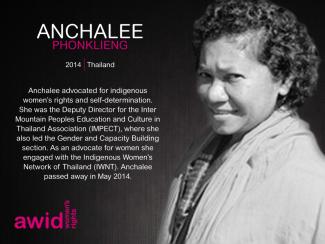
Anchalee Phonklieng

Building Feminist Economies is about creating a world with clean air to breath and water to drink, with meaningful labour and care for ourselves and our communities, where we can all enjoy our economic, sexual and political autonomy.
In the world we live in today, the economy continues to rely on women’s unpaid and undervalued care work for the profit of others. The pursuit of “growth” only expands extractivism - a model of development based on massive extraction and exploitation of natural resources that keeps destroying people and planet while concentrating wealth in the hands of global elites. Meanwhile, access to healthcare, education, a decent wage and social security is becoming a privilege to few. This economic model sits upon white supremacy, colonialism and patriarchy.
Adopting solely a “women’s economic empowerment approach” is merely to integrate women deeper into this system. It may be a temporary means of survival. We need to plant the seeds to make another world possible while we tear down the walls of the existing one.
We believe in the ability of feminist movements to work for change with broad alliances across social movements. By amplifying feminist proposals and visions, we aim to build new paradigms of just economies.
Our approach must be interconnected and intersectional, because sexual and bodily autonomy will not be possible until each and every one of us enjoys economic rights and independence. We aim to work with those who resist and counter the global rise of the conservative right and religious fundamentalisms as no just economy is possible until we shake the foundations of the current system.
Advance feminist agendas: We counter corporate power and impunity for human rights abuses by working with allies to ensure that we put forward feminist, women’s rights and gender justice perspectives in policy spaces. For example, learn more about our work on the future international legally binding instrument on “transnational corporations and other business enterprises with respect to human rights” at the United Nations Human Rights Council.
Mobilize solidarity actions: We work to strengthen the links between feminist and tax justice movements, including reclaiming the public resources lost through illicit financial flows (IFFs) to ensure social and gender justice.
Build knowledge: We provide women human rights defenders (WHRDs) with strategic information vital to challenge corporate power and extractivism. We will contribute to build the knowledge about local and global financing and investment mechanisms fuelling extractivism.
Create and amplify alternatives: We engage and mobilize our members and movements in visioning feminist economies and sharing feminist knowledges, practices and agendas for economic justice.
“The corporate revolution will collapse if we refuse to buy what they are selling – their ideas, their version of history, their wars, their weapons, their notion of inevitability. Another world is not only possible, she is on her way. On a quiet day, I can hear her breathing”.
Arundhati Roy, War Talk
Organized by: UAF-Africa and Agence Française de Développement (AFD)
📅 Tuesday, April 28
🕒 3.00pm
🏢 Venue: Crowne Plaza Hotel
AWID is pleased to share our 2016 Annual Report.
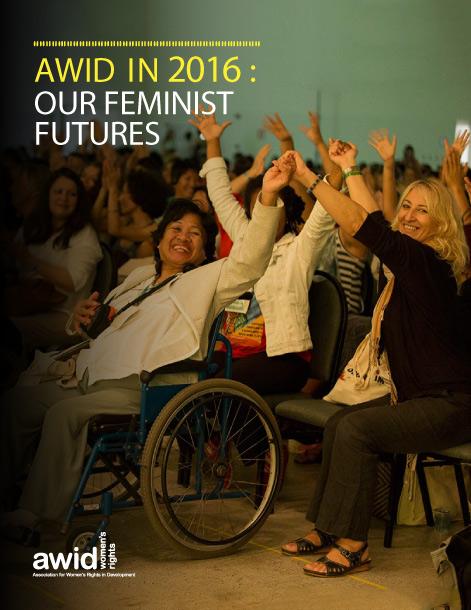
2016 was an incredible year for AWID, we convened the 13th International AWID Forum in Bahia, Brazil, a space for strategizing and alliance building with feminists and other justice movements, which was attended by over 1800 participants from 120 countries and territories across the globe.
We know that women’s rights and feminist movements are key actors in creating sustainable transformative change. Within our movements, organizing, resisting and responding to the challenging context is sharpening, and in our increasingly connected world, the potential for collective action across diverse movements has dramatically grown.
This is the crucial work that AWID seeks to amplify and support every day.
A highlight of 2016 was our ground-breaking 13th International Forum with the theme: “Feminist Futures: Building Collective Power for Rights and Justice”, where we harnessed the thinking and energy of nearly 500 partners, presenters, panelists, moderators, artivists, writers, facilitators, IT innovators, and performers, many of them leaders in their movements. We also supported the convening of the first and historical Black Feminisms Forum (BFF) organised by a working group of Black Feminists from across the world.
AWID, in partnership with other feminist and women’s rights organisations, engaged in advocacy and dialogue to explore better solutions for women’s rights agendas including our work with the Count Me In! consortium .
The experiences of women with disabilities, Black and Afro-descendant women, sex workers, Indigenous women, trans and intersex people, domestic workers and how their lives are impacted by multiple oppressions and violence were placed front and center of the Forum process.
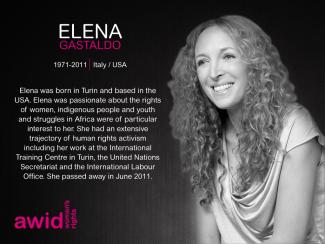
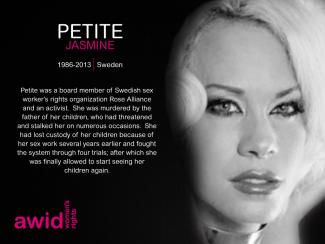
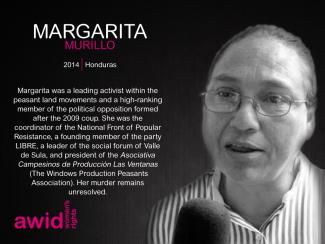
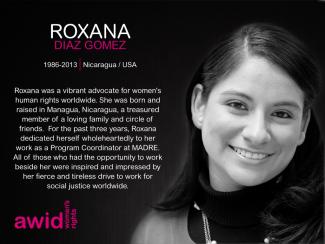
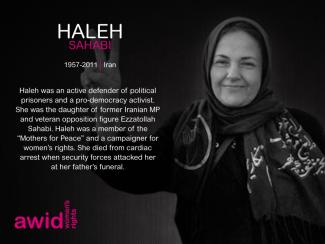
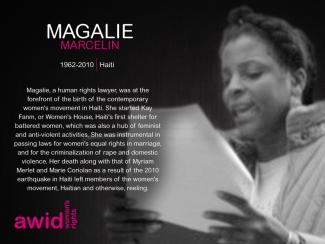
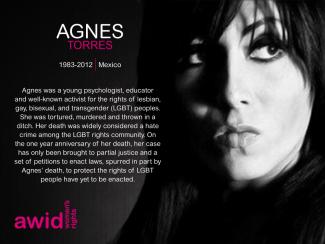
We also launched the 2016 WHRD Tribute to commemorate defenders who are no longer with us, during the 16 Days of activism, and thanks to the contributions from our members,
We drove attention to groups and issues that do not usually receive adequate mainstream media coverage through our partnership with The Guardian and Mama Cash.
Inna is a feminist queer activist and sociologist with many years of deep engagement in feminist and LGBTQI+ struggles, political education and organizing by and for migrant women, and Palestine liberation and solidarity. She joined AWID in 2016 and served in different roles, most recently as Director of Programs. She is based in Berlin, Germany, grew up in Haifa, Palestine/Israel, was born in St. Petersburg, Russia, and carries these political geographies and resistance to colonial past and present into her feminism and transnational solidarity.
Inna is the author of “Women's Economic Empowerment: Feminism, Neoliberalism, and the State” (Palgrave Macmillan, 2022), based on the dissertation which earned her a doctoral degree from the Humboldt University of Berlin. As an academic, she taught courses on globalization, knowledge production, identity and belonging. Inna holds an MA in Cultural Studies from the Hebrew University of Jerusalem. She is a Board Member of the Jewish Voice for a Just Peace in the Middle East (Germany), and previously of +972 Advancement of Citizen Journalism. Previously Inna worked with the Coalition of Women for Peace and she is passionate about mobilizing resources for grassroots activism.
Michelle is a Southeast Asian feminist who enjoys conspiring to bring people together and spark conversations for social change and feminist knowledge sharing, through art, poetry, music and games. With a background in digital advocacy and communications strategy development, she has contributed to initiatives in digital rights, human rights research, and civil society coalition building throughout Southeast Asia. She has an LLB from National University of Singapore, enjoys following her feet down random city streets and likes coffee a little too much.
Khaoula Ksiksi is a passionate advocate for justice, equity, and liberation. As a Gender, Equality, Diversity, and Inclusion (GEDI) Advisor, she works to make inclusivity a lived reality, not just a policy, across humanitarian programs and crisis contexts. She collaborates with teams to challenge structural oppression using bold, transformative tools rooted in lived experience.
Her activism began on the frontlines of Tunisia’s anti-racism movement. With Mnemty, she helped push through the country’s first anti-discrimination law, forcing a national reckoning with racial injustice. She later co-founded Voices of Black Tunisian Women to amplify Black women’s leadership, build solidarity networks, and demand visibility in a society that often silences them.
Khaoula is also a founding member of Falgatna, a radical queer-feminist movement fighting for SOGIESC rights and supporting LGBTQI+ communities through direct action, digital resistance, and survivor-centered advocacy.
Previously, she led regional feminist and climate justice projects at the Rosa Luxemburg Foundation in North and West Africa.
At the heart of her work is a deep belief: no one is free until we all are. Her activism is both a fight and a love letter to her people, her communities, and the world we deserve.
The main focus of our work is global. We also work closely with members and other women’s rights organizations and allies at the local, national and regional levels so that their realities inform our work.

The theme of the Fourth High-level Dialogue on Financing for Development, 23-24 March 2010: The Monterrey Consensus and Doha Declaration on Financing for Development: status of implementation and tasks ahead. It had four round tables on: the reform of the international monetary and financial systems; impact of the financial crisis on foreign direct investments; international trade and private flows; and the role of financial and technical development cooperation, including innovative sources of development finance, in leveraging the mobilization of domestic and international financial resources for development.
There was also the informal interactive dialogue involving various stakeholders that focused on the link between financing for development and achieving the Millennium Development Goals.
For any questions related to the Call for Forum Activities please contact us, selecting Forum Call for Activities as the subject of your email.

Do you want to be inspired by the creative resistance strategies of feminists from all over the world? Do you want to discover feminist initiatives that show us how we can all live in a more just world? Do you want to learn about models of feminist care and healing to bring to your own community? Is that a resounding yes that we hear? YES!
Then check out Crear | Résister | Transform: a festival for feminist movements. This festival took place virtually throughout the month of September 2021 across all of AWID’s platforms, and now you can experience it on your own time.
The panelists participated in their preferred language and at AWID we included subtitles on the videos for your accessibility.
You DO NOT need a visa to attend the Forum in Taipei if you hold a passport from one of the following countries (the allowed length of your stay varies from one country to another):
Andorra, Australia, Austria, Belgium, Bulgaria, Brunei, Canada, Chile, Croatia, Cyprus, Czech Republic, Denmark, Estonia, Eswatini, Finland, France, Germany, Greece, Guatemala, Haiti, Honduras, Hungary, Iceland, Ireland, Israel, Italy, Japan*, Republic of Korea, Latvia, Liechtenstein, Lithuania, Luxembourg, Malta, Marshall Island, Monaco, Netherlands, New Zealand, Nicaragua, Norway, Palau, Paraguay, Philippines, Poland, Portugal, Romania, Russia, San Marino, Slovakia, Slovenia, Spain, Sweden, Switzerland, Tuvalu, the United Kingdom, the United States of America,and Vatican City State, Belize, Dominican Republic, Malaysia, Nauru, St. Kitts and Nevis, Saint Lucia, Saint Vincent and the Grenadines, Singapore.
Please note:
It is likely that, once you have registered to attend the Forum, you will get an event-related code that will allow you to apply for your visa electronically regardless of your citizenship.
We will let you know more about this when the Registration opens.