Contenido relacionado
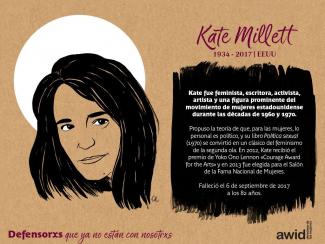
Huffington Post: Muere Kate Millett, activista y referente feminista
TeleSUR: Muere la autora feminista Kate Millett a los 82 años
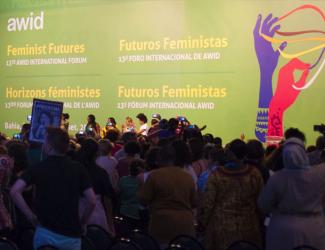
En septiembre de 2016, 1800 feministas y activistas por los derechos de las mujeres de todos los rincones de nuestros movimientos se congregaron en las costas de Bahia, en el 13º Foro Internacional de AWID.
En esta sección se destacan los logros, los aprendizajes y los recursos que surgieron de las ricas conversaciones mantenidas. Te invitamos a analizar, compartir y comentar.
Uno de los aportes más importantes del Foro fue la necesidad de ampliar y profundizar nuestro trabajo entre movimientos, frente a la confluencia de los fascismos en auge, fundamentalismos, codicia corporativa y cambio climático.
Nuestras Iniciativas Semilla han ayudado a 20 ideas que surgieron en el Foro para crecer en forma de acciones concretas
El vídeo «Defendiendo a las Personas y al Planeta» y la guía «Tejiendo la resistencia a través de la acción» estan protagonizados por defensoras de derechos humanos y presentan estrategias concretas para confrontar al poder corporativo
Con nuestras animaciones El estado de nuestros movimientos feministas y Justicia climática y ambiental, los movimientos ahora tienen herramientas creativas para apoyar su trabajo.
La compilación de las expresiones artísticas «Los Movimientos Importan», sigue inspirando una organización más fuerte y creativa en todo el mundo.
Los movimientos también pueden beneficiarse de nuevas metodologías para imaginar nuestros futuros feministas (¡pronto!)
AWID se ha comprometido, mediante su próximo plan estratégico y su proceso del Foro, a continuar y profundizar las relaciones, las lecciones y los procesos iniciados en el Foro 2016 y basándonos en el momento actual.
Los Foros de AWID comenzaron en 1983 en Washington DC. Desde entonces, el evento ha crecido hasta convertirse en muchas cosas para muchas personas: un proceso iterativo para darle forma a nuestros análisis, objetivos y acciones; un hito crucial que fortalece los feminismos de lxs participantes e infunde energías a sus procesos de organización; un hogar político donde lxs defensoras de derechos humanos encuentran un santuario y solidaridad.
Contenido relacionado
Huffington Post: Muere Kate Millett, activista y referente feminista
TeleSUR: Muere la autora feminista Kate Millett a los 82 años
Tout à fait. Vos réponses seront supprimées à la fin du processus de traitement et d’analyse des données. Elles ne seront utilisées qu’à des fins de recherche. Les données ne seront JAMAIS partagées en dehors de l’AWID et ne seront traitées que par le personnel de l’AWID et des consultant·es qui collaborent avec nous à la recherche WITM.
La confidentialité de votre vie privée et votre anonymat sont nos priorités. Notre politique de confidentialité est disponible ici.
Inna es una activista y socióloga feminista queer. Posee muchos años de profundo compromiso con las luchas feministas y LGBTQI+, la educación en política y en procesos de organización de y para las mujeres migrantes, así como por la liberación de y la solidaridad con Palestina. Se incorporó a AWID en 2016 y cumplió diferentes funciones, la más reciente como Directora de Programas. Reside en Berlín (Alemania), creció en Haifa (Palestina/Israel), nació en San Petersburgo (Rusia), y ha puesto todo ese recorrido geográfico político y de resistencia a los colonialismos pasados y presentes al servicio del activismo feminista y la solidaridad transnacional.
Inna es autora de Women's Economic Empowerment: Feminism, Neoliberalism, and the State (Empoderamiento económico de las mujeres: Feminismo, neoliberalismo y Estado. Palgrave Macmillan, 2022), basado en la tesis que le valió un doctorado de la Universidad Humboldt de Berlín. Como académica, impartió cursos sobre globalización, producción de conocimientos, identidad y pertenencia. Inna posee una maestría en Estudios Culturales de la Universidad Hebrea de Jerusalén. Integra la Junta de Jewish Voice for a Just Peace in the Middle East (Voces Judías por una Paz Justa en Medio Oriente, Alemania) y, con anterioridad, fue miembro de la Junta de +972 Advancement of Citizen Journalism (+972 Avance del Periodismo Ciudadano). Antes, Inna trabajó con la Coalición de Mujeres por la Paz y es una apasionada de la movilización de recursos para el activismo de base.
El marco para la investigación te servirá de guía durante todo el proceso y el documento que elabores para especificar ese marco también puede servirte como nota conceptual para compartir con las personas a las que consultes, con las organizaciones con las que te asocies o como propuesta de financiamiento para presentar a posibles donantes.
En esta sección
Antes de realizar una investigación:
- Fija las metas para la investigación
- Enumera las principales preguntas que quieres que te responda la investigación
- Explicita qué tipo de información necesitarás obtener y analizar para responder a las principales preguntas
- Define cuáles serán los productos finales de la investigación
Es posible que el marco de la investigación vaya cambiando con el tiempo, a medida que vayas puliendo las preguntas y obteniendo nueva información. Pese a eso, contar con un marco de referencia inicial para la investigación te ayudará a trabajar sobre bases más sólidas.
Para dotar a la investigación WITM de una base sólida, es importante que tengas claro lo que esperas lograr.
Por ejemplo: una meta de la investigación global WITM de AWID fue aportar información precisa para demostrar lo que ya sabíamos a partir de anécdotas, es decir, que las organizaciones por los derechos de las mujeres tienen mucho menos financiamiento del que necesitan. Pensamos que contar con esa información nos permitiría estar mejor posicionadas para influir sobre las decisiones que toman las financiadoras.
Algunas metas que podrías proponerte:
Enmarca el proceso de investigación con un conjunto de preguntas principales a las que solo tu investigación pueda dar respuesta y limítalas a un período determinado (p.ej. los últimos cinco años, el año pasado, etc.)
Para tener en cuenta:
Elegir un marco temporal específico para la investigación te puede aportar resultados más precisos que si trabajas con un marco temporal abierto. Decidir si vas a repetir o no esta investigación a intervalos regulares te permitirá fijar parámetros para la recolección de datos que permitan replicarlos y compararlos fácilmente entre un período y otro.
Las principales preguntas que guiaron el proceso de investigación WITM de AWID fueron:
- ¿Cuál es la situación actual en cuanto a sostenibilidad financiera de las organizaciones de mujeres en todo el mundo?
- ¿Qué tendencias externas e internas influyen en las decisiones de lxs donantes en cuanto al apoyo para organizaciones y movimientos de mujeres?
Ahora que ya decidiste cuáles serán las preguntas principales, puedes determinar qué tipo de información te servirá para responderlas. Esto a su vez te ayudará a planificar el resto del cronograma de la investigación WITM.
Por ejemplo, ¿vas a realizar una encuesta que abarque a una amplia porción de la población que hayas fijado como prioritaria? ¿Vas a analizar las solicitudes que están recibiendo las financiadoras y que provienen de una determinada región? ¿Vas a realizar también entrevistas (te recomendamos que lo hagas)? Cuando ya sabes qué tipo/s de información necesitas, puedes buscar fuentes externas que puedan aportártela desde el comienzo mismo del proceso y planificar el cronograma de acuerdo a eso. Algunas fuentes de información sugeridas son las siguientes:
Contar con una variedad de información es una buena manera de generar análisis sólidos y profundos.
Por ejemplo, la información recogida en la Encuesta Global 2011 de AWID (en inglés) constituyó el eje central de nuestro análisis más reciente. Pero también obtuvimos información de entrevistas e interacciones con distintxs actores de este campo, desde donantes hasta activistas y organizaciones por los derechos de las mujeres.
Además de permitirte fijar un cronograma, formular un plan inicial acerca de los productos que vas a elaborar también te ayudará a decidir qué recursos vas a necesitar.
Por ejemplo, ¿solo vas a producir un informe extenso o también infografías, folletos y presentaciones? Según los productos que decidas elaborar, tal vez necesites contratar a una empresa de diseño, planificar eventos, etc.
Estos productos también serán las herramientas que utilizarás para alcanzar las metas, por eso es importante tenerlas presentes. Por ejemplo, tu investigación WITM, ¿está pensada solo como una herramienta de incidencia para influir sobre donantes? En ese caso, necesitarás productos que te permitan una mayor interacción con ellxs.
Algunos ejemplos de posibles productos:
Elaborar un marco para la investigación que incluya las metas, preguntas principales, tipos de información y productos finales te ayudará a producir un cronograma bien planificado, preparar por anticipado los recursos que necesitas y estimar un presupuesto realista.
Todo esto te facilitará los vínculos con lxs sociaxs externas y podrás ser flexible cuando ocurran contratiempos.

• 1 mes
• 1 persona (o más) de investigación
• Ejemplo 1: Marco para la investigación
• Ejemplo 2: Marco para la investigación
Nous Sommes la Solution uplifts and grows the leadership of rural women working towards African solutions for food sovereignty.

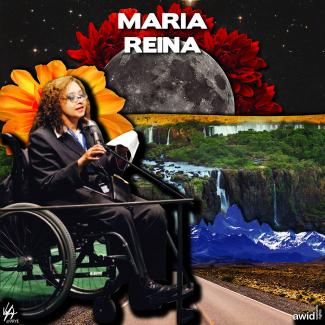
Elle a représenté l'International Disability and Development Consortium (consortium international sur le développement et le handicap) lors de la négociation de la Convention des Nations Unies relative aux droits des personnes handicapées (2001-2006). Son travail a été consacré à la réalisation de l'objectif de la Convention, à savoir la réalisation des droits humains universels par, pour et avec les personnes handicapées pour un monde inclusif, accessible et durable.
Selon ses propres mots, son leadership consistait à « … servir la communauté des personnes handicapées, en commençant par de petites tâches que d'autres pourraient ne pas vouloir faire».
Elle est décédée le 27 octobre 2017 dans sa ville natale de Rosario, en Argentine.
Pour en savoir plus sur María Verónica Reina, retrouvez son témoignage.
The survey is open until the end of August 2024. Please complete it within this timeframe to ensure your responses are included in the analysis.
Dre. Margo Okazawa-Rey est titulaire de la Chaire Barbara Lee pour le leadership des femmes et professeure invitée en études sur les femmes, le genre et la sexualité et en politique publique au Mills College à Oakland, en Californie. Elle est également professeure émérite à la San Francisco State University.
Ses principaux domaines de recherche et d’activisme au cours des 25 dernières années sont le militarisme, les conflits armés et la violence à l’égard des femmes, analysés de manière intersectionelle. Professeure Okazawa-Rey siège au conseil consultatif international de Du Re Bang à Uijongbu en Corée du Sud, au Conseil international de PeaceWomen Across the Globe à Berne, en Suisse, et est co-présidente du conseil du Highlander Research and Education Centre à New Market, Tennessee aux États-Unis.
Ses publications récentes incluent « Nation-izing » Coalition and Solidarity Politics for US Anti-militarist Feminists (en presse) ; « No Freedom without Connections: Envisioning Sustainable Feminist Solidarities » (2018) dans Feminist Freedom Warriors : Genealogies, Justice, Politics, and Hope, Chandra Talpade Mohanty et Linda Carty (ed.) ; Between a Rock and Hard Place: Southeast Asian Women Confront Extractivism, Militarism, and Religious Fundamentalisms (2018) ; à « Liberal Arts Colleges Partnering with Highlander Research and Education Center : Intergenerational Learning for Student Campus Activism and Personal Transformation, » numéro spéciale de Feminist Formations (Feminist Social Justice Pedagogy, (2018).
La investigación secundaria la puedes realizar en todos los estadios del proceso investigativo. Te puede ayudar a formular el marco, a elegir las preguntas de la encuesta y a comprender mejor los resultados.
En esta sección
- Describe el contexto
- Utiliza el conocimiento ya construido
- Posibles fuentes para la investigación secundaria
1. Sitios de donantes en Internet y sus informes anuales
2. Fuentes de información en línea
Realizar investigación secundaria durante todo el proceso investigativo te ayudará a formular el marco de referencia, elegir las preguntas de la encuesta, interpretar la información según el contexto o percibir aspectos interesantes de los resultados de la investigación. Por ejemplo, podrás comparar similitudes y diferencias entre los resultados de tu investigación y la información recogida de la sociedad civil y del sector donante.
Tal vez percibas tendencias en la información que te aporta la encuesta y quieras entenderlas mejor.
Por ejemplo, imagina que la encuesta te indica que los presupuestos de las organizaciones se están reduciendo, pero no te puede decir por qué está sucediendo esto. Consultar publicaciones te puede ayudar a entender el contexto y las posibles razones que explican esa tendencia.
La utilización de fuentes secundarias garantiza que la investigación incorpore el conocimiento ya construido, confirmando así la validez y relevancia de tus resultados.
Estos resultados pueden complementar o contradecir el conocimiento construido, pero deben guardar relación con él.
Para asegurarte de investigar todo el panorama del financiamiento para la temática que estés relevando, necesitarás estudiar un conjunto diverso de sectores donantes.
Puedes tener en cuenta:
- Fondos de mujeres
- Fundaciones privadas y públicas
- Organizaciones no gubernamentales internacionales (ONGI)
- Entidades bilaterales y multilaterales
- Actores del sector privado
- Filantropía individual
- Micromecenazgos (crowdfunding)
Incluye a todo otro actor que resulte relevante para la investigación.
Por ejemplo, puedes decidir que también será importante relevar a las organizaciones no gubernamentales (ONG)
Estas son fuentes directas de información que revelan lo que están haciendo las financiadoras y por lo general también informan acerca de sus políticas y presupuestos. Incluir estos materiales en la investigación antes de entrevistar a donantes te podrá ayudar a formular preguntas más puntuales y a recoger más información durante la entrevista.

• 1-2 meses
• 1 persona (o más) de investigación
7. Sintetiza los resultados de la investigación
Cooperativa Textil Nadia Echazú
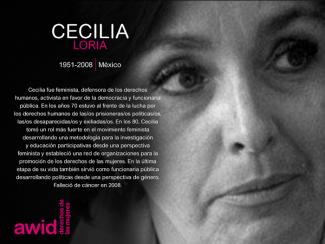
Laura was a leading activist and lawyer who campaigned fearlessly for the decriminalisation of sex work in Ireland.
She is remembered as “a freedom fighter for sex workers, a feminist, a mother to a daughter and a needed friend to many.”
Laura advocated for individuals in the sex industry to be recognised as workers deserving of rights. She advanced demands for decriminalisation, including initiating a judicial review at Belfast’s high court in respect of the provisions criminalising the purchase of sex. Laura stated that her intention was to bring the case to the European Court of Human Rights.

نكمل مشوار بناء الحشد الذي بدأناه قبل 20 عاماً لموارد أفضل وأكبر لحركات التغيير الاجتماعي بقيادة نسوية، تدعوكم/ن جمعية حقوق المرأة في التنمية لاستكمال استطلاعنا
Salome is a feminist activist from Tbilisi, Georgia, devoted to social and gender justice. She holds a Master's degree in gender studies, and has been engaged in feminist, queer and green movements for over twelve years, working amongst others on issues of gender based violence, domestic violence, sexual and reproductive health and rights, LGBTIQ rights, [women’s] Labor Rights, Healing Justice and holistic and digital security and rights.
Since 2014 she has been actively working on safety and security issues of activists and Women Human Rights Defenders, providing integrated security and digital security workshops specifically for activists from under-privileged groups (queer persons, ethnic and religious minorities, rural women and girls, etc) as well as bigger feminist organisations. Salome is a member of the Independent Group of Feminists - a non-formal, non-hierarchical and non-registered initiative that unites feminists with diverse backgrounds in Georgia. Currently, she is the Executive Director of the Women's Fund in Georgia, fully engaged in women's/feminist movement building, providing feminist funding, and encouraging local feminist philanthropy.
Nous croyons que l'économie, le marché, le système financier et les prémisses sur lesquelles ils reposent sont des domaines critiques pour la lutte féministe.
Ainsi, notre vision pour une économie juste dépasse la promotion des droits et de l'autonomisation des femmes sur le marché. Elle propose d'évaluer le rôle des oppressions liées au genre lors de l'élaboration de mesures économiques, afin de les modifier pour favoriser l'égalité de genre et la justice économique.
Nous ne partons pas de zéro et nous ne sommes pas seules à tenter de mettre en avant des propositions féministes pour une économie juste. Beaucoup des propositions formulées dans ce document existaient déjà en théorie et aussi dans la pratique, au sein de diverses communautés qui défient et résistent face aux systèmes économiques fondés sur la croissance et le marché.
Il est également très important de noter qu'il y a une prise de conscience croissante du fait que les micros solutions n’apportent pas toujours de réponses aux problèmes macros, même si elles représentent des espaces importants pour la construction de la résistance et des mouvements. Certaines alternatives spécifiques peuvent ne pas être en mesure de remédier aux injustices du système capitaliste actuel à l'échelle mondiale.
Cela dit, les alternatives féministes pour une économie juste sont essentielles pour ouvrir des brèches dans le système et pouvoir en tirer des leçons, en faveur d’un changement systémique transformateur. Nous n’avons pas la prétention de proposer un compte-rendu complet et exhaustif sur la manière de créer un modèle économique qui soit juste d’un point de vue féministe, ou même des modèles.
À partir d’un dialogue inter-mouvements avec des syndicats, des mouvements ruraux et paysans et des mouvements environnementaux, nous pouvons néanmoins formuler une série de propositions pour cheminer vers cette vision.
Le modèle néolibéral qui domine l'économie mondiale a démontré à maintes reprises son incapacité à traiter les causes profondes de la pauvreté, des inégalités et de l'exclusion. En réalité, le néolibéralisme a même contribué à provoquer et à exacerber ces injustices.
Caractérisées par la mondialisation, la libéralisation, la privatisation, la financiarisation et l'aide conditionnelle, les politiques générales de développement de ces trois dernières décennies ont fait des ravages dans la vie et les moyens de subsistance de tous et toutes. Ces politiques ont également contribué sans faillir à creuser le fossé des inégalités, aux injustices de genre et à une destruction de l'environnement que le monde ne peut plus se permettre de supporter.
Il y a encore des personnes qui affirment qu’en donnant carte blanche aux sociétés et aux entreprises pour favoriser la croissance économique, le vent finira par atteindre les voiles de tous les navires.
Cependant, la notion du développement dominante au cours des dernières décennies, qui repose en grande partie sur le principe d’une croissance économique illimitée, traverse actuellement une crise idéologique.
Le mythe de la croissance économique en tant que panacée capable de résoudre tous nos problèmes prend l’eau.
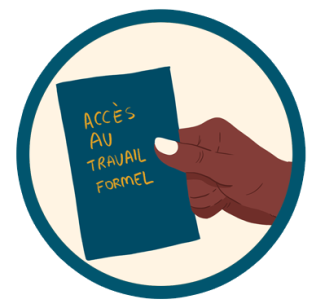
Seul·es 18 % des trans et travestis en Argentine ont accès à un emploi formel.

Al momento de su muerte, luego de una corta pero denodada batalla contra el cáncer, Deborah era la Jefa de Comunicaciones y Participación en la Women’s Funding Network (WFN, Red de financiamiento para mujeres).
Deborah también trabajó para el Fondo Global de Mujeres entre 2008 y 2017. Era sumamente querida y respetada por el consejo asesor, el personal y lxs colaboradorxs de la organización.
Kavita Ramdas, anterior directora ejecutiva del Fondo, acertadamente señaló que Deborah era un «pequeño paquete que explotaba de calidez, generosidad, inteligencia, estilo y un apasionado compromiso por unir la belleza con la justicia. Ella entendía el poder de las historias. El poder de la voz de las mujeres. El poder de la experiencia vivida. El poder de levantarse de las cenizas y decirle a otrxs que era posible. Y todavía nos levantamos».
Musimbi Kanyoro, actual directora ejecutiva del Fondo Global de Mujeres, añadió: «Hemos perdido a una hermana y su vida ilumina valores que nos unen y nos inspiran. Al reunirnos para llorar el fallecimiento de Deborah, recordemos y celebremos su notable, audaz y apasionada vida».

Сделать видимой сложность обеспечения ресурсами различных феминистских организаций